Rosai Dorfman Disease Therapeutic Market Size, Share & Demand Report By Drug Class (Corticosteroids, Chemotherapy, Targeted Therapy, Immunotherapy), By Treatment Type (Systemic Therapy, Localized Therapy), By Distribution Channel (Hospital Pharmacies, Retail Pharmacies, Online Pharmacies), By End-Use (Hospitals, Specialty Clinics, Research Institutes), By Region & Segment Forecasts, 2025–2034
USD 3950
Market Overview
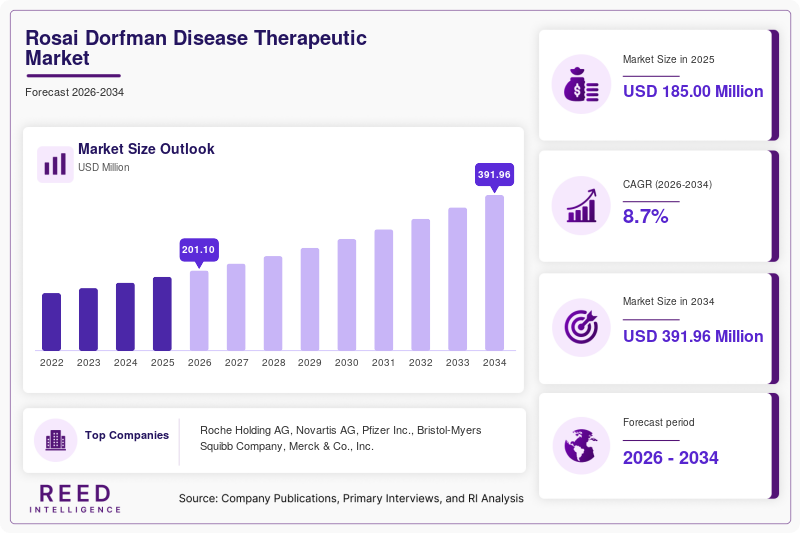
The global Rosai Dorfman Disease Therapeutic Market size was valued at approximately USD 185 million in 2025 and is projected to reach USD 392 million by 2034, expanding at a CAGR of 8.7% from 2025 to 2034. This growth trajectory reflects the rising clinical awareness of rare histiocytic disorders and the gradual expansion of targeted therapeutic approaches. Rosai-Dorfman disease (RDD), a rare non-Langerhans cell histiocytosis, has historically lacked standardized treatment pathways, leading to an increasing focus on personalized medicine and off-label drug utilization.
One major global factor supporting market growth is the increasing investment in orphan drug development programs, particularly in developed economies. Governments and regulatory bodies are providing incentives such as fast-track approvals, tax benefits, and extended exclusivity periods, encouraging pharmaceutical companies to develop innovative therapies for rare diseases like RDD.
Key Highlights:
- North America dominated the market with a 41.3% share, while Asia Pacific is projected to grow at the fastest CAGR of 10.2%.
- Corticosteroids emerged as the leading drug class segment, whereas targeted therapies are expected to grow at the fastest CAGR of 11.4%.
- Hospital pharmacies accounted for the largest distribution share, while online pharmacies are expected to expand at a CAGR of 9.8%.
- The United States remained the dominant country, with market values of USD 62 million in 2024 and USD 66 million in 2025.
Market Trends
Increasing Adoption of Targeted Therapies
The Rosai Dorfman Disease Therapeutic Market is witnessing a transition from conventional treatments toward targeted therapies. Molecular profiling and genetic insights into histiocytic disorders have enabled the identification of actionable mutations such as MAPK pathway alterations. This has encouraged the use of kinase inhibitors and biologics, which offer improved efficacy and reduced systemic toxicity compared to traditional corticosteroids and chemotherapy. As clinical evidence continues to expand, targeted therapies are expected to gain wider adoption.
Growth in Off-Label Drug Utilization
Due to the rarity of Rosai-Dorfman disease and the limited number of approved therapies, clinicians increasingly rely on off-label use of immunosuppressants, monoclonal antibodies, and oncology drugs. This trend is shaping treatment protocols globally, particularly in tertiary care centers. Pharmaceutical companies are also leveraging real-world evidence to support expanded indications, further strengthening this trend within the Rosai Dorfman Disease Therapeutic Market.
Market Drivers
Rising Awareness and Diagnosis of Rare Diseases
Improved awareness among healthcare professionals and advancements in diagnostic technologies are significantly driving the Rosai Dorfman Disease Therapeutic Market. Enhanced access to imaging techniques such as PET-CT scans and advancements in histopathological diagnostics have led to earlier detection. Increased diagnosis rates directly contribute to a larger patient pool requiring therapeutic intervention, thereby boosting market demand.
Expansion of Orphan Drug Development Programs
Pharmaceutical companies are increasingly investing in orphan drug development due to regulatory incentives and favorable reimbursement policies. The Rosai Dorfman Disease Therapeutic Market benefits from such initiatives, as companies explore innovative drug candidates tailored for rare conditions. These developments not only improve treatment outcomes but also accelerate product commercialization, supporting overall market growth.
Market Restraint
Limited Clinical Data and Standardized Treatment Guidelines
One of the primary challenges in the Rosai Dorfman Disease Therapeutic Market is the lack of large-scale clinical trials and standardized treatment protocols. Due to the rarity of the disease, patient populations are small and geographically dispersed, making it difficult to conduct robust clinical studies. This results in limited evidence-based guidelines, leading to variability in treatment approaches across regions.
Additionally, the reliance on off-label therapies introduces uncertainties regarding long-term efficacy and safety. Healthcare providers often depend on case reports and small cohort studies, which may not provide comprehensive insights. This lack of standardization can hinder the adoption of new therapies and slow down regulatory approvals.
The limited availability of specialized treatment centers and expertise in rare diseases further compounds this challenge, particularly in emerging economies. These factors collectively restrict the growth potential of the Rosai Dorfman Disease Therapeutic Market.
Market Opportunities
Development of Precision Medicine Approaches
The integration of genomics and personalized medicine presents a significant opportunity for the Rosai Dorfman Disease Therapeutic Market. Advances in molecular diagnostics are enabling the identification of specific genetic mutations associated with RDD. This paves the way for targeted therapies tailored to individual patient profiles, improving treatment outcomes and reducing adverse effects.
Expansion in Emerging Markets
Emerging economies in Asia Pacific, Latin America, and the Middle East are witnessing improvements in healthcare infrastructure and access to specialized care. Increasing healthcare expenditure and growing awareness of rare diseases create opportunities for market expansion. Pharmaceutical companies are focusing on these regions to expand their presence, offering cost-effective treatment options and collaborating with local healthcare providers to improve diagnosis and treatment rates.
Segmental Analysis
By Drug Class
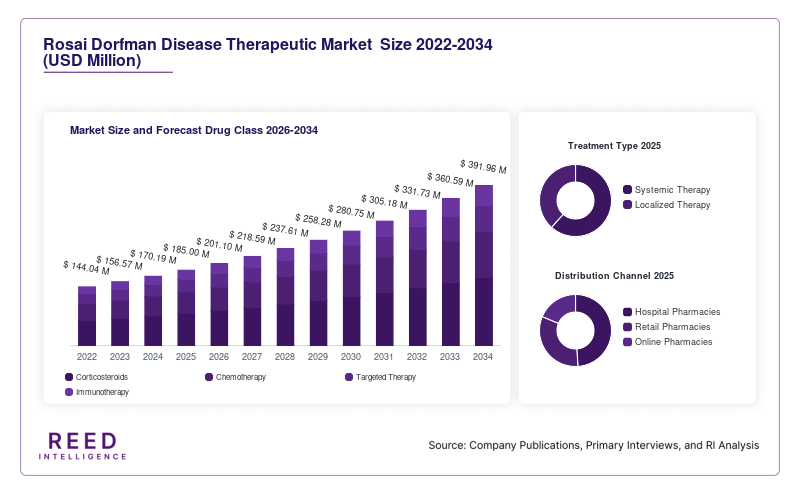
Corticosteroids dominated the Rosai Dorfman Disease Therapeutic Market with a 42.6% share in 2024. These drugs have been widely used as first-line therapy due to their anti-inflammatory and immunosuppressive properties. Their accessibility and cost-effectiveness have made them the preferred treatment option in many regions.
Targeted therapies are expected to grow at the fastest CAGR of 11.4% during the forecast period. The increasing understanding of molecular pathways involved in RDD is driving the adoption of targeted treatments. These therapies offer improved efficacy and reduced side effects, making them a promising option for future treatment strategies.
By Treatment Type
Systemic therapy accounted for the largest share, representing 48.2% in 2024. This approach is commonly used in patients with multi-organ involvement, where localized treatments are insufficient. The widespread use of systemic therapy reflects its effectiveness in managing complex cases.
Immunotherapy is projected to grow at a CAGR of 10.9%, driven by advancements in biologic drugs and increasing research in immune-based treatments. These therapies are expected to play a crucial role in the future management of RDD.
By Distribution Channel
Hospital pharmacies held the dominant share of 51.7% in 2024. These facilities are the primary point of access for patients receiving specialized treatments, particularly in severe cases requiring hospitalization.
Online pharmacies are anticipated to grow at a CAGR of 9.8%, supported by increasing digitalization and patient preference for convenient access to medications. The expansion of e-commerce platforms in healthcare is driving this growth.
By End-Use
Hospitals accounted for the largest share of 46.5% in 2024, as they provide comprehensive care, including diagnosis, treatment, and monitoring of RDD patients.
Specialty clinics are expected to grow at a CAGR of 9.6%, driven by the increasing number of dedicated centers focusing on rare diseases. These clinics offer specialized expertise and personalized treatment approaches, attracting a growing patient base.
Regional Analysis
North America
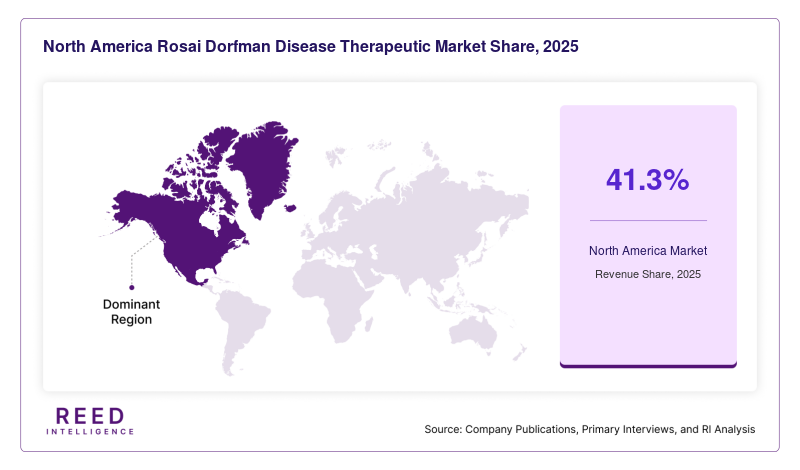
North America accounted for 41.3% of the Rosai Dorfman Disease Therapeutic Market share in 2025 and will grow at a CAGR of 8.3% through 2034. The region benefited from advanced healthcare infrastructure, high awareness of rare diseases, and strong regulatory support for orphan drugs.
The United States dominated the regional market due to robust research funding and the presence of leading pharmaceutical companies. A key growth factor is the integration of advanced diagnostic tools in clinical practice, enabling early and accurate identification of RDD cases. This has increased treatment adoption rates across the country.
Europe
Europe held a 27.5% share in 2025 and is expected to grow at a CAGR of 8.1% during the forecast period. The region’s growth was supported by favorable healthcare policies and increasing investments in rare disease research.
Germany emerged as the dominant country due to its strong healthcare system and extensive clinical research network. The country’s focus on collaborative research initiatives has facilitated the development of innovative treatment approaches for rare conditions, including RDD.
Asia Pacific
Asia Pacific captured 18.9% of the market in 2025 and is projected to expand at the fastest CAGR of 10.2%. The region is experiencing rapid growth due to improving healthcare infrastructure and rising awareness of rare diseases.
China led the regional market, driven by increasing government initiatives to strengthen rare disease diagnosis and treatment. Expanding healthcare access and growing investments in biotechnology are key factors contributing to market growth.
Middle East & Africa
The Middle East & Africa region accounted for 6.8% of the market in 2025 and will grow at a CAGR of 7.6%. Growth in this region was supported by gradual improvements in healthcare infrastructure and increasing awareness of rare diseases.
Saudi Arabia dominated the regional market due to its ongoing healthcare reforms and investments in specialized medical facilities. The country’s focus on expanding access to advanced treatments has contributed to market growth.
Latin America
Latin America held a 5.5% share in 2025 and is expected to grow at a CAGR of 7.9%. The region’s growth was driven by improving healthcare systems and increasing adoption of advanced therapies.
Brazil emerged as the dominant country due to its large patient population and expanding healthcare coverage. Government initiatives aimed at improving access to rare disease treatments have supported market growth.
Competitive Landscape
The Rosai Dorfman Disease Therapeutic Market is moderately fragmented, with several global and regional players focusing on rare disease therapeutics. Companies are investing in research and development to expand their product portfolios and address unmet clinical needs.
The market leader is Roche Holding AG, which has strengthened its position through advancements in targeted therapies and biologics. The company recently expanded its rare disease pipeline with a focus on histiocytic disorders, enhancing its competitive edge.
Other key players are adopting strategies such as partnerships, mergers, and clinical collaborations to accelerate drug development. The competitive environment is characterized by ongoing innovation and increasing emphasis on personalized medicine.
Key Players
- Roche Holding AG
- Novartis AG
- Pfizer Inc.
- Bristol-Myers Squibb Company
- Merck & Co., Inc.
- Johnson & Johnson
- Amgen Inc.
- Sanofi S.A.
- GlaxoSmithKline plc
- AstraZeneca plc
Recent Developments
- 2025: Roche Holding AG announced expansion of its rare disease research program focusing on histiocytic disorders.
- 2024: Novartis AG initiated a clinical study evaluating targeted therapies for rare immune-related diseases.
- 2024: Pfizer Inc. entered a collaboration to explore biologic treatments for rare inflammatory conditions.
- 2023: Bristol-Myers Squibb expanded its immunotherapy portfolio through new product development initiatives.
- 2023: Amgen Inc. increased investment in precision medicine research for rare diseases.
Rosai Dorfman Disease Therapeutic Market Segments
Drug Class
- Corticosteroids
- Chemotherapy
- Targeted Therapy
- Immunotherapy
Treatment Type
- Systemic Therapy
- Localized Therapy
Distribution Channel
- Hospital Pharmacies
- Retail Pharmacies
- Online Pharmacies
End-Use
- Hospitals
- Specialty Clinics
- Research Institutes
By Region
- North America
- Europe
- APAC
- Middle East and Africa
- LATAM