Rotary Indexer Market Size, Share, Demand Report By Product Type (Heavy-Duty Rotary Indexers, Servo-Driven Rotary Indexers, Cam-Driven Rotary Indexers, Precision Rotary Tables, Compact Rotary Indexers), By Application (Automotive Assembly, Semiconductor Manufacturing, Electronics Assembly, Packaging & Labeling, Medical Device Manufacturing, Food Processing, Industrial Inspection Systems), By End-Use Industry (Manufacturing Facilities, Automotive Industry, Electronics & Semiconductor Plants, Phar
USD 3950
Market Overview
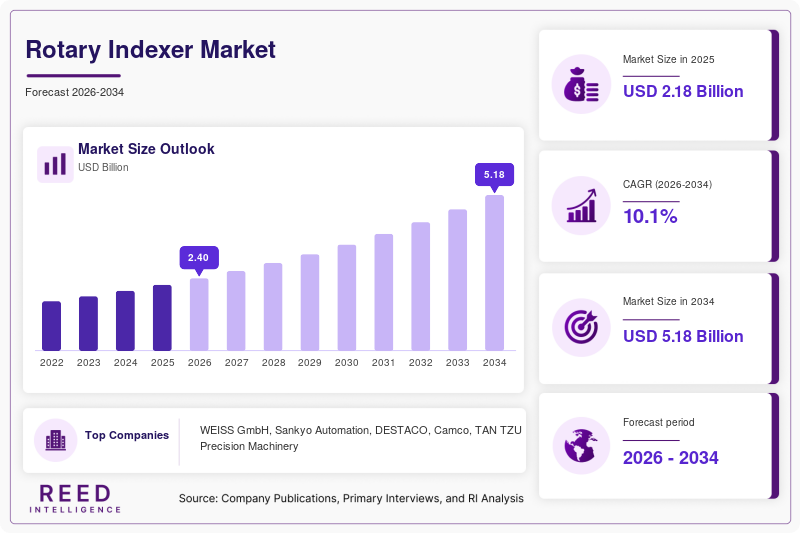
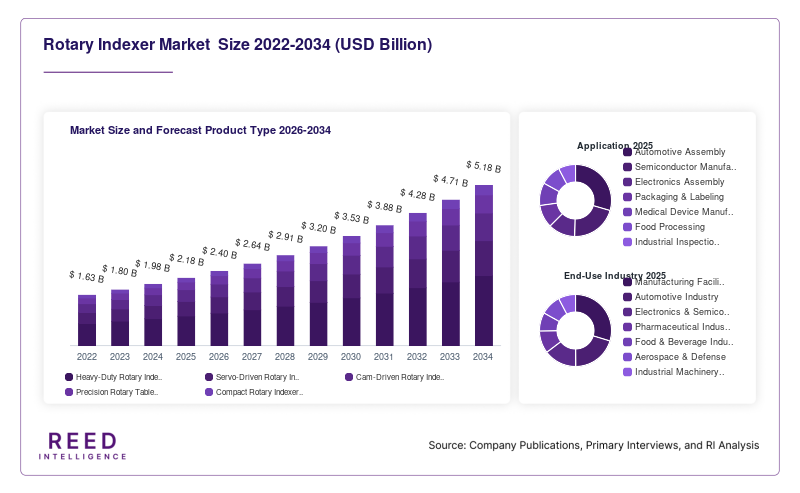
The global Rotary Indexer Market size was valued at USD 2.18 billion in 2026 and is projected to reach USD 4.71 billion by 2034, expanding at a CAGR of 10.1% during the forecast period from 2026 to 2034. Rotary indexers are widely used in automated manufacturing systems to ensure precise positioning, rapid movement, and synchronized assembly line operations across multiple industrial environments. These systems are increasingly integrated into automotive manufacturing, semiconductor fabrication, electronics assembly, food processing, and pharmaceutical packaging operations. The growing need for production efficiency and consistent product quality is encouraging manufacturers to invest in automated indexing solutions that can support higher throughput while reducing labor dependency and operational downtime.
A major global factor supporting market expansion is the acceleration of industrial automation across developed and emerging economies. Manufacturers are shifting toward smart factories and digitally connected production systems to improve operational visibility and reduce production errors. Rotary indexers provide accurate motion control and repeatability, making them essential components in automated assembly and inspection systems. The rapid deployment of robotics, machine vision systems, and automated packaging equipment is also increasing the adoption of rotary indexing technologies. In addition, rising investments in electric vehicle production and semiconductor manufacturing facilities are strengthening long-term demand for advanced rotary indexing systems across global industrial sectors.
Key Highlights
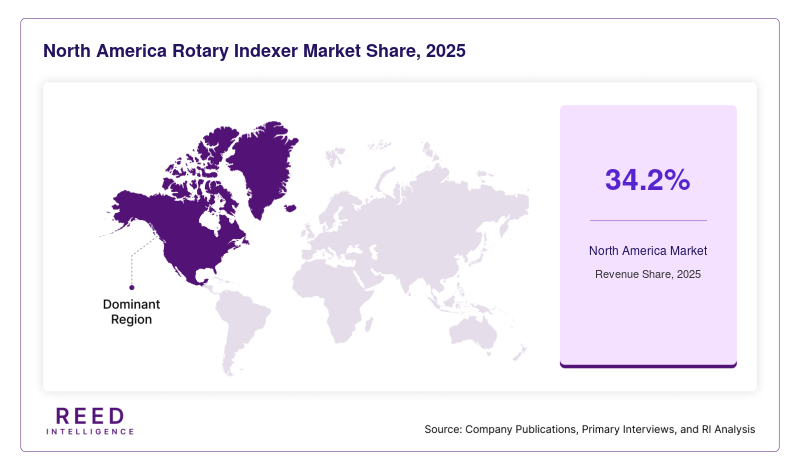
- North America dominated the market with a 34.2% share in 2025, while Asia Pacific is expected to grow at the fastest CAGR of 11.8% during 2026–2034.
- By product type, heavy-duty rotary indexers accounted for the largest share of 39.4%, while servo-driven rotary indexers are projected to grow at a CAGR of 12.6%.
- By application, automotive assembly led with a 36.8% share, whereas semiconductor manufacturing is expected to expand at a CAGR of 13.2%.
- By end-use industry, manufacturing facilities represented the dominant segment with a 42.5% share, while electronics and semiconductor plants are forecast to grow at a CAGR of 12.9%.
- The United States remained the dominant country, with market values of USD 520 million in 2024 and USD 575 million in 2025.
Market Trends
Integration of Smart Motion Control Technologies in Automated Production Systems
Manufacturers across industrial sectors are increasingly integrating smart motion control technologies into rotary indexing systems to improve operational precision and production flexibility. Modern rotary indexers are now equipped with intelligent sensors, digital monitoring interfaces, and predictive maintenance capabilities that allow operators to track system performance in real time. These features reduce unplanned downtime and help production managers optimize machine efficiency in high-speed manufacturing environments. Smart rotary indexers are also being connected with industrial internet of things platforms to support automated diagnostics and process synchronization across assembly lines.
The trend is becoming highly visible in automotive and electronics manufacturing facilities where accurate positioning and rapid indexing cycles are critical for maintaining product quality. Companies are adopting servo-controlled rotary indexers with programmable configurations that can support multiple production formats without requiring extensive mechanical modifications. This flexibility is helping manufacturers reduce setup times and improve productivity in facilities that handle diverse product portfolios. Growing demand for data-driven manufacturing processes is expected to accelerate the use of digitally enabled rotary indexing technologies during the forecast period.
Expansion of Compact Rotary Indexers for Precision Manufacturing Applications
Compact rotary indexers are gaining significant traction as manufacturers focus on miniaturized production equipment and precision assembly operations. Industries such as medical devices, electronics, semiconductor manufacturing, and laboratory automation require smaller equipment footprints while maintaining high positioning accuracy and operational stability. Compact indexing systems enable manufacturers to maximize factory space utilization and improve machine integration in advanced production environments. Their lightweight design and energy-efficient operation are also supporting wider adoption among small and medium-sized manufacturing enterprises.
The increasing use of precision robotics and automated inspection equipment is further driving demand for compact rotary indexing solutions. Manufacturers are developing modular indexing platforms that can be customized according to application-specific requirements in precision engineering environments. In addition, rising investments in semiconductor fabrication facilities and medical device production lines are supporting demand for highly accurate indexing systems capable of operating at micron-level tolerances. This trend is expected to strengthen market growth as industries continue investing in compact and flexible automation technologies.
Market Drivers
Rising Industrial Automation Investments Across Manufacturing Sectors
Industrial automation investments are expanding rapidly across global manufacturing industries, creating substantial demand for rotary indexing systems. Manufacturers are under continuous pressure to increase production output, reduce operating costs, and improve process consistency. Rotary indexers support these objectives by enabling precise positioning, synchronized movement, and high-speed automation within assembly and packaging systems. Their ability to improve manufacturing efficiency while minimizing production errors is making them critical components in automated production facilities.
Automotive manufacturers, electronics producers, and industrial equipment companies are increasingly upgrading their facilities with advanced automation systems that require accurate motion control technologies. Governments in several countries are also supporting industrial modernization initiatives through incentives for smart manufacturing adoption. These investments are accelerating the deployment of automated assembly lines equipped with rotary indexing systems. In addition, labor shortages in manufacturing industries are encouraging companies to adopt automation solutions that can maintain productivity while reducing dependence on manual operations.
Growth of Semiconductor and Electronics Manufacturing Facilities
The expansion of semiconductor fabrication and electronics manufacturing facilities is significantly driving the demand for rotary indexers. Semiconductor production processes require extremely accurate positioning systems that can maintain precision during wafer handling, inspection, and assembly operations. Rotary indexing systems are widely used in these facilities to support high-speed automated processes with minimal deviation and stable operational performance. The increasing production of consumer electronics, industrial electronics, and communication devices is contributing to sustained equipment demand.
Several countries in Asia Pacific, North America, and Europe are investing heavily in semiconductor supply chain development to strengthen domestic manufacturing capabilities. These investments are leading to the construction of new fabrication plants and advanced electronics assembly facilities that rely on precision automation systems. Rotary indexers are becoming essential in these environments because they support continuous production with consistent accuracy. Rising demand for electric vehicles, artificial intelligence hardware, and advanced computing devices is expected to further increase the deployment of semiconductor manufacturing equipment and associated rotary indexing technologies.
Market Restraint
High Initial Equipment Costs and Complex System Integration Challenges
The high initial investment associated with advanced rotary indexing systems remains a significant restraint for market growth, particularly among small and medium-sized enterprises. Modern rotary indexers equipped with servo motors, digital controllers, and intelligent monitoring systems often require substantial capital expenditure. In addition to equipment costs, companies must invest in software integration, operator training, and maintenance infrastructure to ensure efficient operation. These financial requirements can discourage adoption among manufacturers operating with limited automation budgets.
Complex integration processes also create operational challenges for companies upgrading existing production lines. Rotary indexers must be synchronized with robotics systems, conveyor equipment, machine vision technologies, and programmable logic controllers to achieve efficient workflow management. In many older manufacturing facilities, integrating advanced indexing systems requires production redesigns and temporary operational shutdowns, resulting in additional implementation costs. For example, small automotive component manufacturers in developing economies often delay automation investments because of concerns related to integration complexity and long payback periods. These factors may limit adoption rates in cost-sensitive industrial markets during the forecast period.
Market Opportunities
Expansion of Electric Vehicle Manufacturing and Battery Production Facilities
The rapid expansion of electric vehicle manufacturing is creating strong growth opportunities for rotary indexer manufacturers. Electric vehicle production lines require highly synchronized automation systems to manage battery assembly, motor manufacturing, and precision component integration. Rotary indexers support these operations by enabling accurate positioning and repeatable movement during high-speed manufacturing processes. As automotive companies continue increasing electric vehicle production capacity, demand for advanced indexing systems is expected to rise significantly.
Battery manufacturing facilities are also becoming major consumers of rotary indexing technologies. Lithium-ion battery assembly requires precise material handling and automated inspection systems that can maintain operational consistency at high production volumes. Several global automotive companies are investing in large-scale battery production plants across North America, Europe, and Asia Pacific, creating new opportunities for indexing equipment suppliers. The transition toward sustainable transportation and government incentives for electric vehicle adoption are likely to strengthen long-term demand for automation equipment, including rotary indexers.
Increasing Adoption of Automation Solutions in Pharmaceutical and Food Processing Industries
Pharmaceutical and food processing industries are increasingly adopting automated production technologies to improve product quality, operational hygiene, and packaging efficiency. Rotary indexers are widely used in filling, labeling, inspection, and packaging systems because they provide accurate and synchronized product movement during high-speed operations. The growing focus on regulatory compliance and contamination control is encouraging manufacturers to implement precision automation systems capable of maintaining consistent production standards.
The pharmaceutical industry is experiencing strong investment in automated drug manufacturing and medical packaging facilities, particularly in emerging economies. Rotary indexers help pharmaceutical manufacturers improve production efficiency while reducing product handling errors and contamination risks. Similarly, food processing companies are upgrading production lines with automated equipment to support rising consumer demand for packaged and processed food products. These developments are creating favorable opportunities for rotary indexing system providers that offer hygienic, energy-efficient, and high-performance automation solutions.
Segmental Analysis
By Product Type
Heavy-duty rotary indexers accounted for the largest share of the global market in 2024, representing nearly 39.4% of overall revenue. These systems are widely used in automotive manufacturing, heavy industrial assembly, and large-scale packaging operations because they provide high load-bearing capacity and stable performance under demanding operating conditions. Manufacturers prefer heavy-duty indexing systems for applications that require continuous operation, high torque output, and reliable positioning accuracy. Their durability and ability to handle complex industrial workflows make them essential components in automated production environments where operational consistency is critical.
Servo-driven rotary indexers are projected to witness the fastest growth during the forecast period, expanding at a CAGR of 12.6% between 2026 and 2034. These systems are gaining popularity because they offer programmable motion control, improved flexibility, and higher positioning precision compared to conventional mechanical indexers. Industries such as semiconductor manufacturing, electronics assembly, and medical device production increasingly require advanced indexing technologies capable of supporting variable production formats. The growing integration of robotics and digitally connected automation systems is accelerating demand for servo-driven rotary indexers that can support intelligent manufacturing operations and real-time process optimization.
By Application
Automotive assembly emerged as the dominant application segment in 2024 and accounted for approximately 36.8% of the global Rotary Indexer Market share. Rotary indexing systems are extensively used in automotive production lines for welding, component positioning, assembly synchronization, and quality inspection processes. Vehicle manufacturers rely on indexing equipment to improve production speed, reduce operational errors, and maintain consistency across large-scale manufacturing operations. Increasing production of electric vehicles and advanced automotive components is further supporting the widespread adoption of automated indexing systems across modern automotive assembly facilities.
Semiconductor manufacturing is expected to register the fastest CAGR of 13.2% during the forecast period due to rising investments in advanced chip fabrication facilities worldwide. Semiconductor production requires extremely accurate positioning systems capable of supporting high-speed wafer handling and inspection operations. Rotary indexers equipped with precision motion control technologies are becoming critical for maintaining process stability in semiconductor manufacturing environments. The growing demand for artificial intelligence hardware, advanced computing systems, and communication devices is encouraging semiconductor companies to expand production capacity, thereby increasing the need for sophisticated rotary indexing solutions.
By End-Use Industry
Manufacturing facilities represented the dominant end-use industry segment in 2024, accounting for approximately 42.5% of the global market share. General manufacturing industries utilize rotary indexers in automated assembly lines, material handling systems, packaging equipment, and industrial inspection operations. Companies across industrial machinery, consumer goods, and metal fabrication sectors are investing in automation technologies to improve productivity and reduce operational costs. Rotary indexers provide reliable and synchronized movement capabilities that help manufacturers achieve greater efficiency and production consistency in high-volume industrial environments.
Electronics and semiconductor plants are anticipated to grow at the fastest CAGR of 12.9% through 2034 because of increasing investments in advanced electronics manufacturing infrastructure. The growing complexity of electronic devices and miniaturization of components require precision automation systems capable of maintaining high operational accuracy. Rotary indexers are increasingly integrated into electronics assembly lines for circuit board production, micro-component positioning, and automated testing applications. The expansion of consumer electronics manufacturing and government support for semiconductor supply chain development are expected to create substantial growth opportunities for rotary indexing equipment suppliers serving the electronics industry.
Regional Analysis
North America
North America accounted for approximately 34.2% of the global Rotary Indexer Market in 2025 and continues to represent a major regional revenue contributor. The market in the region is projected to expand at a CAGR of 9.4% between 2026 and 2034 due to increasing investments in industrial automation and smart manufacturing infrastructure. Manufacturers across automotive, aerospace, and semiconductor industries are adopting advanced motion control systems to improve production accuracy and reduce downtime. The presence of technologically advanced manufacturing facilities and strong adoption of robotics solutions are supporting stable market growth.
The United States remains the dominant country within North America due to its extensive manufacturing base and ongoing investments in advanced industrial automation technologies. Automotive assembly plants and semiconductor fabrication facilities are major users of rotary indexing systems across the country. A unique growth factor supporting the market is the increasing reshoring of manufacturing operations, particularly in electronics and semiconductor production. Companies are expanding domestic production capacity to reduce supply chain dependency, creating additional demand for precision automation equipment and indexing technologies.
Europe
Europe represented nearly 27.6% of the global Rotary Indexer Market in 2025 and is expected to witness a CAGR of 8.9% during the forecast period. The region benefits from strong industrial infrastructure, widespread adoption of factory automation, and continuous investment in advanced engineering technologies. Manufacturers across Germany, France, Italy, and the United Kingdom are increasingly integrating automated assembly systems to improve productivity and maintain product quality standards. The presence of established automotive and industrial machinery sectors continues to support steady demand for rotary indexing equipment.
Germany dominates the European market due to its leadership in industrial manufacturing and automation engineering. The country is home to numerous automotive manufacturers and industrial equipment producers that rely heavily on precision motion control systems. A distinctive growth factor driving the market is the strong regional emphasis on Industry 4.0 initiatives. European manufacturers are rapidly implementing digitally connected production systems and predictive maintenance technologies, encouraging greater adoption of intelligent rotary indexers equipped with advanced monitoring and control capabilities.
Asia Pacific
Asia Pacific held approximately 24.8% of the global Rotary Indexer Market in 2025 and is forecast to register the fastest CAGR of 11.8% through 2034. Rapid industrialization, expanding manufacturing output, and rising investments in automation technologies are supporting strong regional growth. Countries such as China, Japan, South Korea, and India are increasing deployment of automated production systems across automotive, electronics, and semiconductor industries. The growing number of manufacturing facilities and government support for industrial modernization are contributing significantly to market expansion.
China remains the dominant country within Asia Pacific due to its extensive manufacturing ecosystem and strong investments in industrial automation. The country continues to expand production capacity in electronics, automotive components, and semiconductor manufacturing. A key growth factor supporting the market is the rapid development of domestic semiconductor fabrication facilities. Government policies aimed at strengthening local chip production capabilities are increasing demand for precision automation equipment, including advanced rotary indexing systems used in wafer processing and electronics assembly operations.
Middle East & Africa
The Middle East and Africa region accounted for nearly 7.1% of the global Rotary Indexer Market in 2025 and is expected to grow at a CAGR of 8.1% during the forecast period. Market growth is supported by rising industrial diversification initiatives and increasing investment in manufacturing infrastructure. Countries across the Gulf region are focusing on expanding non-oil industrial sectors, leading to greater adoption of automation technologies in packaging, food processing, and industrial assembly operations. The growing demand for efficient manufacturing systems is contributing to steady regional market development.
Saudi Arabia represents the leading country in the regional market due to its ongoing industrial transformation initiatives and infrastructure development programs. Manufacturing companies are increasingly implementing automated systems to improve productivity and operational efficiency. A unique growth factor driving the market is the expansion of industrial economic zones and smart manufacturing projects under national diversification programs. These projects are encouraging the deployment of modern production technologies, including rotary indexing systems that support high-speed and precision manufacturing processes.
Latin America
Latin America captured approximately 6.3% of the global Rotary Indexer Market in 2025 and is projected to grow at a CAGR of 7.8% from 2026 to 2034. The region is witnessing increasing investments in manufacturing modernization, particularly in automotive assembly, food processing, and packaging industries. Companies are gradually adopting automation technologies to improve operational efficiency and product quality. Economic recovery in several regional markets and growing industrial activity are creating favorable conditions for the adoption of rotary indexing equipment.
Brazil remains the dominant country within Latin America because of its relatively large manufacturing base and expanding industrial automation investments. Automotive production facilities and packaging manufacturers are major users of rotary indexing systems across the country. An important growth factor supporting market expansion is the increasing demand for automated food and beverage processing equipment. Regional manufacturers are investing in efficient production technologies to meet rising consumer demand for packaged food products, creating opportunities for rotary indexer suppliers.
Competitive Landscape
The Rotary Indexer Market is moderately competitive and characterized by the presence of international automation equipment manufacturers and specialized motion control technology providers. Companies are focusing on product innovation, digital integration capabilities, and customized automation solutions to strengthen their market position. Strategic partnerships with robotics manufacturers and industrial automation providers are becoming increasingly common as companies aim to deliver integrated manufacturing systems to end users.
WEISS GmbH remains one of the leading players in the market due to its broad product portfolio, strong engineering capabilities, and extensive presence in automated manufacturing industries. The company continues investing in intelligent indexing systems equipped with predictive maintenance and digital monitoring features. Recent developments within the market include the launch of compact servo-driven indexers designed for semiconductor manufacturing and precision assembly operations.
Key Players
- WEISS GmbH
- Sankyo Automation
- DESTACO
- Camco
- TAN TZU Precision Machinery
- CDS Cam Driven Systems
- Haas Automation
- Rotary Indexing Services
- Motion Index Drives
- Colombo Filippetti
- ITALPLANT
- Nexen Group
- GOIZPER Indexers
- CKD Corporation
- RNA Automation
Recent Developments
- In March 2025, WEISS GmbH introduced a next-generation servo-driven rotary indexing platform designed for high-speed industrial automation systems with improved positioning accuracy and predictive maintenance capabilities.
- In January 2025, Sankyo Automation launched compact smart rotary indexers integrated with digital motion control technology for semiconductor manufacturing and electronics assembly applications.
- In September 2024, DESTACO expanded its precision rotary indexing portfolio for medical device manufacturing and automated packaging operations across North America and Europe.
- In June 2024, Camco increased production capacity at its Asia Pacific manufacturing facilities to address rising demand for heavy-duty rotary indexers in automotive and industrial automation applications.
Rotary Indexer Market Segments
Product Type
- Heavy-Duty Rotary Indexers
- Servo-Driven Rotary Indexers
- Cam-Driven Rotary Indexers
- Precision Rotary Tables
- Compact Rotary Indexers
Application
- Automotive Assembly
- Semiconductor Manufacturing
- Electronics Assembly
- Packaging & Labeling
- Medical Device Manufacturing
- Food Processing
- Industrial Inspection Systems
End-Use Industry
- Manufacturing Facilities
- Automotive Industry
- Electronics & Semiconductor Plants
- Pharmaceutical Industry
- Food & Beverage Industry
- Aerospace & Defense
- Industrial Machinery Production
By Region
- North America
- Europe
- APAC
- Middle East and Africa
- LATAM