Rotary Lobe Compressor Market Size, Share & Demand Report By Type (Oil-Free Compressors, Oil-Lubricated Compressors, Hybrid Compressors), By Application (Wastewater Treatment, Food Processing, Chemical Processing, Oil & Gas, Others), By End-Use Industry (Industrial Manufacturing, Pharmaceuticals, Energy & Utilities, Food & Beverage) & Segment Forecasts, 2026–2034
USD 3950
Market Overview
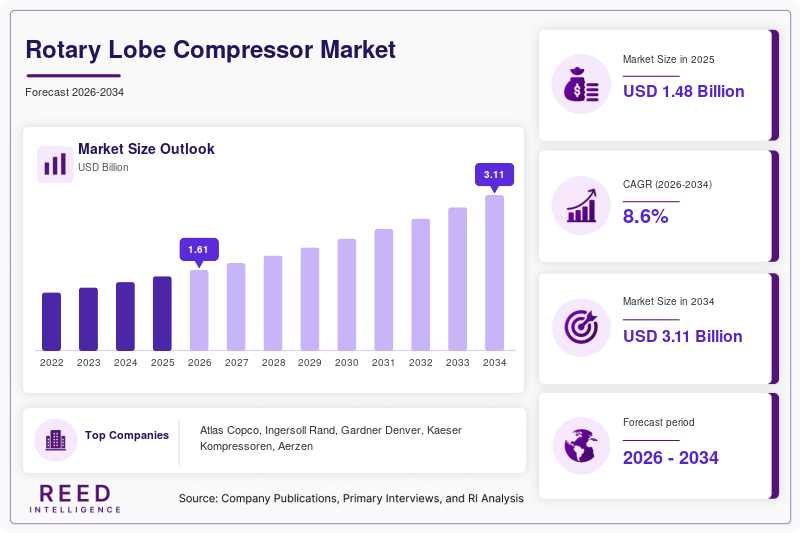
The Rotary Lobe Compressor Market size was valued at USD 1.48 billion in 2026 and is projected to reach USD 2.86 billion by 2034, expanding at a CAGR of 8.6% during the forecast period (2026–2034). Rotary lobe compressors are widely used across industries such as wastewater treatment, food processing, chemical manufacturing, and oil & gas due to their ability to deliver oil-free air and maintain consistent pressure levels. The increasing need for energy-efficient and low-maintenance compression systems has significantly supported the adoption of rotary lobe compressors globally.
One major global factor contributing to market growth is the rising focus on sustainable industrial practices. Industries are transitioning toward environmentally compliant equipment that reduces emissions and energy consumption. Rotary lobe compressors meet these requirements by offering efficient air compression with minimal contamination risks, making them suitable for sensitive applications such as pharmaceuticals and food processing.
Key Highlights
- North America dominated the market with a 33.8% share in 2025.
- Asia Pacific is expected to grow at the fastest CAGR of 10.9% during 2026–2034.
- By type, oil-free compressors accounted for the largest share of 44.6%.
- while hybrid compressors are projected to grow at a CAGR of 11.7%.
- By application, wastewater treatment led with a 39.2% share, whereas food processing is expected to expand at a CAGR of 10.8%.
- The United States remained the dominant country, with market values of USD 420 million in 2024 and USD 455 million in 2025.
Market Trends
Rising adoption of smart compressor systems
The market is experiencing a growing shift toward smart rotary lobe compressors equipped with IoT-enabled monitoring systems. These systems allow real-time performance tracking, predictive maintenance, and energy optimization. Industrial operators are increasingly adopting these solutions to reduce downtime and operational costs. Smart compressors can identify performance deviations early, helping prevent costly breakdowns. Additionally, data analytics integration allows companies to monitor energy consumption patterns and optimize usage across production lines. This trend is particularly strong in developed regions where automation and digitalization are advancing rapidly. As industries prioritize efficiency and reliability, the demand for connected compressor systems is expected to continue rising steadily.
Increasing preference for oil-free compression technology
There is a noticeable shift toward oil-free rotary lobe compressors due to strict regulatory standards and quality requirements in industries such as food processing, pharmaceuticals, and electronics manufacturing. Oil contamination can compromise product integrity, making oil-free compressors a preferred choice. Manufacturers are enhancing designs to improve efficiency while maintaining oil-free operation, which supports broader adoption. This trend is also driven by environmental concerns, as oil-free systems reduce waste disposal requirements and operational risks. Emerging economies are gradually adopting these systems as regulatory frameworks become stricter. As quality assurance becomes a key competitive factor, oil-free compressor demand is expected to grow significantly.
Market Drivers
Expansion of wastewater treatment infrastructure
The rapid expansion of wastewater treatment facilities worldwide is a key driver of the rotary lobe compressor market. Governments and municipalities are investing heavily in water management systems to address urbanization and environmental concerns. Rotary lobe compressors are widely used in aeration processes, sludge handling, and filtration systems due to their consistent airflow and reliability. Their low maintenance requirements make them suitable for continuous operation in treatment plants. Developing countries are increasing infrastructure spending, which is creating strong demand for efficient compression equipment. Additionally, stricter environmental regulations are encouraging the adoption of advanced treatment technologies, further supporting market growth.
Growth of food and beverage processing industry
The expanding global food and beverage industry is significantly driving demand for rotary lobe compressors. These compressors are used for packaging, pneumatic conveying, and processing applications where clean and contamination-free air is essential. The rising demand for processed and packaged food products has led to increased industrial automation, which requires reliable air compression systems. Rotary lobe compressors offer consistent performance and meet hygiene standards, making them suitable for food-grade applications. The growth of organized retail and changing consumer lifestyles are further boosting production capacity, thereby increasing the need for efficient compressor solutions across the industry.
Market Restraint
High initial investment and operational limitations
The high initial cost associated with rotary lobe compressors remains a significant restraint for market growth, particularly for small and medium-sized enterprises. Compared to alternative compressor technologies, rotary lobe compressors require higher upfront investment due to their advanced design and material requirements. Additionally, these compressors may have limitations in handling extremely high-pressure applications, which restricts their usage in certain industrial sectors. Maintenance costs, although relatively lower over time, can still pose a challenge for budget-sensitive operations. For example, smaller manufacturing units often opt for less expensive alternatives despite lower efficiency. This cost barrier can slow adoption rates, especially in developing regions where capital investment constraints are more prominent.
Market Opportunities
Integration of energy-efficient technologies
The growing emphasis on energy efficiency presents a strong opportunity for the rotary lobe compressor market. Manufacturers are focusing on developing compressors with improved energy performance and reduced power consumption. Innovations such as variable speed drives and advanced rotor designs are helping optimize efficiency. Industries are actively seeking solutions that reduce operational costs while maintaining productivity. Energy-efficient compressors not only lower electricity consumption but also contribute to sustainability goals. As energy prices continue to rise globally, the demand for efficient equipment is expected to increase. This creates significant opportunities for manufacturers to introduce advanced products tailored to evolving industrial needs.
Expansion in emerging industrial markets
Emerging economies are creating substantial growth opportunities for rotary lobe compressor manufacturers. Rapid industrialization in regions such as Asia Pacific, Latin America, and parts of Africa is increasing demand for reliable compression systems. Governments are investing in infrastructure, manufacturing, and energy sectors, which require efficient air handling solutions. The expansion of industries such as chemicals, textiles, and pharmaceuticals is further driving demand. Additionally, increasing awareness about energy efficiency and environmental compliance is encouraging adoption of advanced compressor technologies. Companies that establish strong distribution networks and localized production capabilities can capitalize on these growing markets effectively.
Segmental Analysis
By Type
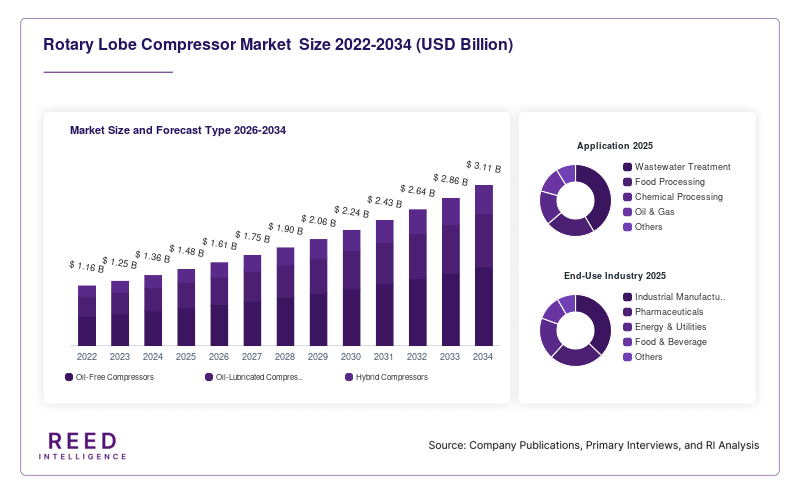
Oil-free rotary lobe compressors dominated the market in 2024, accounting for a share of 44.6%. These compressors are widely used in industries that require clean and contamination-free air, such as food processing, pharmaceuticals, and electronics manufacturing. Their ability to operate without lubrication reduces the risk of product contamination and ensures compliance with stringent quality standards. Additionally, oil-free compressors require less maintenance compared to traditional systems, which enhances their appeal among industrial users. The increasing focus on environmental sustainability and regulatory compliance is further supporting the adoption of oil-free compressor technologies across various industries.
Hybrid compressors are expected to be the fastest-growing subsegment, with a projected CAGR of 11.7% during the forecast period. These compressors combine the advantages of different compression technologies to deliver improved efficiency and performance. The growing demand for versatile and energy-efficient solutions is driving the adoption of hybrid systems. Industries are increasingly seeking equipment that can handle varying operational requirements without compromising performance. Hybrid compressors offer enhanced flexibility and cost efficiency, making them suitable for a wide range of applications. This adaptability is expected to drive significant growth in this segment over the coming years.
By Application
Wastewater treatment emerged as the dominant application segment in 2024, accounting for a share of 39.2%. Rotary lobe compressors play a crucial role in aeration and sludge management processes, ensuring efficient treatment of wastewater. The increasing focus on environmental protection and water conservation has led to significant investments in wastewater treatment infrastructure. Governments and municipalities are adopting advanced technologies to improve treatment efficiency, which is driving demand for reliable compression systems. The ability of rotary lobe compressors to deliver consistent airflow and operate continuously makes them ideal for these applications.
Food processing is projected to be the fastest-growing application segment, with a CAGR of 10.8%. The rising demand for processed and packaged food products is driving the expansion of food manufacturing facilities. Rotary lobe compressors are widely used in packaging, conveying, and processing applications where hygiene and reliability are critical. The increasing adoption of automation in the food industry is further supporting the demand for efficient compression systems. Additionally, stringent food safety regulations are encouraging manufacturers to use oil-free compressors, which is expected to drive growth in this segment.
By End-Use Industry
The industrial manufacturing sector held the largest share of 41.5% in 2024, driven by the widespread use of rotary lobe compressors in various production processes. Industries such as chemicals, automotive, and textiles rely on these compressors for efficient air handling and process optimization. The growing trend of industrial automation and the need for reliable equipment are supporting the adoption of rotary lobe compressors. Their durability and low maintenance requirements make them suitable for continuous operation in demanding industrial environments. As manufacturing activities continue to expand globally, demand for these compressors is expected to remain strong.
The pharmaceutical industry is expected to be the fastest-growing end-use segment, with a CAGR of 11.2%. The increasing demand for high-quality pharmaceutical products is driving the adoption of advanced manufacturing technologies. Rotary lobe compressors are used in various processes where contamination-free air is essential. The growth of the pharmaceutical industry, particularly in emerging markets, is creating significant opportunities for compressor manufacturers. Additionally, strict regulatory standards and the need for clean production environments are encouraging the use of oil-free compressor systems, which is expected to drive growth in this segment.
Regional Analysis
North America
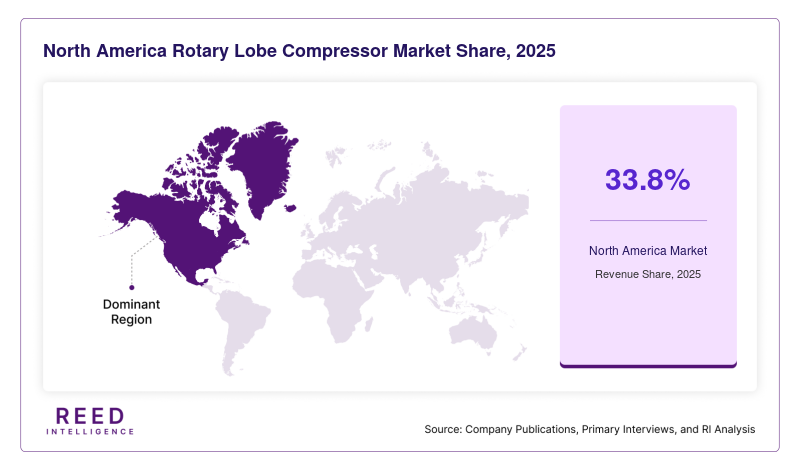
North America held a dominant share of 33.8% in 2025 and is expected to maintain steady growth at a CAGR of 7.9% during the forecast period. The region benefits from well-established industrial infrastructure and strong adoption of advanced technologies. Industries such as oil & gas, wastewater treatment, and food processing drive consistent demand for rotary lobe compressors. The presence of major manufacturers and ongoing investments in automation further support market growth across the region.
The United States leads the regional market due to its large industrial base and high adoption of energy-efficient technologies. A key growth factor is the increasing investment in upgrading aging water treatment facilities. Government initiatives aimed at improving water quality and environmental sustainability are encouraging the use of advanced compression systems. This trend is expected to sustain long-term demand for rotary lobe compressors.
Europe
Europe accounted for a significant share of 27.4% in 2025 and is projected to grow at a CAGR of 8.1%. The region’s focus on sustainability and strict environmental regulations drives demand for oil-free and energy-efficient compressors. Industries such as pharmaceuticals, chemicals, and food processing are major contributors to market growth. Technological advancements and innovation in compressor design further support the expansion of the market in Europe.
Germany is the dominant country in this region, supported by its strong manufacturing sector. A unique growth factor is the country’s emphasis on industrial energy efficiency and carbon reduction initiatives. Companies are increasingly adopting advanced compressor technologies to meet regulatory standards. This focus on sustainability is expected to drive continued demand for rotary lobe compressors across the region.
Asia Pacific
Asia Pacific held a market share of 22.6% in 2025 and is expected to grow at the fastest CAGR of 10.9%. Rapid industrialization, urbanization, and infrastructure development are key factors driving market growth. The region’s expanding manufacturing sector and increasing investments in wastewater treatment facilities are creating strong demand for rotary lobe compressors. Additionally, rising awareness about energy efficiency is supporting adoption.
China dominates the Asia Pacific market due to its extensive industrial base and large-scale manufacturing activities. A unique growth factor is the country’s increasing investment in environmental protection and water management infrastructure. Government policies promoting sustainable industrial practices are encouraging the adoption of advanced compressor systems, which is expected to drive significant market expansion.
Middle East & Africa
The Middle East & Africa region accounted for 8.2% of the market in 2025 and is projected to grow at a CAGR of 8.7%. Growth is driven by investments in oil & gas, water treatment, and infrastructure development. Rotary lobe compressors are widely used in these sectors due to their reliability and efficiency. Increasing industrial diversification is also contributing to market expansion in the region.
Saudi Arabia is the leading country in this region, supported by its strong oil & gas industry. A unique growth factor is the government’s focus on diversifying the economy through industrial development initiatives. Investments in water desalination and wastewater treatment projects are creating demand for advanced compressor technologies, supporting market growth.
Latin America
Latin America held a market share of 8.0% in 2025 and is expected to grow at a CAGR of 8.4%. The region is witnessing increasing industrialization and infrastructure development, which drives demand for rotary lobe compressors. Key industries include mining, food processing, and water treatment. Economic recovery and investment in industrial projects are further supporting market growth.
Brazil dominates the Latin American market due to its large industrial sector. A unique growth factor is the expansion of the food processing industry, which requires reliable and hygienic air compression systems. Increasing export activities and domestic consumption are encouraging industrial growth, thereby boosting demand for rotary lobe compressors.
Competitive Landscape
The rotary lobe compressor market is moderately consolidated, with several global and regional players competing based on product innovation, efficiency, and pricing. Leading companies are focusing on developing energy-efficient and technologically advanced compressors to strengthen their market position. Strategic partnerships, mergers, and product launches are common strategies adopted by key players.
Atlas Copco is a leading player in the market, known for its advanced compressor technologies and global presence. The company recently introduced a new range of energy-efficient rotary lobe compressors designed for industrial applications, enhancing its product portfolio. Other major players are also investing in research and development to improve performance and reduce operational costs, which is intensifying competition in the market.
Key Players
- Atlas Copco
- Ingersoll Rand
- Gardner Denver
- Kaeser Kompressoren
- Aerzen
- Tuthill Corporation
- Howden Group
- Busch Vacuum Solutions
- Kaishan Compressor
- Hitachi Industrial Equipment Systems
- Siemens Energy
- Boge Compressors
- Elmo Rietschle
- Sulzer Ltd.
- Mitsubishi Heavy Industries
Recent Developments
- In 2025, Atlas Copco launched a new series of smart rotary lobe compressors with integrated IoT monitoring capabilities to enhance operational efficiency.
- In 2024, Ingersoll Rand expanded its manufacturing facility to increase production capacity for energy-efficient compressors.
- In 2025, Aerzen introduced an advanced hybrid rotary lobe compressor designed to improve performance and reduce energy consumption in industrial applications.
Rotary Lobe Compressor Market Segments
Type
- Oil-Free Compressors
- Oil-Lubricated Compressors
- Hybrid Compressors
Application
- Wastewater Treatment
- Food Processing
- Chemical Processing
- Oil & Gas
- Others
End-Use Industry
- Industrial Manufacturing
- Pharmaceuticals
- Energy & Utilities
- Food & Beverage
- Others
By Region
- North America
- Europe
- APAC
- Middle East and Africa
- LATAM