Rotary RF Joint Market Size, Share & Demand Report By Type (Single-Channel Rotary RF Joint, Multi-Channel Rotary RF Joint), By Frequency Range (Low Frequency, High Frequency, Ultra-High Frequency), By Application (Radar Systems, Satellite Communication, Broadcasting), By End-Use (Defense, Telecommunications, Aerospace), By Region & Segment Forecasts, 2025–2034
USD 3950
Market Overview
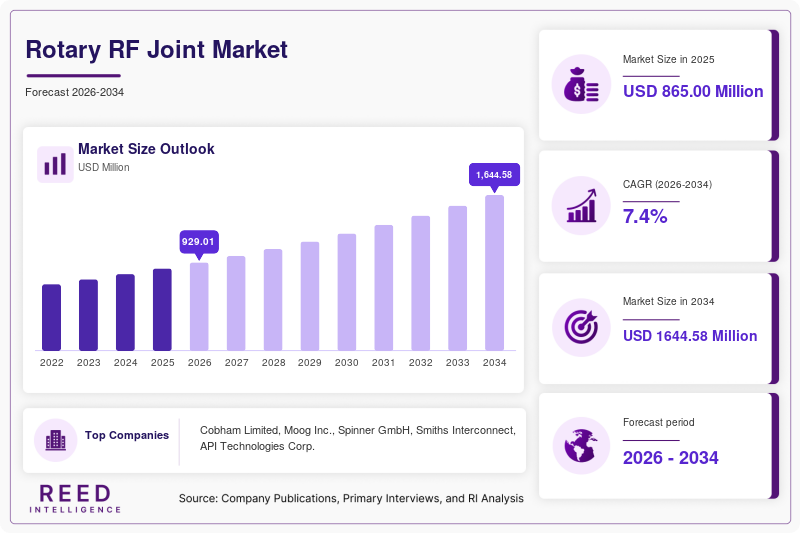
The global Rotary RF Joint Market size was valued at approximately USD 865 million in 2025 and is projected to reach USD 1.64 billion by 2034, expanding at a compound annual growth rate (CAGR) of 7.4% during the forecast period. The market is gaining traction due to its critical role in enabling uninterrupted radio frequency signal transmission between stationary and rotating components in radar systems, satellite communication, and defense equipment.
A key global factor supporting the growth of the Rotary RF Joint Market is the increasing deployment of advanced radar and communication systems across defense and aerospace sectors. As countries continue to invest in modern surveillance, navigation, and communication technologies, the demand for high-performance rotary RF joints is rising steadily. These components ensure reliable signal integrity in high-frequency environments, making them essential in mission-critical applications.
Key Highlights:
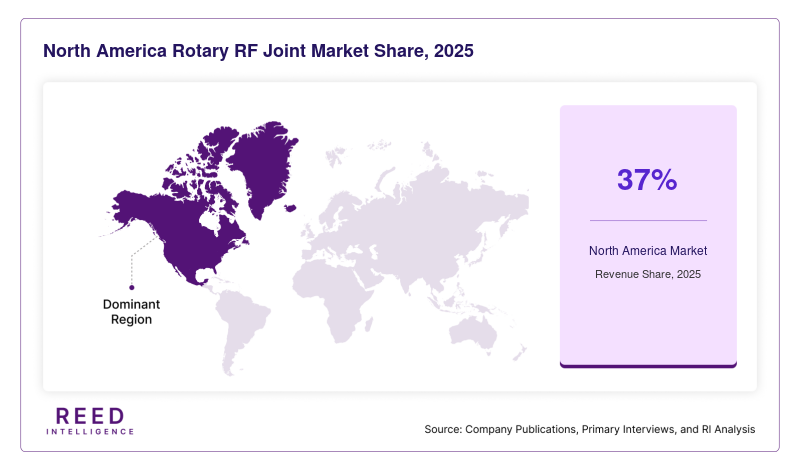
- North America dominated the Rotary RF Joint Market with a 37% share in 2025, while Asia Pacific is expected to register the fastest CAGR of 8.6%.
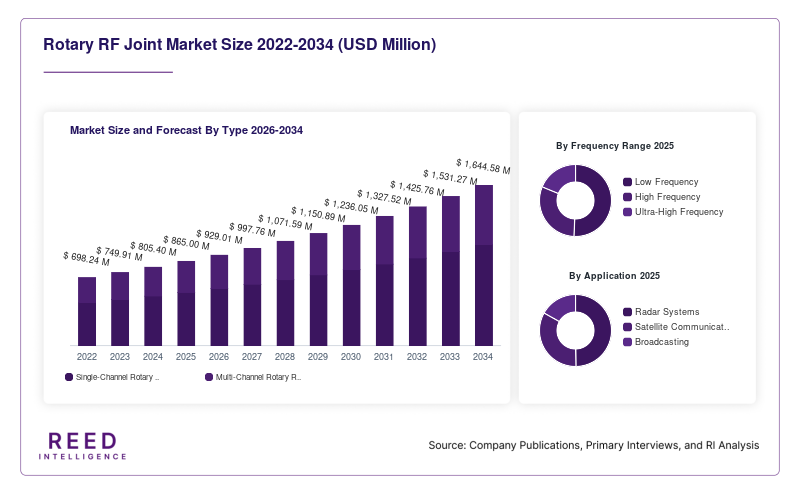
- By type, single-channel rotary RF joints led with a 54% share, while multi-channel rotary RF joints are projected to grow at the fastest CAGR of 8.9%.
- By application, radar systems dominated with a 46% share, while satellite communication is expected to grow at a CAGR of 8.5%.
- The U.S. remained the dominant country with market values of USD 295 million in 2025 and USD 312 million in 2026.
Market Trends
Increasing Integration in Advanced Radar Systems
The Rotary RF Joint Market is witnessing increased integration in modern radar systems used in defense and aerospace applications. These systems require seamless transmission of high-frequency signals between rotating antennas and stationary platforms. Rotary RF joints are essential for ensuring signal stability and performance in such environments. The development of phased array radar and next-generation surveillance systems is further driving demand for advanced RF joint solutions.
Expansion of Satellite Communication Infrastructure
Another notable trend is the expansion of satellite communication networks globally. With the rise of broadband connectivity, space exploration, and satellite-based services, the demand for reliable RF components is increasing. Rotary RF joints are used in ground stations and satellite tracking systems, supporting continuous signal transmission. This trend is contributing to the steady growth of the market.
Market Drivers
Growing Defense and Aerospace Investments
Increasing global defense budgets and investments in aerospace technologies are major drivers for the Rotary RF Joint Market. Governments are focusing on strengthening surveillance and communication capabilities, which require advanced RF components. Rotary RF joints play a critical role in radar and communication systems, supporting their widespread adoption.
Advancements in Wireless Communication Technologies
The rapid development of wireless communication technologies, including 5G and satellite-based networks, is driving demand for high-frequency RF components. Rotary RF joints enable efficient signal transmission in rotating systems, making them essential in modern communication infrastructure. This driver is contributing to market expansion.
Market Restraint
High Cost and Complex Manufacturing Processes
A significant restraint in the Rotary RF Joint Market is the high cost associated with manufacturing and integrating these components. Rotary RF joints require precision engineering and high-quality materials to ensure reliable performance in demanding environments.
Additionally, the complexity of design and testing processes can increase production time and costs. This may limit adoption among smaller organizations and in cost-sensitive applications. The need for specialized expertise and infrastructure further adds to operational challenges, potentially restricting market growth.
Market Opportunities
Growth in Space Exploration and Satellite Launches
The increasing number of satellite launches and space exploration missions presents significant opportunities for the Rotary RF Joint Market. These components are essential for maintaining communication between ground stations and satellites. As space programs expand globally, demand for advanced RF solutions is expected to rise.
Adoption in Commercial Communication Systems
The growing use of rotary RF joints in commercial communication systems offers new growth avenues. Industries such as broadcasting, telecommunications, and maritime communication are adopting these components to improve signal transmission. This diversification of applications is expected to support market expansion.
Segmental Analysis
By Type
Single-channel rotary RF joints dominated the Rotary RF Joint Market with a 54% share in 2025, as they are widely used in standard radar and communication systems. Their simplicity and cost-effectiveness make them suitable for various applications.
Multi-channel rotary RF joints are expected to grow at the fastest CAGR of 8.9%, driven by increasing demand for complex communication systems. These joints enable simultaneous transmission of multiple signals, supporting advanced technologies.
By Frequency Range
The high-frequency segment accounted for 48% of the Rotary RF Joint Market in 2025, as it is essential for advanced radar and communication systems. The demand is driven by the need for high-performance signal transmission.
Ultra-high-frequency segment is anticipated to grow at a CAGR of 8.3%, supported by advancements in communication technologies. Increasing use in satellite and space applications is driving this segment.
By Application
Radar systems accounted for 46% of the market in 2025, as rotary RF joints are critical for radar operation. The increasing demand for surveillance and navigation systems is supporting growth.
Satellite communication is expected to grow at a CAGR of 8.5%, driven by expanding satellite networks. The need for reliable communication systems is boosting demand.
By End-Use
Defense sector dominated with a 52% share in 2025, due to extensive use of RF joints in military applications. Increasing defense spending is supporting demand.
Telecommunications sector is expected to grow at a CAGR of 8.2%, driven by the expansion of communication networks. The adoption of advanced technologies is contributing to growth.
Regional Analysis
North America
North America accounted for 37% of the Rotary RF Joint Market share in 2025 and will grow at a CAGR of 6.9% through 2034. The region benefits from strong defense spending and advanced aerospace infrastructure. The presence of leading technology companies and continuous investment in research and development are supporting market growth.
The United States dominated the region due to its extensive use of radar and communication systems in defense applications. Ongoing modernization of military equipment and increasing adoption of advanced technologies are key growth factors.
Europe
Europe held 26% market share in 2025 and is projected to grow at a CAGR of 7.1%. The region has a well-established aerospace and defense industry, supporting demand for rotary RF joints. Increasing investments in satellite communication and space exploration are contributing to market growth.
Germany emerged as the dominant country due to its strong industrial base and focus on technological innovation. The country’s involvement in space programs and defense projects is driving demand for RF components.
Asia Pacific
Asia Pacific captured 23% of the Rotary RF Joint Market in 2025 and is expected to register the fastest CAGR of 8.6%. Rapid technological advancements, increasing defense budgets, and expansion of communication networks are driving demand. The region is also witnessing growth in satellite launches and space exploration activities.
China led the region due to its significant investments in defense and space programs. The development of advanced communication infrastructure and increasing production capabilities are supporting market growth.
Middle East & Africa
The Middle East & Africa held 8% share in 2025 and will grow at a CAGR of 7.5%. The market is expanding due to increasing investments in defense and communication infrastructure. The adoption of advanced surveillance systems is supporting demand for rotary RF joints.
Saudi Arabia dominated the region due to its focus on modernizing defense capabilities. The country’s investments in advanced technologies and infrastructure development are driving market growth.
Latin America
Latin America accounted for 6% of the Rotary RF Joint Market in 2025 and is projected to grow at a CAGR of 7.8%. The region is experiencing steady growth due to increasing investments in communication systems and defense infrastructure.
Brazil led the region due to its expanding aerospace and defense sector. The adoption of advanced communication technologies is supporting market growth.
Competitive Landscape
The Rotary RF Joint Market is characterized by the presence of several established players focusing on innovation and product development. Companies are investing in advanced manufacturing technologies to improve performance and reliability.
A leading market player has recently introduced a new range of high-frequency rotary RF joints designed for advanced radar systems. This development highlights the increasing demand for high-performance components.
Other players are focusing on strategic collaborations and expanding their global presence. Continuous innovation and investment in research and development are shaping the competitive landscape.
Key Players List
- Cobham Limited
- Moog Inc.
- Spinner GmbH
- Smiths Interconnect
- API Technologies Corp.
- Pasternack Enterprises Inc.
- Mercury Systems Inc.
- ETL Systems Ltd.
- Fairview Microwave Inc.
- MegaPhase LLC
- Huber+Suhner AG
- Rosenberger Hochfrequenztechnik GmbH
- Radiall S.A.
- Teledyne Technologies Incorporated
- Amphenol RF
Recent Developments
- 2024: Launch of advanced high-frequency rotary RF joints for radar systems.
- 2024: Expansion of manufacturing facilities to increase production capacity.
- 2025: Strategic partnerships between RF component manufacturers and defense organizations.
- 2025: Increased investment in research for next-generation communication technologies.
Rotary RF Joint Market Segments
By Type
- Single-Channel Rotary RF Joint
- Multi-Channel Rotary RF Joint
By Frequency Range
- Low Frequency
- High Frequency
- Ultra-High Frequency
By Application
- Radar Systems
- Satellite Communication
- Broadcasting
By End-Use
- Defense
- Telecommunications
- Aerospace
By Region
- North America
- Europe
- APAC
- Middle East and Africa
- LATAM