RTF Racing Drones Market Size, Share & Demand Report By Type (FPV Racing Drones, Non-FPV Racing Drones, AI-Assisted Racing Drones), By Application (Recreational Racing, Professional Racing), By End-User (Individual Consumers, Commercial Users), By Distribution Channel (Online, Offline) By Region & Segment Forecasts, 2025–2034
USD 3950
Market Overview
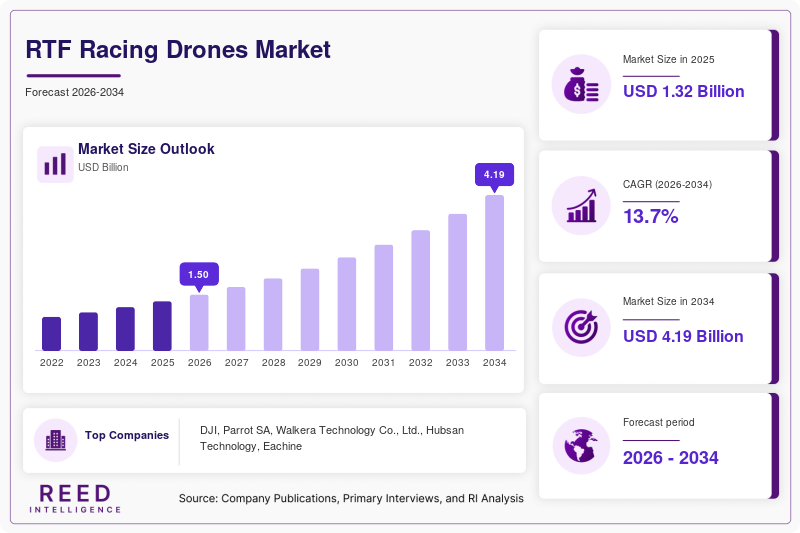
The RTF Racing Drones Market size was valued at approximately USD 1.32 billion in 2025 and is projected to reach USD 4.18 billion by 2034, expanding at a CAGR of 13.7% during the forecast period (2025–2034). The market has gained steady traction due to the rising popularity of drone racing as both a competitive sport and a recreational hobby, supported by technological advancements in drone components such as high-speed motors, FPV (First Person View) systems, and lightweight frames.
A key global factor driving the growth of the RTF Racing Drones Market is the increasing integration of immersive FPV technologies, which enhances user experience and drives adoption among enthusiasts and professionals. Improved video transmission, low-latency systems, and high-definition cameras have made racing drones more accessible and engaging, further fueling market demand.
Key Highlights:
- North America dominated the market with a 38.4% share in 2025, while Asia Pacific is projected to grow at the fastest CAGR of 15.6%.
- The FPV-enabled drones segment led the market, while AI-assisted drones are expected to grow at a CAGR of 16.9%.
- Among applications, recreational racing held the largest share, while professional racing is expected to expand rapidly at a CAGR of 14.8%.
- The United States accounted for USD 420 million in 2024 and reached approximately USD 465 million in 2025, maintaining its dominant country position.
Market Trends
Rising Adoption of FPV and Digital Transmission Systems
The RTF Racing Drones Market is witnessing strong growth due to the increasing adoption of advanced FPV systems with digital video transmission. These systems provide enhanced image clarity, reduced latency, and improved signal stability, which are critical for competitive drone racing. The shift from analog to digital FPV has allowed pilots to achieve greater precision and control, significantly improving race performance. This trend is also encouraging manufacturers to integrate advanced onboard processing units and enhanced camera modules, making RTF drones more appealing to both beginners and professionals.
Expansion of Drone Racing Ecosystem
The expansion of the global drone racing ecosystem is another key trend shaping the market. The emergence of organized leagues, sponsorships, and streaming platforms has increased the visibility of drone racing as a sport. This has led to greater participation, especially among younger demographics. Additionally, gaming and simulation platforms are being integrated with real-world racing, creating hybrid experiences that attract a broader audience. The growing community of drone enthusiasts and the availability of training simulators are further supporting market expansion.
Market Drivers
Increasing Popularity of Drone Racing as a Competitive Sport
The rapid growth of drone racing as an organized sport is a major driver of the RTF Racing Drones Market. International competitions, professional leagues, and sponsorship deals have elevated drone racing into a recognized competitive activity. This has encouraged participants to invest in high-performance RTF drones, boosting overall market demand.
Technological Advancements in Drone Components
Continuous innovation in drone technology is significantly driving market growth. Improvements in battery efficiency, brushless motors, lightweight materials, and flight controllers have enhanced drone speed, agility, and durability. These advancements have reduced the complexity of drone assembly, making ready-to-fly racing drones more attractive to consumers. Additionally, integration of AI-based stabilization and autonomous features is improving user experience and expanding the customer base.
Market Restraint
Regulatory Restrictions and Airspace Limitations
One of the primary challenges facing the RTF Racing Drones Market is the increasing regulatory scrutiny surrounding drone usage. Governments across various regions have implemented strict rules regarding drone operations, including airspace restrictions, licensing requirements, and safety guidelines. These regulations can limit the use of racing drones in certain areas, particularly urban environments.
Furthermore, compliance with varying international regulations creates operational complexities for manufacturers and distributors. Restrictions on drone speed, altitude, and frequency usage can also impact product performance and innovation. These factors may discourage new entrants and reduce consumer adoption in regions with stringent regulatory frameworks.
Market Opportunities
Integration of AI and Autonomous Flight Features
The incorporation of artificial intelligence in RTF racing drones presents a significant growth opportunity. AI-powered features such as obstacle avoidance, automated flight stabilization, and predictive navigation are enhancing drone performance. These capabilities are expected to attract new users, particularly beginners, by simplifying operation and reducing the learning curve.
Growth of E-commerce and Direct-to-Consumer Sales Channels
The rapid expansion of e-commerce platforms is creating new opportunities for the RTF Racing Drones Market. Online channels enable manufacturers to reach a global audience, offering a wide range of products at competitive prices. Direct-to-consumer sales models also allow companies to build stronger customer relationships and provide personalized experiences. This trend is particularly beneficial in emerging markets, where access to physical retail stores may be limited.
Segmental Analysis
By Type
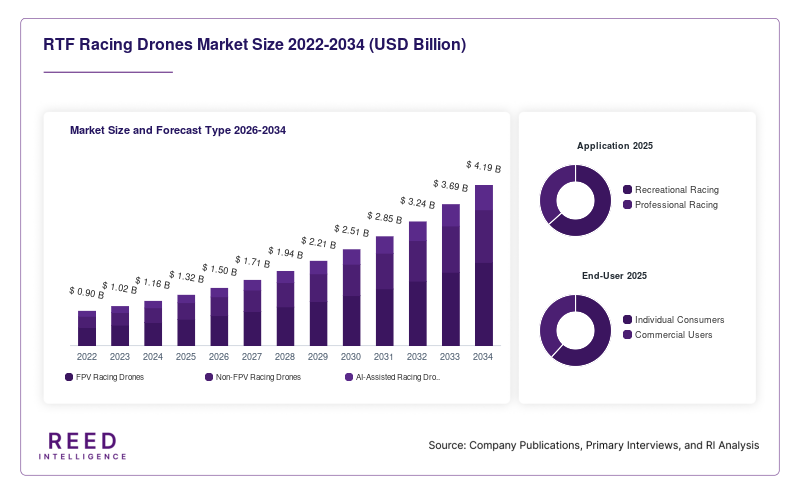
The FPV-enabled RTF racing drones segment held the dominant position, accounting for approximately 62.5% of the market share in 2024. This dominance was attributed to the immersive flying experience provided by FPV systems, allowing pilots to navigate courses in real time with high precision.
AI-assisted drones are expected to grow at the fastest CAGR of 16.9% during the forecast period. The integration of intelligent flight features and automation will enhance performance and attract new users, particularly beginners seeking ease of use.
By Application
The recreational racing segment dominated the market with a share of 58.3% in 2024. The widespread adoption of drones as a hobby and the availability of affordable RTF models contributed to this segment’s leadership.
The professional racing segment is projected to grow at a CAGR of 14.8%. Increasing investments in competitive leagues and sponsorship opportunities will drive demand for high-performance drones in this segment.
By End-User
Individual consumers accounted for the largest share of 64.7% in 2024, driven by growing interest in drone racing as a recreational activity. Easy availability of ready-to-fly models has made it accessible to a wider audience.
Commercial users, including training institutes and event organizers, are expected to grow at a CAGR of 14.2%. The expansion of organized racing events and training programs will support this growth.
By Distribution Channel
Online channels dominated the market with a 55.9% share in 2024, driven by the convenience of e-commerce platforms and wider product availability.
Offline retail is expected to grow at a CAGR of 12.5%, supported by the increasing presence of specialty drone stores and experiential retail formats.
Regional Analysis
North America
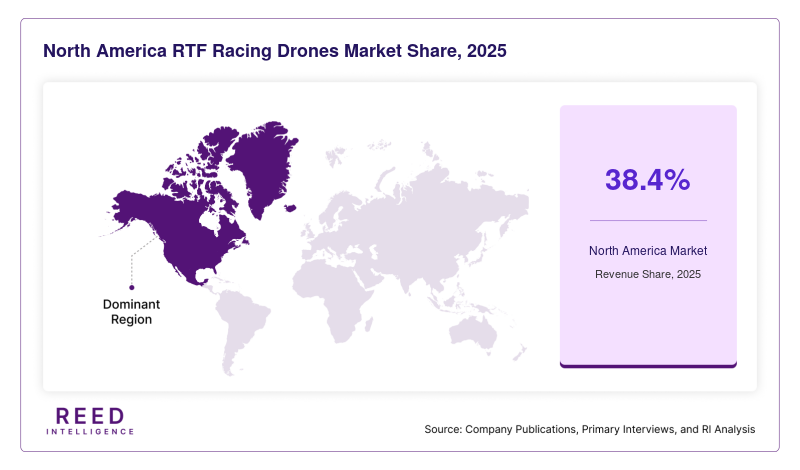
North America accounted for approximately 38.4% of the RTF Racing Drones Market share in 2025 and is expected to grow at a CAGR of 12.8% during the forecast period. The region’s dominance was driven by strong consumer adoption, technological innovation, and the presence of established drone racing leagues.
The United States remained the dominant country due to its well-developed drone ecosystem and high participation in competitive racing events. The country’s strong infrastructure for sports entertainment and early adoption of advanced drone technologies contributed significantly to market growth.
Europe
Europe held around 24.6% of the market share in 2025 and is projected to grow at a CAGR of 13.1% through 2034. The region’s growth was supported by increasing interest in recreational drone activities and supportive government initiatives for innovation.
Germany emerged as the dominant country, driven by its strong engineering capabilities and growing community of drone enthusiasts. The presence of technology-focused startups and hobbyist clubs further contributed to the expansion of the market.
Asia Pacific
Asia Pacific captured nearly 21.8% of the market in 2025 and is anticipated to grow at the fastest CAGR of 15.6%. The region’s growth was fueled by rising disposable incomes and increasing adoption of consumer electronics.
China dominated the regional market due to its strong manufacturing base and cost-effective production capabilities. The availability of affordable RTF racing drones and rapid technological advancements have positioned China as a key growth engine.
Middle East & Africa
The Middle East & Africa region accounted for approximately 8.2% of the market share in 2025 and is expected to grow at a CAGR of 13.4%. Growth in this region was supported by increasing investments in technology and recreational activities.
The United Arab Emirates led the region, driven by its focus on innovation and hosting of technology-driven events. The country’s investment in smart city initiatives and emerging sports has contributed to increased adoption of racing drones.
Latin America
Latin America held around 7.0% of the RTF Racing Drones Market share in 2025 and is projected to grow at a CAGR of 13.0% during the forecast period. The market growth was driven by rising interest in drone-based entertainment and hobbyist activities.
Brazil dominated the region due to its large consumer base and growing popularity of drone racing communities. Increasing internet penetration and access to online platforms have further supported market expansion.
Competitive Landscape
The RTF Racing Drones Market is moderately fragmented, with several global and regional players competing based on product innovation, pricing, and distribution strategies. The market leader, DJI, continues to maintain a strong position due to its advanced technology and extensive product portfolio. The company recently introduced enhanced FPV systems with improved transmission capabilities, strengthening its competitive edge.
Other key players are focusing on expanding their product offerings and entering new markets through strategic partnerships and collaborations. Innovation in AI integration and lightweight materials is a common strategy among leading companies. Additionally, firms are investing in marketing initiatives and sponsorship of racing events to enhance brand visibility and customer engagement.
Key Players
- Parrot SA
- Walkera Technology Co., Ltd.
- Hubsan Technology
- Eachine
- ImmersionRC Ltd.
- Yuneec International
- Autel Robotics
- BetaFPV
- iFlight Innovations
- Diatone Innovations
Recent Developments
- 2025: DJI launched a next-generation FPV racing drone with enhanced low-latency transmission.
- 2024: BetaFPV introduced lightweight racing frames for improved speed performance.
- 2024: Autel Robotics expanded its product portfolio with new racing drone models targeting professionals.
- 2023: Parrot SA focused on software upgrades for improved drone control systems.
- 2023: Walkera Technology introduced advanced battery systems for longer flight durations.
RTF Racing Drones Market Segments
Type
- FPV Racing Drones
- Non-FPV Racing Drones
- AI-Assisted Racing Drones
Application
- Recreational Racing
- Professional Racing
End-User
- Individual Consumers
- Commercial Users
Distribution Channel
- Online Retail
- Electronics and Specialty Stores
- Hobby and Drone Stores
- Sports Equipment Retailers
By Region
- North America
- Europe
- APAC
- Middle East and Africa
- LATAM