Rubber Bulb Seals Market Size, Share, Growth Demand Report By Material (EPDM Rubber, Silicone Rubber, Neoprene Rubber), By Application (Automotive, Construction, Marine, Industrial Machinery, Aerospace), By Product Type (Solid Bulb Seals, Sponge Bulb Seals, Co-Extruded Bulb Seals), By End Use Industry (Automotive, Building & Construction, Transportation, Marine), By Region & Segment Forecasts, 2026–2034
USD 3950
Market Overview
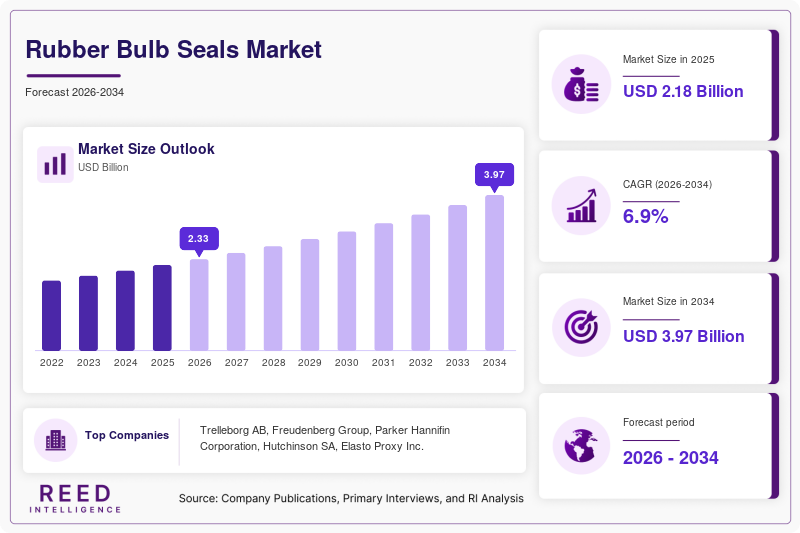
The Rubber Bulb Seals Market Size was valued at approximately USD 2.18 billion in 2026 and is projected to reach USD 3.71 billion by 2034, expanding at a CAGR of 6.9% during the forecast period (2026–2034). The market is witnessing steady growth due to increasing demand for durable sealing solutions across automotive, construction, marine, and industrial applications. Rubber bulb seals are widely used to provide insulation, vibration reduction, water resistance, and air-tight sealing performance in doors, windows, machinery, and transportation equipment. Their ability to withstand environmental stress and provide long-term sealing efficiency is supporting their adoption across multiple industries.
A major global factor driving the Rubber Bulb Seals Market size is the rapid expansion of infrastructure development and transportation manufacturing worldwide. Rising investments in commercial construction projects, automotive production facilities, and industrial machinery are significantly increasing demand for advanced sealing systems that improve operational durability, energy efficiency, and environmental protection.
Key Highlights
- Dominant Region (2025): Asia Pacific held 37% share, supported by strong automotive and construction sector demand
- Fastest-Growing Region: Middle East & Africa is projected to grow at 7.5% CAGR (2026–2034)
- Leading Subsegment (Material): EPDM rubber seals held 44% share in 2025
- Fastest-Growing Subsegment (Application): Automotive sealing systems are projected to grow at 7.8% CAGR
- Dominant Country (2024): China accounted for approximately USD 0.46 billion
- Dominant Country (2025): China increased to USD 0.51 billion, supported by expanding industrial production and vehicle manufacturing
Market Trends
Increasing Adoption of Weather-Resistant Sealing Solutions
The Rubber Bulb Seals Market is experiencing rising demand for weather-resistant and temperature-stable sealing products across construction and transportation applications. Manufacturers are increasingly developing seals with enhanced UV resistance, moisture protection, and thermal stability to improve long-term performance in harsh operating environments. This trend is particularly important in commercial buildings, marine equipment, and automotive door sealing applications where exposure to changing environmental conditions is high.
Shift Toward Customized and Co-Extruded Seal Designs
Another important trend shaping the Rubber Bulb Seals Market is the growing demand for customized and co-extruded sealing profiles designed for specific industrial applications. Manufacturers are increasingly producing multi-functional seal designs that combine flexibility, compression resistance, and acoustic insulation properties. Customized sealing systems are gaining popularity in automotive and industrial machinery applications where precise fit and performance optimization are required.
Market Drivers
Growth in Automotive Production and Vehicle Sealing Applications
Increasing global vehicle production is one of the primary growth drivers for the Rubber Bulb Seals Market. Rubber bulb seals are widely used in automotive doors, trunks, windows, and engine compartments to prevent water leakage, reduce cabin noise, and improve passenger comfort. The expansion of electric vehicle manufacturing is further accelerating demand for lightweight and high-performance sealing materials.
Rising Infrastructure and Commercial Construction Activities
Rapid urbanization and commercial infrastructure development are significantly boosting demand for advanced sealing systems used in doors, windows, curtain walls, and industrial buildings. Rubber bulb seals improve energy efficiency and insulation performance, making them essential components in modern construction projects focused on sustainability and environmental performance.
Market Restraint
Fluctuation in Raw Material Prices
The Rubber Bulb Seals Market faces challenges due to volatility in raw material prices, particularly synthetic rubber and petroleum-derived compounds. Price instability affects manufacturing costs and supply chain efficiency, especially for small and mid-sized manufacturers operating in highly competitive industrial markets.
Market Opportunities
Expansion of Electric Vehicle Manufacturing
The increasing adoption of electric vehicles is creating strong opportunities for the Rubber Bulb Seals Market, as EV manufacturers require advanced sealing systems that support noise reduction, thermal insulation, and battery protection. Lightweight and durable sealing materials are expected to witness higher demand as global EV production expands.
Growing Demand in Marine and Aerospace Applications
Marine and aerospace industries are emerging as important opportunity areas due to rising demand for high-performance sealing systems capable of withstanding moisture, pressure, and extreme environmental conditions. Rubber bulb seals are increasingly being integrated into specialized transportation and defense equipment applications.
Segmental Analysis
By Material
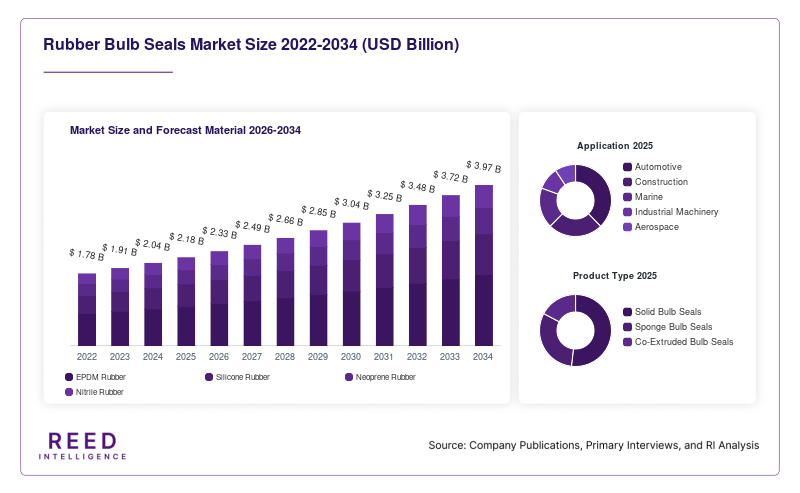
The Rubber Bulb Seals Market is segmented into EPDM rubber, silicone rubber, neoprene rubber, and nitrile rubber. EPDM rubber dominated with 44% share in 2025 due to its excellent weather resistance, flexibility, and durability across outdoor applications. Silicone rubber is projected to grow at a 7.6% CAGR, supported by increasing demand for high-temperature and chemical-resistant sealing systems.
By Application
Applications include automotive, construction, marine, industrial machinery, and aerospace sectors. Automotive applications accounted for 39% share in 2025, driven by strong demand for door, window, and trunk sealing systems. Aerospace applications are expected to grow at a 7.4% CAGR, supported by rising aircraft manufacturing and demand for lightweight sealing materials.
By Product Type
The market includes solid bulb seals, sponge bulb seals, and co-extruded bulb seals. Solid bulb seals dominated with 42% share in 2025 due to their strength and long-term sealing performance in heavy-duty environments. Co-extruded bulb seals are expected to grow at a 7.3% CAGR, driven by demand for multi-functional sealing profiles with enhanced insulation capabilities.
By End Use Industry
End use industries include automotive, building & construction, transportation, marine, and industrial manufacturing. Building & construction accounted for 36% share in 2025, supported by increasing use of insulation and weatherproof sealing systems in commercial infrastructure. Transportation is expected to grow at a 7.2% CAGR, driven by rising railway and electric mobility infrastructure development.
Regional Analysis
North America
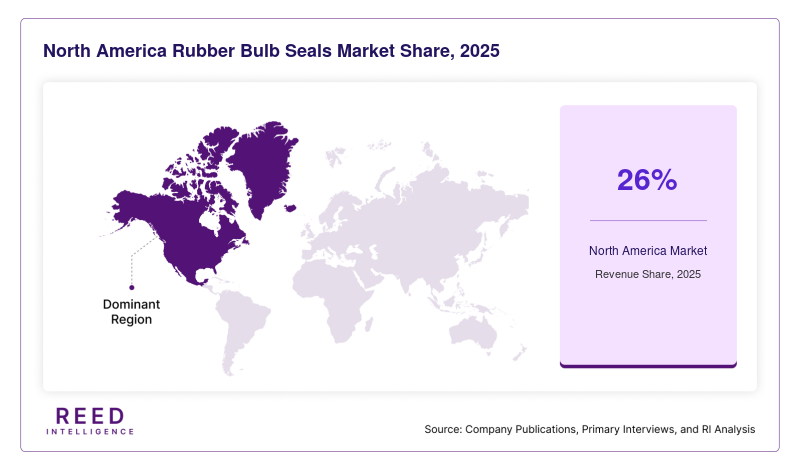
North America accounted for 26% share of the Rubber Bulb Seals Market in 2025 and is expected to grow at a 6.5% CAGR (2026–2034). Growth is supported by strong automotive manufacturing, industrial machinery demand, and commercial construction activity. The United States leads the region due to increasing investment in energy-efficient infrastructure and transportation manufacturing.
Europe
Europe held 24% share in 2025 and is projected to grow at a 6.3% CAGR (2026–2034). Demand is driven by automotive engineering, industrial automation, and sustainable building construction. Germany dominates the region due to its strong automotive component manufacturing ecosystem and advanced industrial production capabilities.
Asia Pacific
Asia Pacific dominated with 37% share in 2025 and is expected to grow at a 7.1% CAGR (2026–2034). The region benefits from expanding automotive production, rising infrastructure investments, and rapid industrialization. China leads regional growth due to strong construction activity and large-scale manufacturing operations.
Middle East & Africa
Middle East & Africa accounted for 7% share in 2025 and is projected to grow at a 7.5% CAGR (2026–2034). Growth is supported by increasing infrastructure projects, industrial expansion, and rising commercial construction activities across Gulf countries. Saudi Arabia leads due to major urban development projects and industrial diversification initiatives.
Latin America
Latin America held 6% share in 2025 and is expected to grow at a 6.4% CAGR (2026–2034). Brazil dominates regional demand due to expanding automotive assembly operations and increasing construction sector investments. Growing industrial modernization is also contributing to steady market growth.
Competitive Landscape
The Rubber Bulb Seals Market is moderately fragmented, with key manufacturers focusing on customized sealing solutions, material innovation, and production expansion. Companies are investing in advanced extrusion technologies and durable rubber compounds to improve sealing efficiency across industrial applications.
Trelleborg AB leads the market with a broad portfolio of industrial sealing products used across automotive, aerospace, and construction sectors. The company recently expanded its engineered sealing solutions business to strengthen supply capabilities for transportation and industrial customers.
Freudenberg Group and Parker Hannifin Corporation continue to strengthen their positions through advanced material technologies and customized sealing solutions. Hutchinson SA focuses on transportation sealing applications, while Elasto Proxy Inc. is expanding its product offerings for industrial and construction sectors.
Key Players List
- Trelleborg AB
- Freudenberg Group
- Parker Hannifin Corporation
- Hutchinson SA
- Elasto Proxy Inc.
- Trim-Lok Inc.
- Hebei Shida Seal Group
- APSOparts
- Minor Rubber Company
- Datwyler Holding Inc.
- Fairchild Industries
- Lauren Manufacturing
- Seashore Rubber
- VIP Rubber Company Inc.
- Metro Rubber Corporation
Recent Developments
- In 2024, Freudenberg Group launched advanced UV-resistant EPDM rubber bulb seals for commercial construction and automotive applications.
- In 2024, Trim-Lok Inc. expanded its customized co-extruded sealing solutions portfolio for industrial machinery and marine sectors.
- In 2025, Trelleborg AB increased production capacity for engineered rubber bulb seals used in transportation and infrastructure projects.
- In 2025, Hutchinson SA introduced lightweight rubber bulb sealing systems designed for electric vehicle applications.
- In 2025, Parker Hannifin Corporation upgraded its industrial sealing product portfolio with enhanced durability and thermal resistance features.
Rubber Bulb Seals Market Segments
Material
- EPDM Rubber
- Silicone Rubber
- Neoprene Rubber
- Nitrile Rubber
Application
- Automotive
- Construction
- Marine
- Industrial Machinery
- Aerospace
Product Type
- Solid Bulb Seals
- Sponge Bulb Seals
- Co-Extruded Bulb Seals
End Use Industry
- Automotive
- Building & Construction
- Transportation
- Marine
- Industrial Manufacturing
By Region
- North America
- Europe
- APAC
- Middle East and Africa
- LATAM