Rubber Extruder Market Size, Share, Demand & Growth Report By Machine Type (Cold Feed Rubber Extruders, Hot Feed Rubber Extruders, Twin-Screw Rubber Extruders, Pin Barrel Rubber Extruders), By Application (Tire Manufacturing, Industrial Rubber Products, Automotive Components, Rubber Hoses & Tubes, Seals & Gaskets, Cable Insulation), By End-Use Industry (Automotive, Industrial Manufacturing, Construction, Healthcare, Aerospace, Energy & Utilities) By Regional Outlook and Segment Forecasts, 2026–2
USD 3950
Market Overview
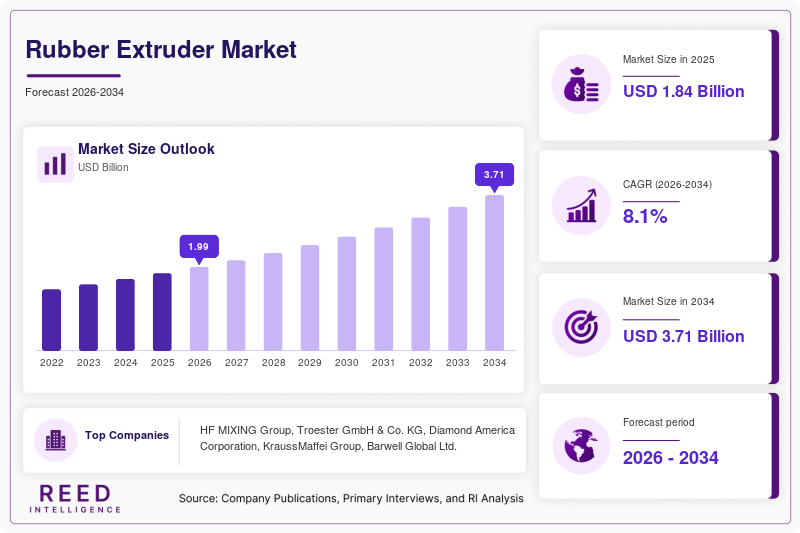
The global Rubber Extruder Market size was valued at USD 1.84 billion in 2026 and is projected to reach USD 3.42 billion by 2034, expanding at a CAGR of 8.1% during the forecast period from 2026 to 2034. The market continues to witness stable expansion due to rising demand for high-performance rubber products across automotive, construction, industrial machinery, medical equipment, and consumer goods industries. Rubber extruders are widely used to shape and process rubber compounds into tubes, seals, hoses, profiles, and tire components, making them a critical part of modern manufacturing operations. Growing industrial automation and increasing investment in precision manufacturing technologies are supporting adoption across both developed and emerging economies.
The automotive industry remains one of the strongest contributors to market growth. Rising production of electric vehicles, commercial trucks, and passenger vehicles has increased the demand for advanced rubber sealing systems, weather strips, hoses, and vibration control components. Manufacturers are investing in efficient extrusion systems capable of handling advanced elastomer materials with greater consistency and reduced material waste. In addition, the growing focus on sustainable manufacturing practices has encouraged the development of energy-efficient rubber extrusion equipment with improved temperature control and automated monitoring systems.
Key Highlights
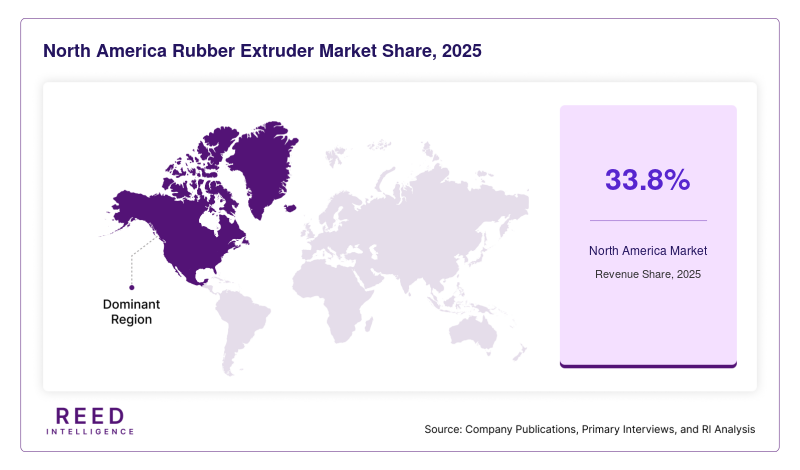
- North America dominated the market with a 33.8% share in 2025.
- Asia Pacific is expected to grow at the fastest CAGR of 10.9% during 2026–2034.
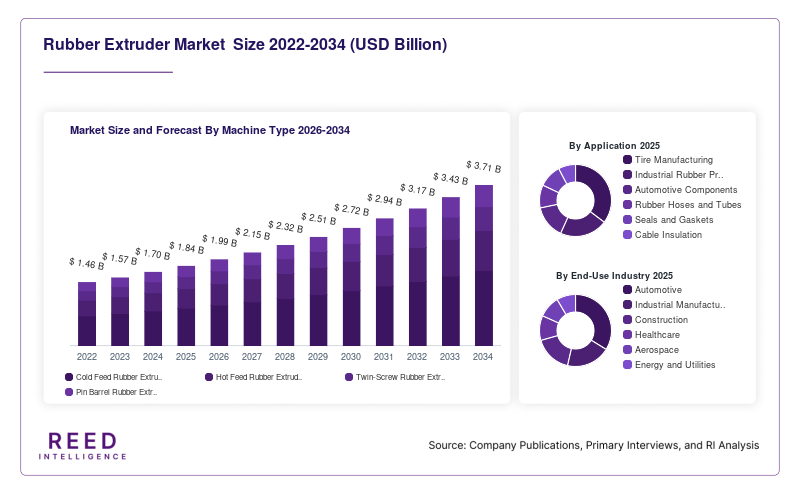
- By machine type, cold feed rubber extruders accounted for the largest share of 42.7%, while twin-screw rubber extruders are projected to grow at a CAGR of 11.6%.
- By application, tire manufacturing led with a 39.5% share, whereas industrial rubber products are expected to expand at a CAGR of 10.8%.
- China remained the dominant country, with market values of USD 295 million in 2024 and USD 328 million in 2025.
Market Trends
Integration of Smart Manufacturing and Automation Technologies
The Rubber Extruder Market is increasingly adopting smart manufacturing technologies to improve production efficiency, minimize downtime, and maintain product quality. Manufacturers are integrating sensors, real-time monitoring systems, programmable logic controllers, and artificial intelligence-based predictive maintenance tools into extrusion equipment. These technologies enable operators to monitor pressure, temperature, and material flow continuously, which helps reduce defects and maintain dimensional consistency in rubber products. Automated extrusion lines also support faster changeovers and lower labor dependency, making them attractive for high-volume production facilities.
Industrial manufacturers are focusing on connected production environments that allow centralized control and data-driven decision-making. Cloud-based monitoring systems are becoming more common in large-scale factories, particularly in automotive and industrial rubber processing plants. The trend is also encouraging equipment suppliers to introduce digitally integrated extrusion systems capable of remote diagnostics and energy optimization. As production facilities aim to improve operational efficiency and reduce waste generation, demand for intelligent and automated rubber extrusion machinery is expected to increase steadily during the forecast period.
Rising Adoption of Sustainable and Energy-Efficient Extrusion Systems
Sustainability goals across manufacturing industries are influencing the design and adoption of advanced rubber extrusion systems. Equipment manufacturers are developing machines with lower power consumption, efficient heating systems, and reduced material wastage to align with environmental regulations and corporate sustainability targets. Companies are increasingly focusing on recyclable rubber compounds and environmentally responsible processing methods, creating demand for extrusion systems capable of handling bio-based and recycled elastomer materials without compromising product quality.
The transition toward energy-efficient manufacturing is particularly visible in Europe and North America, where regulatory frameworks encourage industrial emission reductions and energy conservation. Modern extrusion systems now include improved cooling mechanisms, optimized screw designs, and automated process control technologies that help reduce operating costs and energy use. Manufacturers are also introducing modular equipment designs that extend machine lifespan and simplify maintenance procedures. These developments are supporting broader adoption of sustainable extrusion technologies across automotive, healthcare, and construction applications.
Market Drivers
Expanding Automotive Production and Demand for Rubber Components
The continued growth of global automotive manufacturing is one of the major factors supporting the Rubber Extruder Market. Rubber extruders are widely used to produce automotive seals, gaskets, hoses, weather strips, tire treads, and vibration control components. Increasing production of electric vehicles has further accelerated demand for advanced rubber materials that provide thermal insulation, noise reduction, and durability. Automotive manufacturers are focusing on lightweight and high-performance materials to improve vehicle efficiency, which is increasing the need for precision rubber extrusion technologies.
Developing economies in Asia Pacific and Latin America are experiencing growth in vehicle ownership and transportation infrastructure, creating additional opportunities for extrusion equipment suppliers. Automotive component manufacturers are investing in modern extrusion lines to improve production consistency and meet rising quality standards. Furthermore, the increasing replacement demand for automotive rubber parts in the aftermarket segment is contributing to stable long-term equipment utilization. These factors collectively strengthen market growth across both OEM and replacement manufacturing operations.
Growth in Industrial Infrastructure and Construction Activities
Rising industrial infrastructure development and construction activities are significantly contributing to demand for rubber extrusion equipment. Extruded rubber products are extensively used in building insulation systems, window seals, conveyor belts, protective profiles, and industrial machinery components. Rapid urbanization and infrastructure expansion in emerging economies are driving the need for durable and weather-resistant rubber products suitable for transportation, power generation, and commercial construction projects.
Industrial automation and factory modernization initiatives are also supporting increased adoption of advanced rubber processing equipment. Manufacturing facilities require high-precision rubber components for machinery operation, fluid handling systems, and industrial safety applications. Governments in several regions are investing in transportation infrastructure, renewable energy installations, and industrial parks, which increases demand for extruded rubber products. The construction industry’s focus on energy efficiency and long-lasting materials is encouraging the use of specialized rubber seals and insulation systems, thereby strengthening the demand for efficient extrusion technologies.
Market Restraint
High Initial Investment and Maintenance Costs of Advanced Extrusion Systems
The high capital investment associated with advanced rubber extrusion equipment remains a key challenge for market expansion, particularly among small and medium-sized manufacturers. Modern extrusion systems equipped with automation technologies, digital monitoring platforms, and precision control mechanisms require significant upfront expenditure. In addition to equipment costs, manufacturers must invest in installation, training, tooling, and regular maintenance to ensure efficient operation and product consistency.
Maintenance requirements for sophisticated extrusion machinery can also increase operational expenses over time. Components such as screws, barrels, heating systems, and control units require periodic replacement or calibration, especially in high-volume production environments. Smaller manufacturers in developing economies often face financial limitations that delay equipment upgrades and modernization efforts. Fluctuating raw material prices and uncertain economic conditions may further discourage investment in large-scale extrusion systems. For example, manufacturers operating with traditional machinery may struggle to justify transitioning to automated systems despite long-term efficiency benefits. These financial pressures can slow technology adoption rates and create barriers for new market entrants, particularly in price-sensitive industrial sectors.
Market Opportunities
Increasing Demand for Custom Rubber Profiles in Medical and Healthcare Applications
The healthcare industry is creating new growth opportunities for the Rubber Extruder Market due to rising demand for specialized rubber components used in medical tubing, seals, catheters, and fluid management systems. Medical manufacturers require precision extrusion technologies capable of producing high-quality products that meet strict hygiene and safety standards. Silicone and synthetic rubber materials are increasingly used in healthcare applications because of their flexibility, chemical resistance, and durability.
Growing healthcare infrastructure investments in emerging economies are contributing to higher production volumes for medical equipment and consumables. Demand for disposable medical products and advanced diagnostic equipment is also increasing the need for custom-extruded rubber components. Manufacturers are focusing on cleanroom-compatible extrusion systems and advanced quality control technologies to meet regulatory requirements. As healthcare providers continue expanding patient care facilities and diagnostic services, the requirement for reliable medical-grade rubber products is expected to create long-term opportunities for extrusion equipment suppliers.
Expansion of Renewable Energy and Industrial Automation Sectors
The growing renewable energy industry is opening new opportunities for rubber extrusion equipment manufacturers. Wind turbines, solar panel systems, and energy storage facilities require durable rubber seals, insulation materials, and protective components capable of withstanding harsh environmental conditions. Rubber extrusion technologies are increasingly used to manufacture customized profiles and cable protection systems for renewable energy infrastructure.
Industrial automation is also driving demand for high-performance rubber products used in robotics, conveyor systems, and automated production lines. Manufacturers are adopting advanced elastomer materials that provide flexibility, wear resistance, and thermal stability for industrial applications. As factories continue implementing automated processes, the need for precision-engineered rubber components is increasing steadily. Equipment suppliers that develop extrusion systems capable of processing specialized materials efficiently are expected to benefit from these evolving industrial trends. The combination of renewable energy investment and automation-driven manufacturing expansion creates a favorable environment for long-term market growth.
Segmental Analysis
By Machine Type
Cold feed rubber extruders accounted for the largest share of the Rubber Extruder Market in 2024, representing 42.7% of total revenue. These machines are widely preferred because they provide improved processing efficiency, consistent material flow, and lower energy consumption compared to traditional hot feed systems. Cold feed extruders are extensively used in tire manufacturing, automotive sealing systems, industrial hoses, and cable insulation applications. Manufacturers favor these systems due to their ability to process a wide range of rubber compounds with improved dimensional accuracy and reduced material degradation.
The widespread adoption of cold feed technology is also linked to growing industrial automation trends and demand for precision manufacturing. Automotive and industrial component manufacturers increasingly require equipment capable of delivering uniform product quality while reducing operational downtime. In addition, advancements in screw design and temperature control systems have improved processing capabilities for synthetic and specialty rubber materials. Large-scale manufacturing facilities are replacing older machinery with modern cold feed extrusion systems to improve productivity and reduce long-term operating costs. These factors continue to support the dominance of the segment across multiple industrial sectors.
By Application
Tire manufacturing emerged as the dominant application segment in 2024, accounting for 39.5% of the global Rubber Extruder Market share. Rubber extrusion equipment plays a critical role in producing tire treads, sidewalls, inner liners, and other structural components required for passenger vehicles, commercial trucks, and industrial transportation systems. Rising global vehicle production and replacement tire demand continue to support strong utilization of extrusion technologies within tire manufacturing facilities.
The increasing adoption of electric vehicles has also influenced tire production trends, creating demand for advanced rubber compounds capable of supporting improved energy efficiency and reduced rolling resistance. Tire manufacturers are investing in high-capacity extrusion systems that enable consistent production quality and efficient material utilization. Growing transportation infrastructure development in emerging economies is further contributing to higher demand for commercial vehicle tires. These industry dynamics continue to strengthen the leading position of tire manufacturing within the overall market landscape.
By End-Use Industry
The automotive industry held the largest share of the Rubber Extruder Market in 2024, accounting for 44.3% of total revenue. Automotive manufacturers rely heavily on extruded rubber components for weather sealing systems, hoses, gaskets, vibration dampening parts, and tire production. The increasing complexity of modern vehicles and rising focus on comfort, durability, and energy efficiency are encouraging greater use of advanced rubber materials.
Vehicle manufacturers are adopting automated production systems that require highly precise rubber components with consistent quality standards. Growing electric vehicle production is further supporting demand for specialized rubber parts used in battery systems, thermal insulation, and cable protection applications. In addition, aftermarket replacement demand for automotive rubber components continues to generate stable production volumes for manufacturers. These factors collectively reinforce the automotive sector’s dominant position in the global market.
Regional Analysis
North America
North America accounted for 33.8% of the global Rubber Extruder Market share in 2025 and is expected to maintain stable growth during the forecast period at a CAGR of 7.4%. The region benefits from advanced manufacturing infrastructure, strong automotive production capabilities, and rising adoption of automated industrial equipment. Demand for precision-engineered rubber products across transportation, aerospace, and healthcare industries continues to support equipment modernization. Manufacturers in the United States and Canada are increasingly investing in energy-efficient extrusion systems that reduce operational costs and improve production accuracy.
The United States remains the dominant country in the regional market due to its large automotive manufacturing base and high investment in industrial automation technologies. The country continues to witness rising demand for custom rubber components used in electric vehicles, industrial machinery, and infrastructure applications. Growing replacement demand for aging industrial equipment is also encouraging factories to upgrade extrusion systems with advanced digital monitoring and predictive maintenance features. These factors are helping maintain stable market expansion across multiple end-use industries.
Europe
Europe represented 27.6% of the global Rubber Extruder Market in 2025 and is projected to expand at a CAGR of 7.1% between 2026 and 2034. The region benefits from strict manufacturing quality standards, strong industrial automation adoption, and increasing focus on sustainable production practices. European manufacturers are investing in modern extrusion systems capable of reducing energy consumption and supporting recyclable elastomer materials. The automotive, industrial equipment, and construction industries continue to generate steady demand for high-performance rubber extrusion technologies.
Germany remains the leading country within the European market due to its strong engineering capabilities and advanced automotive manufacturing sector. The country has a significant presence of industrial machinery producers and automotive component suppliers that require precision rubber extrusion equipment. Growing emphasis on environmentally responsible manufacturing is encouraging companies to adopt low-emission and energy-efficient extrusion technologies. Research and development activities related to advanced elastomer processing are also supporting innovation across the regional market.
Asia Pacific
Asia Pacific held 24.9% of the global Rubber Extruder Market share in 2025 and is expected to register the fastest CAGR of 10.9% during the forecast period. Rapid industrialization, rising automotive production, and expanding infrastructure investments are driving strong regional demand. Countries across the region are witnessing increased manufacturing activity in automotive, electronics, construction, and industrial machinery sectors. Growing investments in factory automation and production capacity expansion are encouraging adoption of advanced extrusion equipment.
China dominates the Asia Pacific market due to its large-scale manufacturing ecosystem and extensive rubber processing industry. The country has experienced strong demand for tire manufacturing equipment, industrial rubber products, and automotive sealing components. Government support for industrial modernization and electric vehicle production is further strengthening market opportunities. Additionally, increasing exports of industrial goods and automotive components are encouraging local manufacturers to improve production efficiency through advanced rubber extrusion technologies.
Middle East & Africa
The Middle East & Africa region accounted for 7.1% of the global Rubber Extruder Market in 2025 and is anticipated to grow at a CAGR of 6.8% during the forecast period. Rising infrastructure projects, industrial diversification programs, and construction activities are contributing to market expansion across several countries. Demand for rubber products used in pipelines, insulation systems, industrial machinery, and transportation infrastructure is supporting steady equipment utilization. Industrial development initiatives in Gulf countries are also increasing investment in modern manufacturing technologies.
Saudi Arabia remains the dominant country in the regional market due to its growing industrial sector and infrastructure expansion projects. Government initiatives aimed at diversifying the economy beyond oil production are supporting manufacturing growth in automotive components, industrial equipment, and construction materials. Increased investment in transportation infrastructure and industrial facilities has created demand for durable rubber products with high resistance to heat and environmental stress. These trends are supporting gradual adoption of modern extrusion technologies across the country.
Latin America
Latin America captured 6.6% of the global Rubber Extruder Market share in 2025 and is forecast to grow at a CAGR of 7.3% through 2034. Expanding industrial manufacturing activities and rising demand for automotive components are supporting regional market growth. Countries across the region are witnessing increasing investment in industrial modernization and infrastructure development. Rubber extruders are widely used in the production of hoses, seals, belts, and construction materials required for transportation and industrial applications.
Brazil continues to lead the Latin American market due to its large automotive manufacturing industry and expanding industrial production capabilities. The country is experiencing growing demand for extruded rubber products used in agriculture, transportation, and industrial machinery sectors. Increased focus on local manufacturing and import substitution policies has encouraged investment in advanced production equipment. Rising infrastructure development projects and expansion of industrial facilities are also contributing to higher demand for efficient rubber extrusion systems.
Competitive Landscape
The Rubber Extruder Market is moderately fragmented, with global and regional manufacturers competing through product innovation, automation technologies, and customized processing solutions. Leading companies are focusing on expanding production capacity, improving energy efficiency, and integrating digital monitoring capabilities into extrusion systems. Strategic partnerships with automotive and industrial manufacturers are also helping companies strengthen long-term market presence.
HF MIXING Group remains one of the leading participants in the market due to its extensive portfolio of rubber processing equipment and strong presence across automotive and industrial manufacturing sectors. The company continues investing in automated extrusion technologies designed to improve productivity and reduce operational costs. Other prominent companies are emphasizing research and development initiatives to enhance screw designs, temperature control systems, and material processing efficiency.
Key Players
- HF MIXING Group
- Troester GmbH & Co. KG
- Diamond America Corporation
- KraussMaffei Group
- Barwell Global Ltd.
- Mitsubishi Heavy Industries Ltd.
- Sant Engineering Industries
- Rajoo Engineers Limited
- Steer World Pvt. Ltd.
- Bonnot Company
- Rubicon Gummimaschinen GmbH
- NFM Welding Engineers Inc.
- Uttam Rubtech Machinery Pvt. Ltd.
- Slach Hydratecs Equipment Pvt. Ltd.
- DEGUMA-SCHÜTZ GmbH
Recent Developments
- HF MIXING Group introduced an advanced energy-efficient rubber extrusion system in 2025 featuring automated temperature monitoring and predictive maintenance capabilities for industrial production facilities.
- Troester GmbH & Co. KG expanded its manufacturing operations in Asia Pacific during 2024 to strengthen regional supply capabilities and support increasing demand from tire manufacturers.
- KraussMaffei Group launched a digitally integrated extrusion platform in 2025 designed to improve material consistency, reduce waste generation, and optimize production efficiency for specialty rubber applications.
- Rajoo Engineers Limited announced investment in new research and development programs focused on high-performance extrusion systems for automotive and industrial rubber processing applications.
- Barwell Global Ltd. introduced upgraded extrusion machinery with improved screw configurations and automated control systems aimed at enhancing operational efficiency in custom rubber profile manufacturing.
Rubber Extruder Market Segments
By Machine Type
- Cold Feed Rubber Extruders
- Hot Feed Rubber Extruders
- Twin-Screw Rubber Extruders
- Pin Barrel Rubber Extruders
By Application
- Tire Manufacturing
- Industrial Rubber Products
- Automotive Components
- Rubber Hoses and Tubes
- Seals and Gaskets
- Cable Insulation
By End-Use Industry
- Automotive
- Industrial Manufacturing
- Construction
- Healthcare
- Aerospace
- Energy and Utilities
By Region
- North America
- Europe
- APAC
- Middle East and Africa
- LATAM