Rubber Repair Adhesives Market Size, Share, Demand Report By Product Type (Polyurethane-Based Adhesives, Epoxy-Based Adhesives, Silicone-Based Adhesives, Acrylic-Based Adhesives), By End-Use Industry (Mining & Heavy Industry, Automotive, Construction, Manufacturing, Oil & Gas), By Application (Conveyor Belt Repair, Tire Repair, Industrial Rubber Bonding, Structural Repair Applications) By Region & Segment Forecasts, 2026–2034
USD 3950
Market Overview
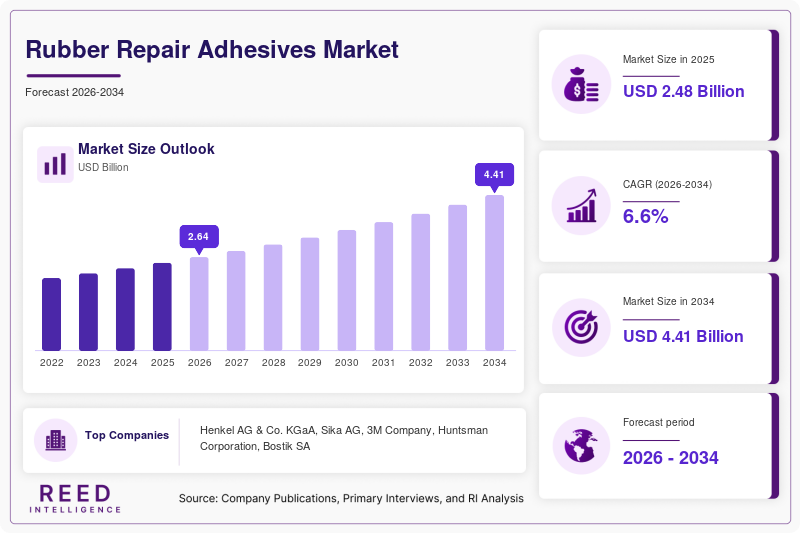
The global Rubber Repair Adhesives Market is projected to be valued at approximately USD 2.48 billion in 2026 and is anticipated to reach nearly USD 4.12 billion by 2034, expanding at a CAGR of 6.6% during the forecast period (2026–2034). The market growth is primarily driven by increasing demand for cost-effective maintenance solutions across mining, automotive, construction, and industrial manufacturing sectors. Rubber repair adhesives are widely used to extend the lifecycle of conveyor belts, hoses, tires, and industrial rubber components, reducing downtime and replacement costs.
A key global factor supporting market expansion is the rising emphasis on operational efficiency and preventive maintenance strategies in heavy industries. As industries face pressure to reduce unplanned shutdowns and maintenance expenditures, the adoption of advanced adhesive-based repair solutions has increased significantly. Additionally, technological improvements in polyurethane-based and epoxy-based adhesive formulations have enhanced bonding strength, chemical resistance, and durability under extreme environmental conditions, further accelerating market adoption.
Key Highlights
- North America dominated the market with a 34.2% share in 2025.
- Asia Pacific is expected to grow at the fastest CAGR of 11.3% during 2026–2034.
- By product type, polyurethane-based adhesives accounted for the largest share of 39.6%.
- while silicone-based adhesives are projected to grow at a CAGR of 10.8%.
- By end-use industry, mining & heavy industrial applications led with a 42.1% share, whereas automotive repair applications are expected to expand at a CAGR of 11.5%.
- The United States remained the dominant country, with market values of USD 620 million in 2024 and USD 670 million in 2025.
Market Trends
Shift Toward High-Performance Polyurethane-Based Adhesives
One major trend shaping the Rubber Repair Adhesives Market is the increasing preference for polyurethane-based formulations. These adhesives are gaining traction due to their superior flexibility, abrasion resistance, and strong bonding capabilities across diverse rubber substrates. Industries such as mining and manufacturing are increasingly replacing traditional solvent-based adhesives with polyurethane systems that offer better environmental compliance and longer service life. The trend is further strengthened by stricter regulations on volatile organic compound emissions, pushing manufacturers to innovate low-VOC adhesive solutions. Additionally, polyurethane adhesives provide improved resistance to moisture, oils, and temperature fluctuations, making them suitable for harsh industrial environments. The adoption of these advanced materials is expected to grow steadily as industries prioritize performance, sustainability, and reduced maintenance cycles.
Growing Adoption of On-Site Repair and Maintenance Solutions
Another significant trend is the rising adoption of on-site repair solutions for rubber equipment. Industries are increasingly using portable adhesive kits and rapid-curing formulations to minimize downtime during maintenance operations. This trend is particularly prominent in mining, construction, and logistics sectors, where equipment downtime directly impacts productivity and revenue. On-site repair systems enable technicians to perform quick fixes without disassembling machinery or transporting components to repair facilities. The demand for fast-curing adhesives that achieve high bond strength within minutes is increasing. Furthermore, advancements in cold bonding technologies are reducing dependency on heat-based vulcanization processes, making repair operations safer and more cost-efficient. This shift toward mobility and operational efficiency is expected to continue driving market growth.
Market Drivers
Expansion of Mining and Heavy Industrial Activities
The growth of mining and heavy industrial operations is a key driver of the Rubber Repair Adhesives Market. Mining equipment such as conveyor belts, crushers, and rubber linings undergo continuous wear and tear due to abrasive materials and extreme working conditions. Rubber repair adhesives play a crucial role in maintaining operational continuity by enabling quick restoration of damaged components. As global demand for minerals, metals, and energy resources increases, mining operations are expanding across Asia Pacific, Latin America, and Africa. This expansion directly increases the consumption of rubber repair solutions. Moreover, mining companies are focusing on reducing equipment downtime and maintenance costs, further driving adoption. The durability and cost-effectiveness of adhesive-based repairs make them a preferred alternative to complete component replacement.
Rising Focus on Cost-Effective Maintenance Practices
Another significant driver is the growing emphasis on cost-efficient maintenance strategies across industries. Organizations are increasingly adopting predictive and preventive maintenance approaches to extend equipment lifespan and minimize unexpected failures. Rubber repair adhesives provide an economical solution by allowing localized repairs instead of full replacements. This reduces material costs, labor expenses, and operational downtime. Industries such as automotive manufacturing, construction, and oil & gas are increasingly integrating adhesive repair systems into their maintenance protocols. The rising awareness of lifecycle cost optimization is encouraging the use of advanced adhesive technologies that deliver long-term durability. This shift toward value-driven maintenance is expected to continue fueling market expansion.
Market Restraint
Limited Performance in Extreme Chemical Environments
One of the major restraints affecting the Rubber Repair Adhesives Market is the limited performance of certain adhesive formulations in highly aggressive chemical environments. While modern adhesives offer improved resistance to oils, moisture, and moderate temperatures, they may still degrade when exposed to strong acids, alkalis, or prolonged chemical contact. This limitation reduces their applicability in specific industrial segments such as chemical processing and petrochemical manufacturing. In such environments, mechanical fastening or full component replacement is often preferred over adhesive repair solutions. Additionally, improper surface preparation or application errors can further compromise bonding strength, leading to premature failure. This performance limitation restricts broader adoption in high-risk industrial settings, slowing down market penetration in certain regions.
Market Opportunities
Advancements in Eco-Friendly Adhesive Technologies
The increasing focus on environmental sustainability presents a significant opportunity for the Rubber Repair Adhesives Market. Manufacturers are investing in the development of eco-friendly adhesive formulations with reduced volatile organic compounds and biodegradable components. These green adhesives align with global regulatory frameworks aimed at reducing industrial pollution. As industries adopt sustainable production practices, demand for environmentally compliant repair solutions is expected to rise. Additionally, eco-friendly adhesives enhance workplace safety by reducing toxic exposure during application. This shift toward sustainable chemistry is likely to open new growth avenues, particularly in developed markets such as Europe and North America, where environmental regulations are stringent.
Expansion of Industrial Automation and Predictive Maintenance Systems
The growing integration of automation and predictive maintenance technologies presents another strong opportunity. Smart industrial systems equipped with sensors and monitoring tools can identify wear patterns in rubber components early, enabling timely repairs using adhesive solutions. This reduces downtime and enhances operational efficiency. Rubber repair adhesives that are compatible with automated maintenance workflows are expected to gain traction. Furthermore, the rise of Industry 4.0 is encouraging the development of advanced repair kits and digitally guided application systems. This technological convergence is expected to significantly enhance the adoption of adhesive repair solutions across large-scale industrial operations.
Segmental Analysis
By Product Type
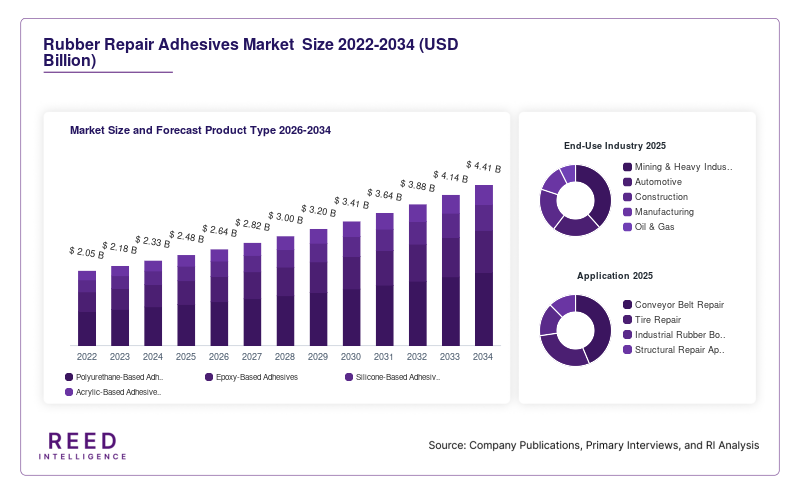
Polyurethane-based adhesives held the dominant share of 39.6% in 2024 due to their strong bonding performance, flexibility, and resistance to abrasion. These adhesives are widely used in conveyor belt repair and heavy industrial applications where durability is essential. Their ability to withstand harsh operating conditions makes them the preferred choice across mining and manufacturing industries.
Silicone-based adhesives are projected to grow at a CAGR of 10.8% due to increasing demand for high-temperature resistance and flexibility. Their growing adoption in automotive and specialized industrial applications is driven by advancements in formulation chemistry that improve adhesion across diverse rubber substrates.
By End-Use Industry
Mining & heavy industry accounted for 42.1% share in 2024, driven by continuous wear of rubber components in harsh environments. Conveyor systems, rollers, and liners require frequent repair, making adhesive solutions essential for operational continuity. The dominance of this segment is reinforced by large-scale mining activities worldwide.
Automotive repair applications are expected to grow at a CAGR of 11.5% due to increasing vehicle maintenance requirements and rising adoption of cost-effective repair solutions. Growth is further supported by expanding automotive aftermarket services and increased vehicle lifespan globally.
By Application
Industrial equipment repair held a 40.3% share in 2024, driven by widespread use in manufacturing and processing plants. Rubber adhesives are essential for maintaining machinery efficiency and reducing downtime.
Structural rubber bonding applications are projected to grow at a CAGR of 10.9% due to increasing infrastructure development and demand for durable bonding solutions in construction equipment.
Regional Analysis
North America
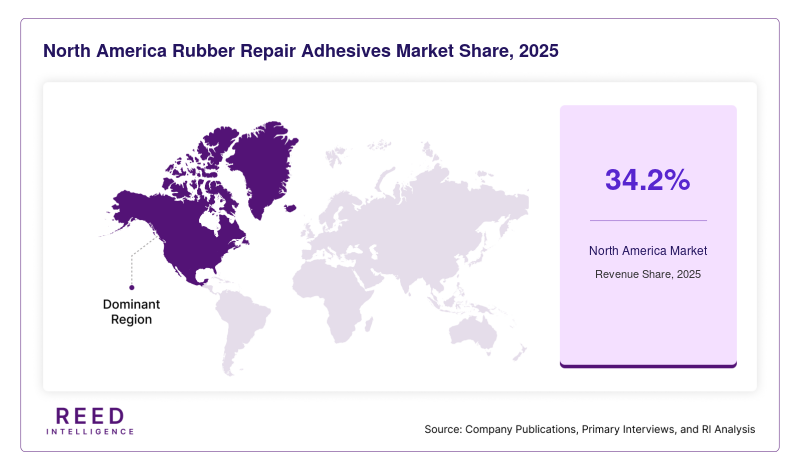
North America accounted for approximately 34.2% of the Rubber Repair Adhesives Market in 2025 and is expected to grow at a CAGR of 6.1% during the forecast period. The region’s strong industrial base, particularly in mining, automotive, and manufacturing sectors, continues to support demand. Increasing focus on maintenance optimization and downtime reduction is further boosting market adoption across industrial facilities.
The United States remains the dominant country in the region, driven by advanced industrial infrastructure and high adoption of maintenance technologies. A key growth factor is the increasing investment in mining automation and conveyor system upgrades, which require frequent rubber component repairs using high-performance adhesives.
Europe
Europe holds a market share of around 27.5% in 2025 and is projected to expand at a CAGR of 5.8%. The region benefits from strict environmental regulations encouraging the use of low-emission adhesive products. Growth in automotive manufacturing and industrial machinery maintenance supports steady demand.
Germany leads the European market due to its strong engineering sector. A major growth factor is the increasing adoption of sustainable adhesive technologies aligned with EU environmental compliance standards.
Asia Pacific
Asia Pacific is the fastest-growing region, with a projected CAGR of 11.3% and a market share of 24.8% in 2025. Rapid industrialization, infrastructure expansion, and mining activities are key drivers of demand across the region.
China dominates the regional market, supported by large-scale manufacturing and mining operations. A key growth factor is the continuous expansion of heavy industries and infrastructure development projects.
Middle East & Africa
The Middle East & Africa region accounts for 7.6% of the market in 2025 and is expected to grow at a CAGR of 7.4%. Growth is driven by oil & gas infrastructure maintenance and mining development in African countries.
South Africa leads the region due to its mining-intensive economy. The primary growth factor is increasing investment in mineral extraction equipment maintenance.
Latin America
Latin America holds a 5.9% market share in 2025 and is projected to grow at a CAGR of 6.9%. Mining expansion in countries such as Brazil and Chile supports steady demand for rubber repair adhesives.
Brazil dominates the regional market, driven by large mining and industrial sectors. A key growth factor is the increasing focus on cost-effective maintenance solutions in mining operations.
Competitive Landscape
The Rubber Repair Adhesives Market is moderately consolidated with the presence of global and regional manufacturers competing on product performance, pricing, and distribution reach. Key players focus on expanding their product portfolios with advanced polyurethane and hybrid adhesive formulations. Leading companies include Henkel AG & Co. KGaA, Sika AG, 3M Company, Huntsman Corporation, and Bostik SA. These companies emphasize research and development to enhance adhesion strength, curing speed, and environmental compliance.
Henkel AG & Co. KGaA is a prominent leader in the market, supported by its strong industrial adhesives portfolio and global distribution network. A recent development includes the expansion of its industrial repair adhesive line to include faster curing and low-VOC formulations aimed at mining and heavy industry applications. Competitive strategies such as mergers, regional expansion, and technological innovation continue to shape the market landscape.
Key Players List
- Henkel AG & Co. KGaA
- Sika AG
- 3M Company
- Huntsman Corporation
- Bostik SA
- Dow Inc.
- H.B. Fuller Company
- Lord Corporation
- Arkema Group
- Mapei S.p.A.
- ITW Performance Polymers
- Avery Dennison Corporation
- Permatex Inc.
- Lord Adhesives & Sealants
- LORD Industrial Solutions
Recent Developments
- In 2025, Henkel expanded its industrial repair adhesives portfolio with a new fast-curing polyurethane-based solution for mining applications.
- In 2025, Sika AG introduced a low-VOC rubber bonding adhesive designed for sustainable industrial maintenance operations.
- In 2026, 3M Company announced the enhancement of its cold bonding technology aimed at reducing repair downtime in conveyor systems
Rubber Repair Adhesives Market Segments
Product Type
- Polyurethane-Based Adhesives
- Epoxy-Based Adhesives
- Silicone-Based Adhesives
- Acrylic-Based Adhesives
End-Use Industry
- Mining & Heavy Industry
- Automotive
- Construction
- Manufacturing
- Oil & Gas
Application
- Conveyor Belt Repair
- Tire Repair
- Industrial Rubber Bonding
- Structural Repair Applications
By Region
- North America
- Europe
- APAC
- Middle East and Africa
- LATAM