Rubber Roller Market Size, Share, Demand Report By Material Type (Natural Rubber Rollers, Polyurethane Rubber Rollers, Silicone Rubber Rollers, EPDM and Specialty Rubber Rollers), By Application (Printing and Packaging, Textile Processing, Industrial Manufacturing, Paper Processing), By End-Use Industry (Packaging Industry, Textile Industry, Automotive Industry, Industrial Machinery), Regional Outlook & Segment Forecasts, 2026–2034
USD 3950
Market Overview
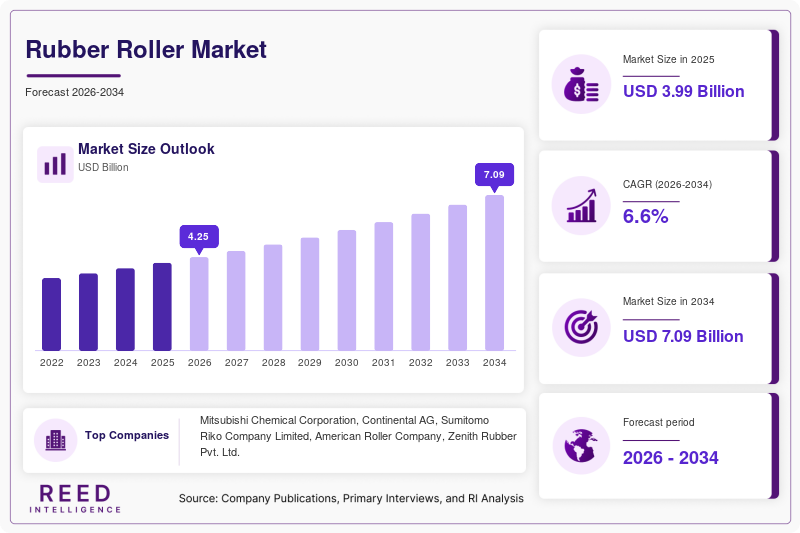
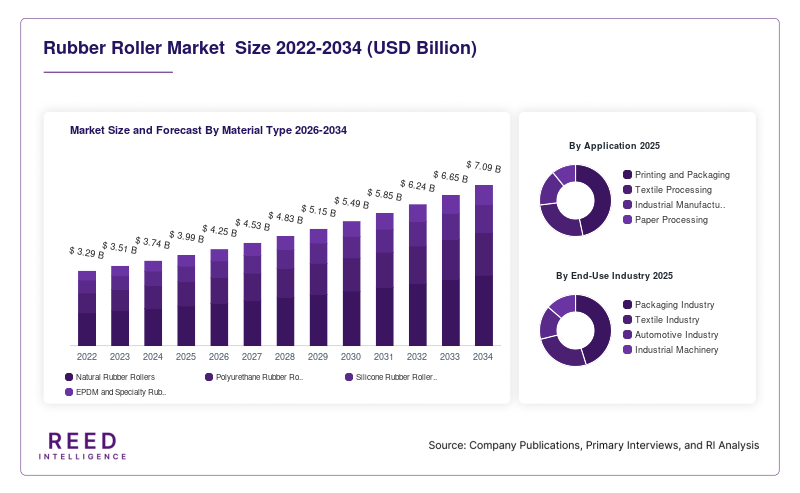
The global Rubber Roller Market size is estimated at approximately USD 4.25 billion, and it is projected to reach nearly USD 7.10 billion by 2034, registering a compound annual growth rate (CAGR) of 6.6% during 2026–2034. Rubber rollers are widely used in applications requiring controlled friction, precise material handling, and surface finishing, making them essential components across multiple industrial workflows.
One of the primary global factors supporting market growth is the sustained expansion of the packaging and printing industries, particularly driven by e-commerce logistics and consumer goods demand. The shift toward high-speed automated production lines has increased the need for durable, wear-resistant rollers capable of maintaining operational consistency under high loads and continuous usage. Additionally, advancements in elastomer materials and coating technologies have improved roller lifespan and performance efficiency, further supporting adoption across industries such as textiles, steel processing, and paper manufacturing.
Key Highlights
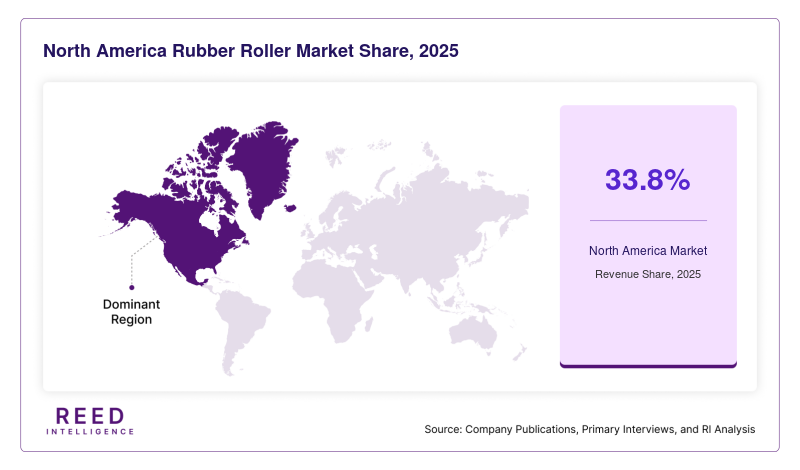
- North America held a 33.8% share of the Rubber Roller Market in 2025.
- Asia Pacific is projected to grow at the fastest CAGR of 11.4% during 2026–2034.
- By material type, polyurethane rubber rollers accounted for the largest share of 36.9%.
- while silicone-based rollers are expected to grow at a CAGR of 10.8%.
- By application, printing and packaging led the market with a 39.5% share, whereas textile processing is expected to expand at a CAGR of 9.7%.
- The United States remained the dominant country, with market values of USD 520 million in 2024 and USD 565 million in 2025.
Market Trends
Adoption of High-Performance Elastomer Materials
The Rubber Roller Market is experiencing a notable shift toward high-performance elastomer materials such as polyurethane, EPDM, and silicone blends. These materials are increasingly preferred due to their superior abrasion resistance, chemical stability, and ability to perform under extreme temperature conditions. Industries such as printing, metal processing, and packaging are replacing traditional rubber compounds with engineered elastomers to improve operational efficiency and reduce downtime. Manufacturers are also focusing on material innovation to enhance load-bearing capacity and extend roller lifespan, which directly reduces maintenance cycles. This trend is particularly strong in automated production environments where consistent performance and precision alignment are critical for maintaining throughput and reducing production losses.
Integration of Precision Engineering and Customization
Another emerging trend is the rising demand for precision-engineered and application-specific rubber rollers. Industries are increasingly requiring rollers tailored to exact specifications, including surface texture, hardness level, and dimensional accuracy. This customization trend is driven by the growing complexity of industrial machinery and the need for enhanced process control in high-speed production lines. Manufacturers are investing in CNC machining, laser engraving, and advanced molding techniques to achieve tighter tolerances and improved performance consistency. Additionally, digital design tools are enabling faster prototyping and reduced lead times, making customized roller solutions more accessible to small and mid-sized manufacturers across various end-use industries.
Market Drivers
Expansion of Packaging and Printing Industries
The continuous expansion of global packaging and printing industries is a major driver for the Rubber Roller Market. The rise of e-commerce, consumer goods distribution, and retail packaging has significantly increased demand for high-speed printing and converting machines, all of which rely heavily on rubber rollers for precise material handling. These rollers ensure uniform ink distribution, controlled tension, and smooth substrate movement, making them essential for maintaining print quality. As packaging formats become more complex and demand for high-resolution printing grows, manufacturers are increasingly adopting advanced rubber rollers that offer improved durability and consistency under continuous operation.
Growth in Industrial Automation and Manufacturing Upgrades
Industrial automation across sectors such as textiles, steel, paper, and logistics is significantly boosting demand for rubber rollers. Automated production systems require components that can operate reliably under continuous and high-load conditions. Rubber rollers are widely used in conveyor systems, lamination lines, and material processing equipment, making them integral to modern manufacturing setups. Additionally, many industries are upgrading legacy machinery to improve productivity and energy efficiency, which is further increasing replacement demand. This transition toward smart and automated factories is expected to sustain long-term growth in the rubber roller industry, particularly in emerging economies with expanding manufacturing bases.
Market Restraint
Volatility in Raw Material Prices and Supply Chain Disruptions
One of the key restraints affecting the Rubber Roller Market is the volatility in raw material prices, particularly natural rubber, synthetic rubber, and specialized polymers. Fluctuations in crude oil prices directly impact the cost of synthetic elastomers, creating pricing instability for manufacturers. Additionally, global supply chain disruptions, including transportation delays and geopolitical uncertainties, have affected the timely availability of raw materials. This has led to increased production costs and inconsistent pricing structures across regions. Smaller manufacturers, in particular, face challenges in maintaining profit margins while competing with larger firms that benefit from economies of scale and integrated supply networks.
Market Opportunities
Expansion in Emerging Manufacturing Economies
Emerging economies in Asia Pacific, Latin America, and parts of Africa present significant opportunities for the Rubber Roller Market. Rapid industrialization, expansion of manufacturing hubs, and government initiatives supporting local production are driving increased demand for industrial machinery components. Countries such as India, Vietnam, and Indonesia are witnessing strong growth in textiles, packaging, and automotive sectors, all of which rely heavily on rubber rollers. Additionally, foreign direct investment in manufacturing infrastructure is accelerating the adoption of modern equipment, creating a steady demand pipeline for both standard and customized roller solutions.
Technological Advancements in Roller Design and Coating
Technological advancements in roller surface engineering and coating technologies present another major opportunity. Innovations such as anti-static coatings, heat-resistant layers, and chemically inert surfaces are enhancing roller performance in specialized applications. These advancements are particularly relevant in industries such as chemical processing, pharmaceuticals, and high-precision printing, where operational conditions are more demanding. The integration of digital manufacturing techniques, including 3D modeling and automated quality testing, is also improving production efficiency and reducing defects. As industries continue to prioritize efficiency and durability, demand for technologically advanced rubber rollers is expected to rise steadily.
Segmental Analysis
By Material Type
Polyurethane rubber rollers held the dominant share of 36.9% in 2024, driven by their superior abrasion resistance and mechanical strength. These rollers are widely used in high-load industrial applications where durability and consistent performance are required over extended operational cycles. Their ability to withstand chemical exposure and mechanical stress makes them highly suitable for printing and packaging machinery.
Silicone rubber rollers are expected to grow at a CAGR of 10.8% during 2026–2034, supported by increasing demand in temperature-sensitive and non-stick applications. Industries such as food processing, pharmaceuticals, and electronics are adopting silicone-based rollers due to their stability under extreme conditions and low contamination risk, making them suitable for precision-driven operations.
By Application
Printing and packaging accounted for 39.5% market share in 2024, making it the dominant application segment. The growth is supported by rising demand for high-speed printing machines and advanced packaging systems used in e-commerce and retail supply chains. Rubber rollers play a critical role in ensuring consistent ink transfer and substrate handling.
Textile processing is expected to grow at a CAGR of 9.7%, driven by modernization of textile machinery and increasing demand for high-quality fabric finishing. The adoption of automated weaving, dyeing, and finishing equipment is increasing reliance on precision rubber rollers for improved efficiency and fabric quality.
By End-Use Industry
The industrial manufacturing segment held a dominant share of 41.2% in 2024, driven by widespread use of rubber rollers in conveyor systems, steel processing, and machinery production lines. These rollers ensure smooth material movement and reduce friction-related wear in heavy-duty applications.
The packaging industry is expected to grow at a CAGR of 10.2%, supported by expansion of e-commerce logistics and consumer goods distribution networks. Increasing demand for efficient packaging systems is driving adoption of advanced rubber rollers designed for high-speed, continuous operations.
Regional Analysis
North America
North America accounted for approximately 33.8% share in 2025, with a projected CAGR of 5.9% during 2026–2034. The region benefits from a mature industrial base and strong adoption of automation technologies. Demand is driven by packaging, printing, and automotive manufacturing sectors that require high-precision rollers for continuous operations.
The United States dominates the regional market due to its advanced manufacturing infrastructure and strong presence of packaging and logistics industries. A key growth factor is the increasing adoption of automated production lines in e-commerce fulfillment centers, which require high-durability rubber rollers for conveyor and sorting systems.
Europe
Europe held nearly 27.4% market share in 2025, with a forecast CAGR of 5.4% through 2034. The region’s growth is supported by strong demand from the printing, textile, and industrial machinery sectors. Environmental regulations are also encouraging the use of sustainable and recyclable roller materials.
Germany leads the European market due to its strong engineering and machinery manufacturing base. A major growth factor is the modernization of industrial equipment in automotive and packaging sectors, which is driving replacement demand for advanced rubber rollers.
Asia Pacific
Asia Pacific accounted for 28.9% share in 2025 and is expected to grow at the fastest CAGR of 11.4% during 2026–2034. Rapid industrialization and expansion of manufacturing hubs are key contributors to regional growth. Rising demand for consumer goods is also supporting packaging and printing industries.
China dominates the region due to large-scale manufacturing output and strong export-oriented industries. A key growth factor is the expansion of textile and electronics manufacturing clusters, which require high-performance rollers for precision processing and assembly operations.
Middle East & Africa
The Middle East & Africa region held a 6.2% share in 2025, with a CAGR of 6.1% projected through 2034. Growth is driven by increasing investments in industrial diversification and packaging industries.
Saudi Arabia leads the region due to industrial diversification initiatives under economic transformation programs. A key growth factor is the development of non-oil manufacturing sectors, which is increasing demand for industrial machinery components, including rubber rollers.
Latin America
Latin America accounted for 3.7% market share in 2025, with a projected CAGR of 5.7% during 2026–2034. Growth is supported by expanding packaging and food processing industries.
Brazil dominates the regional market due to its large industrial base and agricultural processing sectors. A key growth factor is the increasing adoption of automated packaging systems in food and beverage industries, which relies heavily on rubber roller technology.
Competitive Landscape
The Rubber Roller Market is moderately fragmented with the presence of global and regional manufacturers focusing on product innovation and customization. Key players include Mitsubishi Chemical Corporation, Continental AG, Sumitomo Riko Company Limited, American Roller Company, and Zenith Rubber Pvt. Ltd. Mitsubishi Chemical Corporation maintains a strong position due to its diversified elastomer product portfolio and global distribution network. Recent developments include expansion of manufacturing facilities in Asia to strengthen supply chain efficiency and reduce lead times for industrial clients.
Key Players List
- Mitsubishi Chemical Corporation
- Continental AG
- Sumitomo Riko Company Limited
- American Roller Company
- Zenith Rubber Pvt. Ltd.
- Bridgestone Corporation
- Trelleborg AB
- Rol-Tec Inc.
- Nitta Corporation
- Oliver Rubber LLP
- Hannecard
- Fuji Rubber Industry Co., Ltd.
- Lutz Roller GmbH
- Rubber Technology Corporation
- Midwest Rubber Service & Supply Co.
Recent Developments
- In 2025, Continental AG expanded its elastomer production facility in Southeast Asia to enhance supply capacity for industrial roller components. This expansion is expected to improve delivery timelines for regional customers and strengthen its market position.
- In early 2026, American Roller Company introduced a new range of high-durability polyurethane rollers designed for high-speed packaging lines, focusing on improved abrasion resistance and extended service life.
- In late 2025, Sumitomo Riko Company Limited announced investment in advanced coating technologies to enhance chemical resistance properties of industrial rubber rollers, targeting applications in chemical processing and heavy manufacturing industries.
Rubber Roller Market Segments
By Material Type
- Natural Rubber Rollers
- Polyurethane Rubber Rollers
- Silicone Rubber Rollers
- EPDM and Specialty Rubber Rollers
By Application
- Printing and Packaging
- Textile Processing
- Industrial Manufacturing
- Paper Processing
By End-Use Industry
- Packaging Industry
- Textile Industry
- Automotive Industry
- Industrial Machinery
By Region
- North America
- Europe
- APAC
- Middle East and Africa
- LATAM