Rugged Air Quality Monitor Market Size, Share & Demand Report By Product Type (Portable Monitors, Fixed Monitoring Systems), By Application (Industrial Safety Monitoring, Environmental Monitoring), By End-Use Industry (Oil & Gas, Mining, Construction, Manufacturing, Others), By Region & Segment Forecasts, 2026–2034
USD 3950
Market Overview
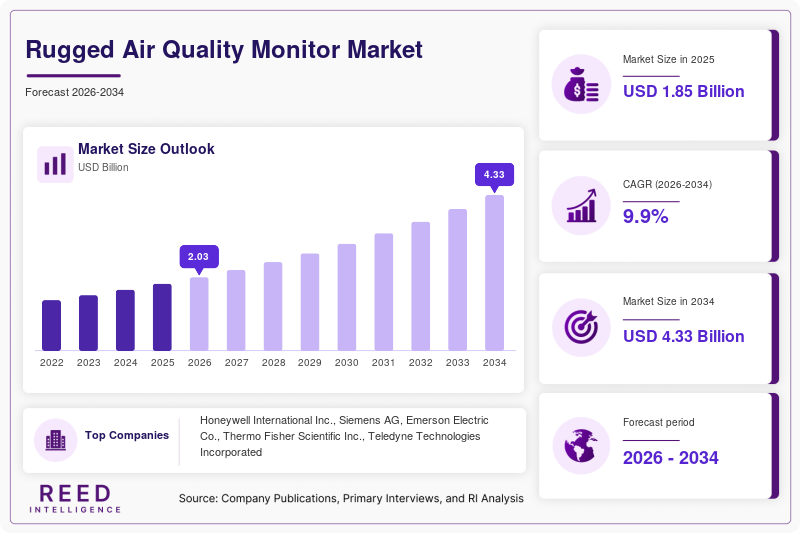
The Rugged Air Quality Monitor Market was valued at approximately USD 1.85 billion in 2026 and is projected to reach USD 3.95 billion by 2034, expanding at a CAGR of 9.9% during 2026–2034. The market is experiencing steady growth due to the rising need for durable and reliable air monitoring systems in harsh and remote environments such as mining sites, industrial facilities, military zones, and construction areas. These rugged systems are designed to withstand extreme temperatures, humidity, dust, and vibration, making them suitable for continuous monitoring in challenging operational conditions.
A key global factor supporting market expansion is the increasing enforcement of environmental and occupational safety regulations across industries. Governments and regulatory bodies are mandating continuous air quality monitoring in hazardous work environments to reduce health risks and ensure compliance. This has led to higher adoption of rugged monitoring devices capable of delivering real-time, accurate data even under adverse conditions.
Key Highlights
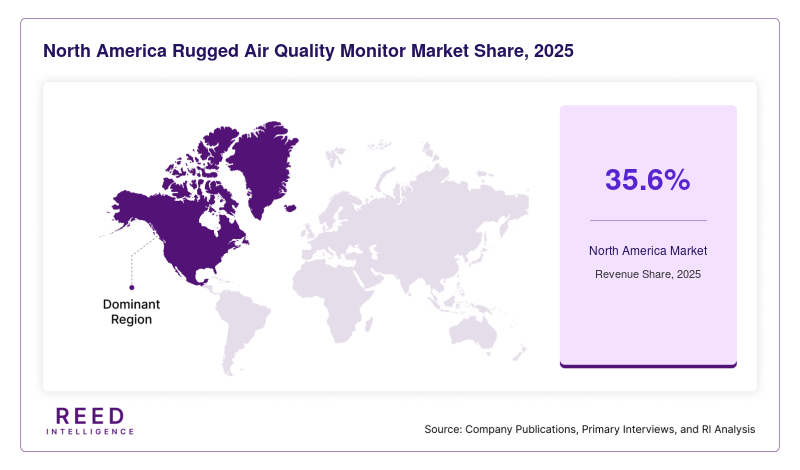
- North America dominated the market with a 35.6% share in 2025.
- Asia Pacific is expected to grow at the fastest CAGR of 11.5% during 2026–2034.
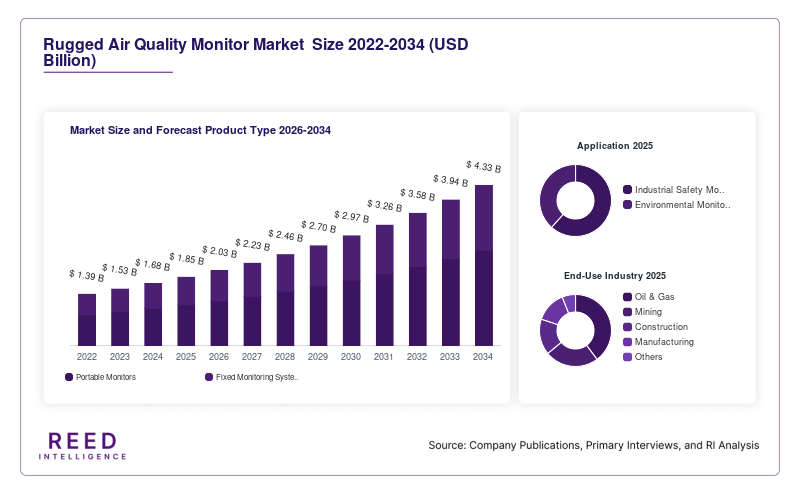
- By product type, portable monitors accounted for the largest share of 42.8%, while fixed monitoring systems are projected to grow at a CAGR of 10.8%.
- By application, industrial safety monitoring led with a 44.3% share, whereas environmental monitoring is expected to expand at a CAGR of 11.2%.
- The United States remained the dominant country, with market values of USD 520 million in 2024 and USD 575 million in 2025.
Market Trends
Integration of IoT and Cloud-Based Monitoring Platforms
The integration of Internet of Things (IoT) technology into rugged air quality monitors is shaping the market landscape. Modern devices are increasingly equipped with wireless connectivity, enabling real-time data transmission to cloud-based platforms. This allows organizations to monitor air quality remotely, analyze trends, and make data-driven decisions. Industries such as oil & gas, mining, and construction are adopting these connected systems to improve operational efficiency and compliance management. The ability to integrate with predictive analytics tools further enhances system value by enabling early detection of hazardous conditions. As digital transformation accelerates, IoT-enabled rugged monitors are becoming standard across industrial environments.
Rising Demand for Multi-Parameter Monitoring Systems
There is a growing shift toward multi-parameter rugged air quality monitors capable of detecting various pollutants simultaneously, including particulate matter, volatile organic compounds, and toxic gases. End-users prefer comprehensive monitoring solutions over single-parameter devices to reduce equipment costs and simplify operations. These systems offer enhanced functionality and flexibility, particularly in industries where multiple contaminants are present. Additionally, advancements in sensor technology are improving accuracy and durability, making multi-parameter systems more reliable. This trend is expected to gain momentum as industries seek integrated solutions that provide holistic environmental insights while reducing maintenance and deployment complexity.
Market Drivers
Stringent Environmental and Workplace Safety Regulations
Governments and regulatory authorities worldwide are enforcing stricter standards for air quality monitoring in industrial and urban environments. Regulations require continuous monitoring of pollutants to protect worker health and environmental safety. Industries operating in hazardous conditions must deploy rugged air quality monitors that can function reliably under extreme conditions. This regulatory pressure is driving demand for advanced monitoring solutions with high durability and precision. Compliance requirements are particularly strong in sectors such as manufacturing, mining, and oil & gas, where exposure to harmful pollutants is high. As regulations continue to evolve, companies are investing in rugged monitoring technologies to avoid penalties and ensure safe working environments.
Increasing Industrialization and Infrastructure Development
Rapid industrial growth and large-scale infrastructure projects are contributing significantly to market expansion. Developing economies are witnessing increased construction activities, mining operations, and energy production, all of which generate air pollutants. Rugged air quality monitors are essential in these environments to ensure compliance with safety standards and maintain operational efficiency. The need for durable monitoring systems is particularly high in remote and harsh locations where traditional devices may fail. As industrialization continues, the demand for reliable air quality monitoring solutions is expected to grow, supporting long-term market development.
Market Restraint
High Initial Costs and Maintenance Requirements
The adoption of rugged air quality monitors is constrained by their high initial investment and ongoing maintenance costs. These devices are designed with advanced materials and technologies to withstand harsh environmental conditions, which significantly increases their production cost. Small and medium-sized enterprises often face budget limitations, making it challenging to invest in such high-cost equipment. Additionally, maintenance requirements, including sensor calibration and periodic replacement, add to the total cost of ownership.
The complexity of rugged systems also requires skilled personnel for installation and operation, further increasing operational expenses. In regions with limited technical expertise, this becomes a significant barrier to adoption. For example, smaller mining companies may rely on basic monitoring tools instead of investing in rugged systems due to cost concerns. This restraint can slow market growth, particularly in price-sensitive markets. However, ongoing technological advancements and economies of scale are expected to gradually reduce costs and improve accessibility over time.
Market Opportunities
Expansion in Smart City Initiatives
The increasing adoption of smart city projects presents a significant opportunity for the rugged air quality monitor market. Governments are investing in advanced environmental monitoring systems to improve urban living conditions and reduce pollution levels. Rugged monitors are well-suited for outdoor deployment in urban environments where durability and reliability are critical. These systems can be integrated into smart infrastructure, providing real-time data for traffic management, pollution control, and public health initiatives. As cities continue to modernize, the demand for robust and scalable monitoring solutions is expected to rise, creating new growth avenues for market players.
Growing Demand in Emerging Economies
Emerging economies are witnessing rapid industrialization and urbanization, leading to increased pollution levels. Governments in these regions are becoming more aware of environmental and health issues, prompting investments in air quality monitoring infrastructure. Rugged air quality monitors offer a reliable solution for challenging environments commonly found in these regions. Additionally, international funding and environmental programs are supporting the deployment of monitoring systems in developing countries. As awareness and regulatory frameworks improve, the market is expected to see strong growth opportunities in regions such as Asia Pacific, Latin America, and Africa.
Segmental Analysis
By Product Type
Portable rugged air quality monitors dominated the market in 2024, accounting for approximately 42.8% of the total share. These devices are widely used due to their flexibility and ease of deployment in various environments. Industries prefer portable monitors for on-site inspections and temporary monitoring needs. Their compact design and advanced features, such as real-time data display and wireless connectivity, make them suitable for dynamic work environments. Additionally, portable devices are cost-effective compared to fixed systems, further supporting their widespread adoption across industries.
Fixed monitoring systems are expected to be the fastest-growing subsegment, with a CAGR of 10.8% during the forecast period. These systems are increasingly used for continuous monitoring in industrial facilities and urban areas. Their ability to provide long-term data and integrate with centralized monitoring systems is a key growth factor. As industries focus on continuous compliance and real-time monitoring, the demand for fixed systems is expected to rise significantly.
By Application
Industrial safety monitoring held the largest market share of 44.3% in 2024. This segment is driven by the need to ensure worker safety in hazardous environments such as factories, mines, and construction sites. Rugged air quality monitors play a critical role in detecting harmful pollutants and preventing accidents. The increasing emphasis on occupational health and safety is driving the adoption of these systems across various industries.
Environmental monitoring is projected to be the fastest-growing segment, with a CAGR of 11.2%. Governments and organizations are investing in air quality monitoring to address pollution and climate change concerns. The integration of monitoring systems with smart city initiatives is a key growth factor. These systems provide valuable data for policy-making and environmental management, supporting their increasing adoption.
By End-Use Industry
The oil & gas industry dominated the market in 2024, accounting for a significant share due to its high demand for durable monitoring systems. Operations in this industry often take place in extreme conditions, requiring rugged devices capable of withstanding harsh environments. Air quality monitoring is essential to ensure safety and compliance, making it a critical component of operations.
The construction industry is expected to be the fastest-growing segment, with a CAGR of 10.5%. Rapid infrastructure development and increasing awareness of environmental impact are driving demand for monitoring systems. Rugged air quality monitors are used to track emissions and ensure compliance with regulations. The growing number of construction projects worldwide is expected to support market growth.
Regional Analysis
North America
North America accounted for approximately 35.6% of the rugged air quality monitor market in 2025 and is expected to grow at a CAGR of 8.7% during the forecast period. The region’s growth is driven by strict environmental regulations and high adoption of advanced monitoring technologies. Industries such as oil & gas, manufacturing, and construction are major contributors to market demand. Additionally, the presence of established market players supports technological innovation and widespread adoption.
The United States dominates the regional market due to its strong regulatory framework and focus on workplace safety. A unique growth factor in this region is the increasing adoption of smart monitoring systems integrated with cloud platforms. These systems enable real-time data analysis and remote monitoring, enhancing operational efficiency. The emphasis on digital transformation further supports market expansion.
Europe
Europe held a market share of around 24.8% in 2025 and is projected to grow at a CAGR of 9.1%. The region’s growth is supported by stringent environmental policies and a strong focus on sustainability. Countries across Europe are investing in air quality monitoring infrastructure to meet regulatory requirements and reduce pollution levels. Industrial sectors are also adopting rugged monitoring systems to ensure compliance and improve worker safety.
Germany is the dominant country in this region, driven by its advanced industrial base and commitment to environmental protection. A unique growth factor is the integration of air quality monitoring systems with renewable energy projects. These systems are used to monitor emissions and ensure compliance with environmental standards, supporting sustainable development initiatives.
Asia Pacific
Asia Pacific is expected to be the fastest-growing region, with a CAGR of 11.5% during the forecast period, and held a share of 22.3% in 2025. Rapid industrialization and urbanization are key factors driving market growth. Countries in this region are facing increasing pollution levels, leading to higher demand for air quality monitoring solutions. Government initiatives to improve environmental conditions further support market expansion.
China leads the regional market due to its large industrial base and significant investments in environmental monitoring. A unique growth factor is the government’s focus on pollution control and smart city development. These initiatives are driving the adoption of rugged air quality monitors across urban and industrial environments, contributing to strong market growth.
Middle East & Africa
The Middle East & Africa region accounted for approximately 9.5% of the market in 2025 and is projected to grow at a CAGR of 9.8%. The region’s growth is driven by increasing industrial activities and rising awareness of environmental issues. Oil & gas operations, in particular, require reliable air quality monitoring systems to ensure safety and compliance.
Saudi Arabia is the dominant country in this region, supported by its extensive oil & gas industry. A unique growth factor is the increasing investment in infrastructure and industrial projects under economic diversification plans. These projects require robust monitoring systems, driving demand for rugged air quality monitors.
Latin America
Latin America held a market share of around 7.8% in 2025 and is expected to grow at a CAGR of 9.3%. The region’s growth is supported by expanding industrial activities and increasing environmental awareness. Governments are implementing regulations to control pollution, leading to higher adoption of air quality monitoring systems.
Brazil dominates the regional market due to its large industrial sector and growing focus on environmental protection. A unique growth factor is the expansion of mining and construction activities, which require durable monitoring solutions. This is driving demand for rugged air quality monitors across various industries.
Competitive Landscape
The rugged air quality monitor market is moderately fragmented, with several global and regional players competing based on product innovation, durability, and technological capabilities. Leading companies are focusing on developing advanced monitoring systems with enhanced accuracy, connectivity, and durability to meet evolving industry requirements.
Honeywell International Inc. is a key market leader, offering a wide range of rugged monitoring solutions for industrial applications. The company recently introduced an advanced IoT-enabled air quality monitoring system designed for harsh environments, enhancing its product portfolio. Other major players are also investing in research and development to improve sensor technology and expand their market presence. Strategic partnerships, mergers, and acquisitions are common strategies adopted by companies to strengthen their competitive position and expand their global footprint.
Key Players
- Honeywell International Inc.
- Siemens AG
- Emerson Electric Co.
- Thermo Fisher Scientific Inc.
- Teledyne Technologies Incorporated
- Aeroqual Limited
- TSI Incorporated
- Drägerwerk AG & Co. KGaA
- Horiba Ltd.
- 3M Company
- Testo SE & Co. KGaA
- Ecotech Pty Ltd
- Environnement S.A
- Oizom Instruments Pvt. Ltd.
- Vaisala Oyj
Recent Developments
- In 2025, Honeywell launched a rugged multi-gas monitoring system with enhanced wireless connectivity for industrial applications.
- In 2024, Siemens introduced an integrated air quality monitoring platform designed for smart city deployments.
- In 2025, Aeroqual expanded its product line with advanced portable monitors featuring improved sensor accuracy and durability.
Rugged Air Quality Monitor Market Segments
Product Type
- Portable Monitors
- Fixed Monitoring Systems
Application
- Industrial Safety Monitoring
- Environmental Monitoring
End-Use Industry
- Oil & Gas
- Mining
- Construction
- Manufacturing
- Others
Region
- North America
- Europe
- Asia Pacific
- Middle East & Africa
- Latin America
By Region
- North America
- Europe
- APAC
- Middle East and Africa
- LATAM