Safety Relay Timer Market Size, Share & Demand Report By Type (Electromechanical Relay Timers, Solid-State Relay Timers, Programmable Safety Relay Timers), By Application (Industrial Machinery Safety, Process Automation Safety, Building Automation Safety), By End-Use Industry (Manufacturing, Energy and Utilities, Transportation, Oil and Gas, Others) By Region & Segment Forecasts, 2026–2034
USD 3950
Market Overview
The Safety Relay Timer Market size was valued at approximately USD 1.42 billion in 2026 and is projected to reach USD 2.68 billion by 2034, expanding at a CAGR of 8.3% during the forecast period. The market is driven by increasing industrial automation across manufacturing, energy, and infrastructure sectors, where safety relay timers play a vital role in ensuring controlled shutdowns, timed safety functions, and regulatory compliance. These devices are widely used to manage time-delayed operations in emergency stop circuits, light curtains, and machine guarding systems, making them integral to modern industrial safety architectures.
A key global factor supporting market growth is the rising enforcement of workplace safety regulations across developed and emerging economies. Governments and industry bodies are implementing stricter compliance frameworks, pushing manufacturers to adopt advanced safety components such as programmable relay timers and integrated safety controllers. This regulatory push has significantly increased demand for reliable and fail-safe timing devices, particularly in high-risk environments such as automotive manufacturing and heavy machinery operations.
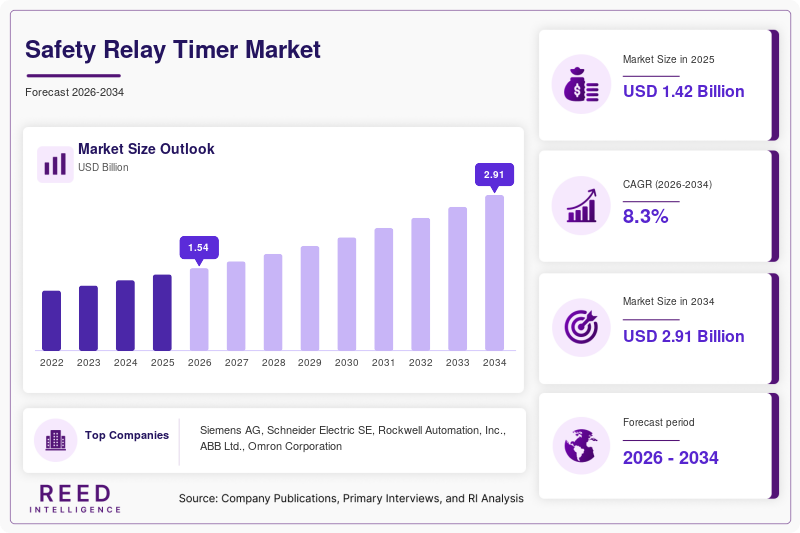
Key Highlights
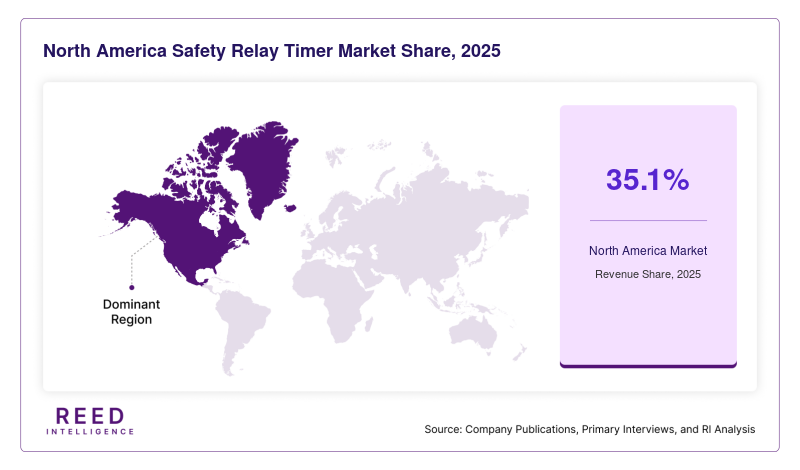
- North America dominated the market with a 35.1% share in 2025.
- Asia Pacific is expected to grow at the fastest CAGR of 9.6% during 2026–2034.
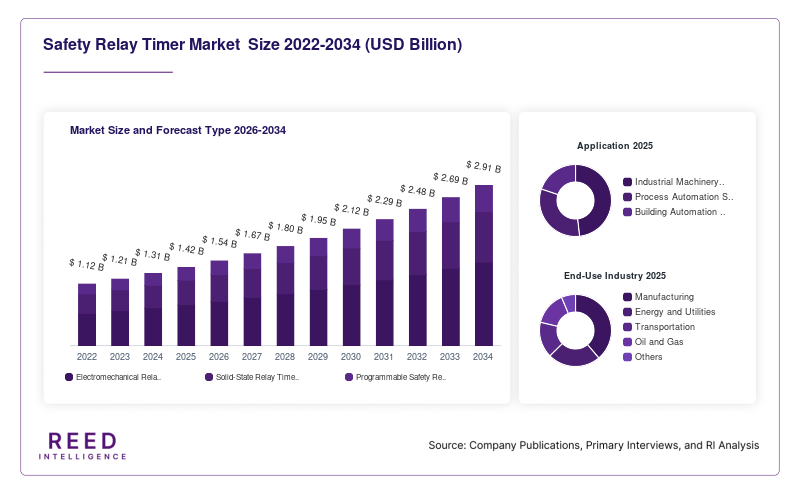
- By type, electromechanical relay timers accounted for the largest share of 42.3%, while programmable safety relay timers are projected to grow at a CAGR of 10.2%.
- By application, industrial machinery safety led with a 44.8% share, whereas process automation safety is expected to expand at a CAGR of 9.4%.
- The United States remained the dominant country, with market values of USD 480 million in 2024 and USD 525 million in 2025.
Market Trends
Integration of Smart and Programmable Safety Systems
The increasing shift toward smart manufacturing has influenced the Safety Relay Timer Market by driving the adoption of programmable and intelligent relay timers. Modern industrial environments require flexible and scalable safety solutions that can adapt to complex operations. Programmable safety relay timers offer configurable logic, remote monitoring, and integration with industrial control systems such as PLCs and SCADA platforms. This trend aligns with Industry 4.0 initiatives, where real-time data and predictive maintenance are becoming essential.
Manufacturers are focusing on developing compact, multi-functional devices that combine timing, monitoring, and diagnostic capabilities. These advanced systems reduce wiring complexity and enhance operational efficiency. Additionally, integration with IoT-enabled platforms allows operators to track performance metrics and detect anomalies early. This evolution toward smart safety devices is expected to continue shaping the market, particularly in high-tech industries such as semiconductor manufacturing and robotics.
Rising Adoption in Renewable Energy and Infrastructure Projects
The expansion of renewable energy installations and large-scale infrastructure projects has created new opportunities for safety relay timers. Wind farms, solar plants, and grid management systems require precise timing mechanisms to ensure safe operation and fault isolation. Safety relay timers are used in these systems to manage delays during power switching, equipment shutdowns, and emergency responses.
Infrastructure development, including smart cities and transportation networks, also relies on automated safety systems. Relay timers are deployed in railway signaling, elevator systems, and building automation to maintain safety standards. As governments invest in sustainable energy and urban development, the demand for reliable timing devices is increasing. This trend is particularly strong in emerging economies, where rapid industrialization and infrastructure growth are driving the need for advanced safety components.
Market Drivers
Increasing Industrial Automation Across Key Sectors
The rapid adoption of automation in industries such as automotive, food processing, and pharmaceuticals is a major driver for the Safety Relay Timer Market. Automated systems require precise timing and coordination to ensure safe operations, especially in environments involving heavy machinery and high-speed production lines. Safety relay timers play a crucial role in managing delays in emergency stop functions and machine interlocks, preventing accidents and equipment damage.
As companies aim to improve productivity and reduce human intervention, the reliance on automated safety systems is growing. This shift has led to increased demand for reliable and durable relay timers that can operate in harsh industrial conditions. Furthermore, the integration of automation with digital technologies has enhanced the functionality of safety devices, making them more efficient and adaptable to changing operational requirements.
Stringent Safety Regulations and Compliance Standards
Global regulatory frameworks focused on workplace safety have significantly influenced the adoption of safety relay timers. Organizations such as occupational safety authorities and industry standards bodies mandate the use of certified safety components in industrial operations. Compliance with these regulations is essential to avoid penalties, ensure worker safety, and maintain operational continuity.
Manufacturers are investing in advanced safety solutions to meet these standards, leading to increased demand for high-performance relay timers. These devices are designed to meet international certifications and provide fail-safe operation in critical applications. The growing emphasis on risk assessment and hazard prevention has further strengthened the role of safety relay timers in industrial systems, making them a necessary component rather than an optional upgrade.
Market Restraint
High Installation and Maintenance Costs in Advanced Systems
One of the primary challenges in the Safety Relay Timer Market is the high cost associated with installation and maintenance of advanced safety systems. While basic relay timers are relatively affordable, programmable and integrated systems require significant investment in terms of hardware, software, and skilled labor. This cost factor can be a barrier for small and medium-sized enterprises, particularly in developing regions where budget constraints limit technology adoption.
Additionally, maintaining these systems requires specialized expertise to ensure proper configuration and operation. Any malfunction or misconfiguration can lead to system downtime or safety risks, increasing operational costs. For example, in complex manufacturing setups, replacing or upgrading safety relay timers may involve extensive system recalibration. These challenges can slow market growth, especially in cost-sensitive industries, despite the long-term benefits of enhanced safety and efficiency.
Market Opportunities
Expansion in Emerging Economies with Industrial Growth
Emerging economies present significant growth opportunities for the Safety Relay Timer Market due to rapid industrialization and infrastructure development. Countries in Asia Pacific, Latin America, and parts of Africa are investing heavily in manufacturing, energy, and transportation sectors. This expansion creates a strong demand for safety systems, including relay timers, to ensure compliance with international safety standards.
Local governments are also promoting industrial safety through policy reforms and incentives, encouraging companies to adopt modern safety technologies. As industries in these regions upgrade their equipment and processes, the demand for advanced relay timers is expected to increase. This trend provides opportunities for manufacturers to expand their presence and develop cost-effective solutions tailored to regional needs.
Technological Advancements in Miniaturization and Connectivity
Technological innovation in miniaturization and connectivity is creating new opportunities in the Safety Relay Timer Market. Modern relay timers are becoming more compact, energy-efficient, and capable of integrating with digital control systems. These advancements allow for easier installation in space-constrained environments and improve overall system performance.
Connectivity features such as wireless communication and cloud integration enable real-time monitoring and remote diagnostics. This capability is particularly valuable in large-scale industrial operations where centralized control is essential. As technology continues to evolve, manufacturers can develop next-generation relay timers with enhanced functionality, opening new application areas and driving market growth.
Segmental Analysis
By Type
Electromechanical relay timers dominated the Safety Relay Timer Market in 2024, accounting for approximately 42.3% of the total share. These devices are widely used due to their reliability, simplicity, and cost-effectiveness. They are particularly suitable for basic timing applications in industrial environments where advanced programming is not required. Their robust design allows them to operate in harsh conditions, making them a preferred choice in sectors such as manufacturing and energy.
Programmable safety relay timers are expected to be the fastest-growing subsegment, with a CAGR of 10.2% during the forecast period. The growth is driven by increasing demand for flexible and customizable safety solutions. These devices offer advanced features such as configurable logic, remote monitoring, and integration with digital systems. As industries adopt automation and smart technologies, the demand for programmable relay timers is expected to rise significantly.
By Application
Industrial machinery safety was the dominant application segment in 2024, holding a share of 44.8%. Safety relay timers are extensively used in machinery to manage emergency stop functions, interlocks, and timed shutdowns. Their role in preventing accidents and ensuring compliance with safety standards makes them essential in manufacturing environments.
Process automation safety is projected to be the fastest-growing application segment, with a CAGR of 9.4%. The increasing adoption of automated processes in industries such as chemicals, food processing, and pharmaceuticals drives this growth. Safety relay timers are used to control timing sequences and ensure safe operation of automated systems. This trend is expected to continue as industries focus on improving efficiency and safety.
By End-Use Industry
The manufacturing sector dominated the Safety Relay Timer Market in 2024, accounting for a significant share due to its extensive use of automated machinery and safety systems. The need to ensure worker safety and comply with regulations drives the adoption of relay timers in this sector. These devices are used in various applications, including assembly lines, packaging systems, and material handling equipment.
The energy and utilities sector is expected to be the fastest-growing end-use segment, with a CAGR of 9.1%. The growth is driven by the expansion of renewable energy projects and the need for reliable safety systems in power generation and distribution. Safety relay timers are used to manage timing functions in electrical systems, ensuring safe operation and fault isolation.
Regional Analysis
North America
North America accounted for approximately 35.1% of the Safety Relay Timer Market share in 2025 and is expected to grow at a CAGR of 7.9% during the forecast period. The region benefits from a well-established industrial base and early adoption of automation technologies. Industries such as automotive, aerospace, and pharmaceuticals drive demand for advanced safety systems. Additionally, stringent safety regulations and high awareness of workplace safety contribute to steady market growth.
The United States remains the dominant country in this region, supported by strong manufacturing output and continuous investment in automation. A unique growth factor is the increasing adoption of smart factories, where safety relay timers are integrated with digital control systems. This trend enhances operational efficiency and ensures compliance with safety standards, further driving market demand.
Europe
Europe held a significant share of the Safety Relay Timer Market in 2025 and is projected to grow at a CAGR of 7.5% through 2034. The region is known for its strict regulatory framework and emphasis on worker safety, which drives the adoption of certified safety components. Industries such as automotive manufacturing and industrial machinery are key contributors to market growth.
Germany leads the European market due to its advanced manufacturing sector and strong focus on industrial safety. A unique growth factor is the region’s commitment to sustainable manufacturing practices, which require reliable safety systems to manage energy-efficient operations. This focus on sustainability supports the demand for advanced relay timers.
Asia Pacific
Asia Pacific is expected to witness the fastest growth in the Safety Relay Timer Market, with a CAGR of 9.6% during the forecast period. The region’s rapid industrialization and expansion of manufacturing activities are key drivers. Countries such as China, India, and Japan are investing heavily in automation and infrastructure development, increasing the demand for safety components.
China dominates the regional market, driven by large-scale manufacturing and government initiatives to improve industrial safety standards. A unique growth factor is the rising adoption of automation in small and medium enterprises, which is boosting demand for cost-effective safety relay timers. This trend is expected to accelerate market growth in the coming years.
Middle East & Africa
The Middle East & Africa region is experiencing steady growth in the Safety Relay Timer Market, supported by investments in oil and gas, construction, and infrastructure projects. The market is projected to grow at a CAGR of 6.8% during the forecast period. The need for reliable safety systems in hazardous environments drives demand for relay timers.
Saudi Arabia is a key market in this region, with significant investments in industrial diversification and infrastructure development. A unique growth factor is the expansion of smart city projects, which require advanced safety and automation systems. This development is expected to increase the adoption of safety relay timers across various applications.
Latin America
Latin America holds a moderate share of the Safety Relay Timer Market and is expected to grow at a CAGR of 7.1% during the forecast period. The region’s growth is driven by industrial expansion and increasing awareness of workplace safety. Sectors such as mining, manufacturing, and energy contribute to market demand.
Brazil leads the regional market due to its large industrial base and ongoing infrastructure projects. A unique growth factor is the modernization of manufacturing facilities, which involves upgrading safety systems to meet international standards. This trend is expected to drive the adoption of advanced relay timers in the region.
Competitive Landscape
The Safety Relay Timer Market is characterized by the presence of several global and regional players competing on product innovation, quality, and pricing. Leading companies are focusing on developing advanced and programmable relay timers to meet the evolving needs of industrial automation. Strategic partnerships, mergers, and product launches are common strategies adopted by market participants.
Siemens AG is a leading player in the market, known for its comprehensive portfolio of industrial automation and safety solutions. The company recently introduced a new range of programmable safety relay timers with enhanced connectivity features, targeting smart manufacturing applications. Other key players are also investing in research and development to improve product performance and expand their market presence.
Key Players
- Siemens AG
- Schneider Electric SE
- Rockwell Automation, Inc.
- ABB Ltd.
- Omron Corporation
- Eaton Corporation plc
- Phoenix Contact GmbH & Co. KG
- Pilz GmbH & Co. KG
- Banner Engineering Corp.
- IDEC Corporation
- Carlo Gavazzi Holding AG
- Weidmüller Interface GmbH & Co. KG
- Finder S.p.A.
- Lovato Electric S.p.A.
- Mitsubishi Electric Corporation
Recent Developments
- Siemens AG launched a new series of compact programmable safety relay timers designed for Industry 4.0 applications, featuring enhanced connectivity and diagnostics.
- Schneider Electric introduced an upgraded safety relay timer with integrated IoT capabilities, enabling real-time monitoring and predictive maintenance.
- Rockwell Automation expanded its safety product portfolio by acquiring a specialized safety component manufacturer, strengthening its position in the global market.
Safety Relay Timer Market Segments
Type
- Electromechanical Relay Timers
- Solid-State Relay Timers
- Programmable Safety Relay Timers
Application
- Industrial Machinery Safety
- Process Automation Safety
- Building Automation Safety
End-Use Industry
- Manufacturing
- Energy and Utilities
- Transportation
- Oil and Gas
- Others
By Region
- North America
- Europe
- APAC
- Middle East and Africa
- LATAM