Saffron Derivative Market Size, Share & Demand Report By Type (Crocin, Safranal, Picrocrocin), By Application (Pharmaceuticals, Cosmetics, Food & Beverages, Nutraceuticals), By Form (Liquid Extracts, Powder, Capsules), By End-Use Industry (Healthcare, Cosmetics Industry, Food Industry), By Distribution Channel (Online Retail, Specialty Stores, Pharmacies, Supermarkets/Hypermarkets), By Region & Segment Forecasts, 2026–2034
USD 3950
Market Overview
The Saffron Derivative Market was valued at approximately USD 785 million in 2026 and is projected to reach USD 1,645 million by 2034, expanding at a CAGR of 9.7% during the forecast period (2026–2034). The market growth is primarily supported by the increasing global demand for natural and plant-based ingredients across pharmaceuticals, cosmetics, and functional food industries. Rising awareness regarding the health benefits of saffron-derived compounds such as crocin, safranal, and picrocrocin has further strengthened its commercial utilization.
A significant global factor contributing to market expansion is the growing shift toward clean-label and organic products. Consumers increasingly prefer ingredients that are minimally processed and derived from natural sources, thereby driving demand for saffron derivatives in nutraceuticals and premium skincare formulations. Additionally, technological advancements in extraction processes have improved yield efficiency and cost-effectiveness, enabling broader industrial adoption.
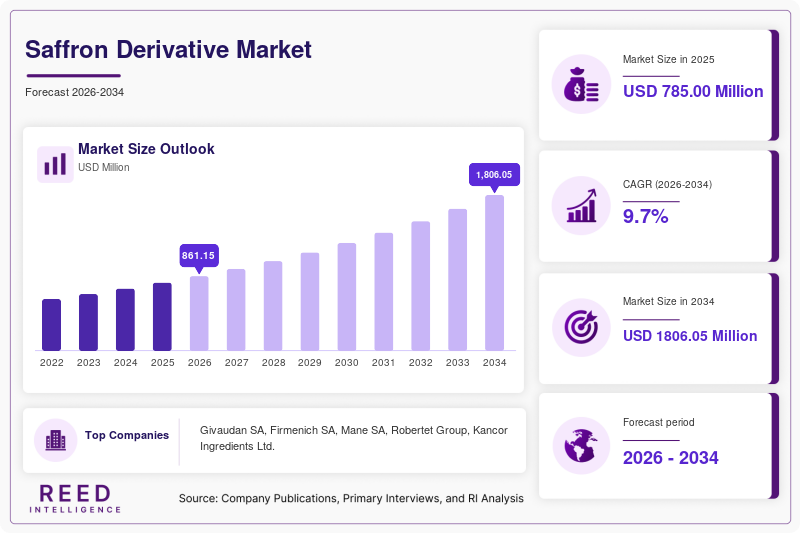
Key Highlights:
- Dominant Region: Asia Pacific accounted for 41.2% market share in 2025, while Europe is expected to be the fastest-growing region with a CAGR of 10.4%.
- Leading Subsegments: Crocin dominated the type segment with 38.5% share, while safranal is projected to grow at a CAGR of 10.9%. In application, pharmaceuticals led with 34.7% share, while cosmetics is anticipated to grow fastest at 10.8% CAGR.
- Dominant Country: India recorded market values of USD 162 million in 2024 and USD 178 million in 2025, driven by strong cultivation and export activities.
Market Trends
Expansion of Saffron-Based Nutraceuticals
The Saffron Derivative Market is witnessing increased incorporation of saffron extracts into nutraceutical formulations. These derivatives are used in supplements targeting mental wellness, cardiovascular health, and anti-inflammatory benefits. Manufacturers are investing in standardized saffron extracts to ensure consistent bioactive compound levels, improving product credibility. The trend is further supported by rising preventive healthcare practices and consumer inclination toward dietary supplements with natural origins. As regulatory frameworks evolve, saffron derivatives are increasingly recognized for their functional benefits, leading to wider product portfolios.
Integration in Premium Cosmetic Formulations
Saffron derivatives are gaining traction in luxury and premium skincare products due to their antioxidant and skin-brightening properties. Cosmetic manufacturers are incorporating compounds such as crocin and safranal into serums, creams, and anti-aging solutions. This trend is particularly evident in regions with high disposable income and strong demand for natural cosmetics. Product differentiation through exotic ingredients like saffron is becoming a key marketing strategy. Moreover, the clean beauty movement has accelerated the adoption of plant-derived active ingredients, positioning saffron derivatives as a valuable component in innovative cosmetic formulations.
Market Drivers
Rising Demand for Natural Bioactive Compounds
The growing preference for natural bioactive compounds across industries is a primary driver for the Saffron Derivative Market. Consumers are shifting away from synthetic additives due to concerns over long-term health effects. Saffron derivatives, known for their antioxidant, antidepressant, and anti-inflammatory properties, are increasingly used in pharmaceuticals and functional foods. This transition toward natural ingredients has created sustained demand, encouraging manufacturers to expand production capacities and invest in research for enhanced applications.
Advancements in Extraction Technologies
Technological advancements in extraction and processing methods have significantly improved the commercial viability of saffron derivatives. Modern techniques such as supercritical fluid extraction and solvent-free processing enable higher purity and better preservation of active compounds. These innovations reduce wastage and increase scalability, making saffron derivatives more accessible to multiple industries. Enhanced efficiency also lowers production costs over time, encouraging wider adoption in both established and emerging markets.
Market Restraint
High Cost of Raw Material and Production
One of the primary challenges facing the Saffron Derivative Market is the high cost associated with saffron cultivation and extraction. Saffron is one of the most expensive spices globally due to its labor-intensive harvesting process and limited geographic cultivation. The extraction of derivatives further adds to production costs, requiring specialized equipment and expertise. This cost factor limits market penetration, particularly in price-sensitive regions and applications. Additionally, fluctuations in supply due to climatic conditions can impact pricing stability, creating uncertainty for manufacturers and end-users. As a result, smaller companies may face barriers to entry, and large-scale adoption may be constrained in certain industries.
Market Opportunities
Expansion into Functional Food and Beverage Sector
The integration of saffron derivatives into functional foods and beverages presents a strong growth opportunity. Products such as saffron-infused teas, health drinks, and fortified snacks are gaining popularity among health-conscious consumers. The increasing demand for value-added food products with health benefits is expected to create new revenue streams for market players. Manufacturers can leverage saffron’s unique flavor and health properties to develop innovative offerings targeting niche consumer segments.
Growing Demand in Emerging Markets
Emerging economies in Asia, the Middle East, and Latin America are witnessing rising disposable incomes and increased awareness of natural health products. This creates a favorable environment for the expansion of the Saffron Derivative Market. Companies can tap into these markets by offering affordable product variants and establishing local distribution networks. Strategic partnerships and investments in regional production facilities can further enhance market presence and accessibility.
Segmental Analysis
By Type
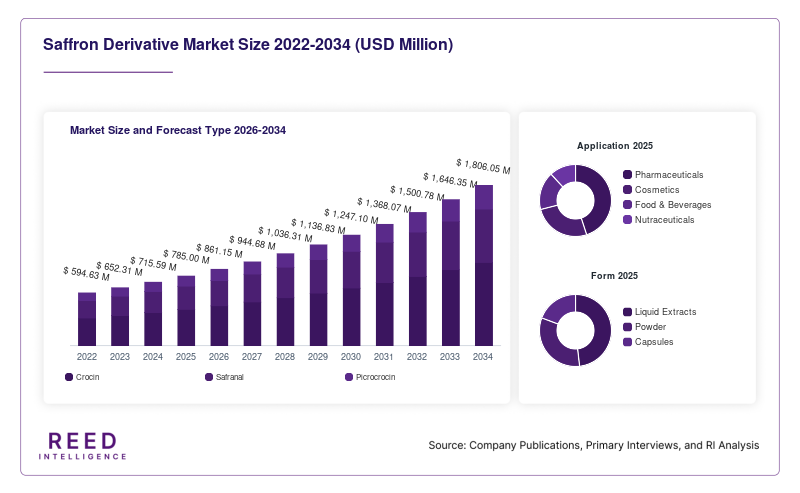
Crocin dominated the Saffron Derivative Market with a 38.5% share in 2025, owing to its strong antioxidant properties and wide application in pharmaceuticals and nutraceuticals. Its effectiveness in improving mood and cognitive function has made it a preferred ingredient in health supplements.
Safranal is expected to be the fastest-growing subsegment, projected to grow at a CAGR of 10.9%. Its increasing use in fragrance and cosmetic formulations due to its aromatic properties and therapeutic benefits will drive growth.
By Application
Pharmaceuticals held the largest share at 34.7% in 2025, driven by the extensive use of saffron derivatives in treating depression, anxiety, and inflammatory conditions. The growing acceptance of herbal medicine has further strengthened this segment.
Cosmetics is anticipated to grow at a CAGR of 10.8%, fueled by rising demand for natural skincare products. The incorporation of saffron derivatives in anti-aging and skin-brightening formulations will support this growth.
By Form
Liquid extracts dominated the market with a 45.2% share in 2025, as they are easier to incorporate into various applications, including beverages and cosmetics. Their high bioavailability enhances effectiveness.
Powder form is expected to grow at a CAGR of 9.8%, driven by its convenience in storage and use in dietary supplements and functional foods.
By End-Use Industry
The nutraceutical industry accounted for 36.1% share in 2025, supported by increasing demand for dietary supplements and functional ingredients.
The cosmetics industry is projected to grow at a CAGR of 10.6%, driven by innovation in natural and organic product lines.
By Distribution Channel
Offline channels dominated with 62.4% share in 2025, as traditional retail and specialty stores remain key distribution points.
Online channels are expected to grow at a CAGR of 11.2%, supported by the rise of e-commerce and direct-to-consumer sales models.
Regional Analysis
North America
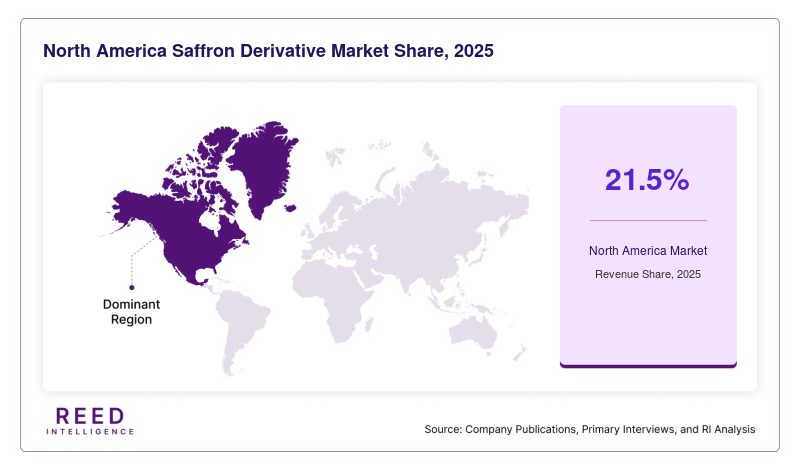
North America held 21.5% market share in 2025 and is expected to grow at a CAGR of 8.9% during 2026–2034. The region’s demand is driven by high adoption of dietary supplements and natural skincare products. Regulatory support for herbal ingredients has also contributed to market stability.
The United States dominated the regional market due to strong consumer demand for plant-based supplements. The country’s focus on wellness and preventive healthcare has encouraged the use of saffron derivatives in mental health supplements and functional foods.
Europe
Europe accounted for 18.3% market share in 2025 and is projected to grow at a CAGR of 10.4%. The region benefits from a well-established cosmetics industry and increasing demand for natural ingredients. Strict regulations on synthetic additives further boost the adoption of saffron derivatives.
Germany emerged as the dominant country, driven by its robust pharmaceutical sector and emphasis on herbal medicine. The country’s investment in research and development has supported innovation in saffron-based formulations.
Asia Pacific
Asia Pacific led the Saffron Derivative Market with 41.2% share in 2025 and is anticipated to grow at a CAGR of 9.5%. The region’s dominance is attributed to large-scale saffron cultivation and traditional usage in food and medicine.
India remained the leading country, supported by favorable climatic conditions for saffron farming and strong export demand. Government initiatives promoting agricultural productivity have further strengthened the market.
Middle East & Africa
The Middle East & Africa region held 11.6% market share in 2025 and is expected to grow at a CAGR of 9.2%. The region’s cultural association with saffron in cuisine and medicine drives consistent demand.
Iran dominated the market due to its position as a major saffron producer. The country’s export-oriented production and expertise in saffron processing contribute significantly to regional growth.
Latin America
Latin America captured 7.4% market share in 2025 and is forecast to grow at a CAGR of 8.7%. Increasing awareness of natural health products and expanding food industry applications are key growth factors.
Brazil led the regional market, supported by rising demand for functional foods and growing interest in herbal supplements. The country’s expanding middle-class population has further fueled market adoption.
Competitive Landscape
The Saffron Derivative Market is moderately fragmented, with several regional and global players competing based on product quality and innovation. Key companies focus on expanding their product portfolios and improving extraction technologies.
The market leader, Givaudan SA, has strengthened its position through continuous investment in natural ingredient research. The company recently introduced advanced saffron extract formulations aimed at enhancing stability and efficacy in cosmetic applications.
Other players emphasize strategic partnerships, mergers, and geographic expansion to gain competitive advantage. Companies are also investing in sustainable sourcing practices to ensure consistent supply and maintain product quality.
Key Players List
- Givaudan SA
- Firmenich SA
- Mane SA
- Robertet Group
- Kancor Ingredients Ltd.
- Synthite Industries Ltd.
- Shahid Saffron Co.
- Rowhani Saffron Co.
- Tarvand Saffron Co.
- Novin Saffron Co.
- Esfedan Trading Co.
- Saffron Business Co.
- King Kesariya
- Baby Brand Saffron
- Royal Saffron Company
Recent Developments
- In 2025, major manufacturers expanded production facilities to improve extraction efficiency.
- Several companies introduced standardized saffron extracts for pharmaceutical applications.
- Strategic collaborations were formed to enhance global distribution networks.
- Investment in sustainable saffron farming practices increased to ensure consistent supply.
- New product launches in the cosmetics sector focused on anti-aging and skin-brightening solutions.
Saffron Derivative Market Segments
Type
- Crocin
- Safranal
- Picrocrocin
Application
- Pharmaceuticals
- Cosmetics
- Food & Beverages
- Nutraceuticals
Form
- Liquid Extracts
- Powder
- Capsules
End-Use Industry
- Healthcare
- Cosmetics Industry
- Food Industry
Distribution Channel
- Online Retail
- Specialty Stores
- Pharmacies
- Supermarkets/Hypermarkets
By Region
- North America
- Europe
- APAC
- Middle East and Africa
- LATAM