Sailboat Propeller Market Size, Share & Demand Report By Type (Folding Propellers, Feathering Propellers, Fixed Propellers), By Material (Bronze, Stainless Steel, Composite), By Application (Recreational Sailing, Racing, Commercial), By End-Use (OEM, Aftermarket), By Distribution Channel (Direct Sales, Distributors, Online Sales), By Region & Segment Forecasts, 2025–2034
USD 3950
Market Overview
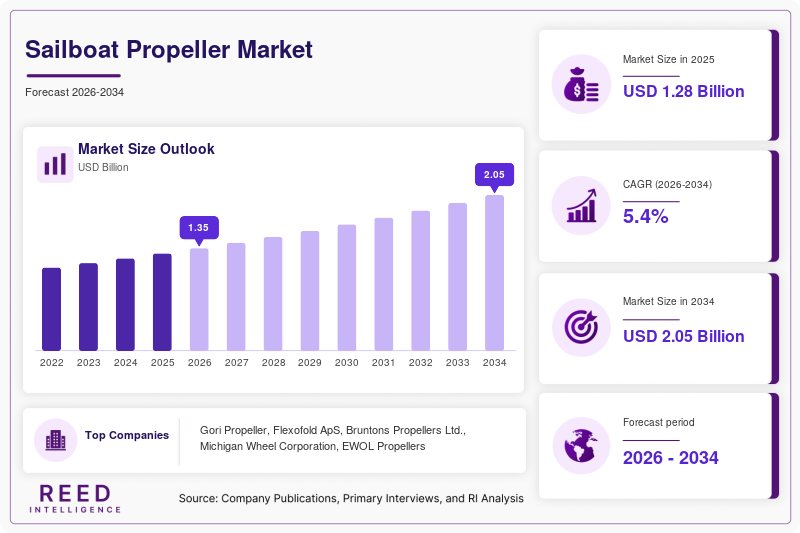
The global Sailboat Propeller Market size was valued at approximately USD 1.28 billion in 2025 and is projected to reach USD 2.05 billion by 2034, expanding at a compound annual growth rate (CAGR) of 5.4% during the forecast period (2025–2034). The market growth is primarily supported by the increasing popularity of recreational sailing and marine tourism across coastal economies, combined with the rising demand for fuel-efficient and performance-enhancing propulsion systems.
A significant global factor contributing to the expansion of the Sailboat Propeller Market is the growing emphasis on energy efficiency and sustainability in marine operations. Sailboat owners and operators are increasingly adopting advanced propeller technologies such as folding and feathering propellers that reduce drag and improve sailing performance, aligning with environmental regulations and fuel optimization goals.
Key Highlights
- Europe dominated the market with a 34% share in 2025, while Asia Pacific is projected to grow at the fastest CAGR of 6.3% during the forecast period.
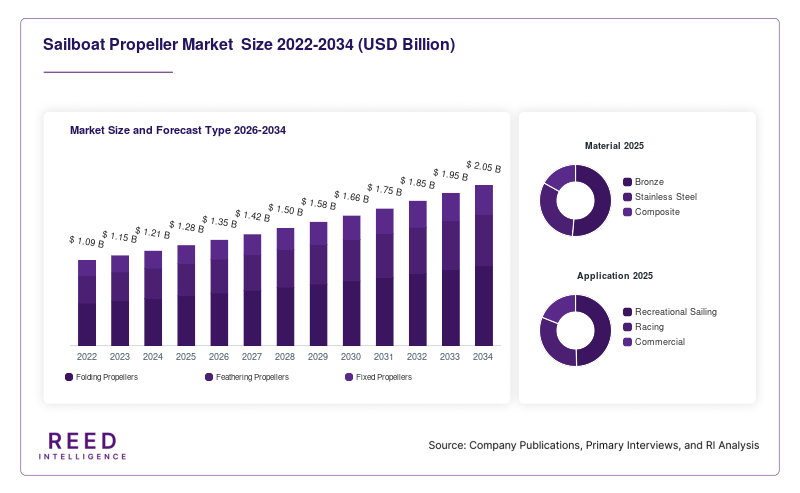
- Folding propellers led the type segment with a 41% share, while feathering propellers are expected to grow fastest at a CAGR of 6.7%.
- Bronze material dominated with a 46% share, whereas composite materials are anticipated to expand at a CAGR of 6.9%.
- The United States market was valued at USD 310 million in 2025 and is estimated to reach USD 325 million in 2026, maintaining its position as the leading country market.
Market Trends
Rising Adoption of Folding and Feathering Propellers
The Sailboat Propeller Market is witnessing increased adoption of folding and feathering propellers due to their ability to reduce drag while sailing. These propellers automatically adjust blade orientation, improving hydrodynamic efficiency and enhancing vessel speed under sail. This trend is particularly strong among performance-oriented sailing enthusiasts and competitive sailing segments. Manufacturers are focusing on precision engineering and lightweight designs to improve responsiveness and durability.
Integration of Advanced Materials and Coatings
Another key trend shaping the Sailboat Propeller Market is the use of advanced materials such as stainless steel alloys and reinforced composites. These materials offer improved corrosion resistance, reduced maintenance, and longer service life. In addition, anti-fouling coatings are being increasingly integrated into propeller designs to minimize marine growth, which can negatively impact efficiency. This trend aligns with the broader marine industry shift toward reducing maintenance costs and improving lifecycle performance.
Market Drivers
Growth in Recreational Boating and Marine Tourism
The increasing participation in recreational boating activities has significantly driven the Sailboat Propeller Market. Coastal tourism, yacht charter services, and sailing competitions have expanded globally, particularly in Europe and North America. As more consumers invest in leisure sailing, the demand for efficient and reliable propeller systems continues to grow. This driver is further supported by rising disposable incomes and lifestyle shifts toward outdoor recreational activities.
Demand for Fuel Efficiency and Performance Optimization
Efficiency remains a critical factor influencing propeller selection. Sailboat owners are increasingly seeking solutions that minimize fuel consumption when engines are in use while maximizing sailing performance. Advanced propeller systems help reduce resistance and improve propulsion efficiency, making them an attractive upgrade for existing vessels. The Sailboat Propeller Market benefits from this shift as operators prioritize cost savings and operational performance.
Market Restraint
High Initial Cost of Advanced Propeller Systems
One of the primary challenges in the Sailboat Propeller Market is the high cost associated with advanced propeller technologies such as folding and feathering systems. These products require precision manufacturing and specialized materials, leading to higher upfront costs compared to traditional fixed propellers.
For many small boat owners and budget-conscious consumers, the initial investment can be a deterrent, despite long-term efficiency benefits. Additionally, installation and maintenance of advanced propellers often require technical expertise, further increasing total ownership costs.
This restraint is particularly evident in developing regions where cost sensitivity remains high. While premium products dominate in mature markets, price competitiveness becomes crucial in emerging economies. As a result, manufacturers must balance innovation with affordability to expand their customer base and sustain growth in the Sailboat Propeller Market.
Market Opportunities
Expansion in Emerging Coastal Economies
Emerging economies in Asia Pacific and Latin America present significant growth opportunities for the Sailboat Propeller Market. Increasing investments in marina infrastructure, coastal tourism, and sailing events are driving demand for recreational boats and associated components. As disposable incomes rise, a growing middle class is expected to adopt sailing as a leisure activity, creating new market avenues for propeller manufacturers.
Aftermarket Sales and Retrofit Solutions
The aftermarket segment offers considerable potential within the Sailboat Propeller Market. Many existing sailboats are equipped with older propeller systems that can be upgraded to improve performance and efficiency. Retrofit solutions, including folding and feathering propellers, are gaining traction among boat owners seeking enhanced sailing experiences without purchasing new vessels. This opportunity is further supported by increasing awareness of performance optimization and maintenance benefits.
Segmental Analysis
By Type
Folding propellers dominated the Sailboat Propeller Market, accounting for 41% of the market share in 2025. Their ability to reduce drag when sailing and improve overall vessel performance made them the preferred choice among sailing enthusiasts. These propellers are particularly popular in racing and performance-oriented applications where efficiency is critical.
Feathering propellers are expected to be the fastest-growing subsegment, expanding at a CAGR of 6.7% during the forecast period. Their capability to adjust blade angles for optimal performance in both forward and reverse motion will drive adoption. Increased demand for versatile and high-performance propulsion systems will support their growth.
By Material
Bronze propellers held the largest share of 46% in 2025, owing to their durability, corrosion resistance, and cost-effectiveness. They have been widely used in marine applications due to their reliability and ease of manufacturing.
Composite materials are anticipated to grow at the fastest CAGR of 6.9%. These materials offer lightweight properties, reduced corrosion, and improved efficiency. Their adoption will increase as manufacturers focus on innovation and performance optimization.
By Application
Recreational sailing dominated the Sailboat Propeller Market with a 58% share in 2025. The growing popularity of leisure boating and sailing activities contributed significantly to this segment's dominance. Consumers increasingly invest in high-quality propellers to enhance their sailing experience.
Racing applications are expected to grow at a CAGR of 6.5%, driven by the increasing number of competitive sailing events. High-performance requirements in racing will boost demand for advanced propeller technologies.
By End-Use
OEM (Original Equipment Manufacturer) sales accounted for 52% of the market share in 2025, as new sailboat production continues to drive demand for propellers. Manufacturers often integrate advanced propulsion systems into new vessels.
The aftermarket segment is projected to grow at a CAGR of 6.8%, supported by retrofit and replacement demand. Boat owners upgrading their vessels will contribute to this growth.
By Distribution Channel
Direct sales dominated the Sailboat Propeller Market with a 55% share in 2025, as manufacturers maintain strong relationships with boat builders and large buyers. This channel ensures better customization and product integration.
Online sales are expected to grow at a CAGR of 7.1%, driven by increasing digitalization and consumer preference for convenient purchasing options. E-commerce platforms will play a significant role in expanding market reach.
Regional Analysis
North America
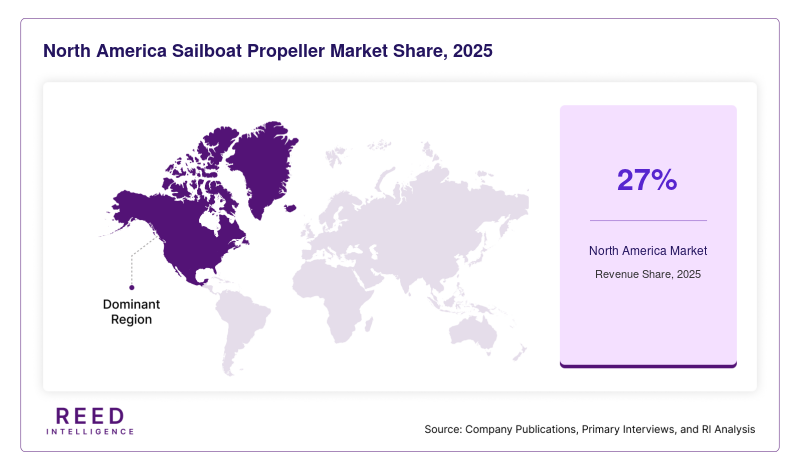
North America accounted for approximately 27% of the Sailboat Propeller Market share in 2025 and will grow at a CAGR of 4.9% through 2034. The region has a well-established recreational boating culture supported by extensive marina infrastructure and strong consumer spending on leisure activities. Technological adoption remains high, with consumers favoring advanced propeller systems that enhance performance and efficiency.
The United States dominated the regional market due to its large base of recreational boat owners and sailing enthusiasts. The presence of numerous sailing clubs and competitive events contributes to consistent demand for high-performance propellers. Additionally, the growing trend of upgrading existing vessels with modern propulsion systems supports market growth.
Europe
Europe held the largest share of the Sailboat Propeller Market at 34% in 2025 and is expected to grow at a CAGR of 5.1% during the forecast period. The region benefits from a strong maritime heritage and a high concentration of sailing communities. Countries such as France, Italy, and Spain have well-developed sailing industries and attract significant tourism.
Germany emerged as a key country due to its engineering expertise and strong manufacturing base for marine components. The demand for precision-engineered propellers and sustainable marine solutions drives innovation in the region. Environmental awareness also encourages the adoption of efficient propeller systems that reduce fuel consumption and emissions.
Asia Pacific
Asia Pacific represented 21% of the Sailboat Propeller Market in 2025 and is projected to grow at the fastest CAGR of 6.3% through 2034. The region is witnessing rapid growth in marine tourism and recreational boating activities, particularly in countries such as China, Australia, and Southeast Asian nations.
China dominated the regional market due to increasing investments in coastal infrastructure and rising interest in leisure sailing. Government initiatives to promote tourism and water sports are boosting demand for sailboats and related components. The expanding middle class and improving economic conditions further contribute to market growth.
Middle East & Africa
The Middle East & Africa accounted for 9% of the Sailboat Propeller Market in 2025 and will grow at a CAGR of 5.6% during the forecast period. The region is gradually emerging as a niche market for recreational boating, supported by luxury tourism and marina developments.
The United Arab Emirates led the regional market, driven by high-end yacht ownership and premium marine infrastructure. The demand for technologically advanced propellers is increasing among affluent consumers seeking performance and efficiency. Coastal tourism initiatives and investments in marine facilities are expected to support steady growth.
Latin America
Latin America held 9% of the Sailboat Propeller Market share in 2025 and is projected to grow at a CAGR of 5.2% through 2034. The region is experiencing gradual growth in recreational boating, supported by favorable coastal conditions and increasing tourism.
Brazil dominated the regional market due to its extensive coastline and growing interest in water-based leisure activities. The expansion of sailing clubs and tourism initiatives is driving demand for sailboats and associated equipment. Economic improvements and infrastructure development are expected to further enhance market growth.
Competitive Landscape
The Sailboat Propeller Market is moderately fragmented, with several established players competing on product innovation, performance, and pricing. Key companies focus on developing advanced propeller technologies and expanding their global presence through strategic partnerships.
Gori Propeller is considered a market leader, known for its high-performance folding propellers. The company recently introduced an upgraded propeller design aimed at improving fuel efficiency and reducing drag, strengthening its competitive position.
Other notable players include Flexofold ApS, Bruntons Propellers Ltd., Michigan Wheel Corporation, and EWOL Propellers. These companies emphasize innovation, material advancements, and customization to meet diverse customer requirements.
Continuous investment in research and development and a focus on aftermarket solutions are expected to shape the competitive dynamics of the Sailboat Propeller Market.
Key Players List
- Gori Propeller
- Flexofold ApS
- Bruntons Propellers Ltd.
- Michigan Wheel Corporation
- EWOL Propellers
- Radice S.p.A.
- Volvo Penta
- Yanmar Marine International
- Mercury Marine
- Solas Propellers
- Kawasaki Precision Machinery
- Veem Ltd.
- Hundested Propeller A/S
- West Mekan
- Heliceo
Recent Developments
- Introduction of lightweight composite propellers for improved efficiency
- Expansion of aftermarket product portfolios by key manufacturers
- Increased focus on eco-friendly and low-drag propeller designs
- Strategic partnerships between propeller manufacturers and boat builders
- Launch of digitally optimized propeller designs using simulation technology
Sailboat Propeller Market Segments
Type
- Folding Propellers
- Feathering Propellers
- Fixed Propellers
Material
- Bronze
- Stainless Steel
- Composite
Application
- Recreational Sailing
- Racing
- Commercial
End-Use
- OEM
- Aftermarket
Distribution Channel
- Direct Sales
- Distributors
- Online Sales
By Region
- North America
- Europe
- APAC
- Middle East and Africa
- LATAM