Sandalwood Market Size, Share Demand Report By Type (Raw Wood, Sandalwood Oil, Sandalwood Powder), By Application (Fragrance & Cosmetics, Religious & Incense, Pharmaceuticals, Carving, Wellness & Other Applications), By Region & Segment Forecasts, 2026–2034
USD 3950
Sandalwood Market Size
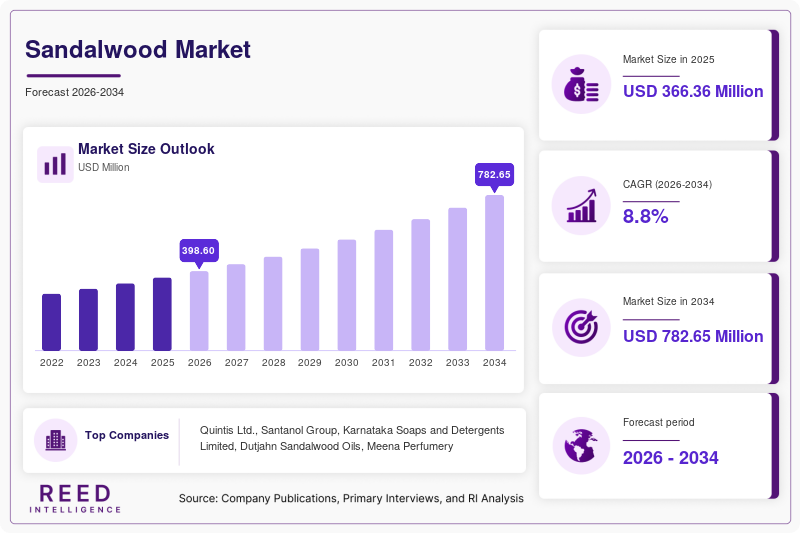
The global sandalwood market size is projected at USD 398.2 million in 2026 and is expected to hit USD 782.65 million by 2034 with a CAGR of 8.8%. The market is increasingly influenced by demand for traceable raw materials, sustainable cultivation, premium sandalwood oil, and natural fragrance ingredients. Detailed segmentation by product form, application, geography, and competitive positioning is becoming important as producers address supply constraints and changing regulatory requirements.
Key takeaways
- Asia Pacific dominated the global market with an estimated 38% share in 2025, supported by cultivation, traditional consumption, fragrance production, and religious applications. North America is among the fastest-growing regions, with an estimated CAGR of approximately 9.4% through 2034.
- Raw Wood was the leading type segment with approximately 46% share in 2025, while Sandalwood Powder is expected to record the fastest growth at nearly 10.2% CAGR during 2026–2034.
- Fragrance & Cosmetics represented approximately 38% of global demand in 2025, supported by premium perfumes, skincare, personal care, and natural fragrance formulations.
- India accounted for approximately 3.9% of the global market in 2025 and is projected to reach around USD 30.2 million by 2034, expanding at approximately 8.8% CAGR.
- South Korea is emerging as a high-growth Asia Pacific market and is projected to reach approximately USD 11.7 million by 2034, supported by premium beauty, fragrance, wellness, and aromatherapy consumption.
The global sandalwood market covers the cultivation, harvesting, processing, trading, and utilization of aromatic sandalwood species, particularly Santalum album and Santalum spicatum. The market includes raw heartwood, chips, powder, extracted oil, and value-added products used across fragrance, cosmetics, religious products, wellness, pharmaceuticals, and traditional medicine. The global sandalwood plantation area is estimated at more than 23,000 hectares in India, while Australia remains an important source of plantation-grown sandalwood and sandalwood oil. Estimated commercial production across major producing regions is approximately 35,000–40,000 tonnes of sandalwood material annually, although volumes vary according to harvest cycles and reporting practices. Natural and plantation-based supply is increasingly complemented by improved seedlings, genetic selection, controlled irrigation, host-plant management, and modern oil extraction. Raw wood contributes the largest share of market value, while oil and powder collectively account for more than half of processed-market demand.
Sandalwood Market Trends
Shift Toward Sustainable and Traceable Sandalwood
Sandalwood cultivation is shifting from predominantly natural-resource dependence toward managed plantations, agroforestry, certified sourcing, genetic improvement, and traceable supply chains. Producers are adopting improved planting material, host-tree management, remote monitoring, and optimized heartwood development practices to improve yield over long cultivation cycles. Traceability is becoming particularly important for premium fragrance and cosmetics manufacturers that require documented sourcing and consistent quality.
Premiumization Across Fragrance and Wellness
Demand is moving toward high-purity sandalwood oil, fine fragrance grades, natural cosmetic ingredients, aromatherapy formulations, and premium incense. Advanced steam-distillation and processing techniques are improving consistency in oil composition, while product developers increasingly combine sandalwood with other botanical ingredients. Traditional religious consumption continues to provide a stable base, particularly across India and other Asian markets.
Sandalwood Market Drivers
Rising Demand for Natural Fragrance Ingredients
Increasing consumer preference for botanical and naturally derived ingredients is supporting sandalwood demand in luxury perfumes, skincare, soaps, haircare, aromatherapy, and wellness products. Sandalwood's distinctive woody aroma and long-standing cultural positioning allow it to command premium pricing, particularly when sourced through controlled and sustainable cultivation systems.
Sandalwood Market Restraints
Long Cultivation Cycles and Restricted Supply
Sandalwood trees require several years before commercially valuable heartwood and oil can be obtained, creating a structural supply constraint. Mature heartwood formation can require approximately 10–15 years depending on species and growing conditions. Regulatory controls, harvesting restrictions, land availability, theft risks, and fluctuations in raw-material prices can further restrict market expansion.
Sandalwood Market Opportunities
Expansion of Commercial Plantations and Value-Added Processing
Expansion of private plantations and agroforestry systems provides an opportunity to increase long-term supply while reducing dependence on natural forests. Opportunities are also emerging in high-value oil extraction, standardized powder, cosmetic-grade ingredients, pharmaceutical formulations, sustainable incense, and certified premium fragrance products. Genetic improvement and improved nursery systems can further increase oil yield and plantation productivity.
Challenges in Sandalwood Market
Balancing Commercial Growth With Conservation
The industry must balance increasing commercial demand with biodiversity protection, sustainable harvesting, and conservation of natural sandalwood populations. Climate variability, pests, diseases, water availability, unauthorized harvesting, inconsistent quality standards, and fragmented supply chains can affect production. Synthetic fragrance alternatives also create competitive pressure in price-sensitive applications.
Sandalwood Market Segmentation Analysis
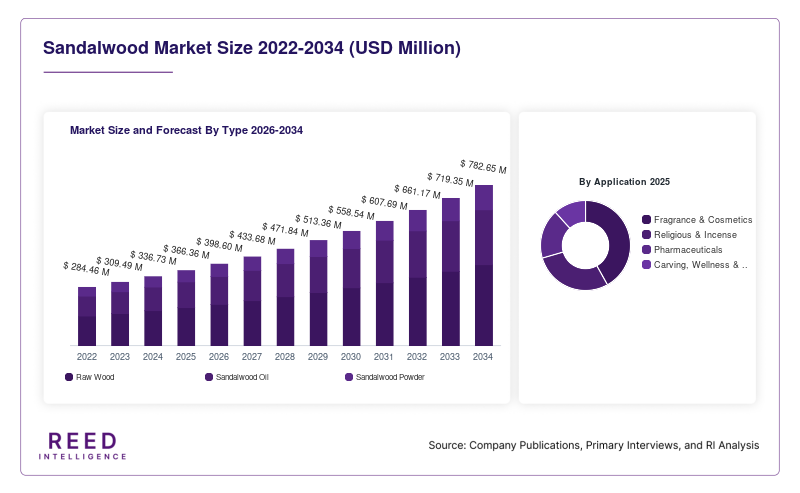
By type, Raw Wood dominated with approximately 46% market share in 2025, followed by Sandalwood Oil at about 31% and Sandalwood Powder at 23%. By application, Fragrance & Cosmetics represented nearly 38% of demand, followed by Religious & Incense at 27% and Pharmaceuticals at approximately 18%, while carving, wellness, and other uses represented the remaining share.
By Type
Raw Wood accounted for approximately 46% of the market in 2025. Estimated commercial raw sandalwood throughput was around 17,000–18,000 tonnes, depending on harvest availability. The segment primarily includes heartwood, logs, chips, and carving-grade material with high aromatic content. Premium heartwood is selected for oil extraction, incense, religious products, and luxury handicrafts. Demand remains strongest where authentic natural sandalwood is preferred over synthetic substitutes.
Sandalwood Oil represented approximately 31% of market value in 2025 and is the highest-value processed form. Estimated global commercial output is approximately 70–80 tonnes annually across major plantation and processing regions. Steam distillation is the principal extraction method, with oil quality influenced by species, heartwood maturity, geographic origin, and processing conditions. Premium grades are primarily used in perfumes, cosmetics, aromatherapy, and pharmaceutical formulations.
Sandalwood Powder held approximately 23% share and is projected to be the fastest-growing type. Estimated annual commercial production is approximately 7,000–9,000 tonnes. Fine powder is produced from processed heartwood and is used in incense, religious rituals, skincare masks, traditional formulations, soaps, and personal-care products. Improved milling and particle-size control are supporting standardized cosmetic and wellness applications.
By Application
Fragrance & Cosmetics: This segment held approximately 38% share in 2025 and represented an estimated 13,000–15,000 tonnes of equivalent sandalwood material demand. Sandalwood oil is used as a base note in perfumes and fine fragrances, while powder and extracts are incorporated into soaps, creams, skincare products, and premium personal-care formulations. Natural-origin claims, clean-label positioning, and premium beauty trends are supporting demand.
Religious & Incense applications accounted for approximately a 27% share and represent an estimated 9,000–11,000 tonnes of equivalent annual demand. Sandalwood paste, powder, chips, sticks, and incense products are used in religious ceremonies, meditation, temples, cultural practices, and household rituals. Demand is particularly strong across India and Asia, where sandalwood retains deep cultural significance.
Pharmaceuticals contributed approximately 18% of market demand, equivalent to roughly 6,000–7,000 tonnes of material demand. Sandalwood-derived ingredients are used in traditional medicine, topical preparations, wellness products, and selected therapeutic formulations. Research into antimicrobial, anti-inflammatory, and skin-related properties is supporting continued interest in standardized sandalwood extracts and oils.
Sandalwood Market Regional Analysis
North America Sandalwood Market
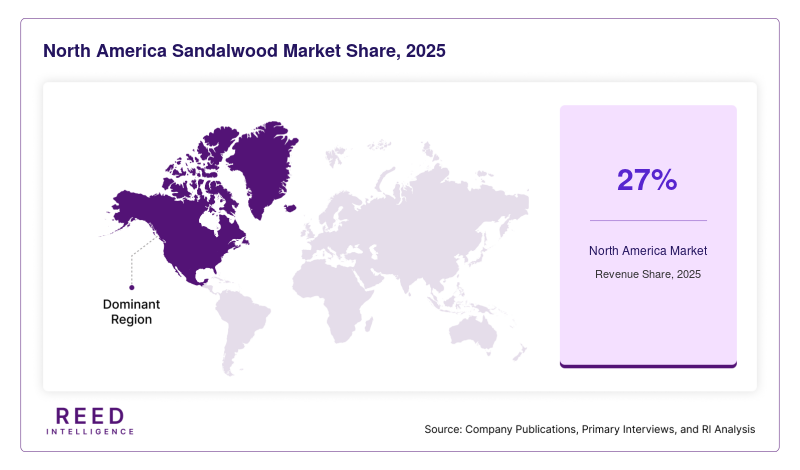
North America represented approximately 27% of the global market in 2025. The United States contributes the majority of regional demand through premium perfumes, natural skincare, aromatherapy, wellness products, and specialty essential oils. Fragrance and cosmetics represent the largest sector split, followed by wellness and pharmaceutical applications. Demand is increasingly centered on sustainably sourced and traceable sandalwood oil.
Europe Sandalwood Market
Europe accounted for approximately 23% of the market. Germany, France, the United Kingdom, Italy, and Switzerland contribute strongly through luxury fragrance, cosmetics, aromatherapy, and natural personal-care industries. The regional market is characterized by strict ingredient standards and increasing demand for sustainable sourcing. Premium fragrance remains the largest sector, followed by cosmetics and wellness.
Asia Pacific Sandalwood Market
Asia Pacific held approximately a 38% share in 2025 and remained the leading regional market. India, China, Japan, South Korea, Indonesia, and Australia are major contributors. India remains important for cultivation and traditional consumption, Australia for plantation-based production, while China, Japan, and South Korea contribute strongly to fragrance, beauty, wellness, and aromatherapy demand. Religious and incense applications remain particularly significant across South Asia.
Middle East & Africa Sandalwood Market
The Middle East & Africa region accounted for approximately 12% of global demand. Gulf markets contribute through luxury perfumes, traditional fragrance products, oud and incense blends, and premium personal-care products. Saudi Arabia and the UAE represent key consumption centers, while selected African markets provide developing opportunities for plantation and processed sandalwood products.
Top players in the Sandalwood Market
- Quintis Ltd.
- Santanol Group
- Karnataka Soaps and Detergents Limited
- Dutjahn Sandalwood Oils
- Meena Perfumery
- R.K. Essential Oils Company
- Eden Botanicals
- Shiva Exports India
- Plant Therapy
- doTERRA
- Haldin Natural
- Blossom Kochhar Beauty Products
Recent Developments in Sandalwood Market
- February 2026: Karnataka Soaps and Detergents Limited and the Institute of Wood Science and Technology established India's first sandalwood gene pool and germplasm bank to support improved planting material, oil yield, and commercial cultivation.
- March 2026: Punjab's Forest Department initiated laboratory testing of mature sandalwood trees from its pilot agroforestry program to evaluate oil yield and support future commercial cultivation.
- September 2025: Dutjahn Sandalwood Oils expanded its portfolio of Australian and Indian sandalwood oils, including fine-fragrance and certified sourcing grades.
- November 2025: Research published on genetic and genomic resources of Santalum album highlighted genetic diversity and conservation requirements relevant to future sandalwood improvement programs.
- September 2026: Increased policy and industry attention in India focused on expanding sandalwood cultivation, processing, and agroforestry, reinforcing the country's effort to rebuild commercial sandalwood supply.
Sandalwood Market Segments
By Type
- Raw Wood
- Sandalwood Oil
- Sandalwood Powder
By Application
- Fragrance & Cosmetics
- Religious & Incense
- Pharmaceuticals
- Carving, Wellness & Other Applications
By Region
- North America
- Europe
- APAC
- Middle East and Africa
- LATAM