Sanitary Pumps Market Size, Share & Demand Report By Pump Type (Centrifugal Pumps, Positive Displacement Pumps), By Material (Stainless Steel, Alloy-Based Materials, Polymer-Based Materials, Others), By Application (Food & Beverage Processing, Pharmaceutical Processing, Biotechnology Processing), By End-Use Industry (Pharmaceutical Manufacturing, Food Processing Industries, Dairy Industries), By Flow Capacity (Low Flow, Medium Flow), By Region & Segment Forecasts, 2026–2034
USD 3950
Market Overview
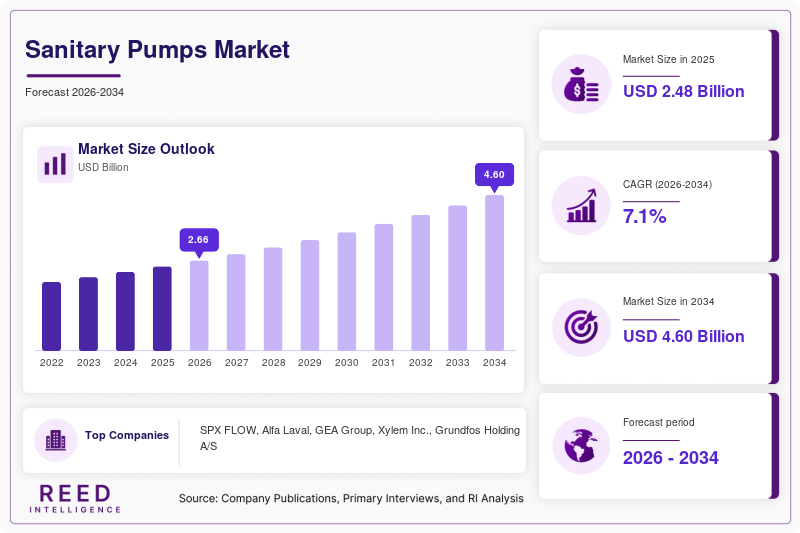
The Sanitary Pumps Market size was valued at USD 2.48 billion in 2026 and is projected to reach USD 4.31 billion by 2034, expanding at a CAGR of 7.1% during the forecast period (2026–2034). The market growth was supported by the increasing adoption of hygienic processing systems across food & beverage, pharmaceutical, biotechnology, and personal care industries. Rising investments in contamination-free fluid handling equipment and stricter hygiene compliance standards across manufacturing facilities contributed significantly to the expansion of the Sanitary Pumps Market.
The growing emphasis on product purity, process automation, and operational efficiency accelerated the deployment of sanitary pumps in production environments requiring sterile handling. Manufacturers increasingly adopted advanced centrifugal and positive displacement pumps to improve clean-in-place (CIP) and sterilize-in-place (SIP) operations. In addition, rapid industrialization in emerging economies and expansion of processed food production facilities created favorable conditions for long-term market development.
Key Highlights
- North America accounted for 34.8% of the global Sanitary Pumps Market share in 2025, while Asia Pacific is projected to register the fastest CAGR of 8.4% during the forecast period.
- By pump type, centrifugal pumps held the leading share of 46.2% in 2025, whereas diaphragm pumps are expected to witness the fastest CAGR of 8.9% through 2034.
- By material, stainless steel sanitary pumps dominated with a 68.5% share in 2025, while alloy-based sanitary pumps are forecast to expand at a CAGR of 8.1%.
- By application, food & beverage processing represented the largest share of 39.4% in 2025, whereas biopharmaceutical processing is anticipated to record the fastest CAGR of 9.3%.
- By end-use, pharmaceutical manufacturing accounted for 31.6% of the market share in 2025, while cosmetics and personal care facilities are projected to grow at a CAGR of 8.7%.
- The United States Sanitary Pumps Market was valued at USD 620 million in 2024 and reached USD 661 million in 2025.
Market Trends
Integration of Smart Monitoring Technologies
The integration of digital monitoring systems into sanitary pumping equipment emerged as a major trend influencing the Sanitary Pumps Market. Manufacturers increasingly deployed pumps equipped with IoT-enabled sensors, predictive maintenance software, and remote monitoring platforms. These systems improved operational efficiency by minimizing downtime and enabling real-time diagnostics. Industrial facilities adopted smart sanitary pumps to reduce maintenance costs, monitor fluid flow accuracy, and ensure compliance with hygienic processing standards.
The trend was particularly visible in pharmaceutical and biotechnology manufacturing plants where process consistency and traceability remain critical. Automated monitoring capabilities also improved energy management and reduced operational disruptions during continuous processing.
Rising Preference for Energy-Efficient Pump Designs
Energy-efficient sanitary pumps gained significant traction across industrial processing facilities. Companies increasingly focused on reducing electricity consumption and improving sustainability metrics. Variable frequency drive (VFD)-enabled pumps, low-energy impellers, and optimized fluid transfer systems became more common across production facilities.
This trend accelerated as manufacturers sought to reduce operational expenditures and meet environmental targets. Food processing facilities and dairy manufacturers increasingly adopted high-efficiency sanitary pumps to improve productivity while lowering energy costs. The growing demand for sustainable industrial equipment is expected to continue supporting the long-term outlook of the Sanitary Pumps Market.
Market Drivers
Expansion of Processed Food Manufacturing Facilities
The rapid expansion of processed food production facilities significantly contributed to the growth of the Sanitary Pumps Market. Rising urbanization, changing dietary patterns, and increasing consumption of packaged food products created strong demand for hygienic fluid transfer systems.
Food manufacturers required sanitary pumps for handling liquids, syrups, dairy products, sauces, and beverages while maintaining strict contamination control. The need for reliable cleaning systems and hygienic material handling accelerated the adoption of advanced sanitary pumps across food processing plants. Increasing investments in dairy processing and ready-to-eat food production also supported market expansion.
Increasing Pharmaceutical Production Capacity
The growth of pharmaceutical manufacturing activities globally accelerated the demand for sanitary pumps. Drug manufacturers increasingly required sterile pumping systems capable of maintaining product purity during formulation, filtration, and filling operations.
Biopharmaceutical production facilities adopted sanitary pumps to handle sensitive fluids and maintain contamination-free production environments. The rising demand for injectable drugs, vaccines, and biologics further strengthened equipment investments. Pharmaceutical companies also focused on upgrading production lines with advanced hygienic systems to meet evolving regulatory standards, supporting continuous growth in the Sanitary Pumps Market.
Market Restraint
High Initial Equipment and Maintenance Costs
The high acquisition and maintenance costs associated with sanitary pumping systems restrained market growth to some extent. Advanced sanitary pumps manufactured with corrosion-resistant materials and precision-engineered components often involve significant capital expenditure. Small and medium-sized manufacturers faced budget limitations while upgrading conventional pumping systems. In addition, periodic maintenance requirements and replacement of specialized seals increased operational expenses for end users.
Market Opportunities
Growing Demand for Hygienic Equipment in Emerging Economies
Emerging economies present strong growth opportunities for the Sanitary Pumps Market due to rapid industrialization and increasing investments in hygienic processing facilities. Countries across Asia Pacific, Latin America, and the Middle East are witnessing expanding pharmaceutical manufacturing and food processing sectors.
Government initiatives supporting domestic manufacturing and export-oriented food production are expected to encourage adoption of sanitary fluid handling systems. The increasing awareness regarding contamination control and product quality will continue creating favorable market opportunities.
Expansion of Biotechnology Manufacturing
The rapid expansion of biotechnology manufacturing activities is expected to generate substantial opportunities for sanitary pump manufacturers. Biotech facilities require highly sterile and accurate fluid transfer systems for handling sensitive biological materials.
The increasing development of cell therapies, biologics, and advanced pharmaceutical formulations is projected to drive demand for precision sanitary pumps. Manufacturers focusing on low-shear and contamination-resistant pumping technologies are expected to benefit from this emerging growth avenue.
Segmental Analysis
By Pump Type
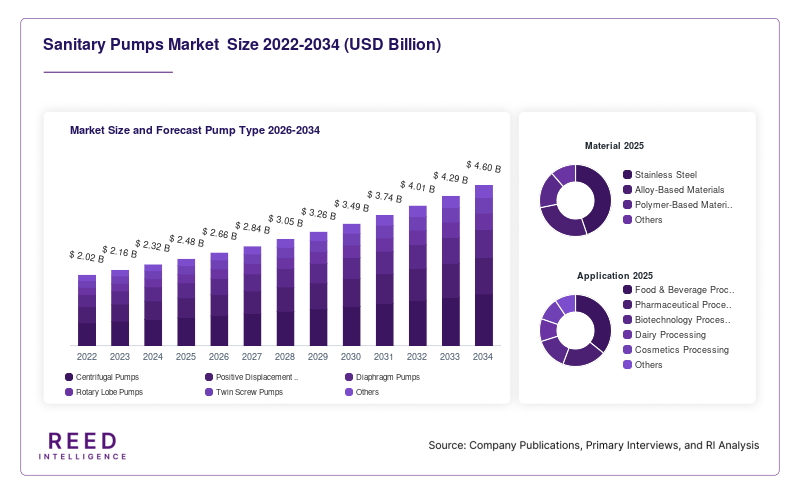
Based on pump type, the Sanitary Pumps Market is segmented into centrifugal pumps, positive displacement pumps, diaphragm pumps, rotary lobe pumps, twin screw pumps, and others.
Centrifugal pumps accounted for the largest market share of 46.2% in 2025. Their dominance was attributed to their widespread use in beverage processing, dairy handling, and liquid food transfer applications. These pumps offered high flow rates, efficient cleaning capabilities, and lower operational complexity. Manufacturers preferred centrifugal sanitary pumps due to their compatibility with continuous production systems and clean-in-place operations.
Rotary lobe pumps also maintained a substantial share due to their ability to handle viscous fluids without damaging product consistency. These pumps were extensively utilized in pharmaceutical and cosmetic production environments where gentle product handling remained essential.
Diaphragm pumps are projected to register the fastest CAGR of 8.9% during the forecast period. The growth is expected to be driven by increasing demand for contamination-free fluid transfer in biotechnology and sterile pharmaceutical applications. Diaphragm pumps will gain traction because of their leak-resistant designs and suitability for handling sensitive fluids. The rising use of single-use bioprocessing systems is expected to further support adoption.
Twin screw pumps are also anticipated to witness steady growth due to their capability to perform both product transfer and cleaning functions within the same system. Their increasing use in multi-functional food processing facilities will contribute to segment expansion.
By Material
Based on material, the Sanitary Pumps Market is categorized into stainless steel, alloy-based materials, polymer-based materials, and others.
Stainless steel sanitary pumps dominated the market with a 68.5% share in 2025. Their widespread adoption was supported by superior corrosion resistance, durability, and hygienic properties. Stainless steel pumps remained highly preferred across pharmaceutical, dairy, and beverage processing industries due to their compatibility with sterilization procedures and stringent sanitation standards.
The use of stainless steel materials also reduced contamination risks and enhanced equipment longevity in high-temperature processing environments. Manufacturers increasingly adopted stainless steel sanitary pumps to maintain regulatory compliance and operational efficiency.
Alloy-based sanitary pumps are projected to grow at a CAGR of 8.1% during the forecast period. Their growth will be supported by increasing demand for advanced chemical resistance and enhanced durability in aggressive processing environments. Alloy materials will gain importance in specialized pharmaceutical and biotechnology applications involving corrosive fluids and high-pressure systems.
Polymer-based sanitary pumps are also expected to witness moderate growth due to their lightweight structure and cost advantages. These pumps will find increasing application in low-pressure and portable processing systems.
By Application
Based on application, the Sanitary Pumps Market is divided into food & beverage processing, pharmaceutical processing, biotechnology processing, dairy processing, cosmetics processing, and others.
Food & beverage processing accounted for the leading market share of 39.4% in 2025. The segment’s dominance was attributed to the increasing demand for hygienic fluid transfer systems in beverage production, liquid food handling, and packaged food manufacturing. Sanitary pumps played a critical role in maintaining contamination-free operations while improving process efficiency.
Manufacturers increasingly utilized sanitary pumps for handling juices, sauces, syrups, edible oils, and other liquid food products. The growing consumption of processed and packaged foods further supported demand within this segment.
Biotechnology processing is projected to register the fastest CAGR of 9.3% during the forecast period. The segment growth will be driven by expanding biologics manufacturing and increasing investments in cell therapy production. Biotechnology facilities will require highly sterile and low-shear pumping systems capable of preserving biological integrity during fluid transfer operations.
Pharmaceutical processing is also anticipated to maintain strong growth due to rising global drug manufacturing activities and increasing production of injectable medicines. Stringent hygiene requirements will continue supporting the adoption of sanitary pumps within pharmaceutical facilities.
By End-Use Industry
Based on end-use industry, the Sanitary Pumps Market is segmented into pharmaceutical manufacturing, food processing industries, dairy industries, cosmetics & personal care, chemical processing, and others.
Pharmaceutical manufacturing held the largest market share of 31.6% in 2025. The segment growth was supported by increasing production of sterile drugs, vaccines, and biologics. Pharmaceutical manufacturers adopted sanitary pumps to maintain contamination-free operations and comply with stringent production standards.
The industry increasingly utilized advanced pumping systems for filtration, formulation, filling, and fluid transfer applications. The growing demand for injectable medications and biopharmaceutical products further strengthened segment demand.
Cosmetics & personal care is projected to register the fastest CAGR of 8.7% during the forecast period. The growth will be driven by increasing production of skincare products, lotions, creams, and liquid personal care formulations. Manufacturers will adopt sanitary pumps to improve product consistency and maintain hygienic processing conditions.
Food processing industries are also expected to maintain stable growth due to rising demand for packaged foods and ready-to-consume beverages. Increasing investments in automated food manufacturing facilities will continue supporting adoption of sanitary pumping systems.
By Flow Capacity
Based on flow capacity, the Sanitary Pumps Market is segmented into low flow, medium flow, and high flow systems.
Medium flow sanitary pumps accounted for the dominant market share in 2025 due to their broad applicability across pharmaceutical, dairy, and beverage processing facilities. These systems offered balanced operational efficiency and flexibility for medium-scale industrial operations.
High flow sanitary pumps are projected to grow at a notable CAGR during the forecast period due to increasing deployment in large-scale food processing and beverage manufacturing facilities. Expanding industrial automation and rising production volumes will support segment growth.
Regional Analysis
North America
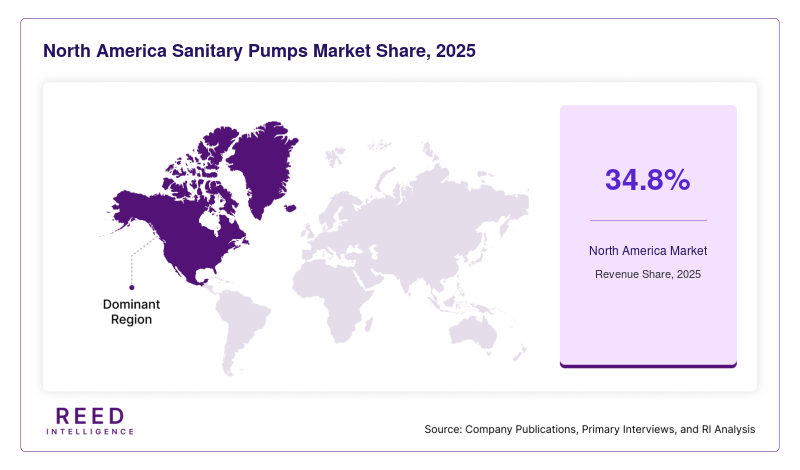
North America held 34.8% of the global Sanitary Pumps Market share in 2025 and is projected to expand at a CAGR of 6.5% during the forecast period. The region maintained a strong market position due to advanced pharmaceutical infrastructure and extensive food processing operations.
The United States dominated the regional market due to the increasing modernization of dairy processing facilities. Manufacturers across the country invested in automated hygienic processing equipment to improve operational productivity and maintain stringent food safety standards. Rising investments in biotechnology manufacturing also supported regional demand for sanitary pumps.
Europe
Europe accounted for 28.6% of the Sanitary Pumps Market share in 2025 and is anticipated to grow at a CAGR of 6.8% through 2034. The region experienced stable demand due to the strong presence of beverage processing and pharmaceutical manufacturing industries.
Germany led the European market owing to its industrial automation capabilities and advanced engineering sector. Companies in the country increasingly adopted precision sanitary pumps to improve fluid handling efficiency in beverage and pharmaceutical production environments. Increasing investments in sustainable manufacturing technologies also supported market development.
Asia Pacific
Asia Pacific represented 24.9% of the global Sanitary Pumps Market share in 2025 and is expected to register the fastest CAGR of 8.4% during the forecast period. The region witnessed rapid expansion due to increasing industrial investments and rising consumption of processed food products.
China dominated the regional market due to the expansion of pharmaceutical manufacturing capacity and increasing dairy production activities. Industrial modernization initiatives and large-scale investments in hygienic production infrastructure accelerated the adoption of sanitary pumping systems across the country.
Middle East & Africa
The Middle East & Africa accounted for 6.1% of the Sanitary Pumps Market share in 2025 and is forecast to grow at a CAGR of 6.2% during the forecast period. Increasing food processing investments and expansion of beverage manufacturing supported regional growth.
Saudi Arabia emerged as the dominant country due to the growing establishment of domestic food manufacturing plants. Rising investments in industrial diversification programs encouraged the adoption of advanced sanitary processing systems within the country.
Latin America
Latin America held 5.6% of the global Sanitary Pumps Market share in 2025 and is projected to expand at a CAGR of 6.4% during the forecast period. The regional market benefited from increasing dairy production and modernization of beverage manufacturing facilities.
Brazil dominated the Latin American market due to expanding processed food exports and increasing investments in hygienic packaging operations. The rising focus on food quality standards accelerated demand for sanitary pumping systems across industrial facilities.
Competitive Landscape
The Sanitary Pumps Market remains moderately competitive with the presence of international and regional manufacturers focusing on hygienic fluid handling technologies, product innovation, and industrial automation. Leading companies continue investing in advanced pump designs with enhanced energy efficiency and contamination control features.
SPX FLOW maintained a strong position in the market due to its broad sanitary processing equipment portfolio and strong distribution network across pharmaceutical and food industries. The company recently introduced upgraded hygienic pump systems designed for automated CIP operations and improved process reliability.
Other prominent companies focused on partnerships, production expansion, and technology integration to strengthen their market presence. Manufacturers also emphasized customized sanitary pumping solutions to meet industry-specific operational requirements. Increasing investments in biotechnology processing equipment are expected to intensify competitive activities across the global Sanitary Pumps Market.
Key Players List
- SPX FLOW
- Alfa Laval
- Fristam Pumpen KG
- Verder Group
- GEA Group
- Xylem Inc.
- Grundfos Holding A/S
- Ampco Pumps Company
- INOXPA
- NETZSCH Pumps & Systems
- Watson-Marlow Fluid Technology Solutions
- ITT Inc.
- Tapflo Group
- PCM Group
- Viking Pump
Recent Developments
- In 2025, Alfa Laval expanded its hygienic pump product line with improved energy-efficient centrifugal systems for dairy and beverage applications.
- SPX FLOW introduced automated sanitary pumps integrated with digital monitoring capabilities for pharmaceutical production facilities in 2024.
- GEA Group enhanced its hygienic processing equipment portfolio through upgraded low-shear sanitary pumping technologies.
- Verder Group expanded its manufacturing capacity to support rising demand from biotechnology processing industries.
- INOXPA launched compact sanitary pump systems designed for small-scale food and beverage manufacturers.
- Watson-Marlow Fluid Technology Solutions developed advanced peristaltic sanitary pumps for sterile pharmaceutical fluid transfer applications.
- Grundfos Holding A/S invested in energy-efficient pumping technologies focused on reducing industrial processing energy consumption.
Sanitary Pumps Market Segments
Pump Type
- Centrifugal Pumps
- Positive Displacement Pumps
- Diaphragm Pumps
- Rotary Lobe Pumps
- Twin Screw Pumps
- Others
Material
- Stainless Steel
- Alloy-Based Materials
- Polymer-Based Materials
- Others
Application
- Food & Beverage Processing
- Pharmaceutical Processing
- Biotechnology Processing
- Dairy Processing
- Cosmetics Processing
- Others
End-Use Industry
- Pharmaceutical Manufacturing
- Food Processing Industries
- Dairy Industries
- Cosmetics & Personal Care
- Chemical Processing
- Others
Flow Capacity
- Low Flow
- Medium Flow
- High Flow
By Region
- North America
- Europe
- APAC
- Middle East and Africa
- LATAM