SAP Digital Services Ecosystem Market Size, Share & Demand Report By Service Type (Consulting Services, Implementation Services, Integration Services, Managed Services, Support and Maintenance Services, SAP Analytics Services), By Deployment Mode (Cloud-Based Deployment, On-Premise Deployment, Hybrid Deployment), By Enterprise Size (Large Enterprises, Small and Medium Enterprises), By Industry Vertical (Manufacturing, BFSI, Retail and E-commerce, Healthcare, Energy and Utilities, Telecommunicati
USD 3950
Market Overview
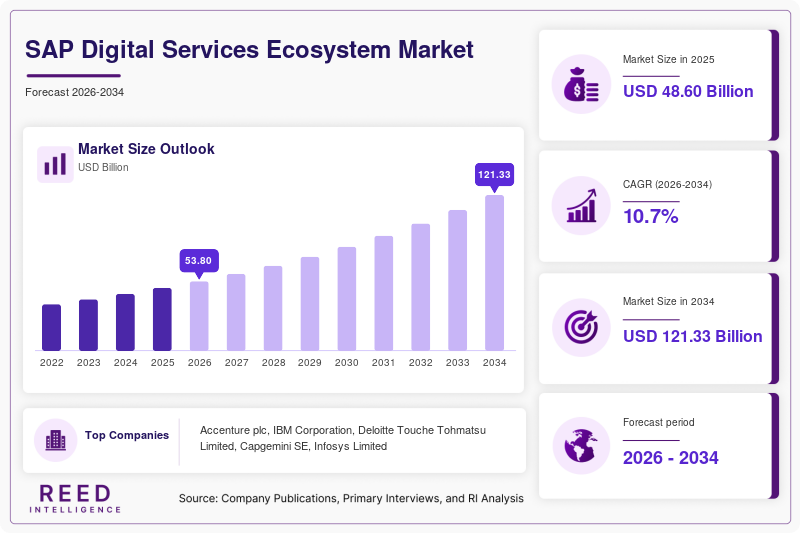
The global SAP Digital Services Ecosystem Market size was valued at USD 48.6 billion in 2026 and is projected to reach USD 109.4 billion by 2034, expanding at a CAGR of 10.7% during the forecast period from 2026 to 2034. The market is witnessing sustained growth due to rapid enterprise modernization initiatives, increasing cloud migration projects, and rising demand for integrated business transformation services. Organizations across manufacturing, retail, BFSI, healthcare, and public sectors are investing in SAP consulting, deployment, integration, analytics, managed services, and cloud optimization solutions to improve operational efficiency and digital agility.
A major global factor supporting market expansion is the accelerated adoption of intelligent enterprise frameworks driven by automation and AI-enabled workflows. Enterprises are shifting from legacy ERP environments toward cloud-based SAP S/4HANA ecosystems to support real-time analytics, scalable infrastructure, and data-driven decision-making. Businesses are also prioritizing cybersecurity, compliance management, and hybrid cloud integration, which has strengthened the role of SAP digital service providers worldwide. In addition, growing partnerships between SAP vendors, hyperscale cloud providers, and system integrators continue to create a broad digital transformation ecosystem that supports long-term market growth.
Key Highlights
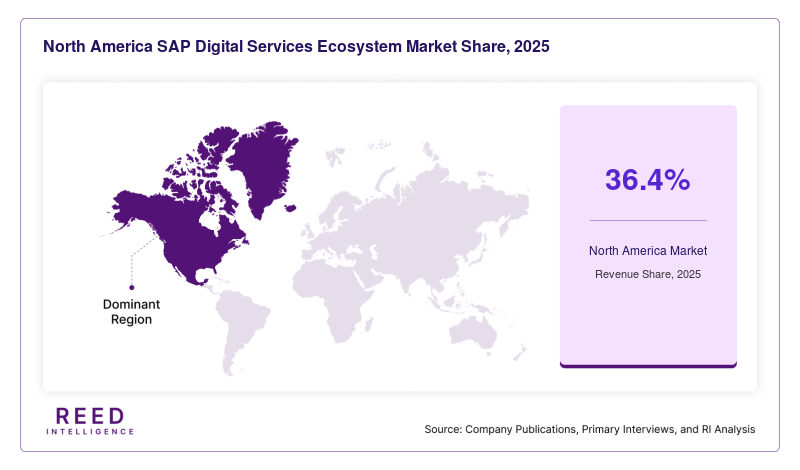
- North America dominated the SAP Digital Services Ecosystem Market with a 36.4% share in 2025.
- Asia Pacific is expected to grow at the fastest CAGR of 12.1% during 2026–2034.
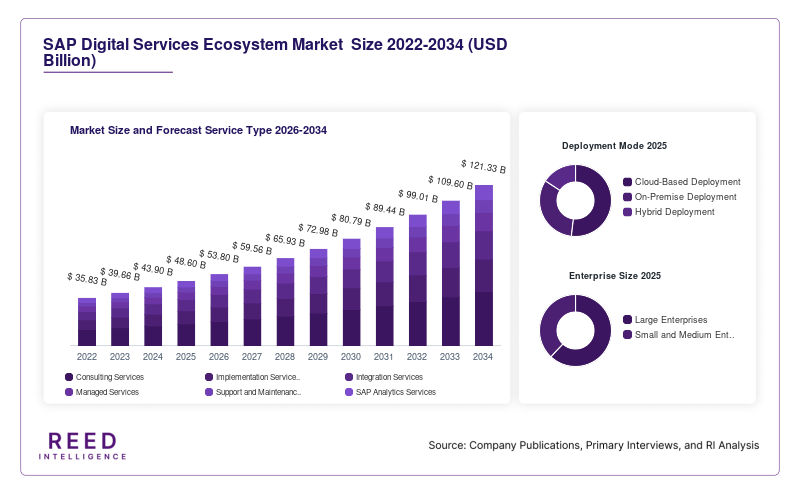
- By service type, SAP consulting and implementation services accounted for the largest share of 39.2%, while SAP cloud managed services are projected to grow at a CAGR of 13.4%. By deployment mode, cloud-based deployment led with a 58.7% share, whereas hybrid deployment is expected to expand at a CAGR of 12.8%.
- By enterprise size, large enterprises held a dominant share of 67.5%, while small and medium enterprises are projected to grow at a CAGR of 11.9%. The United States remained the dominant country, with market values of USD 12.1 billion in 2024 and USD 13.4 billion in 2025.
Market Trends
Growing Adoption of AI-Integrated SAP Business Platforms
The integration of artificial intelligence into SAP business platforms has emerged as a major trend influencing the SAP Digital Services Ecosystem Market. Enterprises are increasingly deploying AI-enabled SAP solutions to automate workflows, improve forecasting accuracy, and optimize supply chain operations. Intelligent ERP systems powered by machine learning algorithms are helping organizations reduce operational costs while improving enterprise-wide productivity. SAP service providers are expanding their AI consulting capabilities to support predictive analytics, robotic process automation, and intelligent finance operations across industries. This trend is particularly visible in manufacturing and retail sectors where enterprises are using AI-driven SAP applications to manage inventory planning, customer demand forecasting, and operational risk analysis.
The growing adoption of generative AI tools within SAP environments is also transforming enterprise decision-making processes. Companies are integrating conversational analytics, automated reporting systems, and AI-based procurement tools into their SAP ecosystems. Service vendors are increasingly offering customized AI integration packages, enabling businesses to improve scalability and data visibility. The rising use of intelligent automation within SAP S/4HANA migration projects is expected to further strengthen market demand during the forecast period.
Expansion of Multi-Cloud and Hybrid SAP Infrastructure
Enterprises are increasingly shifting toward hybrid and multi-cloud SAP environments to improve flexibility, scalability, and disaster recovery capabilities. Organizations with geographically distributed operations are adopting hybrid infrastructure models that combine private cloud, public cloud, and on-premise systems. This trend is driving demand for SAP digital services focused on cloud orchestration, migration management, cybersecurity integration, and infrastructure optimization. Large enterprises are particularly investing in multi-cloud strategies to avoid vendor dependency and improve operational continuity across global business units.
Cloud hyperscalers and SAP ecosystem partners are strengthening collaborative frameworks to deliver industry-specific digital transformation solutions. Businesses are demanding faster implementation timelines, lower infrastructure costs, and stronger compliance capabilities, encouraging service providers to enhance hybrid cloud deployment models. The rise of edge computing and real-time analytics applications is also increasing the complexity of SAP infrastructure management, creating long-term opportunities for managed service providers and cloud consulting firms operating within the SAP Digital Services Ecosystem Market.
Market Drivers
Rising Enterprise Migration Toward SAP S/4HANA Platforms
The ongoing migration from legacy ERP systems to SAP S/4HANA platforms is a major driver supporting the growth of the SAP Digital Services Ecosystem Market. Enterprises are modernizing their digital infrastructure to improve operational agility, reduce data silos, and enable real-time analytics capabilities. SAP S/4HANA migration projects often require consulting, integration, application management, cybersecurity assessment, and employee training services, creating substantial opportunities for digital service providers. Industries such as manufacturing, logistics, retail, and BFSI are leading adoption due to increasing demand for intelligent enterprise operations.
The approaching end of mainstream support for older SAP ERP systems is accelerating enterprise migration activities across developed and emerging economies. Organizations are investing heavily in cloud transformation programs to avoid operational disruptions and maintain compliance standards. SAP implementation partners are expanding migration accelerators, automation tools, and cloud readiness frameworks to support faster deployments. As enterprises continue prioritizing digital transformation strategies, the demand for SAP ecosystem services is expected to rise steadily over the forecast period.
Increasing Demand for Data-Driven Business Operations
Organizations are increasingly relying on real-time analytics and data-driven decision-making processes to improve competitiveness and operational efficiency. This shift is driving strong demand for SAP digital services related to analytics integration, enterprise data management, and intelligent reporting systems. Businesses are deploying SAP analytics cloud platforms and business intelligence solutions to improve visibility across finance, procurement, inventory, customer engagement, and workforce operations.
The growth of connected enterprise environments has further increased the importance of integrated data ecosystems. Enterprises require scalable SAP platforms capable of processing large volumes of operational and customer data across multiple business units. SAP service providers are therefore offering advanced integration frameworks that combine analytics, AI, IoT, and automation capabilities within centralized ERP ecosystems. The growing focus on predictive analytics and operational intelligence is expected to remain a key market growth driver throughout the forecast period.
Market Restraint
High Implementation Complexity and Rising Project Costs
The SAP Digital Services Ecosystem Market faces a significant restraint related to the high complexity and cost associated with SAP transformation projects. Large-scale ERP modernization initiatives often involve extensive infrastructure upgrades, application customization, process restructuring, and workforce training requirements. These projects may take several months or years to complete, creating operational disruptions and increasing financial risks for enterprises. Small and medium enterprises frequently face challenges related to budget constraints, limited technical expertise, and resource allocation, which can delay SAP adoption decisions.
Complex integration requirements also create implementation risks for organizations operating across multiple geographies and legacy systems. Businesses often encounter difficulties related to data migration, cybersecurity compliance, third-party application compatibility, and process standardization. Delays in project execution may increase operational costs and reduce return on investment expectations. For example, enterprises transitioning from highly customized legacy ERP environments to cloud-based SAP systems may require additional consulting and application redesign services, significantly increasing total implementation expenditure. These challenges continue to limit market penetration among cost-sensitive organizations despite growing digital transformation demand.
Market Opportunities
Expansion of Industry-Specific SAP Service Solutions
The increasing demand for industry-focused digital transformation solutions is creating strong growth opportunities within the SAP Digital Services Ecosystem Market. Enterprises across healthcare, energy, retail, automotive, and manufacturing sectors are seeking customized SAP service models designed for specific operational requirements. Service providers are developing vertical-specific SAP frameworks that support regulatory compliance, supply chain visibility, predictive maintenance, and customer experience optimization. These specialized solutions are helping organizations accelerate implementation timelines while improving operational efficiency.
Healthcare organizations are increasingly deploying SAP-based patient management and procurement systems, while manufacturers are investing in smart factory integrations and industrial IoT analytics. Retail companies are using SAP digital services to strengthen omnichannel commerce operations and inventory optimization capabilities. As industry requirements become more specialized, SAP ecosystem vendors are expected to increase investments in tailored consulting, analytics, and cloud integration services, creating long-term revenue opportunities across multiple sectors.
Rising Adoption of SAP Services Among Mid-Sized Enterprises
Mid-sized enterprises are emerging as an important growth opportunity for SAP digital service providers due to increasing cloud accessibility and subscription-based deployment models. Historically, SAP implementations were concentrated among large organizations with substantial IT budgets. However, cloud-native ERP platforms and modular deployment structures are now enabling mid-sized businesses to adopt SAP solutions with lower upfront infrastructure costs. This trend is expanding the addressable market for SAP consulting, integration, training, and managed services.
Growing competition among cloud providers and managed service vendors is also improving service affordability for smaller enterprises. Mid-sized companies are increasingly investing in digital finance systems, cloud procurement platforms, and customer experience solutions to improve operational scalability. SAP ecosystem providers are responding by launching simplified implementation packages and industry-focused cloud templates designed for faster deployment cycles. This transition is expected to significantly strengthen market expansion across emerging economies during the forecast period.
Segmental Analysis
By Service Type
SAP consulting and implementation services dominated the SAP Digital Services Ecosystem Market with a 39.2% share in 2024 due to the rising volume of enterprise ERP transformation projects. Organizations across manufacturing, retail, healthcare, and BFSI sectors increasingly relied on consulting firms to manage migration planning, application customization, workflow optimization, and enterprise integration activities. The growing complexity of SAP S/4HANA migration programs further strengthened demand for implementation specialists capable of reducing deployment risks and improving operational continuity. Enterprises also prioritized consulting services to align digital transformation strategies with long-term business objectives. Large-scale hybrid cloud deployments and process automation initiatives contributed significantly to the expansion of consulting-related revenue across global markets.
SAP cloud managed services are projected to witness the fastest CAGR of 13.4% during the forecast period due to increasing demand for scalable and cost-efficient ERP management solutions. Enterprises are increasingly outsourcing application monitoring, cybersecurity management, cloud optimization, and performance maintenance activities to specialized managed service providers. The growing adoption of subscription-based ERP infrastructure and hybrid cloud environments is creating strong demand for long-term operational support services. Businesses are also focusing on reducing internal IT management complexity while improving system uptime and compliance capabilities. As enterprise cloud ecosystems become more interconnected and data-intensive, demand for advanced managed services is expected to accelerate substantially across multiple industries.
By Deployment Mode
Cloud-based deployment accounted for the largest market share of 58.7% in 2024 due to the growing shift toward scalable and remotely accessible enterprise systems. Organizations are increasingly adopting cloud-native SAP platforms to reduce infrastructure costs, improve operational flexibility, and accelerate digital transformation initiatives. Cloud deployment models provide faster implementation cycles, real-time analytics accessibility, and centralized data management capabilities, making them attractive for enterprises operating across multiple locations. Industries such as retail, banking, healthcare, and telecommunications are prioritizing cloud ERP systems to improve collaboration and customer engagement efficiency. The rising adoption of software-as-a-service business models and hyperscale cloud partnerships has also strengthened the market position of cloud-based SAP deployments worldwide.
Hybrid deployment is expected to register the fastest CAGR of 12.8% during the forecast period due to increasing enterprise demand for flexible infrastructure strategies. Organizations with complex operational environments are adopting hybrid deployment models that combine on-premise systems with private and public cloud capabilities. This structure allows enterprises to maintain control over sensitive workloads while benefiting from scalable cloud resources for analytics and customer engagement applications. Regulatory compliance requirements and cybersecurity concerns are also encouraging businesses to retain selected workloads within private infrastructure environments. SAP ecosystem vendors are increasingly offering advanced hybrid integration frameworks that support real-time synchronization, operational continuity, and cross-platform analytics management, driving future segment growth.
By Enterprise Size
Large enterprises held the dominant share of 67.5% in 2024 due to extensive investments in global digital transformation programs and enterprise-wide ERP modernization initiatives. Multinational corporations across manufacturing, finance, logistics, and healthcare sectors are heavily dependent on integrated SAP ecosystems to manage complex operational networks and real-time analytics requirements. These organizations possess the financial and technical resources required for large-scale SAP migration, customization, and cloud integration projects. Growing adoption of AI-driven business intelligence systems and predictive analytics platforms has further increased SAP service demand among large enterprises. In addition, increasing focus on operational resilience, compliance management, and cross-border supply chain visibility continues to support long-term market dominance within this segment.
Small and medium enterprises are expected to grow at the fastest CAGR of 11.9% during the forecast period due to improving accessibility of cloud-based ERP platforms and subscription-oriented pricing models. Mid-sized organizations are increasingly recognizing the operational benefits of integrated finance, procurement, inventory, and customer management systems. SAP service providers are launching simplified deployment packages, industry-specific cloud templates, and managed service solutions tailored for smaller enterprises. The reduced need for extensive infrastructure investment is encouraging wider SAP adoption among growing businesses in emerging economies. As digital competition intensifies across industries, SMEs are expected to accelerate ERP modernization initiatives to improve operational efficiency, scalability, and customer experience management.
Regional Analysis
North America
North America accounted for 36.4% of the global SAP Digital Services Ecosystem Market share in 2025 and is expected to maintain a strong growth trajectory throughout the forecast period. The region is projected to expand at a CAGR of 9.8% from 2026 to 2034 due to rising investments in cloud ERP modernization and enterprise automation technologies. Large enterprises across finance, healthcare, retail, and manufacturing industries continue to accelerate SAP migration projects to improve operational efficiency and digital resilience. The strong presence of global consulting firms and cloud infrastructure providers further supports regional market expansion.
The United States remains the dominant country within the regional market due to extensive adoption of SAP S/4HANA transformation programs and advanced analytics platforms. Organizations across the country are increasing investments in AI-driven enterprise resource planning systems and cloud integration services. Another unique growth factor is the rapid adoption of sustainability reporting frameworks integrated within SAP ecosystems. Enterprises are increasingly using SAP digital solutions to track carbon emissions, regulatory compliance, and ESG reporting metrics, strengthening demand for specialized consulting and analytics services.
Europe
Europe held a substantial share of the SAP Digital Services Ecosystem Market in 2025 and is projected to grow at a CAGR of 9.5% during the forecast period. The region continues to witness strong demand for SAP consulting and cloud migration services due to increasing enterprise digitization efforts and strict regulatory compliance standards. Industries such as automotive, industrial manufacturing, pharmaceuticals, and logistics are heavily investing in integrated ERP systems to improve operational transparency and process automation. Growing emphasis on sustainable supply chain management is also contributing to market growth across European economies.
Germany remains the dominant country within the European market due to the large presence of manufacturing enterprises and industrial automation companies. German businesses are rapidly adopting intelligent ERP systems to improve production planning, predictive maintenance, and inventory optimization capabilities. A unique growth factor in the country is the strong integration of Industry 4.0 technologies with SAP ecosystems. Manufacturers are increasingly combining industrial IoT platforms, robotics, and AI-driven analytics with SAP infrastructure to strengthen operational efficiency and factory automation processes.
Asia Pacific
Asia Pacific is expected to register the fastest CAGR of 12.1% during the forecast period due to rapid enterprise digitization and increasing cloud adoption across emerging economies. Organizations in China, India, Japan, South Korea, and Southeast Asia are investing heavily in ERP modernization initiatives to improve business scalability and supply chain resilience. Rising adoption of smart manufacturing technologies and AI-enabled enterprise systems is also supporting strong demand for SAP digital consulting and integration services across the region.
China remains the dominant country in the Asia Pacific market owing to extensive industrial automation initiatives and large-scale enterprise cloud transformation programs. Chinese enterprises are increasingly adopting SAP-based analytics and procurement platforms to improve operational efficiency and global competitiveness. A major growth factor supporting the market is the expansion of domestic manufacturing digitalization projects under smart industry initiatives. This trend is encouraging widespread deployment of integrated ERP and analytics systems across industrial enterprises.
Middle East & Africa
The Middle East & Africa SAP Digital Services Ecosystem Market is projected to grow steadily due to increasing investments in digital infrastructure and government-led economic diversification initiatives. The region is expected to expand at a CAGR of 8.7% during the forecast period as enterprises modernize legacy systems and adopt cloud-based ERP platforms. Sectors such as energy, telecommunications, logistics, and public administration are leading SAP service adoption due to rising demand for operational efficiency and real-time business analytics.
Saudi Arabia represents the dominant country within the regional market due to large-scale digital transformation programs associated with economic modernization strategies. Enterprises and government institutions are investing in cloud ERP platforms, cybersecurity frameworks, and AI-enabled enterprise applications to improve operational transparency. A unique regional growth factor is the increasing deployment of SAP systems within smart city and infrastructure development projects. These initiatives are driving demand for analytics integration, supply chain management, and intelligent procurement solutions.
Latin America
Latin America accounted for a moderate share of the SAP Digital Services Ecosystem Market in 2025 and is expected to expand at a CAGR of 8.9% from 2026 to 2034. The regional market is being supported by increasing enterprise cloud adoption and modernization initiatives across manufacturing, banking, and retail sectors. Businesses are gradually replacing fragmented legacy systems with integrated ERP platforms to improve financial management, operational visibility, and supply chain coordination. Rising awareness regarding digital transformation benefits is further contributing to market growth across the region.
Brazil remains the dominant country within the Latin American market due to growing investments in enterprise automation and cloud infrastructure development. Large organizations are increasingly adopting SAP analytics and procurement platforms to improve operational efficiency and regulatory compliance. A key growth factor supporting the Brazilian market is the rapid digitalization of financial services and retail commerce ecosystems. Enterprises are using SAP digital solutions to strengthen customer engagement, inventory management, and payment processing capabilities.
Competitive Landscape
The SAP Digital Services Ecosystem Market remains highly competitive due to the presence of global consulting firms, cloud service providers, and specialized enterprise software integrators. Companies are focusing on strategic partnerships, AI-enabled service expansion, and industry-specific digital transformation offerings to strengthen market positioning. Service providers are also investing heavily in cloud migration accelerators, cybersecurity integration capabilities, and automation-driven consulting frameworks to improve operational efficiency for enterprise clients.
Accenture continues to maintain a leading market position due to its large SAP consulting network, extensive cloud integration expertise, and strong enterprise client base across multiple industries. The company recently expanded its AI-powered SAP modernization services to support intelligent automation and predictive analytics integration for large enterprises.
Other major participants include IBM, Deloitte, Capgemini, and Infosys. These companies are increasing investments in SAP cloud transformation services, industry-focused ERP frameworks, and managed infrastructure solutions. Competitive intensity is expected to rise further as enterprises continue accelerating cloud ERP adoption and AI-driven business transformation initiatives.
Key Players
- Accenture
- IBM
- Deloitte
- Capgemini
- Infosys
- Tata Consultancy Services
- Wipro
- Cognizant
- NTT DATA
- HCLTech
- PwC
- EY
- Atos
- Fujitsu
- DXC Technology
- Tech Mahindra
- Hitachi Digital Services
- Mindtree
- KPMG
- BearingPoint
Recent Developments
- In February 2026, Accenture expanded its SAP Business AI transformation services through a strategic collaboration focused on generative AI-enabled ERP automation solutions.
- In September 2025, IBM launched an advanced SAP cloud migration framework designed to accelerate enterprise transition toward hybrid cloud infrastructure environments.
- In June 2025, Infosys introduced industry-specific SAP digital transformation suites for manufacturing and retail enterprises to improve analytics and operational automation capabilities.
- In January 2026, Capgemini expanded its managed SAP cybersecurity services portfolio to support compliance and cloud risk management across global enterprises.
- In November 2025, Tata Consultancy Services strengthened its SAP consulting partnership ecosystem by launching new AI-driven enterprise process optimization services for multinational organizations.
SAP Digital Services Ecosystem Market Segments
Service Type
- Consulting Services
- Implementation Services
- Integration Services
- Managed Services
- Support and Maintenance Services
- SAP Analytics Services
Deployment Mode
- Cloud-Based Deployment
- On-Premise Deployment
- Hybrid Deployment
Enterprise Size
- Large Enterprises
- Small and Medium Enterprises
Industry Vertical
- Manufacturing
- BFSI
- Retail and E-commerce
- Healthcare
- Energy and Utilities
- Telecommunications
- Government and Public Sector
- Transportation and Logistics
By Region
- North America
- Europe
- APAC
- Middle East and Africa
- LATAM