Sarcopenia Clinical Trials Market Size, Share & Demand Report By Phase (Phase I, Phase II, Phase III), By Intervention Type (Pharmacological Therapies, Biologics, Nutritional Supplements), By End-Use (Pharmaceutical & Biotechnology Companies, Contract Research Organizations, Academic & Research Institutes), By Region & Segment Forecasts, 2026–2034
USD 3950
Market Overview
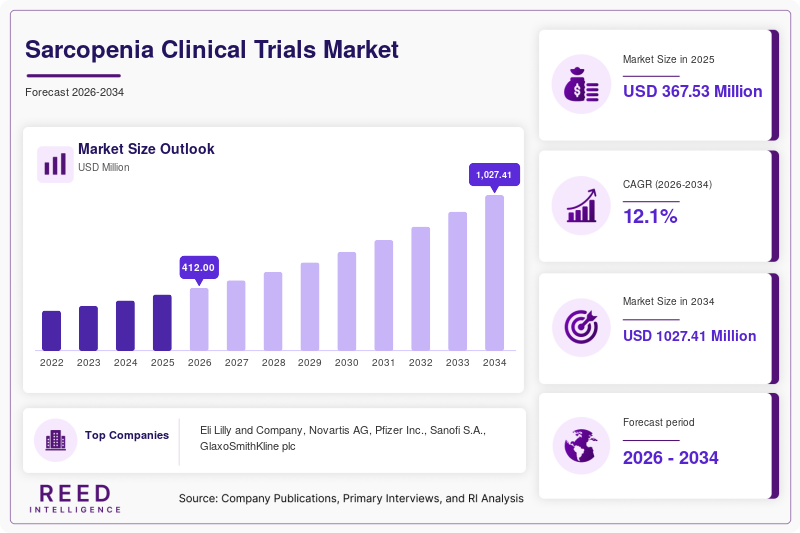
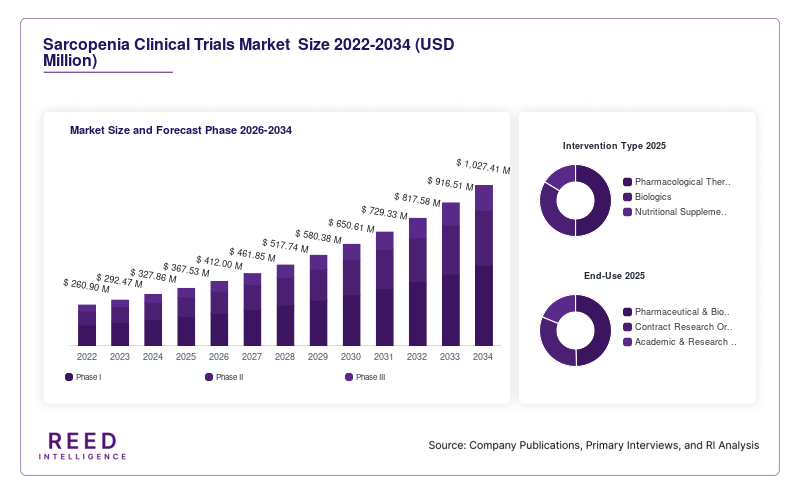
The Sarcopenia Clinical Trials Market size is estimated to reach a value of USD 412 million in 2026 and is projected to grow to approximately USD 1.02 billion by 2034, expanding at a CAGR of 12.1% during the forecast period (2026–2034). The market is driven by increasing global awareness of age-related muscle degeneration and the rising elderly population, which has created a demand for targeted therapeutics and clinical validation of novel treatment approaches. Pharmaceutical companies and research organizations are actively investing in sarcopenia-focused drug pipelines, contributing to steady expansion in clinical trial activity across both developed and emerging regions.
A key global factor supporting market growth is the growing emphasis on healthy aging initiatives by healthcare systems and governments. As healthcare costs associated with frailty and muscle loss increase, there is a shift toward preventive and therapeutic strategies, including clinical trials evaluating biologics, small molecules, and nutritional interventions. This has resulted in a consistent rise in funding for sarcopenia research, along with collaborative efforts between academic institutions and industry stakeholders.
Key Highlights
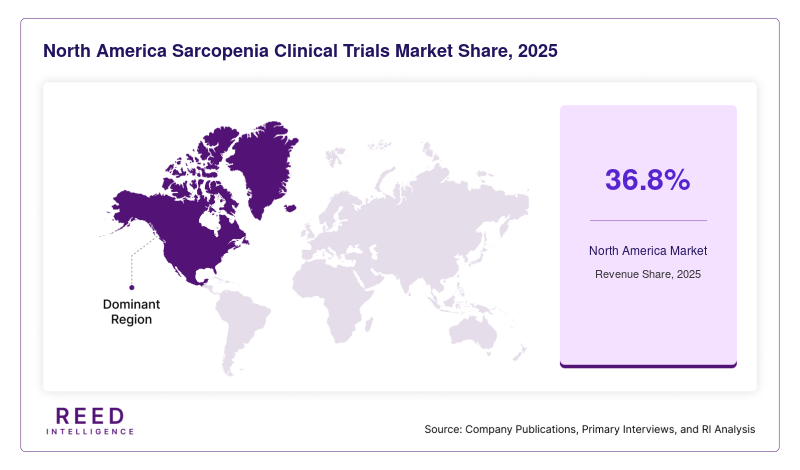
- North America dominated the market with a 36.8% share in 2025.
- Asia Pacific is expected to grow at the fastest CAGR of 13.4% during 2026–2034.
- By phase, Phase II trials accounted for the largest share of 42.6%, while Phase III trials are projected to grow at a CAGR of 12.9%.
- By intervention type, pharmacological therapies led with a 47.3% share, whereas biologics are expected to expand at a CAGR of 13.2%.
- The United States remained the dominant country, with market values of USD 145 million in 2024 and USD 162 million in 2025.
Market Trends
Increasing focus on biomarker-driven clinical trials
One of the notable trends shaping the Sarcopenia Clinical Trials Market is the increasing integration of biomarker-driven approaches in study design. Researchers are focusing on identifying reliable biomarkers that can accurately measure muscle mass, strength, and function, which improves trial efficiency and outcomes. This shift allows sponsors to better stratify patient populations and optimize treatment responses, reducing variability in clinical endpoints. The use of advanced imaging technologies, wearable devices, and digital health tools further supports real-time monitoring, enhancing data accuracy. As precision medicine gains traction, biomarker-driven trials are expected to play a significant role in improving success rates and reducing trial durations.
Expansion of combination therapy studies
Another emerging trend is the growing emphasis on combination therapy approaches within clinical trials. Sarcopenia is a multifactorial condition influenced by aging, metabolic disorders, and lifestyle factors, which has encouraged researchers to explore integrated treatment strategies. Clinical trials are increasingly evaluating combinations of pharmacological agents, nutritional supplements, and exercise regimens to achieve improved patient outcomes. This trend reflects a shift from single-intervention studies toward holistic treatment models. Additionally, collaborations between pharmaceutical companies and nutrition-based firms are becoming more common, leading to innovative trial designs that address multiple pathways involved in muscle degeneration.
Market Drivers
Rising geriatric population and disease burden
The rapid increase in the global aging population is a primary driver of the Sarcopenia Clinical Trials Market. As life expectancy continues to rise, the prevalence of sarcopenia and related conditions such as frailty and mobility impairment is increasing significantly. This demographic shift has created a growing demand for effective therapeutic solutions, prompting pharmaceutical and biotechnology companies to invest in clinical research. The burden on healthcare systems has also intensified, encouraging policymakers to support research initiatives that address age-related disorders. Consequently, the expansion of the elderly population is directly contributing to the growth in clinical trial activity focused on sarcopenia.
Increasing investment in drug development and research
Another key driver is the surge in investment directed toward drug development for muscle-wasting conditions. Pharmaceutical companies are expanding their pipelines to include innovative therapies targeting muscle growth pathways, inflammation, and metabolic regulation. Government funding agencies and private investors are also providing financial support for early-stage and late-stage clinical trials. This influx of capital is accelerating the pace of research and enabling the adoption of advanced technologies in trial design. Furthermore, partnerships between academic institutions and industry players are facilitating knowledge exchange and resource sharing, which enhances the overall efficiency of clinical trials in the sarcopenia space.
Market Restraint
Challenges in standardization of diagnostic criteria
A significant restraint impacting the Sarcopenia Clinical Trials Market is the lack of universally accepted diagnostic criteria and endpoints. Variability in definitions of sarcopenia across regions and clinical guidelines creates challenges in patient selection and data comparison. This inconsistency often leads to difficulties in designing robust clinical trials and achieving regulatory approval. Moreover, differences in measurement techniques for muscle mass and strength can affect trial outcomes, resulting in delays or failures. For example, trials conducted in different regions may use varying assessment tools, making it harder to establish standardized benchmarks. This lack of harmonization increases the complexity and cost of clinical trials, ultimately hindering market growth.
Market Opportunities
Adoption of digital health technologies in trials
The integration of digital health technologies presents a promising opportunity for the Sarcopenia Clinical Trials Market. Wearable devices, mobile health applications, and remote monitoring tools are increasingly being used to track patient activity levels, muscle strength, and overall health status. These technologies enable decentralized clinical trials, reducing the need for frequent site visits and improving patient compliance. Additionally, real-time data collection enhances the accuracy of trial results and supports better decision-making. As digital health solutions continue to evolve, their adoption in sarcopenia clinical trials is expected to expand, creating new avenues for efficient and patient-centric research.
Emerging markets as new trial hubs
Emerging economies offer significant growth opportunities for the expansion of sarcopenia clinical trials. Countries in Asia Pacific, Latin America, and parts of the Middle East are witnessing improvements in healthcare infrastructure and regulatory frameworks, making them attractive destinations for clinical research. These regions provide access to large and diverse patient populations, which is essential for conducting comprehensive trials. Additionally, lower operational costs compared to developed markets make these regions economically favorable for sponsors. As global pharmaceutical companies seek to optimize trial efficiency and reduce expenses, the shift toward emerging markets is expected to drive growth in the sarcopenia clinical trials landscape.
Segmental Analysis
By Phase
Phase II trials dominated the Sarcopenia Clinical Trials Market in 2024, accounting for approximately 42.6% of the total share. These trials play a critical role in evaluating the efficacy and safety of potential treatments, making them a focal point for pharmaceutical companies. The high share of Phase II trials reflects the growing number of investigational therapies targeting sarcopenia. Companies are investing heavily in mid-stage trials to validate their drug candidates before progressing to larger studies. Additionally, advancements in trial design and patient recruitment strategies have improved the efficiency of Phase II trials, further contributing to their dominance.
Phase III trials are expected to be the fastest-growing subsegment, with a projected CAGR of 12.9% during the forecast period. This growth is driven by the increasing number of promising candidates advancing from earlier phases. The expansion of Phase III trials indicates a maturing pipeline and growing confidence in therapeutic approaches. A key growth factor is the rising demand for large-scale validation studies required for regulatory approval. As more therapies demonstrate positive results in Phase II, the transition to Phase III trials is expected to accelerate, boosting overall market growth.
By Intervention Type
Pharmacological therapies held the largest share of the Sarcopenia Clinical Trials Market in 2024, accounting for 47.3%. These therapies include small molecules and drugs targeting muscle growth pathways, inflammation, and metabolic processes. The dominance of pharmacological interventions is attributed to the strong focus on drug development by pharmaceutical companies. Significant investments in research and development have led to a robust pipeline of drug candidates, driving the growth of this segment. Additionally, the potential for scalable manufacturing and commercialization makes pharmacological therapies a preferred choice for sponsors.
Biologics are projected to be the fastest-growing subsegment, with a CAGR of 13.2% during the forecast period. The growth of biologics is driven by their ability to target specific molecular pathways involved in muscle degeneration. Advances in biotechnology have enabled the development of innovative biologic therapies with improved efficacy and safety profiles. A key growth factor is the increasing adoption of personalized medicine approaches, which favor biologics due to their targeted mechanisms of action. As research in this area continues to evolve, biologics are expected to gain significant traction in clinical trials.
By End-Use
Pharmaceutical and biotechnology companies dominated the Sarcopenia Clinical Trials Market in 2024, holding a share of approximately 51.8%. These organizations are the primary sponsors of clinical trials, driving innovation and development in the field. Their strong financial capabilities and extensive research infrastructure enable them to conduct large-scale studies and bring new therapies to market. The dominance of this segment is also supported by strategic collaborations and partnerships that enhance research efficiency and accelerate trial timelines.
Contract research organizations (CROs) are expected to be the fastest-growing subsegment, with a CAGR of 12.7% during the forecast period. The increasing outsourcing of clinical trials to CROs is a major growth factor, as companies seek to reduce costs and improve operational efficiency. CROs provide specialized expertise and infrastructure, enabling faster trial execution and better data management. As the complexity of clinical trials continues to increase, the demand for CRO services is expected to rise, contributing to the growth of this segment.
Regional Analysis
North America
North America accounted for the largest share of the Sarcopenia Clinical Trials Market in 2025, capturing approximately 36.8% of the global market. The region is expected to maintain its dominance, growing at a CAGR of 11.5% during the forecast period. This growth is supported by a well-established healthcare infrastructure, high research funding, and a strong presence of pharmaceutical and biotechnology companies actively involved in sarcopenia-related trials.
The United States remains the dominant country in this region, driven by its advanced clinical research ecosystem and high adoption of innovative technologies. A unique growth factor is the strong support from government agencies and regulatory bodies that encourage research into age-related diseases. This has resulted in a steady increase in clinical trial registrations and funding opportunities.
Europe
Europe holds a significant share of the Sarcopenia Clinical Trials Market, accounting for around 27.4% in 2025, with a projected CAGR of 11.2% through 2034. The region benefits from collaborative research initiatives and funding programs that support clinical trials across multiple countries. The presence of established healthcare systems also contributes to market stability.
Germany leads the European market due to its strong focus on geriatric healthcare and clinical research. A unique growth factor is the increasing collaboration between academic institutions and pharmaceutical companies, which enhances research capabilities and accelerates the development of new therapies for sarcopenia.
Asia Pacific
Asia Pacific is the fastest-growing region in the Sarcopenia Clinical Trials Market, with a CAGR of 13.4% during the forecast period and a 2025 market share of 18.6%. The region’s growth is driven by a rapidly aging population and increasing healthcare investments. Governments are prioritizing research into age-related conditions, leading to a rise in clinical trial activities.
Japan dominates the Asia Pacific market due to its large elderly population and advanced healthcare infrastructure. A unique growth factor is the country’s proactive approach to addressing aging-related health issues through national healthcare policies, which support the expansion of clinical trials focused on sarcopenia.
Middle East & Africa
The Middle East & Africa region accounted for approximately 8.1% of the Sarcopenia Clinical Trials Market in 2025 and is expected to grow at a CAGR of 10.6% during the forecast period. The market is gradually expanding due to improving healthcare infrastructure and increasing awareness of age-related diseases.
Saudi Arabia leads the region, supported by government initiatives aimed at strengthening the healthcare sector. A unique growth factor is the growing investment in clinical research facilities and partnerships with international organizations, which is enhancing the region’s capability to conduct advanced clinical trials.
Latin America
Latin America held a market share of 9.1% in 2025 and is projected to grow at a CAGR of 10.9% through 2034. The region is witnessing steady growth due to increasing participation in global clinical trials and improvements in regulatory frameworks.
Brazil is the dominant country in Latin America, benefiting from a large patient pool and expanding healthcare infrastructure. A unique growth factor is the rising interest of global pharmaceutical companies in conducting trials in the region due to cost advantages and diverse population demographics.
Competitive Landscape
The Sarcopenia Clinical Trials Market is characterized by moderate competition, with several pharmaceutical and biotechnology companies actively engaged in research and development. Leading players are focusing on expanding their clinical pipelines and forming strategic partnerships to strengthen their market position. The competitive landscape is also influenced by collaborations with academic institutions and research organizations, which facilitate innovation and knowledge sharing.
A key leader in the market is Eli Lilly and Company, which has a strong presence in muscle-related therapeutic research. The company has recently advanced its sarcopenia-focused drug candidate into late-stage clinical trials, reflecting its commitment to addressing age-related muscle loss. Other major players are also investing in innovative trial designs and technologies to enhance their competitive edge. The market is expected to witness increased competition as new entrants and emerging companies introduce novel therapies.
Key Players
- Eli Lilly and Company
- Novartis AG
- Pfizer Inc.
- Sanofi S.A.
- GlaxoSmithKline plc
- AbbVie Inc.
- Amgen Inc.
- Merck & Co., Inc.
- AstraZeneca plc
- Bayer AG
- Biogen Inc.
- Regeneron Pharmaceuticals, Inc.
- Takeda Pharmaceutical Company Limited
- Boehringer Ingelheim International GmbH
- Johnson & Johnson
Recent Developments
- A leading pharmaceutical company initiated a Phase III clinical trial for a novel sarcopenia treatment targeting muscle regeneration pathways.
- A biotechnology firm announced a collaboration with a research institute to develop biomarker-based diagnostic tools for sarcopenia trials.
- A contract research organization expanded its clinical trial services in Asia Pacific to support increasing demand for sarcopenia studies.
Sarcopenia Clinical Trials Market Segments
Phase
- Phase I
- Phase II
- Phase III
Intervention Type
- Pharmacological Therapies
- Biologics
- Nutritional Supplements
End-Use
- Pharmaceutical & Biotechnology Companies
- Contract Research Organizations
- Academic & Research Institutes
By Region
- North America
- Europe
- APAC
- Middle East and Africa
- LATAM