Satellite Backhaul Market Size, Share & Demand Report By Component (Equipment, Managed Services, Professional Services), By Network Type (Geostationary Satellite Systems, Medium-Earth-Orbit Satellite Systems, Low-Earth-Orbit Satellite Systems), By Application (Mobile Backhaul, Maritime Communication, Aviation Connectivity, Enterprise Communication, Defense and Government Communication, Disaster Recovery Communication), By End User (Telecom Operators, Government and Defense, Maritime Operators, A
USD 3950
Market Overview
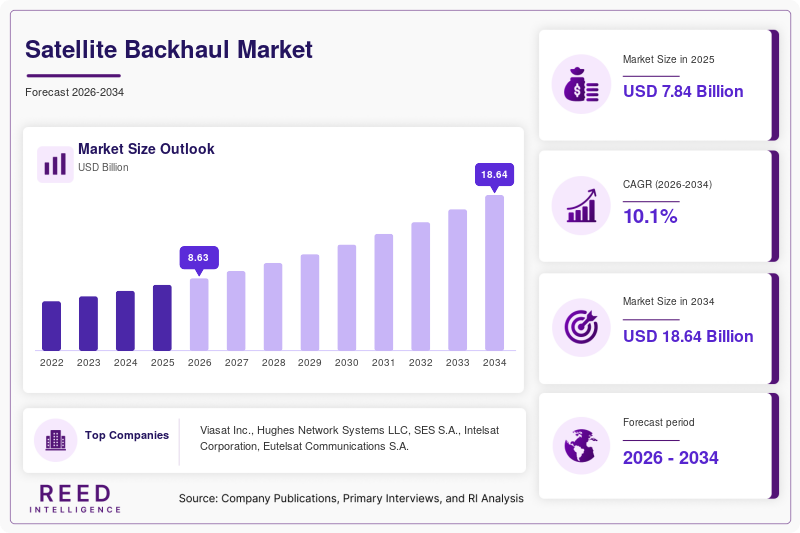
The global Satellite Backhaul Market size was valued at USD 7.84 billion in 2026 and is projected to reach USD 16.92 billion by 2034, expanding at a CAGR of 10.1% during the forecast period from 2026 to 2034. The market is witnessing stable expansion due to the increasing need for uninterrupted broadband connectivity in remote and underserved regions. Satellite backhaul systems are widely deployed by telecom operators, internet service providers, maritime communication companies, and defense organizations to support reliable data transmission where terrestrial infrastructure remains limited or economically impractical. Growing mobile data traffic, increasing 5G deployment activities, and rising demand for low-latency communication networks continue to support industry growth across both developed and emerging economies.
A major global factor contributing to market expansion is the increasing digital inclusion initiatives launched by governments and telecom operators. Several countries are investing in rural broadband programs to improve internet accessibility for businesses, schools, healthcare facilities, and households located in geographically challenging areas. Satellite backhaul solutions provide flexible and scalable connectivity for isolated regions, islands, mining zones, and offshore energy facilities. In addition, the integration of high-throughput satellites and low-earth-orbit satellite constellations has improved bandwidth efficiency and reduced operational delays, encouraging telecom providers to expand their satellite-supported mobile networks.
Key Highlights
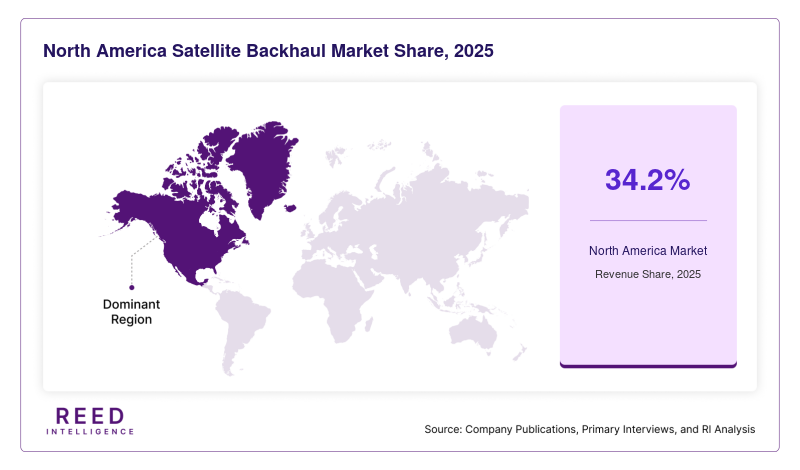
- North America dominated the market with a 34.2% share in 2025, while Asia Pacific is expected to grow at the fastest CAGR of 11.8% during 2026–2034.
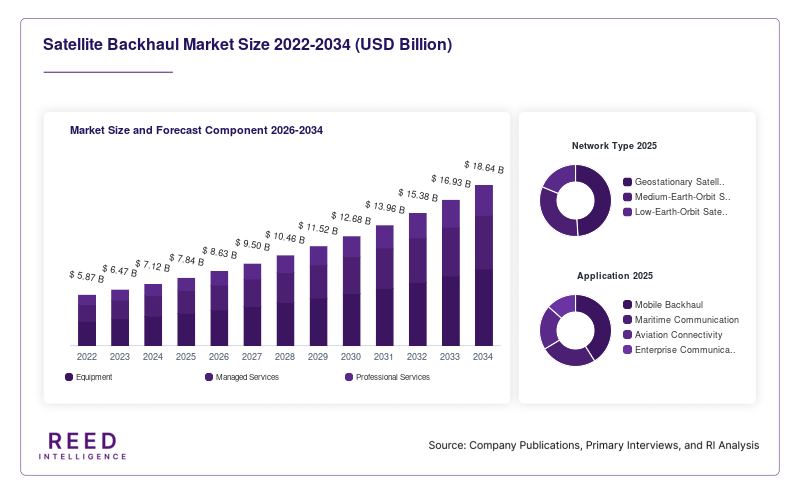
- By component, equipment accounted for the largest share of 46.7%, while managed services are projected to grow at a CAGR of 12.3%.
- By network type, geostationary satellite systems led with a 52.4% share, whereas low-earth-orbit satellite systems are expected to expand at a CAGR of 13.6%.
- By application, mobile backhaul led with a 44.9% share, whereas maritime communication is expected to expand at a CAGR of 12.7%.
- The United States remained the dominant country, with market values of USD 2.08 billion in 2024 and USD 2.31 billion in 2025.
Market Trends
Expansion of Low-Earth-Orbit Satellite Networks
The increasing deployment of low-earth-orbit satellite constellations is reshaping the Satellite Backhaul Market. Telecom operators and satellite communication providers are focusing on low-earth-orbit infrastructure to improve latency performance, bandwidth capacity, and network responsiveness. Unlike conventional geostationary systems, low-earth-orbit satellites operate closer to the earth, enabling faster communication speeds and better service quality for data-intensive applications. The growing demand for high-speed connectivity across rural communities, maritime routes, and aviation networks is accelerating investment in these systems. Several telecom operators are integrating hybrid satellite-terrestrial architectures to support expanding 5G services and enterprise connectivity requirements. The trend is also encouraging new partnerships between satellite manufacturers, launch service providers, and telecom infrastructure companies to strengthen commercial deployment capabilities.
Integration of Satellite Backhaul with 5G Infrastructure
The growing commercialization of 5G networks is creating strong demand for advanced satellite backhaul solutions. Telecom providers are increasingly using satellite-supported backhaul infrastructure to extend 5G coverage into rural and remote locations where fiber deployment remains costly. Satellite networks are becoming an important complement to terrestrial infrastructure because they provide rapid deployment and broader geographic reach. Operators are also utilizing satellite systems for temporary network expansion during large public events, emergency response operations, and infrastructure failures. High-throughput satellites are supporting enhanced mobile broadband services and enabling stable connectivity for industrial automation, telemedicine, and smart transportation applications. The combination of satellite communication and 5G architecture is improving network resilience and supporting the development of connected digital ecosystems across multiple industries.
Market Drivers
Rising Demand for Rural Broadband Connectivity
The increasing demand for broadband access in underserved and remote regions continues to drive the Satellite Backhaul Market. Many rural communities still lack reliable terrestrial communication infrastructure because of high installation costs and difficult geographical conditions. Satellite backhaul systems provide an effective alternative by delivering internet and mobile connectivity across mountainous regions, deserts, islands, and offshore locations. Governments across Asia Pacific, Africa, and Latin America are launching digital inclusion programs that support the deployment of satellite-supported communication infrastructure. Telecom operators are also partnering with satellite service providers to improve network accessibility and customer reach. The expansion of remote learning, telehealth services, e-commerce platforms, and digital banking activities has increased the urgency for dependable rural connectivity, further supporting long-term market growth.
Growth in Data Traffic and Connected Devices
The rapid increase in mobile data consumption and connected devices is significantly accelerating demand for satellite backhaul solutions. Businesses and consumers are using bandwidth-intensive applications such as cloud computing, video streaming, online collaboration platforms, and industrial IoT systems at a growing scale. Telecom operators require reliable backhaul infrastructure to manage rising network traffic while maintaining service quality. Satellite communication systems offer flexible capacity expansion and support network continuity during congestion or terrestrial outages. In sectors such as mining, oil and gas, transportation, and defense, connected devices often operate in isolated environments where terrestrial infrastructure remains limited. Satellite backhaul solutions help maintain uninterrupted communication and data exchange in these locations. The increasing adoption of smart infrastructure and connected enterprise operations is expected to maintain strong demand for scalable satellite communication networks.
Market Restraint
High Infrastructure and Deployment Costs
The Satellite Backhaul Market faces a significant challenge due to the high cost associated with satellite infrastructure development and deployment. Building satellite communication networks requires substantial investments in satellite manufacturing, launch services, ground station infrastructure, spectrum licensing, and network management systems. Telecom operators operating in cost-sensitive markets may hesitate to adopt advanced satellite backhaul systems because of long return-on-investment periods. In addition, maintaining satellite networks requires specialized technical expertise and ongoing operational expenditures. Smaller regional operators often struggle to compete with larger communication companies that possess stronger financial resources and established satellite partnerships.
The high cost burden can also delay network expansion projects in developing economies where funding support remains limited. For example, rural broadband programs in certain emerging countries have experienced slower deployment timelines because operators faced budget constraints related to equipment procurement and satellite bandwidth leasing. Although low-earth-orbit satellite systems are improving network performance, their large-scale constellation deployment requires extensive capital investment and continuous satellite replacement cycles. These financial pressures may restrict adoption among small telecom providers and limit the pace of market penetration in lower-income regions.
Market Opportunities
Increasing Demand for Maritime and Aviation Connectivity
The growing need for uninterrupted connectivity across maritime and aviation sectors is creating new opportunities for the Satellite Backhaul Market. Shipping companies, cruise operators, airlines, and offshore energy facilities increasingly rely on high-speed communication systems to support operational efficiency and passenger connectivity. Satellite backhaul infrastructure enables reliable communication in regions where terrestrial networks are unavailable, including oceans, remote air routes, and offshore production sites. Airlines are investing in advanced in-flight connectivity systems to improve customer experience and digital entertainment services. Similarly, maritime operators are adopting satellite communication solutions to enhance navigation monitoring, fleet management, crew welfare, and safety operations. The expansion of global trade routes and international tourism activities is expected to support continued investment in satellite-enabled mobility communication systems.
Expansion of Smart Infrastructure and Industrial IoT
The rising adoption of industrial IoT platforms and smart infrastructure projects presents substantial growth opportunities for satellite communication providers. Industries such as mining, agriculture, energy, logistics, and transportation increasingly depend on connected sensors, remote monitoring systems, and cloud-based operational platforms. Many industrial facilities operate in isolated areas where terrestrial communication networks remain unreliable or unavailable. Satellite backhaul systems provide secure and scalable connectivity for real-time data transmission and operational monitoring. Governments and enterprises are also investing in smart city initiatives that require resilient communication infrastructure for intelligent transportation systems, public safety monitoring, and environmental management applications. As enterprises continue expanding digital transformation strategies, demand for dependable satellite-supported communication networks is expected to increase steadily across industrial and commercial sectors.
Segmental Analysis
By Component
The equipment segment accounted for the largest share of the Satellite Backhaul Market in 2024, representing nearly 46.7% of total revenue. This segment includes satellite antennas, modems, transceivers, gateways, and ground communication terminals that are essential for establishing and maintaining satellite-supported communication networks. Telecom operators continue to invest heavily in advanced equipment capable of supporting higher bandwidth capacity and improved signal efficiency. High-throughput satellite technology adoption has increased the need for upgraded network infrastructure across telecom, maritime, aviation, and defense applications. Demand for advanced communication hardware is also rising because enterprises require reliable connectivity in remote operational environments. The growing deployment of 5G infrastructure and expansion of rural broadband projects are encouraging telecom providers to modernize existing backhaul equipment and integrate hybrid satellite-terrestrial communication systems.
Managed services are expected to witness the fastest CAGR of 12.3% during the forecast period due to increasing demand for outsourced network management and operational support solutions. Telecom operators and enterprises are increasingly relying on managed service providers to reduce operational complexity and improve network performance. Managed services include bandwidth management, network monitoring, maintenance support, cybersecurity management, and performance optimization. The rising adoption of cloud-based communication infrastructure and software-defined networking technologies is supporting demand for flexible service-based business models. Many small and medium-sized telecom providers prefer managed service solutions because they reduce infrastructure management costs and provide access to specialized technical expertise. Growing concerns regarding network reliability and cybersecurity threats are also encouraging organizations to adopt professionally managed satellite communication services.
By Network Type
Geostationary satellite systems held the dominant market share of 52.4% in 2024 due to their widespread deployment across telecom, broadcasting, maritime, and enterprise communication applications. These satellite systems remain widely preferred because they provide broad geographic coverage and stable long-duration connectivity. Many telecom operators continue using geostationary satellites for rural broadband services and emergency communication support because the infrastructure is well established and commercially mature. The segment also benefits from strong demand across government and defense applications where wide-area coverage and operational reliability remain critical. High-capacity geostationary satellites equipped with advanced frequency reuse technology are improving communication efficiency and bandwidth capabilities. In addition, the relatively predictable operational framework of geostationary networks continues to support adoption among enterprises seeking stable communication infrastructure.
Low-earth-orbit satellite systems are projected to expand at the fastest CAGR of 13.6% during the forecast period because of their ability to deliver lower latency and higher-speed communication services. Telecom providers are increasingly adopting low-earth-orbit systems to support next-generation broadband connectivity and 5G backhaul applications. These systems are particularly valuable in remote locations where low-latency communication is essential for industrial automation, telemedicine, cloud computing, and autonomous operations. The growing commercialization of satellite constellations by private space companies is accelerating technological innovation and reducing launch costs. Enterprises and governments are also investing in low-earth-orbit infrastructure to improve network resilience and support secure communication systems. Increasing demand for real-time connectivity across aviation, maritime, and remote industrial sectors is expected to maintain strong growth momentum for this segment.
By Application
Mobile backhaul emerged as the leading application segment in 2024, accounting for approximately 44.9% of the global Satellite Backhaul Market share. Telecom operators increasingly depend on satellite-supported mobile backhaul infrastructure to extend network coverage into rural and geographically challenging regions. The rapid expansion of mobile subscribers and rising data traffic volumes continue to strengthen demand for reliable backhaul networks capable of supporting high-capacity communication services. Satellite-based mobile backhaul systems are also widely used during temporary events, disaster recovery operations, and emergency communication deployments where terrestrial infrastructure may be unavailable or overloaded. The increasing deployment of 5G networks is further encouraging telecom providers to integrate satellite communication systems into broader network architectures. High-throughput satellite technology improvements are also helping operators deliver enhanced mobile broadband performance across remote areas.
Maritime communication is anticipated to register the fastest CAGR of 12.7% during the forecast period due to rising demand for connected shipping operations and passenger connectivity services. Commercial shipping companies, cruise operators, offshore energy facilities, and naval organizations increasingly rely on satellite-supported communication systems to maintain operational efficiency and safety. Modern maritime communication platforms support navigation monitoring, fleet tracking, predictive maintenance, crew welfare applications, and real-time weather updates. Growing international trade activity and increasing adoption of digital fleet management systems are creating stable demand for advanced satellite connectivity solutions. In addition, the expansion of offshore energy exploration projects and rising expectations for onboard internet access among cruise passengers are encouraging shipping operators to invest in high-capacity satellite communication infrastructure.
Regional Analysis
North America
North America accounted for 34.2% of the global Satellite Backhaul Market share in 2025 and continues to maintain a strong position due to advanced telecom infrastructure and early adoption of satellite communication technologies. The region is projected to expand at a CAGR of 9.4% during the forecast period. Strong investments in 5G deployment, enterprise communication networks, and defense communication systems are supporting market expansion. Telecom operators in the United States and Canada are increasingly integrating satellite backhaul systems to strengthen rural broadband accessibility and improve network resilience during natural disasters and infrastructure outages.
The United States remains the dominant country within the regional market because of extensive investments in satellite manufacturing, commercial space activities, and defense modernization programs. A unique growth factor supporting the country’s expansion is the rapid commercialization of low-earth-orbit satellite constellations designed to improve high-speed connectivity in underserved regions. Government broadband initiatives and partnerships between telecom operators and satellite communication providers are further accelerating deployment activities. Growing demand for enterprise cloud connectivity and mobile network expansion in remote industrial sites also contributes to long-term market growth.
Europe
Europe represented approximately 24.8% of the global Satellite Backhaul Market share in 2025 and is expected to register a CAGR of 9.1% through 2034. The regional market benefits from strong digital infrastructure policies, rising demand for secure communication networks, and expanding adoption of satellite-enabled transportation services. European telecom operators are increasingly using satellite backhaul systems to support mobile connectivity across rural regions and remote transportation corridors. The growing focus on network redundancy and emergency communication preparedness is also encouraging investment in satellite-supported communication systems.
Germany remains the leading country in the European market due to its strong industrial communication infrastructure and increasing investment in aerospace technologies. One unique growth factor supporting the German market is the integration of satellite communication systems into advanced manufacturing and logistics operations. Industrial enterprises are utilizing satellite-enabled networks to maintain communication continuity across supply chains and remote industrial facilities. In addition, the country’s focus on smart mobility and connected transportation infrastructure is creating stable demand for reliable satellite-supported communication networks.
Asia Pacific
Asia Pacific held nearly 22.6% of the global Satellite Backhaul Market share in 2025 and is expected to witness the fastest CAGR of 11.8% during the forecast period. Rapid urbanization, expanding mobile subscriber bases, and increasing digital transformation initiatives are driving regional market growth. Several countries in the region continue to face connectivity gaps in rural and geographically isolated communities, creating strong demand for satellite-supported broadband services. Telecom providers are increasingly adopting satellite backhaul systems to improve network coverage and support expanding 5G infrastructure deployment activities.
China dominates the Asia Pacific market due to extensive investments in communication infrastructure, satellite manufacturing, and digital connectivity initiatives. A unique factor supporting market expansion in China is the government-backed development of large-scale rural broadband projects designed to improve internet accessibility across remote provinces. Telecom companies are deploying satellite-enabled communication networks to support smart agriculture, mining operations, and transportation monitoring systems. Rising demand for enterprise cloud services and industrial automation technologies is also contributing to increased adoption of satellite communication infrastructure across the country.
Middle East & Africa
The Middle East & Africa region accounted for around 10.3% of the global Satellite Backhaul Market share in 2025 and is projected to expand at a CAGR of 10.4% through 2034. Market growth is supported by increasing demand for broadband connectivity in remote desert regions, offshore energy facilities, and underserved rural communities. Governments and telecom operators are investing in satellite communication systems to improve digital inclusion and strengthen national communication infrastructure. The growing adoption of satellite-enabled services across oil and gas operations, defense applications, and maritime transportation sectors is also supporting regional expansion.
Saudi Arabia remains the dominant country within the regional market because of significant investments in digital transformation initiatives and communication infrastructure modernization. One unique growth factor contributing to market expansion is the country’s increasing adoption of satellite communication systems for smart energy management and remote industrial operations. Oil and gas facilities located in isolated environments require reliable connectivity for monitoring and operational coordination. Government-supported smart city projects and rising enterprise digitalization activities are further increasing the demand for satellite-supported backhaul infrastructure across the country.
Latin America
Latin America captured approximately 8.1% of the global Satellite Backhaul Market share in 2025 and is expected to register a CAGR of 9.7% during the forecast period. The market is gaining momentum due to increasing efforts to improve internet accessibility in remote and underserved communities. Many countries across the region continue to face limitations in terrestrial communication infrastructure, encouraging telecom providers to adopt satellite-supported networks. Rising mobile data consumption, increasing cloud adoption, and expanding digital government services are also contributing to regional market growth.
Brazil remains the leading country in the Latin American market because of its large population base and growing demand for rural broadband services. A unique factor driving market growth in Brazil is the expansion of satellite-supported connectivity for agricultural operations and environmental monitoring activities in remote regions. Agribusiness companies are increasingly using satellite communication systems to support precision farming, supply chain coordination, and real-time monitoring applications. In addition, rising investments in education connectivity programs and telemedicine services are strengthening demand for satellite backhaul infrastructure across the country.
Competitive Landscape
The Satellite Backhaul Market remains moderately consolidated, with established satellite communication providers competing alongside emerging low-earth-orbit network operators and telecom infrastructure companies. Leading market participants are focusing on strategic partnerships, satellite launches, network modernization projects, and service portfolio expansion to strengthen their competitive positions. Companies are also investing in advanced high-throughput satellite systems, cloud-integrated communication platforms, and managed network services to improve operational flexibility and bandwidth performance.
Viasat Inc. continues to maintain a leading position in the market due to its strong global communication infrastructure, extensive satellite fleet, and diversified enterprise connectivity portfolio. The company recently expanded its broadband service capabilities through enhanced satellite capacity integration designed to support aviation and maritime communication customers. Other major participants including Hughes Network Systems, SES S.A., Intelsat, and Eutelsat Communications are strengthening their market presence through regional expansion strategies and partnerships with telecom operators. Competition is expected to intensify further as low-earth-orbit constellation providers accelerate commercial deployment activities and target high-growth rural broadband opportunities.
Key Players
- Viasat Inc.
- Hughes Network Systems LLC
- SES S.A.
- Intelsat Corporation
- Eutelsat Communications S.A.
- Inmarsat Global Limited
- Gilat Satellite Networks
- Iridium Communications Inc.
- Thuraya Telecommunications Company
- Telesat Corporation
- Avanti Communications Group plc
- EchoStar Corporation
- Arabsat
- Yahsat
- SpaceX Starlink
Recent Developments
- In March 2025, Viasat Inc. expanded its high-throughput satellite capacity to strengthen broadband connectivity services for aviation and maritime communication networks.
- In January 2025, SES S.A. partnered with regional telecom operators to support rural 5G backhaul deployment projects across Africa and Asia Pacific.
- In September 2024, Intelsat Corporation upgraded its managed satellite communication platforms to enhance cloud integration capabilities and enterprise network flexibility.
- In June 2024, Hughes Network Systems introduced advanced managed satellite communication services designed to support industrial IoT connectivity and enterprise digital transformation initiatives.
Satellite Backhaul Market Segments
Component
- Equipment
- Managed Services
- Professional Services
Network Type
- Geostationary Satellite Systems
- Medium-Earth-Orbit Satellite Systems
- Low-Earth-Orbit Satellite Systems
Application
- Mobile Backhaul
- Maritime Communication
- Aviation Connectivity
- Enterprise Communication
End User
- Telecom Operators
- Government and Defense
- Maritime Operators
- Aviation Companies
By Region
- North America
- Europe
- APAC
- Middle East and Africa
- LATAM