Sauce And Gravy Market Size, Share & Demand Report By Product Type (Cooking Sauces, Dipping Sauces, Gravy Mixes, Marinades, Pasta Sauces, Specialty Sauces), By Distribution Channel (Supermarkets and Hypermarkets, Convenience Stores, Online Retail, Specialty Stores, Foodservice Distribution), By End User (Household, Foodservice, Industrial Food Processing) By Region & Segment Forecasts, 2026–2034
USD 3950
Market Overview
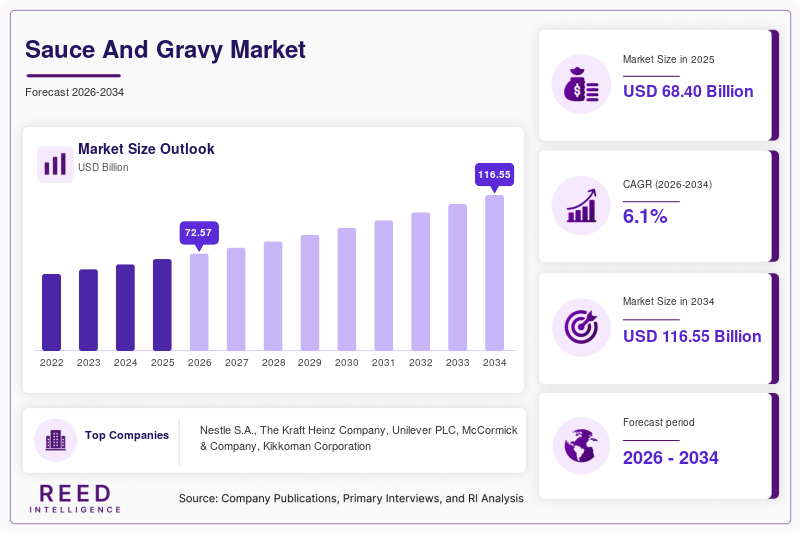
The global Sauce And Gravy Market size was valued at USD 68.4 billion in 2026 and is projected to reach USD 109.7 billion by 2034, expanding at a CAGR of 6.1% during the forecast period from 2026 to 2034. The market continues to witness stable expansion due to changing consumer eating habits, rising demand for convenience foods, and the growing influence of international cuisines across retail and foodservice channels. Consumers are increasingly purchasing ready-to-use sauces and packaged gravies that reduce cooking time while delivering consistent flavor profiles. Rapid urbanization, dual-income households, and increasing consumption of processed and packaged foods are also contributing to market growth across both developed and emerging economies.
One of the major global factors supporting the growth of the Sauce And Gravy Market is the expansion of quick-service restaurants and online food delivery platforms. Restaurant chains are introducing region-specific flavor combinations and premium dipping sauces to attract consumers seeking variety and customization. At the same time, retail brands are investing in low-sodium, organic, vegan, and preservative-free sauce products to meet changing health preferences. Product innovation in ethnic sauces, barbecue marinades, cheese sauces, and ready-made gravy mixes is also strengthening demand among younger consumers. Manufacturers are further benefiting from improvements in cold-chain logistics, e-commerce distribution, and shelf-stable packaging technologies.
Key Highlights
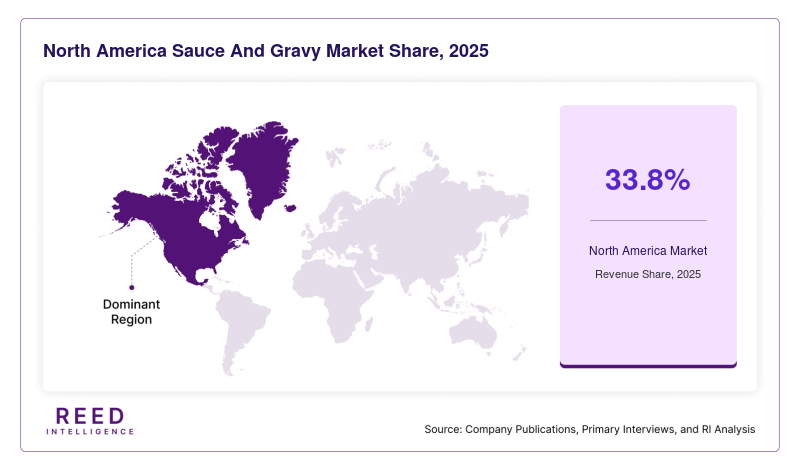
- North America dominated the market with a 33.8% share in 2025.
- Asia Pacific is expected to grow at the fastest CAGR of 8.4% during 2026–2034.
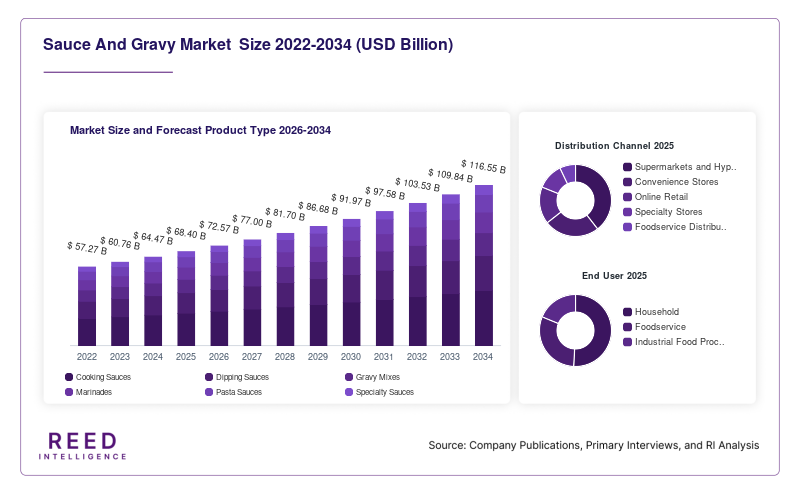
- By product type, cooking sauces accounted for the largest share of 39.4%, while dipping sauces are projected to grow at a CAGR of 8.9%.
- By distribution channel, supermarkets and hypermarkets led with a 46.1% share, whereas online retail is expected to expand at a CAGR of 10.2%.
- The United States remained the dominant country, with market values of USD 16.8 billion in 2024 and USD 17.6 billion in 2025.
Market Trends
Rising Demand for Ethnic and Fusion Flavors
The Sauce And Gravy Market is experiencing strong momentum from the increasing popularity of ethnic and fusion food products. Consumers are becoming more interested in trying international cuisines such as Korean, Mexican, Indian, Thai, and Mediterranean dishes at home. This trend has encouraged manufacturers to launch sauces and gravies inspired by regional recipes while adapting them to local taste preferences. Retail shelves now feature products such as peri-peri sauces, teriyaki glazes, tikka masala gravies, and spicy garlic blends that appeal to younger demographics seeking culinary experimentation.
Foodservice operators are also contributing to this trend by offering customized sauces with burgers, wraps, pizzas, and grilled products. The growing influence of food bloggers and social media cooking content has increased awareness of international recipes and encouraged consumers to purchase ready-made sauces. Manufacturers are responding with smaller packaging formats, premium ingredients, and clean-label claims. The trend is expected to remain significant as global food culture becomes more interconnected and consumers continue prioritizing convenience combined with flavor diversity.
Expansion of Clean-Label and Health-Oriented Products
Health-conscious consumers are reshaping the Sauce And Gravy Market by demanding products with transparent ingredient labels and reduced artificial additives. Many consumers now prefer sauces and gravies made with natural spices, low sugar content, reduced sodium, and plant-based ingredients. This trend has accelerated the launch of organic pasta sauces, gluten-free gravies, preservative-free marinades, and vegan mayonnaise alternatives across retail stores and online channels.
Manufacturers are investing in product reformulation strategies to align with evolving dietary preferences while maintaining flavor consistency. The clean-label movement is particularly strong among millennials and urban consumers who actively review nutritional information before purchasing packaged foods. Companies are also using recyclable packaging materials and sustainable sourcing practices to strengthen brand positioning. Increasing awareness regarding obesity, hypertension, and food allergies is further encouraging consumers to choose healthier sauce alternatives. This trend is expected to create long-term opportunities for premium and specialized sauce categories across developed and emerging markets.
Market Drivers
Growth of Convenience and Ready-to-Eat Food Consumption
The increasing demand for convenience foods is one of the primary drivers supporting the growth of the Sauce And Gravy Market. Modern consumers are spending less time on traditional cooking due to busy work schedules and changing lifestyles. As a result, packaged sauces and ready-made gravies have become essential kitchen products that simplify meal preparation while improving taste consistency. Consumers are increasingly using cooking sauces, pasta sauces, and instant gravy mixes for quick meal solutions during weekdays and social gatherings.
The expansion of supermarkets, hypermarkets, and online grocery delivery services has improved product accessibility across urban and semi-urban regions. Food manufacturers are introducing microwave-friendly and easy-pour packaging formats to enhance convenience. Additionally, rising consumption of frozen foods, snacks, and processed meat products is increasing demand for complementary sauces and dips. The convenience trend is particularly visible among younger consumers and working professionals who prioritize quick meal preparation without compromising flavor quality.
Expansion of Foodservice and Quick-Service Restaurant Chains
The rapid growth of foodservice establishments and quick-service restaurant chains is another important factor driving the Sauce And Gravy Market. Restaurants rely heavily on sauces and gravies to maintain standardized taste profiles and create menu differentiation. Global fast-food brands are continuously introducing signature sauces, spicy dips, cheese blends, and premium gravy options to strengthen customer engagement and encourage repeat purchases.
The growth of online food delivery applications has also increased sauce consumption because consumers often order meals with additional dips and condiments. Cloud kitchens and casual dining chains are adopting customized sauce formulations to support regional flavor preferences and seasonal menu innovations. In emerging economies, rising disposable incomes and urbanization are encouraging consumers to dine out more frequently, creating additional demand for commercial sauce suppliers. Manufacturers are responding by expanding production capacities and forming partnerships with restaurant chains to strengthen long-term supply agreements.
Market Restraint
Fluctuating Raw Material Prices and Supply Chain Challenges
The Sauce And Gravy Market faces challenges associated with fluctuating prices of key raw materials such as tomatoes, spices, edible oils, dairy ingredients, and packaging materials. Climatic changes, transportation disruptions, and agricultural supply shortages can significantly impact production costs and profit margins for manufacturers. For instance, tomato-based sauces are highly vulnerable to crop yield fluctuations caused by droughts or excessive rainfall in major agricultural regions. Similarly, volatility in edible oil prices directly affects the production costs of mayonnaise and creamy sauces.
Supply chain disruptions can also lead to delays in product distribution and inventory shortages across retail stores and foodservice channels. Smaller manufacturers are particularly affected because they often lack long-term sourcing contracts and advanced logistics infrastructure. Rising energy costs and international shipping expenses have further increased operational pressure on global suppliers. In some regions, strict food labeling regulations and sodium reduction requirements also increase compliance costs for manufacturers. These factors may limit pricing flexibility and create challenges for companies operating in highly competitive markets with strong private-label competition.
Market Opportunities
Growth Potential in Plant-Based and Vegan Sauce Categories
The increasing adoption of plant-based diets presents significant opportunities for the Sauce And Gravy Market. Consumers are actively seeking vegan alternatives to traditional dairy-based and meat-based gravies due to health, ethical, and environmental concerns. This shift has encouraged manufacturers to introduce plant-based mayonnaise, dairy-free cheese sauces, mushroom gravies, and nut-based creamy sauces. Vegan food products are gaining popularity among flexitarian consumers who occasionally replace animal-based meals with plant-based alternatives.
Retailers are expanding shelf space for vegan condiments and ready-made meal accompaniments to address rising demand. Foodservice operators are also incorporating vegan sauce options into burgers, sandwiches, pizzas, and pasta dishes. Product innovation using oat milk, almond milk, cashew cream, and pea protein ingredients is helping companies improve texture and taste profiles. The growing availability of vegan products through e-commerce platforms and specialty health food stores is expected to support continued expansion in this segment during the forecast period.
Increasing Penetration of E-Commerce and Digital Grocery Platforms
The rapid expansion of e-commerce and digital grocery platforms is creating new growth opportunities for the Sauce And Gravy Market. Consumers increasingly prefer online shopping because it offers product variety, doorstep delivery, and convenient subscription options. Sauce manufacturers are leveraging digital platforms to introduce premium products, regional flavors, and limited-edition variants directly to consumers without depending entirely on traditional retail distribution.
Online channels also allow companies to gather consumer feedback and analyze purchasing behavior more effectively. Social media marketing campaigns and influencer collaborations are helping brands improve visibility and encourage trial purchases. Smaller and regional manufacturers benefit from e-commerce because digital marketplaces reduce entry barriers and allow broader geographic reach. The availability of bundled meal kits and recipe-based marketing strategies is further encouraging consumers to experiment with different sauces and gravies. As internet penetration and smartphone usage continue to rise globally, online retail sales are expected to become a major contributor to market revenue.
Segmental Analysis
By Product Type
Cooking sauces accounted for the largest share of the Sauce And Gravy Market in 2024, representing approximately 39.4% of global revenue. These products are widely used in pasta dishes, stir-fry recipes, curries, and ready-made meal preparations. Consumers prefer cooking sauces because they simplify meal preparation while maintaining consistent flavor quality. Tomato-based sauces, soy sauces, curry sauces, and cheese sauces are among the most commonly consumed products across both retail and foodservice channels. The growth of ready-to-cook meal kits and packaged food products has further strengthened demand for cooking sauces. Manufacturers are focusing on introducing premium variants with authentic regional flavors and clean-label ingredients to improve product differentiation. Strong adoption across urban households and restaurants continues to support the dominance of this subsegment.
Dipping sauces are projected to register the fastest CAGR of 8.9% during the forecast period due to rising demand for snack accompaniments and fast-food products. Consumers increasingly use dipping sauces with fried foods, sandwiches, wraps, and grilled snacks, particularly in quick-service restaurant environments. Popular varieties include spicy chili sauce, garlic dip, honey mustard, ranch dressing, and cheese-based dips. The expansion of online food delivery services and increasing consumption of frozen snacks are creating additional opportunities for manufacturers. Younger consumers are also showing interest in experimenting with unique flavor combinations and limited-edition products. Companies are introducing smaller portable packaging formats and premium spice blends to strengthen product appeal. The increasing popularity of social dining and casual snacking culture is expected to sustain strong growth in this subsegment.
By Distribution Channel
Supermarkets and hypermarkets held the dominant share of the Sauce And Gravy Market in 2024, accounting for nearly 46.1% of total revenue. These retail channels provide consumers with access to a wide variety of domestic and international sauce brands under one location. Large retail chains also support product visibility through promotional displays, discount campaigns, and private-label offerings. Consumers prefer supermarkets because they can compare flavors, packaging sizes, and pricing options while shopping for groceries. The availability of chilled, frozen, and shelf-stable sauce products within organized retail environments further contributes to strong sales performance. In developed economies, supermarkets remain the primary distribution channel for premium and organic sauce categories. Expanding retail infrastructure in developing countries is also supporting higher product penetration through modern trade networks.
Online retail is expected to grow at the fastest CAGR of 10.2% during the forecast period because of increasing consumer preference for digital grocery shopping and home delivery services. E-commerce platforms allow consumers to access specialty sauces, imported products, and health-focused variants that may not always be available in physical stores. Subscription-based meal kits and bundled promotional offers are also encouraging online purchases. Manufacturers benefit from online platforms because they provide direct consumer engagement and detailed purchasing analytics. Social media advertising and recipe-based marketing campaigns are helping brands attract younger demographics interested in culinary experimentation. Improvements in logistics infrastructure and cold-chain delivery systems are expected to strengthen online distribution capabilities further, making digital retail an increasingly important channel for sauce manufacturers.
By End User
The household segment dominated the Sauce And Gravy Market in 2024 and accounted for approximately 58.7% of total market revenue. Growing demand for convenient meal preparation solutions among urban consumers has significantly increased household consumption of packaged sauces and gravies. Consumers commonly use pasta sauces, barbecue sauces, curry gravies, and salad dressings during daily cooking activities. The rising number of dual-income families and busy lifestyles has strengthened dependence on ready-to-use food products that save preparation time. Manufacturers are introducing family-sized packaging, resealable containers, and health-oriented formulations to attract household consumers. Increased exposure to international cuisines through social media and cooking shows is also encouraging consumers to experiment with new sauce flavors at home. Consistent demand from retail grocery channels continues to reinforce the leadership position of this segment.
The foodservice segment is projected to expand at the fastest CAGR of 7.8% during the forecast period due to rapid growth in restaurants, cafes, cloud kitchens, and quick-service dining chains. Foodservice operators rely heavily on sauces and gravies to maintain taste consistency, improve menu variety, and enhance customer experience. The rising popularity of takeaway meals and online food delivery applications has increased the use of customized dipping sauces and premium condiments. Restaurants are also introducing region-specific flavor combinations to attract younger consumers seeking unique dining experiences. Commercial kitchens prefer bulk packaging and standardized sauce formulations that improve operational efficiency and reduce preparation time. Increasing tourism activity and expansion of international restaurant chains in emerging economies are expected to create sustained growth opportunities for sauce suppliers serving the foodservice industry.
Regional Analysis
North America
North America accounted for 33.8% of the global Sauce And Gravy Market share in 2025 and is expected to maintain stable growth at a CAGR of 5.7% during the forecast period. The region benefits from high consumption of processed foods, established retail infrastructure, and strong demand for packaged condiments across households and restaurants. Consumers in the United States and Canada regularly purchase pasta sauces, barbecue sauces, gravies, and salad dressings as part of everyday meal preparation. The growing popularity of premium gourmet sauces and organic product variants is also contributing to regional market expansion.
The United States remains the dominant country in North America due to its large foodservice sector and high consumer spending on convenience foods. One unique growth factor in the country is the increasing demand for customized and regionally inspired sauces across restaurant chains and retail brands. Companies are launching smoky barbecue blends, spicy chili sauces, and low-sugar condiments tailored to changing consumer preferences. Strong investments in product innovation and marketing campaigns continue to strengthen the position of major manufacturers in the country.
Europe
Europe represented 27.4% of the global Sauce And Gravy Market in 2025 and is projected to expand at a CAGR of 5.4% from 2026 to 2034. The region has a mature packaged food industry supported by strong consumer demand for pasta sauces, cooking gravies, and specialty condiments. Western European countries show high adoption of ready-made sauces due to busy urban lifestyles and increasing preference for quick meal preparation. Manufacturers are also focusing on sustainable packaging and organic ingredient sourcing to meet strict regional food regulations and environmental standards.
Germany emerged as the dominant country within the European market because of its strong retail distribution network and growing consumption of convenience foods. A unique factor supporting market growth in Germany is the increasing popularity of international cuisines among younger consumers. Retailers are expanding product offerings that include Asian stir-fry sauces, Mediterranean marinades, and spicy Mexican dips. Demand for low-fat and preservative-free sauce products is also rising as health-conscious consumers seek healthier meal accompaniments.
Asia Pacific
Asia Pacific held 22.1% of the global Sauce And Gravy Market share in 2025 and is anticipated to register the fastest CAGR of 8.4% during the forecast period. Rapid urbanization, rising disposable incomes, and changing dietary habits are driving regional market growth. Consumers are increasingly adopting packaged cooking sauces and instant gravies as convenient alternatives to traditional homemade preparations. The expansion of organized retail chains and online grocery platforms is also improving product availability across developing economies.
China remains the dominant country in the Asia Pacific region due to its large population base and strong demand for soy sauces, chili sauces, and cooking pastes. One unique growth factor in the country is the rapid expansion of domestic quick-service restaurant chains and cloud kitchens. These businesses rely heavily on standardized sauce formulations to maintain product consistency and improve operational efficiency. Increasing exposure to Western cuisines among urban consumers is also supporting demand for pasta sauces, cheese sauces, and fusion condiments.
Middle East & Africa
The Middle East & Africa region accounted for 8.2% of the global Sauce And Gravy Market in 2025 and is projected to grow at a CAGR of 6.2% during the forecast period. Market growth is supported by rising urbanization, expanding tourism activity, and increasing adoption of international cuisines. Consumers in Gulf countries are showing strong interest in packaged sauces used for grilled meat dishes, rice meals, and fast-food products. The growing presence of international restaurant chains is also contributing to higher demand for ketchup, mayonnaise, and specialty dipping sauces.
Saudi Arabia is the dominant country in the regional market due to its expanding foodservice industry and high per capita spending on packaged foods. A unique growth factor in the country is the increasing number of modern retail outlets and hypermarkets that provide extensive shelf space for imported and premium sauce products. Rising youth population and strong demand for convenience foods are encouraging manufacturers to introduce spicy and flavor-rich product varieties tailored to regional preferences.
Latin America
Latin America captured 8.5% of the global Sauce And Gravy Market share in 2025 and is expected to grow at a CAGR of 5.9% through 2034. The region is benefiting from increasing consumption of packaged foods and rising demand for ready-to-use condiments across households and restaurants. Consumers in countries such as Brazil and Mexico frequently use sauces and gravies in traditional dishes, which supports consistent product demand. Expanding supermarket chains and improvements in food processing infrastructure are also strengthening regional market growth.
Brazil continues to dominate the Latin American market because of its large consumer base and growing packaged food sector. One unique factor driving market growth in the country is the rising popularity of barbecue culture and meat-based dining experiences. This trend has increased demand for marinades, spicy sauces, and flavored gravies across retail and foodservice channels. Manufacturers are also investing in affordable product packaging and local flavor innovations to attract middle-income consumers.
Competitive Landscape
The Sauce And Gravy Market is characterized by the presence of multinational food companies, regional manufacturers, and private-label brands competing across multiple product categories. Companies are focusing on flavor innovation, clean-label formulations, and sustainable packaging strategies to strengthen market positioning. Product launches featuring reduced sodium, organic ingredients, and ethnic flavor profiles are becoming increasingly common as consumer preferences evolve. Strategic partnerships with restaurant chains and online grocery platforms are also helping manufacturers expand distribution networks and improve brand visibility.
Nestle S.A. remains one of the leading participants in the global Sauce And Gravy Market due to its diversified product portfolio and extensive international distribution network. The company continues to invest in premium cooking sauces and health-oriented product formulations. Kraft Heinz Company, Unilever PLC, McCormick & Company, and Kikkoman Corporation also maintain strong market presence through established retail relationships and ongoing product innovation initiatives. In 2025, Kraft Heinz introduced a new range of low-sugar dipping sauces targeted at health-conscious consumers in North America and Europe. Several regional manufacturers are also increasing investments in local flavor development and e-commerce expansion to compete more effectively with multinational brands.
Key Players
- Nestle S.A.
- The Kraft Heinz Company
- Unilever PLC
- McCormick & Company
- Kikkoman Corporation
- Campbell Soup Company
- Conagra Brands Inc.
- General Mills Inc.
- Del Monte Foods Inc.
- Hormel Foods Corporation
- Ajinomoto Co. Inc.
- Lee Kum Kee Company Limited
- Mizkan Holdings Co. Ltd.
- Fuchs Group
- Bolton Group
Recent Developments
- In March 2025, Nestle S.A. expanded its premium cooking sauce portfolio with new Asian-inspired flavors across European retail markets.
- In July 2025, Unilever PLC introduced recyclable packaging solutions for selected mayonnaise and dipping sauce products in North America.
- In November 2025, Kikkoman Corporation announced capacity expansion for soy sauce production facilities in Asia Pacific to support rising export demand.
- In February 2026, McCormick & Company launched a clean-label gravy mix range featuring reduced sodium and preservative-free ingredients.
- In April 2026, Kraft Heinz Company partnered with a leading online grocery platform to improve direct-to-consumer sauce distribution in the United States.
Sauce And Gravy Market Segments
Product Type
- Cooking Sauces
- Dipping Sauces
- Gravy Mixes
- Marinades
- Pasta Sauces
- Specialty Sauces
Distribution Channel
- Supermarkets and Hypermarkets
- Convenience Stores
- Online Retail
- Specialty Stores
- Foodservice Distribution
End User
- Household
- Foodservice
- Industrial Food Processing
By Region
- North America
- Europe
- APAC
- Middle East and Africa
- LATAM