Sauce Making Machine Market Size, Share & Demand Report By Type (Automatic, Semi-Automatic), By Application (Commercial Food Processing, Household & Small-Scale), By End-Use (Food Manufacturing Companies, Food Service Providers) By Region & Segment Forecasts, 2025–2034
USD 3950
Market Overview
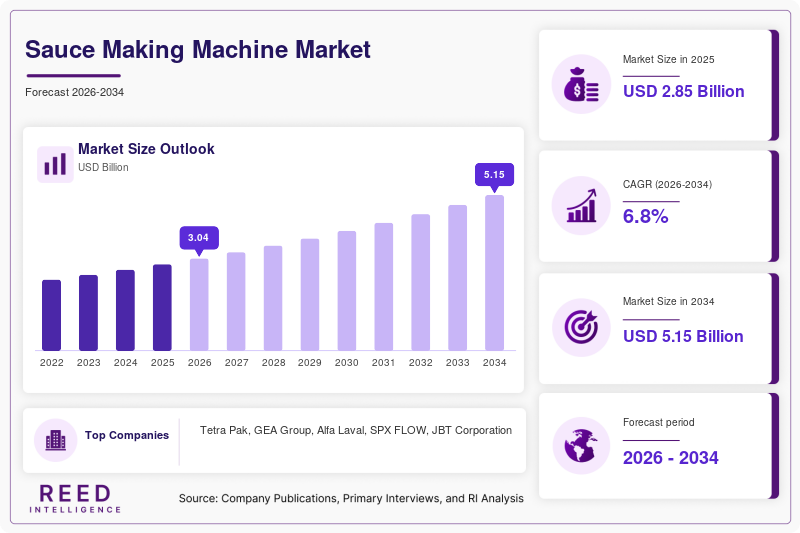
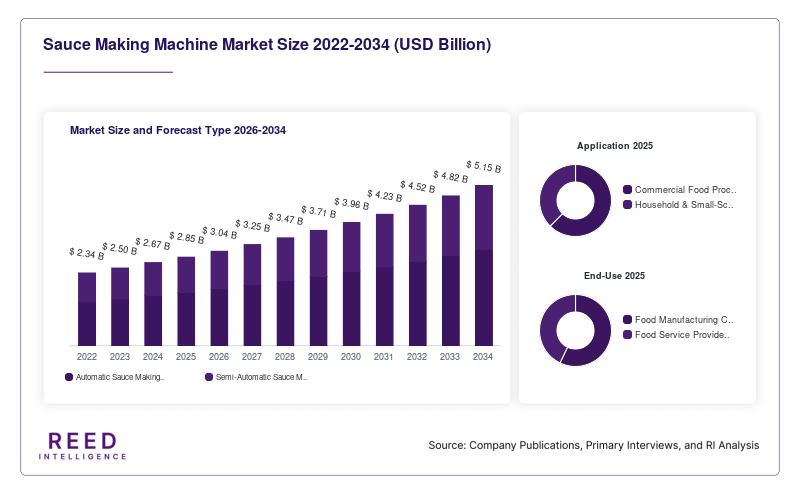
The Sauce Making Machine Market size is estimated at USD 2.85 billion and is projected to reach approximately USD 3.05 billion in 2026. Over the forecast period from 2025 to 2034, the market is expected to expand at a compound annual growth rate (CAGR) of 6.8%, reaching a valuation of nearly USD 5.48 billion by 2034.
This growth is driven by the rising consumption of packaged sauces, condiments, and ready-to-eat food products. Urbanization and changing dietary habits are encouraging food manufacturers to invest in automated machinery that enhances production efficiency and consistency. Additionally, technological advancements in food processing equipment are enabling precise control over mixing, grinding, heating, and packaging processes, which is critical for maintaining product quality and safety.
Key Highlights
- Market size reached USD 2.85 billion in 2025 and is expected to grow to USD 3.05 billion in 2026, with projections to reach USD 5.48 billion by 2034 at a CAGR of 6.8%
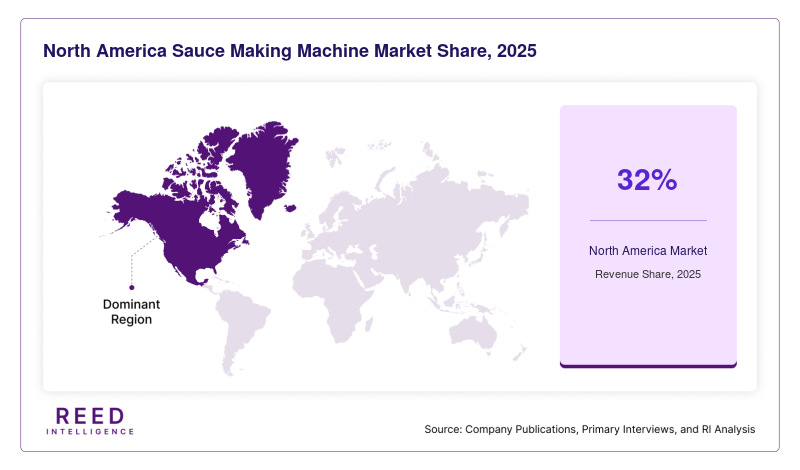
- North America dominated the global market in 2025, accounting for approximately 32% share due to strong food processing infrastructure and high demand for packaged sauces
- Asia Pacific is the fastest-growing region, expected to register a CAGR of 8.2% during 2025–2034, driven by rapid urbanization and expanding food manufacturing sectors
- Automatic sauce making machines led the segmentation in 2024 with around 58% market share, supported by high efficiency and large-scale production capabilities
- The commercial food processing segment held the largest share of 64% in 2024, reflecting strong demand from large food manufacturers and industrial kitchens
- Increasing demand for processed and convenience foods, along with technological advancements and rising adoption among small-scale and artisanal producers, continues to drive market expansion
Market Trends
Integration of Smart Automation and IoT in Sauce Making Machines
The adoption of smart automation technologies is becoming a defining trend in the Sauce Making Machine Market. Manufacturers are integrating Internet of Things (IoT) capabilities into equipment to enable real-time monitoring, predictive maintenance, and remote operation. These systems allow operators to track temperature, viscosity, and mixing consistency with precision, reducing human error and enhancing production efficiency. Smart machines also provide data analytics that helps optimize production cycles and minimize waste. This trend is particularly beneficial for large-scale food processing companies aiming to maintain consistent product quality across multiple production lines. Additionally, automated cleaning systems are being incorporated to ensure hygiene compliance and reduce downtime.
Rising Demand for Multi-Functional and Compact Equipment
Another significant trend is the increasing preference for multi-functional sauce making machines that combine multiple processes such as grinding, mixing, heating, and homogenizing into a single unit. This trend is driven by the need for space optimization and cost efficiency, especially among small and medium enterprises. Compact machines are gaining popularity in urban production setups where space constraints are common. These systems offer flexibility to produce a wide variety of sauces, including tomato-based, chili, and specialty gourmet sauces. The ability to handle different ingredients and recipes without extensive reconfiguration is making these machines attractive to both startups and established manufacturers.
Market Drivers
Growing Demand for Processed and Ready-to-Eat Food Products
The increasing consumption of processed and ready-to-eat food products is a major driver for the Sauce Making Machine Market. Busy lifestyles and urbanization have led consumers to prefer convenient meal options, which often include packaged sauces and condiments. Food manufacturers are scaling up production to meet this demand, thereby increasing the need for efficient and high-capacity machinery. Additionally, the expansion of global food chains and quick-service restaurants is contributing to higher consumption of standardized sauces. These factors are encouraging investments in advanced machinery that can deliver consistent quality and meet high production volumes while maintaining food safety standards.
Technological Advancements in Food Processing Equipment
Continuous innovation in food processing technology is significantly driving market growth. Modern sauce making machines are equipped with advanced features such as automated controls, energy-efficient motors, and precision mixing systems. These innovations improve operational efficiency and reduce production costs over time. Furthermore, the integration of programmable logic controllers (PLCs) and touch-screen interfaces allows for easy customization of recipes and process parameters. This level of control is essential for maintaining consistency in large-scale production. Manufacturers are also focusing on developing eco-friendly machines that consume less energy and water, aligning with sustainability goals and regulatory requirements.
Market Restraint
High Initial Investment and Maintenance Costs
One of the key challenges in the Sauce Making Machine Market is the high initial cost associated with purchasing advanced machinery. Small and medium-sized enterprises often face financial constraints that limit their ability to invest in automated systems. In addition to the upfront cost, maintenance and repair expenses can be significant, especially for machines with complex components and advanced technologies. These costs can impact profitability and deter new entrants from adopting high-end equipment. For example, a small-scale sauce manufacturer may opt for manual or semi-automatic machines instead of fully automated systems due to budget limitations. This restraint slows down the adoption of advanced machinery in certain segments of the market and creates a gap between large and small producers.
Market Opportunities
Expansion of Food Processing Industry in Emerging Economies
Emerging economies are presenting significant growth opportunities for the Sauce Making Machine Market. Rapid urbanization, rising disposable incomes, and changing dietary habits are driving the demand for processed food products in regions such as Asia Pacific and Latin America. Governments in these regions are also promoting food processing industries through subsidies and incentives, encouraging manufacturers to invest in modern equipment. This creates a favorable environment for the adoption of sauce making machines. Additionally, the growing presence of international food brands is increasing the need for standardized production processes, further boosting market demand.
Increasing Demand for Custom and Artisanal Sauce Production
The rising popularity of artisanal and specialty sauces is creating new opportunities in the market. Consumers are increasingly seeking unique flavors and high-quality ingredients, leading to the growth of small-scale and niche food producers. These businesses require flexible and efficient machinery capable of handling small batches and diverse recipes. Manufacturers of sauce making machines are responding by developing compact and customizable equipment tailored to these needs. This trend is also supported by the growth of online food businesses and direct-to-consumer sales channels, which allow small producers to reach a wider audience.
Segmental Analysis
By Type
The automatic sauce making machine segment dominated the market in 2024, accounting for approximately 58% of the total share. These machines are widely used in large-scale production facilities due to their ability to perform multiple functions with minimal human intervention. Automatic systems offer advantages such as consistent product quality, reduced labor costs, and higher production efficiency. They are equipped with advanced features such as programmable controls and real-time monitoring, which allow manufacturers to optimize processes and reduce waste.
The semi-automatic segment is expected to grow at the fastest CAGR of 7.4% during the forecast period. This growth is driven by the increasing adoption among small and medium enterprises that require cost-effective solutions. Semi-automatic machines provide a balance between manual and automated processes, offering flexibility and affordability. They are particularly suitable for businesses that produce small batches or customized products, making them a popular choice in emerging markets.
By Application
The commercial food processing segment held the largest market share of 64% in 2024. This segment includes large-scale manufacturers that produce sauces for retail and food service industries. The demand for high-capacity and efficient machinery is driving growth in this segment. These machines are designed to handle large volumes of ingredients while maintaining consistency and quality. The increasing demand for packaged sauces and condiments is further boosting this segment.
The household and small-scale segment is expected to grow at a CAGR of 7.1% during the forecast period. This growth is fueled by the rising popularity of home-based food businesses and artisanal production. Consumers are increasingly experimenting with homemade sauces, creating demand for compact and user-friendly machines. Manufacturers are developing affordable and easy-to-use equipment to cater to this segment.
By End-Use
The food manufacturing companies segment dominated the market in 2024, accounting for 61% of the total share. These companies require large-scale machinery to meet high production demands. The focus on efficiency, quality, and compliance with food safety standards is driving the adoption of advanced equipment. These machines are designed to handle continuous production processes, making them essential for large manufacturers.
The food service providers segment is expected to grow at the fastest CAGR of 7.6%. This includes restaurants, catering services, and cloud kitchens. The growth of this segment is driven by the increasing demand for customized sauces and quick preparation. These businesses require flexible machinery that can produce small batches efficiently. The rise of food delivery platforms is also contributing to the growth of this segment.
Regional Analysis
North America
North America accounted for approximately 32% of the global Sauce Making Machine Market share in 2025 and is expected to grow at a CAGR of 5.9% during the forecast period. The region benefits from a well-established food processing industry and high demand for convenience foods. Technological adoption is also high, with manufacturers investing in automated systems to improve efficiency and maintain product quality.
The United States dominates the regional market due to its large-scale food manufacturing sector. A key growth factor is the increasing demand for organic and clean-label sauces, which requires advanced machinery capable of preserving ingredient integrity. This trend is encouraging manufacturers to upgrade their equipment.
Europe
Europe held around 27% of the market share in 2025 and is projected to grow at a CAGR of 5.7% through 2034. The region’s growth is driven by strong regulatory frameworks and a focus on food safety and quality. Manufacturers are adopting advanced machinery to comply with stringent standards.
Germany leads the European market due to its robust manufacturing capabilities. A unique growth factor is the increasing demand for premium and gourmet sauces, which requires precise processing techniques. This is boosting the adoption of high-performance sauce making machines.
Asia Pacific
Asia Pacific accounted for nearly 24% of the market share in 2025 and is expected to grow at the fastest CAGR of 8.2% during the forecast period. Rapid urbanization and population growth are driving demand for processed food products in the region.
China dominates the market due to its large food processing industry. A key growth factor is the expansion of local food brands and export-oriented production, which is increasing the need for efficient and scalable machinery.
Middle East & Africa
The Middle East & Africa region held approximately 9% of the market share in 2025 and is projected to grow at a CAGR of 6.3%. The market is supported by the growing food service industry and increasing demand for packaged food products.
The United Arab Emirates leads the region due to its развит food processing sector. A unique growth factor is the expansion of tourism and hospitality industries, which is driving demand for high-quality sauces and condiments.
Latin America
Latin America accounted for about 8% of the market share in 2025 and is expected to grow at a CAGR of 6.5%. The region is witnessing increased investment in food processing infrastructure.
Brazil dominates the market due to its large agricultural base. A key growth factor is the rising demand for locally produced sauces, which is encouraging manufacturers to adopt modern machinery.
Competitive Landscape
The Sauce Making Machine Market is moderately competitive, with several global and regional players focusing on product innovation and expansion strategies. Leading companies are investing in research and development to introduce advanced machinery with enhanced efficiency and automation features. Strategic partnerships and mergers are also common as companies aim to strengthen their market presence.
A leading player in the market is Tetra Pak, known for its advanced food processing solutions. The company recently introduced a new range of energy-efficient sauce processing systems designed to reduce operational costs and improve sustainability. Other key players are focusing on expanding their product portfolios and entering emerging markets to capitalize on growth opportunities.
Key Players
- Tetra Pak
- GEA Group
- Alfa Laval
- SPX FLOW
- JBT Corporation
- Marel
- Buhler Group
- Krones AG
- Middleby Corporation
- Heat and Control Inc.
- Selo Food Technology
- ProXES GmbH
- Lee Industries
- Stephan Machinery
- Feldmeier Equipment
Recent Developments
- In 2024, Tetra Pak launched an upgraded sauce processing system with improved automation and energy efficiency.
- In 2023, GEA Group expanded its production facility to increase output of food processing equipment.
- In 2024, Alfa Laval introduced a new hygienic mixing solution designed for sauce applications.
Sauce Making Machine Market Segments
Type
- Automatic Sauce Making Machines
- Semi-Automatic Sauce Making Machines
Application
- Commercial Food Processing
- Household & Small-Scale Production
End-Use
- Food Manufacturing Companies
- Food Service Providers (Restaurants, Cloud Kitchens, Catering)
By Region
- North America
- Europe
- APAC
- Middle East and Africa
- LATAM