School And Campus Security Market Size, Share & Trends Analysis Report By Type (Video Surveillance, Access Control, Fire Protection), By Component (Hardware, Software), By End Use (K-12 Schools, Higher Education Institutions, Training Centers), By Application (Perimeter Security, Emergency Communication, Visitor Management, Intrusion Detection, Other Applications) and By Region (North America, Europe, APAC, Middle East and Africa, LATAM) Forecasts, 2026–2034
USD 3950
School And Campus Security Market Size
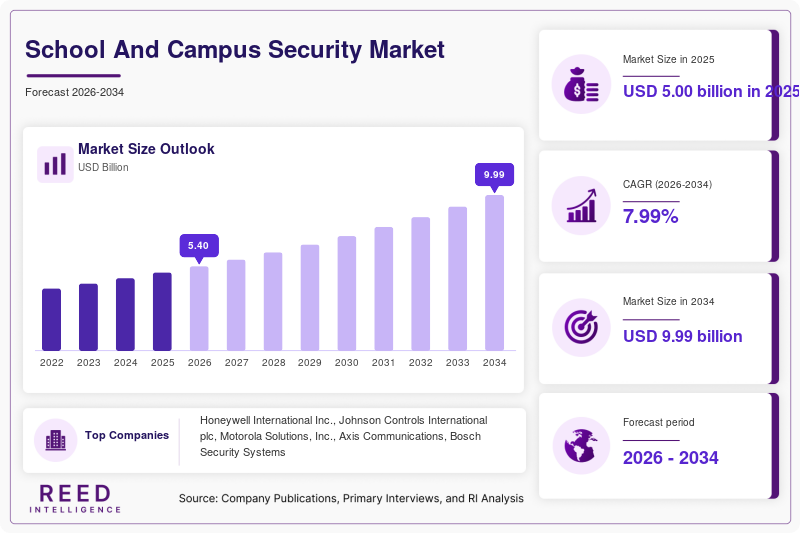
The global School and Campus Security Market size was valued at USD 5.00 billion in 2025 and is projected to grow from USD 5.40 billion in 2026 to USD 9.99 billion by 2034, registering a CAGR of 7.99% during the forecast period from 2026 to 2034.
School and campus security is shifting from standalone security equipment toward integrated systems combining video surveillance, access control, emergency communication, visitor management, intrusion detection, and security software. Educational institutions are increasingly connecting cameras, access points, alarms, communication systems, and monitoring platforms so security teams can identify incidents and coordinate responses from centralized systems.
Government funding is also supporting demand. In May 2026, the U.S. Department of Education announced USD 93 million in FY2026 School Safety Enhancement funding for evidence-based measures covering school infrastructure security, emergency response planning, coordination, training, and preparedness.
School And Campus Security Market Drivers
Government Funding for School Safety Infrastructure
Government funding is directly increasing institutional purchasing capacity for school security systems. The U.S. Department of Education's FY2026 School Safety Enhancement program provides an estimated USD 93 million for statewide school safety systems and physical security improvements. The program specifically supports infrastructure security, emergency response planning, coordination, training, and preparedness.
The commercial impact extends across multiple product categories because eligible improvements include security cameras, access-control systems, electronic entry systems, panic buttons, emergency notification systems, visitor-management kiosks, and secure entry areas.
This funding mechanism reduces the budget barrier for schools that need to replace outdated systems or add new security infrastructure. It also encourages vendors to offer integrated solutions instead of isolated products.
Expansion of Integrated Security Systems
Schools and universities increasingly require security systems that work together rather than separate devices operating independently. Video surveillance can be connected with access control, alarms, emergency communication, visitor management, and centralized monitoring.
The integration creates a stronger commercial value proposition because security teams can use one platform to monitor multiple parts of a campus. Software becomes increasingly important as institutions seek automated alerts, remote monitoring, analytics, reporting, and centralized administration.
The market is therefore expanding beyond cameras and physical locks toward integrated physical-security platforms that combine hardware, software, connectivity, and security services.
Adoption of AI and Smart Surveillance
AI-enabled surveillance is changing how educational institutions detect and respond to security incidents. Video analytics can help identify unusual activity, unauthorized entry, suspicious objects, or movement patterns and can reduce the dependence on continuous manual monitoring.
This trend is particularly relevant for large campuses where hundreds of cameras or multiple buildings generate large volumes of video. AI-based analytics can prioritize alerts and provide security teams with more actionable information.
The adoption of cloud-based video management and AI analytics also creates recurring software revenue for security providers, changing the market from one-time hardware procurement toward a combination of equipment, software subscriptions, maintenance, and managed services.
School And Campus Security Market Restraints
Budget Constraints and Procurement Complexity
Schools operate under defined budgets and often require lengthy procurement processes before purchasing security infrastructure. Large campuses may need to upgrade cameras, access-control systems, networks, emergency communication equipment, and software at different stages.
The total cost therefore includes installation, integration, cybersecurity, maintenance, training, upgrades, and system management rather than only the initial hardware purchase.
Smaller schools and institutions may postpone large modernization projects when available funding is insufficient. This creates uneven adoption between well-funded districts and institutions with limited capital budgets.
Privacy and Cybersecurity Requirements
Modern security systems increasingly connect cameras, access-control devices, visitor-management systems, and emergency communication platforms to institutional networks. This creates additional cybersecurity and data-governance requirements.
The U.S. Department of Education's FY2026 guidance specifically states that school safety equipment and technology must comply with applicable codes and that applicants should consider state and local cybersecurity requirements for internet-connected equipment.
Vendors therefore need to demonstrate secure data handling, access controls, encryption, software updates, and appropriate privacy practices. These requirements can increase deployment costs and lengthen purchasing decisions.
School And Campus Security Market Opportunities
Cloud-Based Security Management
Cloud-based security provides schools with centralized access to cameras, access control, alarms, visitor management, and reporting without requiring every campus to maintain extensive local infrastructure.
This model can be particularly valuable for school districts managing multiple buildings because administrators can monitor and manage systems across campuses through a common platform. It also supports software-as-a-service revenue models and regular feature updates.
The shift toward cloud platforms creates opportunities for security technology companies that can combine video management, access control, analytics, emergency communication, and cybersecurity within one environment.
Smart Campus and AI Security
Smart-campus development creates opportunities for AI-enabled surveillance, automated visitor management, digital credentials, emergency communication, and analytics. These technologies can be integrated into broader campus modernization projects instead of being purchased as standalone security products.
APAC is particularly relevant because expanding education infrastructure and digital transformation are creating new opportunities for integrated security systems. Industry research identifies APAC as the fastest-growing regional market for education security.
Segmental Analysis
By Type
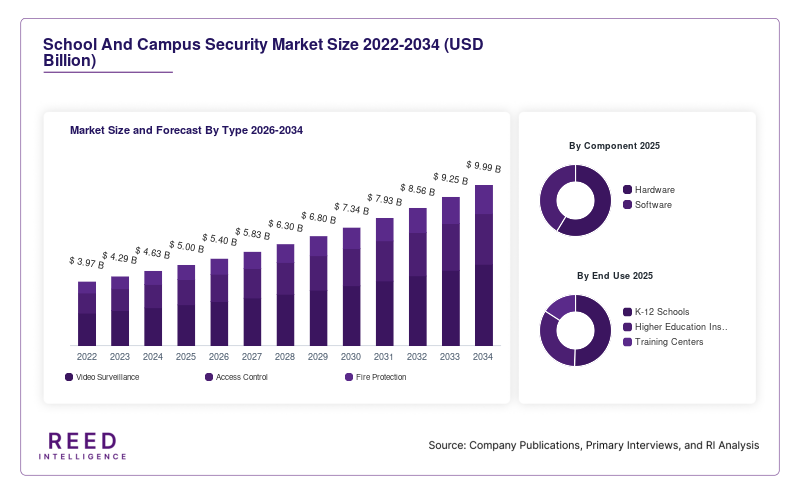
Video surveillance accounted for approximately 42% of the global School And Campus Security Market in 2025, equivalent to USD 2.10 Billion. Cameras remain a foundational component because schools need continuous visibility across entrances, hallways, parking areas, classrooms, sports facilities, and campus perimeters.
The segment is also evolving from conventional recording toward networked cameras with AI analytics, centralized video management, motion detection, object detection, and real-time alerts. This increases the value of surveillance beyond recording and supports broader integration with access control and emergency systems.
Access control represented approximately 34% of the market in 2025, equivalent to USD 1.70 Billion. Schools are increasingly using electronic locks, badge readers, keyless entry, visitor-management systems, and controlled entry points to restrict unauthorized access.
The U.S. Department of Education specifically identifies badge readers, keyless access devices, electronic entry systems, interior classroom door hardware, and visitor-management systems as eligible school-safety improvements under the FY2026 program.
Fire protection accounted for approximately 24% of the market in 2025, equivalent to USD 1.20 Billion. Educational institutions require fire alarms, detection systems, notification equipment, emergency communication, and related safety infrastructure to protect students and staff and meet building and life-safety requirements.
By Component
Hardware represented approximately 61% of the market in 2025, equivalent to USD 3.05 Billion. Cameras, access-control equipment, alarms, locks, sensors, emergency communication equipment, and related infrastructure form the physical foundation of campus security systems.
Software accounted for approximately 39% of the market, equivalent to USD 1.95 Billion in 2025. Video management, analytics, access management, incident management, cloud platforms, and centralized monitoring are becoming increasingly important as schools connect multiple security systems.
Software also supports recurring revenue through subscriptions, updates, analytics, cloud storage, and managed security services.
By End Use
K-12 schools represented approximately 57% of the market in 2025, equivalent to USD 2.85 Billion. Demand is supported by security upgrades across elementary, middle, and high schools, particularly for controlled entrances, cameras, emergency communication, visitor management, and classroom security.
Higher education institutions accounted for approximately 35% of the market, equivalent to USD 1.75 Billion. Universities and colleges operate larger and more complex campuses, creating demand for integrated access control, surveillance, emergency notification, perimeter protection, and centralized security operations.
Training centers represented approximately 8% of the market, equivalent to USD 400 Million. These facilities require access control, surveillance, fire protection, visitor management, and emergency communication systems based on their campus size and student population.
By Application
Perimeter security represented approximately 27% of the market in 2025, equivalent to USD 1.35 Billion. Schools use cameras, gates, sensors, lighting, barriers, and access-control systems to manage movement around campus boundaries.
Emergency communication accounted for approximately 24% of the market, equivalent to USD 1.20 Billion. Panic buttons, mass notification systems, public-address systems, alerts, and emergency communications allow schools to communicate rapidly during security incidents.
Visitor management represented approximately 19% of the market, equivalent to USD 950 Million. Digital visitor registration, identification, screening, badges, and access permissions help schools control non-student and non-staff movement.
Intrusion detection accounted for approximately 18% of the market, equivalent to USD 900 Million. Sensors, alarms, door monitoring, motion detection, and integrated alerts support protection against unauthorized access.
Regional Analysis
North America
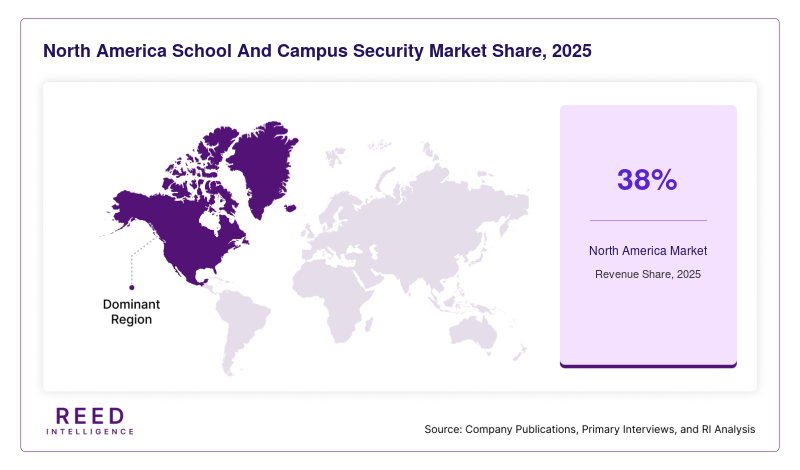
North America accounted for approximately 38% of the global School And Campus Security Market in 2025, equivalent to USD 1.90 Billion, making it the largest regional market.
The region benefits from established school-security infrastructure, large installed bases of cameras and access-control systems, mature security technology providers, and government-supported school safety programs. The U.S. Department of Education's FY2026 School Safety Enhancement program provides an estimated USD 93 million for statewide school safety systems and physical security improvements.
The U.S. also has a large addressable base of K-12 schools and higher education campuses requiring continuous security upgrades. Current government guidance specifically identifies cameras, access-control systems, panic buttons, emergency notification devices, secure entry vestibules, and visitor-management kiosks as eligible improvements.
The region is projected to reach approximately USD 3.55 Billion by 2034, supported by replacement cycles, technology upgrades, government funding, AI surveillance, and integrated security platforms.
Europe
Europe represented approximately 19% of the global market in 2025, equivalent to USD 950 million. Demand is supported by school safety requirements, modernization of public infrastructure, access control, video surveillance, fire protection, and emergency communication.
European educational institutions increasingly require security systems that can integrate with existing building-management and communication infrastructure. Privacy and data protection requirements also influence technology selection, particularly for surveillance and visitor-management systems.
The region is projected to reach approximately USD 1.77 billion by 2034, supported by modernization of educational buildings, replacement of legacy security infrastructure, and increased adoption of integrated security technologies.
APAC
APAC accounted for approximately 27% of the global market in 2025, equivalent to USD 1.35 Billion, and is the fastest-growing regional market, with a CAGR of approximately 11.0% during 2026–2034.
Growth is supported by expanding education infrastructure, urbanization, digital transformation, new school construction, and increasing deployment of surveillance and access-control technologies. Industry research also identifies APAC as the fastest-growing education-security region, with software, cloud security, and AI-enabled technologies gaining traction.
China, India, Japan, South Korea, Australia, and Southeast Asian markets provide major opportunities. Large education systems create demand for scalable security platforms that can connect multiple schools or campuses.
APAC is projected to reach approximately USD 3.43 Billion by 2034, supported by new infrastructure, modernization of existing campuses, AI surveillance, cloud platforms, and smart-campus initiatives.
Middle East and Africa
The Middle East and Africa represented approximately 8% of the market in 2025, equivalent to USD 400 Million. Demand is supported by new educational facilities, private schools, universities, smart-city development, and modernization of security infrastructure.
The Middle East has particularly strong opportunities in large universities, international schools, education cities, and newly developed campuses. Integrated access control, surveillance, fire protection, and emergency communication systems are relevant to these projects.
Africa provides longer-term potential as education infrastructure expands and institutions modernize physical security. However, procurement budgets, technology availability, and infrastructure maturity differ considerably between countries.
The regional market is projected to reach approximately USD 786 Million by 2034.
LATAM
Latin America accounted for approximately 8% of the global market in 2025, equivalent to USD 400 Million. Brazil, Mexico, Argentina, Colombia, and Chile represent important markets for school and university security systems.
Demand is supported by urbanization, education infrastructure development, modernization of school facilities, and growing adoption of surveillance and access-control technologies.
The market is also shifting toward integrated solutions because institutions increasingly require cameras, controlled entry, alarms, and emergency communication to operate together rather than as separate systems.
LATAM is projected to reach approximately USD 770 Million by 2034, supported by infrastructure investment, security modernization, and digital technology adoption.
Competitive Landscape
The School And Campus Security Market includes security technology manufacturers, building-automation companies, video surveillance providers, access-control specialists, fire-protection companies, software providers, and system integrators.
Competition is increasingly based on integration rather than individual hardware specifications. Vendors that can combine video surveillance, access control, emergency communications, visitor management, fire protection, and software can address larger institutional projects.
AI is also becoming an important differentiator. Security providers are incorporating analytics into video-management platforms to support automated detection and reduce the amount of manual monitoring required by campus security teams.
Key Market Players
- Honeywell International Inc.
- Johnson Controls International plc
- Motorola Solutions, Inc.
- Axis Communications
- Bosch Security Systems
- Genetec Inc.
- Verkada Inc.
- Cisco Systems, Inc.
- ADT Inc.
- Hanwha Vision
- Hangzhou Hikvision Digital Technology Co., Ltd.
- Panasonic Holdings Corporation
Recent Market Developments
- July 2026 – UK Department for Education: The UK Department for Education updated its School and College Security Guidance on July 3, 2026. The updated guidance strengthens recommendations around security policies, risk assessment, visitor management, emergency planning, and coordination with police and local authorities. This supports demand for integrated security planning and campus-security systems.
- July 2025 – National Commission for Protection of Child Rights (India): India's NCPCR, under the Ministry of Women and Child Development, published its Guidelines on School Safety and Security, dated July 1, 2025. The publication provides an official framework for improving safety and security practices in schools across India.
School And Campus Security Market Segments
By Type
- Video Surveillance
- Access Control
- Fire Protection
By Component
- Hardware
- Software
By End Use
- K-12 Schools
- Higher Education Institutions
- Training Centers
By Application
- Perimeter Security
- Emergency Communication
- Visitor Management
- Intrusion Detection
- Other Applications
By Region
- North America
- Europe
- APAC
- Middle East and Africa
- LATAM