Screen Printing Mesh Market Size, Share & Demand Report By Material (Polyester, Nylon, Stainless Steel), By Mesh Count (Low, Medium, High), By Application (Textile Printing, Electronics Printing, Glass Printing, Ceramic Printing), By End-Use Industry (Textile, Electronics, Automotive, Packaging) & Segment Forecasts, 2025–2034
USD 3950
Market Overview
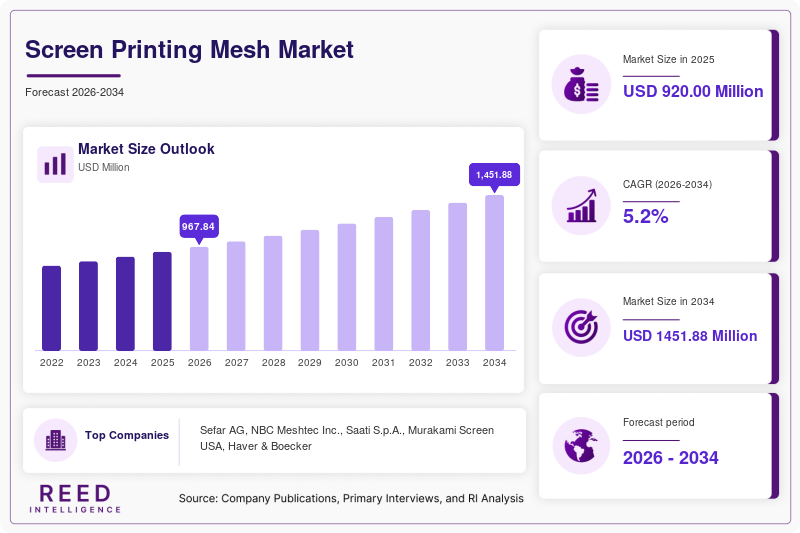
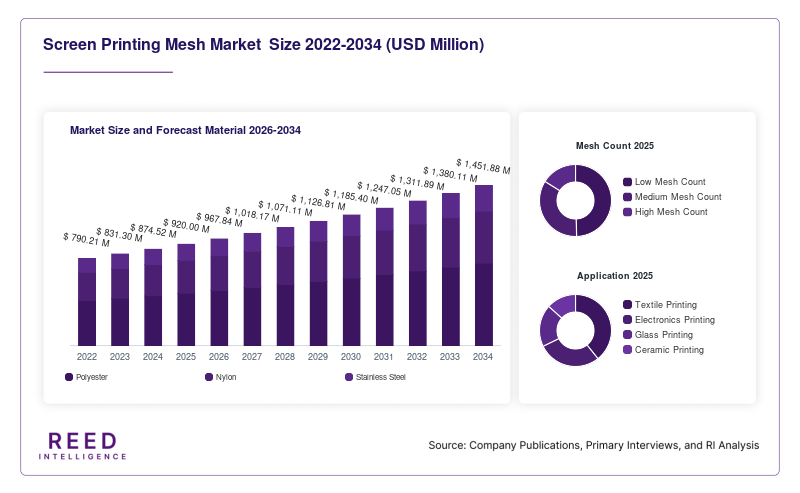
The global Screen Printing Mesh Market was valued at approximately USD 920 million in 2025 and is projected to reach USD 1.46 billion by 2034, expanding at a CAGR of 5.2% during the forecast period (2025–2034). The market growth is primarily supported by the rising demand for high-precision printing across industries such as textiles, electronics, packaging, and automotive components. Screen printing mesh, a critical component in stencil-based printing processes, ensures consistent ink transfer, fine detailing, and durability, making it essential in both industrial and commercial applications.
A key global factor driving the Screen Printing Mesh Market is the steady expansion of the textile and apparel industry, particularly in emerging economies. The increasing adoption of customized and short-run printing solutions has amplified the need for reliable and high-performance mesh materials, especially polyester-based meshes.
Key Highlights:
- Asia Pacific dominated the market with a share of 42.8% in 2025, while it will register the fastest CAGR of 6.1% during the forecast period.
- By material, polyester mesh held the leading share of 58.6%, while nylon mesh will be the fastest-growing subsegment with a CAGR of 5.8%.
- By application, textile printing accounted for the largest share at 47.3%, while electronics printing is expected to grow at a CAGR of 6.5%.
- China remained the dominant country, with market values of USD 185 million in 2024 and USD 194 million in 2025.
Market Trends
Shift Toward High-Precision and Fine Mesh Counts
The Screen Printing Mesh Market is witnessing a transition toward higher mesh counts and finer thread diameters. This trend is driven by the growing demand for detailed printing in electronics, including printed circuit boards and display panels. Manufacturers are focusing on improving mesh uniformity, tension stability, and thread consistency to meet stringent quality standards. The use of advanced weaving technologies is enabling higher resolution outputs, which is particularly important in industrial and high-tech applications.
Adoption of Sustainable and Recyclable Materials
Sustainability is emerging as a key trend in the Screen Printing Mesh Market. Companies are increasingly developing eco-friendly mesh materials with reduced environmental impact. Polyester meshes with extended lifecycle and recyclability features are gaining traction. Additionally, the adoption of water-based inks in conjunction with compatible mesh types is influencing product innovation. This trend aligns with global regulatory pressures and corporate sustainability goals, encouraging manufacturers to invest in environmentally responsible solutions.
Market Drivers
Growth in Textile and Apparel Printing Industry
The expanding textile sector continues to drive the Screen Printing Mesh Market. Increasing consumer preference for customized clothing and branded apparel has boosted the demand for screen printing processes. Mesh materials play a crucial role in ensuring print quality and repeatability, making them indispensable in large-scale textile production. The rise of fast fashion and on-demand printing further supports this demand.
Rising Demand in Electronics Manufacturing
The rapid growth of the electronics industry has significantly contributed to the expansion of the Screen Printing Mesh Market. Screen printing is widely used in the production of printed circuit boards, sensors, and photovoltaic cells. The need for precision and consistency in these applications drives the demand for high-quality mesh materials. Technological advancements in electronics manufacturing are also increasing the complexity of designs, further fueling market growth.
Market Restraint
Availability of Alternative Printing Technologies
The Screen Printing Mesh Market faces challenges from the increasing adoption of alternative printing technologies such as digital printing and inkjet printing. These technologies offer advantages such as reduced setup time, lower material waste, and the ability to handle short production runs efficiently. As industries shift toward digital solutions for flexibility and cost-effectiveness, the demand for traditional screen printing processes may experience limitations.
Additionally, the initial setup and maintenance costs associated with screen printing mesh systems can act as a barrier for small and medium-sized enterprises. The need for skilled labor and regular mesh replacement further adds to operational costs. These factors collectively restrain the widespread adoption of screen printing mesh, particularly in regions with high labor costs or limited technical expertise.
Market Opportunities
Expansion in Emerging Economies
Emerging economies present significant growth opportunities for the Screen Printing Mesh Market. Rapid industrialization, urbanization, and increasing disposable incomes are driving demand for printed textiles, packaging, and consumer goods. Countries in Asia, Africa, and Latin America are witnessing increased investments in manufacturing infrastructure, creating a favorable environment for market expansion.
Technological Advancements in Mesh Manufacturing
Advancements in mesh production technologies are opening new avenues for growth in the Screen Printing Mesh Market. Innovations such as precision weaving, improved coating techniques, and enhanced durability are enabling manufacturers to cater to specialized applications. These advancements are particularly relevant in high-performance sectors such as electronics and automotive printing. The development of customized mesh solutions tailored to specific industry requirements is expected to drive market growth further.
Segmental Analysis
By Material
Polyester mesh dominated the Screen Printing Mesh Market with a share of 58.6% in 2024. Its widespread use is attributed to its durability, chemical resistance, and cost-effectiveness. Polyester meshes are commonly used in textile and industrial printing due to their consistent performance and long lifespan.
Nylon mesh will be the fastest-growing subsegment, with a projected CAGR of 5.8% during the forecast period. Its superior elasticity and abrasion resistance make it suitable for applications requiring flexibility and precision. Increasing demand in specialized industrial applications will support its growth.
By Mesh Count
Medium mesh counts accounted for the largest share of 46.2% in 2024. These meshes are widely used across various applications, offering a balance between ink flow and print detail. Their versatility has made them a preferred choice in textile and packaging industries.
High mesh counts will grow at the fastest CAGR of 6.3% through 2034. The increasing demand for high-resolution printing in electronics and fine-detail applications will drive this growth. Advancements in weaving technology will further enhance their adoption.
By Application
Textile printing dominated the market with a share of 47.3% in 2024. The segment’s growth is driven by high demand for printed fabrics and apparel. Screen printing remains a preferred method for large-scale textile production due to its efficiency and cost advantages.
Electronics printing will be the fastest-growing segment, with a CAGR of 6.5% during the forecast period. The increasing use of screen printing in printed circuit boards and electronic components will drive demand for specialized mesh materials.
By End-Use Industry
The textile industry held the largest share of 44.8% in 2024. The widespread use of screen printing in garment manufacturing has contributed to this dominance. The ability to produce high-quality prints at scale supports continued demand.
The electronics industry will witness the fastest growth, with a CAGR of 6.4%. The rising production of electronic devices and components will drive the need for precision printing solutions, boosting demand for high-performance mesh materials.
Regional Analysis
North America
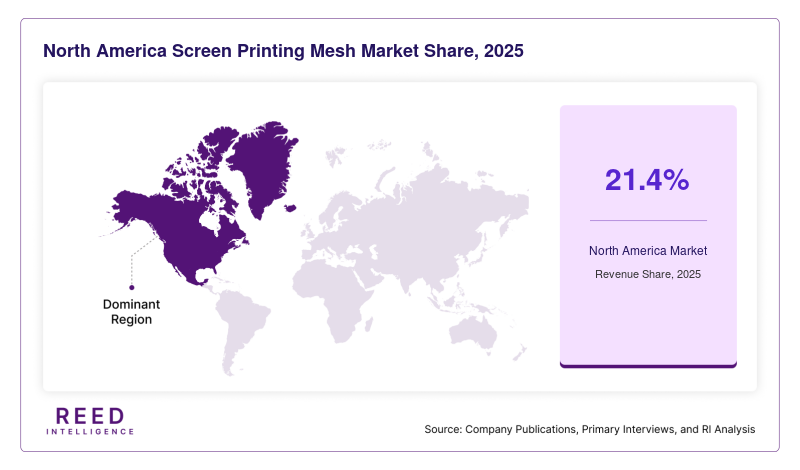
North America accounted for 21.4% of the Screen Printing Mesh Market share in 2025 and will expand at a CAGR of 4.3% during the forecast period. The region’s growth will be driven by established industrial infrastructure and steady demand from the electronics and automotive sectors. The presence of advanced manufacturing facilities and high adoption of precision printing technologies will support market expansion.
The United States dominated the regional market due to strong demand in electronics and industrial printing applications. The country’s focus on technological innovation and high-quality production standards has contributed to the adoption of advanced mesh materials. Increasing investments in printed electronics and renewable energy applications are expected to support continued growth.
Europe
Europe held a market share of 19.7% in 2025 and will grow at a CAGR of 4.6% through 2034. The region’s growth will be supported by demand from the textile and packaging industries, along with increasing emphasis on sustainable manufacturing practices.
Germany emerged as the leading country in the region, driven by its strong industrial base and focus on precision engineering. The country’s advanced manufacturing capabilities and emphasis on quality control have led to increased adoption of high-performance screen printing mesh products.
Asia Pacific
Asia Pacific dominated the Screen Printing Mesh Market with a share of 42.8% in 2025 and will register the fastest CAGR of 6.1% during the forecast period. The region’s growth will be fueled by rapid industrialization, expanding textile production, and increasing demand for consumer electronics.
China led the regional market due to its large-scale manufacturing sector and strong export-oriented economy. The country’s dominance in textile and electronics production has significantly contributed to the demand for screen printing mesh. Continuous investments in industrial infrastructure and technological advancements are expected to sustain growth.
Middle East & Africa
The Middle East & Africa accounted for 8.3% of the market share in 2025 and will grow at a CAGR of 4.8% during the forecast period. The region’s growth will be driven by expanding industrial activities and increasing demand for printed packaging solutions.
Saudi Arabia emerged as a key market, supported by investments in industrial diversification and manufacturing development. The country’s focus on non-oil sectors has encouraged growth in packaging and textile industries, contributing to the demand for screen printing mesh.
Latin America
Latin America held a market share of 7.8% in 2025 and will grow at a CAGR of 4.5% through 2034. The region’s growth will be influenced by rising demand for printed textiles and packaging materials.
Brazil dominated the regional market due to its strong textile industry and growing consumer goods sector. The country’s expanding manufacturing base and increasing adoption of modern printing technologies are expected to drive market growth.
Competitive Landscape
The Screen Printing Mesh Market is characterized by moderate competition, with key players focusing on product innovation, quality enhancement, and geographic expansion. Leading companies are investing in advanced manufacturing technologies to improve mesh precision and durability.
Sefar AG is recognized as a market leader, known for its extensive product portfolio and strong global presence. The company has recently introduced advanced mesh solutions tailored for high-precision applications, strengthening its competitive position.
Other prominent players are focusing on strategic partnerships and capacity expansions to enhance their market reach. Continuous research and development activities are enabling companies to cater to evolving industry requirements and maintain competitiveness.
Key Players
- Sefar AG
- NBC Meshtec Inc.
- Saati S.p.A.
- Trelleborg AB
- Murakami Screen USA
- Haver & Boecker
- Nittoku Co., Ltd.
- Asada Mesh Co., Ltd.
- Maishi Wire Mesh Manufacture Group
- Anping County Bolin Metal Wire Mesh Co., Ltd.
Recent Developments
- 2024: A leading manufacturer launched high-tension polyester mesh designed for precision electronics printing.
- 2023: Strategic collaboration between mesh producers and textile companies to develop customized solutions.
- 2023: Expansion of production facilities in Asia Pacific to meet growing regional demand.
- 2022: Introduction of eco-friendly mesh materials with improved recyclability.
- 2022: Increased investment in R&D for advanced weaving technologies.
Screen Printing Mesh Market Segments
Material
- Polyester
- Nylon
- Stainless Steel
Mesh Count
- Low Mesh Count
- Medium Mesh Count
- High Mesh Count
Application
- Textile Printing
- Electronics Printing
- Glass Printing
- Ceramic Printing
End-Use Industry
- Textile Industry
- Electronics Industry
- Automotive Industry
- Packaging Industry
By Region
- North America
- Europe
- APAC
- Middle East and Africa
- LATAM