Search Engine Market Size, Share & Demand Report By Type (Crawler Search Engine, Meta Search Engine, Hybrid/Federated Search Engine), By Application (Large Enterprises, Small and Medium-sized Enterprises (SMEs), Individual Users), By Region & Segment Forecasts, 2026–2034
USD 3950
Search Engine Market Size
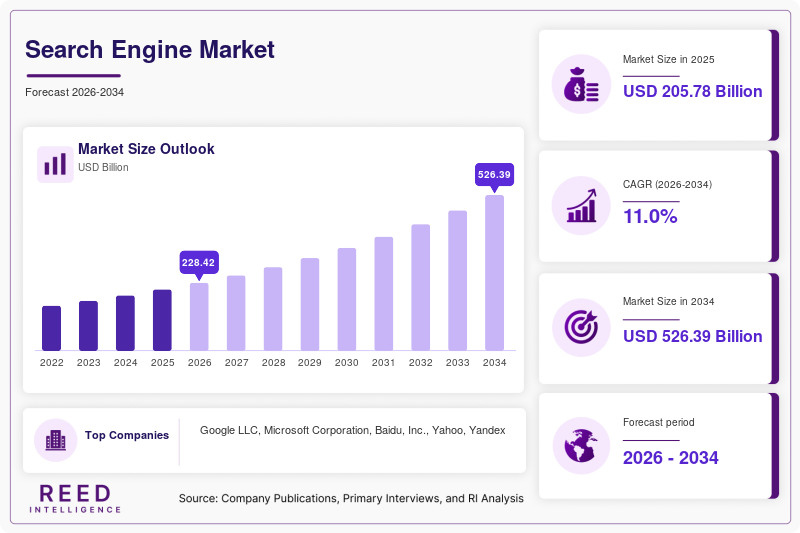
Global Search Engine market size is projected at USD 228.42 billion in 2026 and is expected to hit USD 526.39 billion by 2034 with a CAGR of 11.0%. The market is being reshaped by artificial intelligence, conversational interfaces, multimodal discovery, mobile-first usage, and increasingly personalized search experiences. Detailed segmentation and competitive analysis are becoming essential for understanding shifts in user behavior, advertising monetization, enterprise search requirements, and the emergence of AI-native search platforms.
Key Takeaways
- Regional leadership: Asia Pacific dominated the global market with approximately 38.7% revenue share in 2025, while Africa is projected to be the fastest-growing region, advancing at approximately 14.6% CAGR through the forecast period.
- Type leadership: Crawler-based search engines represented approximately 85.4% of market revenue in 2025, supported by their extensive indexing infrastructure and established advertising ecosystems. Vertical and specialized search solutions are expected to record the fastest expansion.
- Application leadership: Individual and personal-use search represented approximately 63.4% of market revenue in 2025, while enterprise and commercial applications are expected to grow rapidly as organizations adopt AI-enabled information retrieval.
- Platform shift: Mobile-based search accounted for approximately 58.5% of market revenue in 2025, while voice and connected-device search are forecast to expand at more than 16% CAGR as conversational interfaces become mainstream.
- Emerging-country opportunity: India is becoming an important growth market. The broader next-generation search segment in India was approximately USD 1.54 billion in 2025 and is forecast to reach USD 3.79 billion by 2034, representing a CAGR of about 10.2%.
The global search engine market comprises digital platforms that discover, crawl, index, rank, retrieve, and present information from the internet and connected databases. The market includes conventional crawler-based engines, metasearch platforms, hybrid search systems, specialized search services, and increasingly AI-enhanced search interfaces. Market activity is primarily measured through revenue generated from search advertising, sponsored listings, subscriptions, licensing, and related search services rather than physical production. In 2025, crawler-based engines accounted for approximately 85.4% of market revenue, while mobile platforms contributed about 58.5%. Individual users represented approximately 63.4% of application revenue, reflecting the continued importance of everyday information discovery, navigation, commerce, entertainment, and communication.
Search Engine Market Trends
AI-Native and Multimodal Search Transformation
Artificial intelligence is rapidly changing the architecture of search engines from keyword matching toward conversational, contextual, and agentic information retrieval. Search providers are integrating generative AI, large language models, retrieval-augmented generation, semantic ranking, image understanding, voice recognition, and real-time web grounding into conventional search interfaces. AI-generated summaries and conversational follow-ups are increasingly positioned alongside traditional links, while multimodal search allows users to combine text, images, voice, and video within a single discovery journey.
Sector-specific demand is also encouraging more specialized search experiences. E-commerce platforms require product and price discovery, healthcare users increasingly seek structured and trustworthy information, enterprises need internal knowledge retrieval, and travel users demand location-aware recommendations. Voice assistants, visual search, local discovery, and AI agents are consequently expanding the addressable market beyond conventional desktop web queries.
Search Engine Market Drivers
Rapid Expansion of AI-Powered Search
The integration of generative AI and advanced ranking models is a major growth driver. Search engines can increasingly understand natural-language questions, summarize multiple sources, personalize responses, identify user intent, and execute multi-step tasks. These capabilities increase engagement and create new monetization opportunities through contextual advertising, premium services, enterprise APIs, and AI-powered commercial discovery.
Search Engine Market Restraints
Privacy, Regulatory, and Data Governance Pressure
Growing privacy requirements and competition regulations are increasing compliance costs for search providers. Rules governing data collection, personalized advertising, self-preferencing, content licensing, and AI-generated results can require substantial changes to ranking systems and commercial relationships. Regional differences in regulation also make it more difficult for global providers to maintain a uniform search experience.
Search Engine Market Opportunities
Growth of Vertical and Agentic Search
Specialized search represents a significant opportunity as users increasingly seek domain-specific answers rather than generic web results. Vertical search across shopping, travel, healthcare, finance, enterprise knowledge, and professional research can deliver higher-value results. Agentic search creates an additional opportunity by allowing systems to move from retrieving information to completing actions such as comparing products, booking services, researching markets, or preparing business workflows.
Challenges in Search Engine Market
Maintaining Search Quality and Trust in the AI Era
Search providers face the challenge of maintaining relevance, accuracy, freshness, transparency, and source attribution while deploying generative AI. Hallucinated information, manipulated content, low-quality AI-generated pages, copyright concerns, and declining publisher traffic can undermine confidence in search platforms. Providers must therefore balance answer generation with reliable source discovery and sustainable relationships with content creators.
Search Engine Market Segmentation Analysis
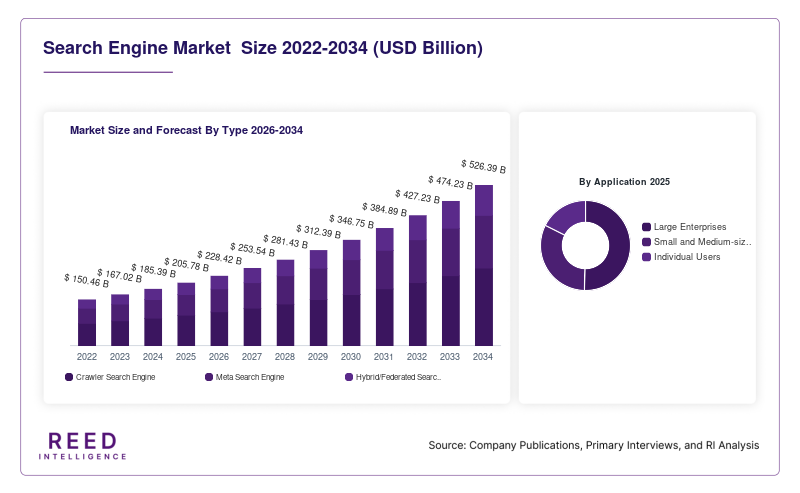
The global search engine market is segmented by type and application. Crawler-based engines remain the dominant type, accounting for approximately 85.4% of revenue in 2025, while individual users represented around 63.4% of application revenue. The segmentation is increasingly influenced by AI capabilities, mobile usage, enterprise information requirements, and the shift toward specialized and conversational discovery.
By Type
Crawler Search Engine: Crawler-based engines accounted for approximately 85.4% of global market revenue in 2025 and remain the principal search infrastructure. They continuously discover web pages through automated crawlers, process content, maintain large indexes, and rank results using hundreds of relevance signals. Rather than physical units, production is measured through indexed pages, queries processed, and results served. Leading platforms process billions of searches and maintain indexes spanning hundreds of billions of web resources. Integration of semantic ranking, AI-generated summaries, image understanding, and real-time indexing is increasing the technical complexity of these systems.
Meta Search Engine: Meta search engines represented a smaller share of overall market revenue but continue to serve users seeking aggregated results from multiple underlying search providers. Their value proposition is based on reducing dependence on one index and presenting diversified results. The segment is supported by privacy-focused services, specialized discovery, and comparison-oriented searches. Technical requirements include query federation, result deduplication, ranking normalization, low-latency API connectivity, and increasingly AI-assisted relevance scoring. Growth is expected to remain moderate as major search platforms improve their own aggregation capabilities.
Hybrid/Federated Search Engine: Hybrid and federated platforms combine conventional web indexes with proprietary databases, vertical indexes, enterprise repositories, or AI-generated knowledge layers. This category is gaining importance as businesses seek unified retrieval across structured and unstructured data. The segment is particularly relevant for enterprise, professional research, commerce, and specialized information services. AI embeddings, vector databases, semantic retrieval, reranking, and retrieval-augmented generation are becoming important technical specifications, enabling systems to process natural-language queries alongside conventional keywords.
By Application
Large Enterprises: Large enterprises increasingly use search technology for customer discovery, internal knowledge management, market intelligence, commerce, advertising, and productivity. The segment is estimated to contribute a significant portion of commercial search spending, supported by high-volume query processing and API requirements. Enterprise deployments require scalable infrastructure, security controls, multilingual retrieval, analytics, access permissions, and integration with business databases. AI-enabled enterprise search is expanding rapidly because organizations can combine internal documents with trusted external information.
Small and Medium-sized Enterprises (SMEs): SMEs use search platforms primarily for customer acquisition, digital advertising, local discovery, product research, competitive intelligence, and online commerce. The segment benefits from increasingly automated advertising tools and affordable AI-enabled discovery solutions. SMEs also represent an important user base for local search because consumers frequently use search engines to locate nearby products and services. Adoption is expected to increase as cloud-based search and AI marketing solutions reduce the technical requirements associated with digital visibility.
Individual Users: Individual users represented approximately 63.4% of market revenue in 2025 and remain the largest application segment. Search is embedded into daily activities including information retrieval, navigation, shopping, entertainment, education, health information, and travel planning. Mobile devices account for the majority of search activity, while voice, visual, and conversational interfaces are expanding the range of queries. Search production is best measured through billions of daily query interactions rather than physical units, with personalization and AI-generated answers increasingly influencing engagement.
Search Engine Market Regional Analysis
North America Search Engine Market
North America remains one of the most technologically advanced search markets, supported by high internet penetration, sophisticated digital advertising infrastructure, and rapid adoption of generative AI. The U.S. accounts for the overwhelming majority of regional revenue, with Canada contributing through digital commerce, enterprise search, and advertising. The regional market is increasingly divided between traditional web search, AI-assisted discovery, enterprise retrieval, and specialized vertical search.
Europe Search Engine Market
Europe maintains a significant share of global search activity, supported by mature digital economies across Germany, the U.K., France, Italy, Spain, and the Nordic countries. Search providers face particularly strong regulatory requirements concerning competition, privacy, data usage, advertising, and platform self-preferencing. AI search, local discovery, travel, retail, and multilingual applications remain important growth areas, while regulatory compliance is expected to influence platform design.
Asia Pacific Search Engine Market
Asia Pacific was the largest regional contributor, accounting for approximately 38.7% of global market revenue in 2025. China, India, Japan, South Korea, and Southeast Asia collectively drive regional demand through large online populations, mobile-first behavior, expanding digital commerce, and localized search ecosystems. China remains an important market for Baidu and other domestic platforms, while India is experiencing strong growth as internet access, smartphone usage, multilingual search, and AI adoption increase.
Latin America Search Engine Market
Latin America represents an expanding search market led by Brazil and Mexico. Increasing smartphone penetration, digital commerce, online advertising, and local business discovery are supporting demand. Spanish- and Portuguese-language AI search capabilities are becoming increasingly important, while SMEs are using search advertising and local search to reach consumers. Growth is expected to remain above mature-market levels as digital adoption expands.
Middle East & Africa Search Engine Market
The Middle East & Africa region has substantial long-term potential due to rising broadband availability, smartphone adoption, cloud infrastructure, and digital transformation. Gulf countries are driving enterprise and government adoption, while South Africa, Nigeria, Egypt, and other African markets contribute through expanding consumer internet usage. Africa is expected to record the fastest regional growth as connectivity improves and mobile-first search becomes more prevalent.
Top players in the Search Engine Market
- Google LLC
- Microsoft Corporation
- Baidu, Inc.
- Yahoo
- Yandex
- DuckDuckGo
- Brave Search
- Perplexity AI
- Naver Corporation
- Seznam.cz
- Ask.com
- Mojeek
- Ecosia
- Startpage
Recent Developments in Global Search Engine Market
- May 2026: Google announced major AI Search enhancements, including expanded AI Mode capabilities, agentic search functionality, a redesigned AI-powered search interface, and deeper personalization.
- May 2026: Microsoft introduced an AI-guided Bing Image Search experience that organizes image results into categories and provides generated contextual summaries.
- May 2026: DuckDuckGo expanded its privacy-focused AI strategy by improving access to AI-free search while continuing to develop optional AI functionality.
- August 2026: Perplexity expanded its agent-oriented search ecosystem through new enterprise, computer-use, and API capabilities, strengthening the convergence of search, reasoning, and autonomous task execution.
- September 2026: Google introduced further regional changes to its European search experience in response to regulatory requirements, increasing visibility for vertical search services and changing the presentation of certain commercial results.
Search Engine Market Segments
By Type
- Crawler Search Engine
- Meta Search Engine
- Hybrid/Federated Search Engine
By Application
- Large Enterprises
- Small and Medium-sized Enterprises (SMEs)
- Individual Users
By Region
- North America
- Europe
- APAC
- Middle East and Africa
- LATAM