Search Engine Optimization Advertising Software Market Size, Share Demand Report By Product Type (On-Page SEO Tools, Off-Page SEO Tools, Keyword Research Tools, Rank Tracking Tools), By Application (Large Enterprises, Small & Medium Enterprises, Agencies), By Deployment Mode (Cloud-Based, On-Premises) & Segment Forecasts, 2026–2034
USD 3950
Search Engine Optimization Advertising Software Market Size
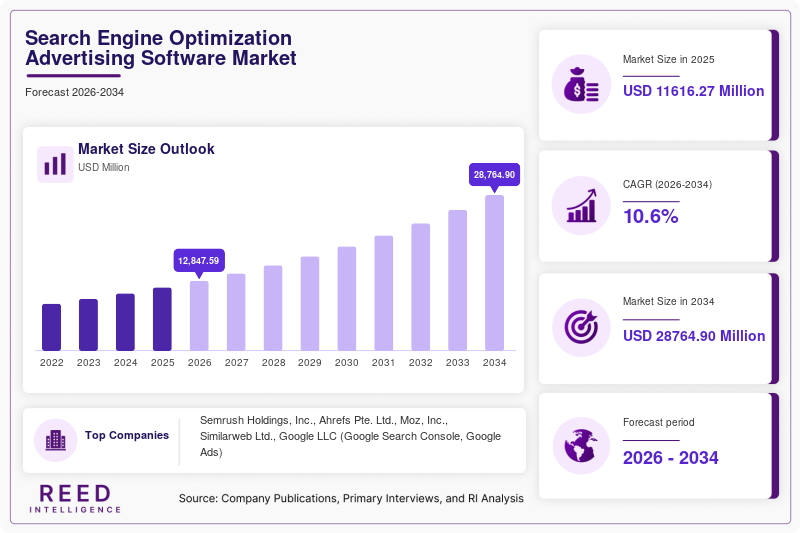
Search Engine Optimization Advertising Software market size is projected at USD 12,847.6 million in 2026 and is expected to hit USD 28,847.5 million by 2034 with a CAGR of 10.6% during the forecast period. The increasing demand for digital marketing and online visibility, coupled with the growing complexity of search engine algorithms and the need for data-driven advertising strategies, underpins market expansion. This report delivers a comprehensive analysis of the Search Engine Optimization Advertising Software market, including segmentation by type and application, competitive dynamics, and regional growth patterns, equipping stakeholders with critical intelligence. The Search Engine Optimization Advertising Software market continues to demonstrate robust growth potential, fueled by the global shift toward digital advertising, the increasing adoption of AI and machine learning in marketing, and continuous innovation in SEO software capabilities.
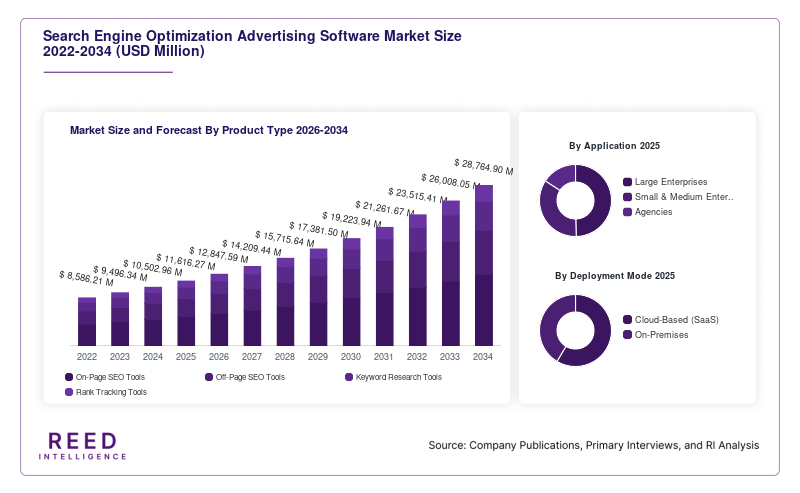
Search Engine Optimization (SEO) advertising software refers to a suite of digital tools designed to help businesses improve their search engine rankings, manage pay-per-click (PPC) campaigns, and optimize their online presence. These tools provide analytics, keyword research, rank tracking, and automation capabilities. The global adoption of SEO software is growing rapidly, with the number of users exceeding 12 million in 2025, reflecting a 14% increase from 2023, driven by the increasing importance of online visibility for businesses of all sizes. Adoption patterns reveal that the Keyword Research Tools type dominates the market, accounting for 32% of total demand, followed by On-Page SEO Tools at 28%, Rank Tracking Tools at 22%, and Off-Page SEO Tools at 18%. The Search Engine Optimization Advertising Software market's trajectory is closely linked to the growth of the global digital advertising market, which is projected to reach USD 1 trillion by 2028, and the increasing need for businesses to compete effectively in the digital landscape.
Search Engine Optimization Advertising Software Market Trends
Integration of AI and Machine Learning for Automation and Insights
The Search Engine Optimization Advertising Software market is witnessing a significant trend toward the integration of AI and machine learning, driven by the need for automation, predictive analytics, and enhanced decision-making. The revenue from AI-powered SEO software grew to USD 4.2 billion in 2025, a year-on-year increase of 22%, as 50% of new software launches in 2025 specified AI-driven features for content optimization and campaign management. Adoption rates of AI-driven SEO tools in agencies reached 40%, with this figure projected to exceed 70% by 2030. The Search Engine Optimization Advertising Software market's trend toward AI integration is reinforced by the need for efficiency, the increasing volume of data, and the continuous innovation in machine learning algorithms.
Growing Focus on Voice Search and Local SEO Capabilities
The increasing focus on voice search and local SEO capabilities is a major trend shaping the Search Engine Optimization Advertising Software market, with the development of tools optimized for conversational queries and location-based searches. The market has seen a 20% increase in the demand for voice search optimization features since 2022, with 30% of new products in 2025 featuring capabilities for voice and local search. The use of SEO software for optimizing Google My Business and local listings has also gained significant traction. The Search Engine Optimization Advertising Software market's trend toward voice and local SEO is reinforced by the growing use of smart speakers, the increasing importance of mobile search, and the continuous innovation in natural language processing technologies.
Search Engine Optimization Advertising Software Market Drivers
The Search Engine Optimization Advertising Software market's expansion is primarily driven by the increasing importance of online presence and digital marketing for businesses, with global digital ad spend exceeding USD 600 billion in 2025 and growing at a rapid pace. The need to improve search engine rankings and drive organic traffic has been a major driver, with SEO software being a critical tool. The rising complexity of search engine algorithms and the need for data-driven strategies have also fueled market growth. Additionally, the increasing adoption of digital marketing by small and medium businesses has spurred demand. The Search Engine Optimization Advertising Software market's growth is further reinforced by the continuous advancement in software capabilities and the increasing availability of user-friendly platforms.
Search Engine Optimization Advertising Software Market Restraints
Despite favorable growth prospects, the Search Engine Optimization Advertising Software market faces significant constraints, primarily related to the high cost of premium software solutions, which can be a barrier for small businesses and startups. The complexity of SEO and the steep learning curve for new users can also be a limitation. The Search Engine Optimization Advertising Software market's growth is also tempered by the constant changes in search engine algorithms, requiring continuous software updates, and the challenge of demonstrating clear ROI.
Search Engine Optimization Advertising Software Market Opportunities
The Search Engine Optimization Advertising Software market presents significant opportunities in the rapidly expanding market for content marketing and video SEO, where specialized tools are in high demand. The development of integrated platforms that combine SEO, PPC, and social media management is expected to grow at a CAGR of 12% through 2034. Emerging opportunities also exist in the use of SEO software for e-commerce and international SEO. The Search Engine Optimization Advertising Software market's opportunity profile is further enhanced by the growing trend of data-driven marketing and the increasing reliance on analytics for decision-making.
Challenges in Search Engine Optimization Advertising Software Market
The Search Engine Optimization Advertising Software market faces persistent challenges related to the need for continuous innovation to keep pace with search engine updates and evolving user behavior. The complexity of integrating with other marketing technologies and data sources can also be a challenge. The market is also contending with the challenge of managing data privacy and security. Additionally, the Search Engine Optimization Advertising Software market is challenged by the need to differentiate products in a highly competitive space.
Search Engine Optimization Advertising Software Market Segmentation
The Search Engine Optimization Advertising Software market is segmented by Type and Application to provide a comprehensive market perspective. By Type, Keyword Research Tools dominate with a 32% market share, driven by their essential role in strategy. The Application segment is led by Small & Medium Enterprises, which accounts for 45% of the market, followed by Large Enterprises at 30%, and Agencies at 25%.
By Type
Keyword Research Tools represent the largest segment in the Search Engine Optimization Advertising Software market, commanding a 32% share, with revenue exceeding USD 4.1 billion in 2025. These are characterized by their use in identifying high-value search terms and topics. Technical specifications include search volume data, competition analysis, and keyword suggestions. The Search Engine Optimization Advertising Software market's Keyword Research segment is driven by its use in content and campaign strategy.
On-Page SEO Tools capture a 28% share of the Search Engine Optimization Advertising Software market, with revenue of USD 3.6 billion in 2025. These are characterized by their use in optimizing website content and structure. Technical specifications include content analysis, meta tag optimization, and internal linking. The Search Engine Optimization Advertising Software market's On-Page segment is driven by its use in content creation and website audits.
Rank Tracking Tools represent 22% of the Search Engine Optimization Advertising Software market, with revenue of USD 2.8 billion in 2025. These are characterized by their use in monitoring keyword rankings. Technical specifications include tracking across search engines, local and mobile rankings, and competitor analysis. The Search Engine Optimization Advertising Software market's Rank Tracking segment is driven by its use in performance measurement.
Off-Page SEO Tools comprise the remainder of the Search Engine Optimization Advertising Software market, accounting for 18% of total revenue, with USD 2.3 billion in 2025. This includes use in link building and reputation management. The Search Engine Optimization Advertising Software market's Off-Page segment is driven by its use in authority building and backlink analysis.
By Application
Small & Medium Enterprises dominates the Search Engine Optimization Advertising Software market, accounting for 45% of sales, representing USD 5.8 billion in 2025. This segment includes use by businesses for organic growth and online visibility. Usage penetration exceeds 40% in the sector. The Search Engine Optimization Advertising Software market's SME segment is characterized by its focus on affordability, ease of use, and all-in-one solutions.
Large Enterprises accounts for 30% of the Search Engine Optimization Advertising Software market, with revenue of USD 3.9 billion in 2025. This segment encompasses use by corporations for comprehensive digital marketing strategies. The segment is growing at a steady CAGR, driven by the need for enterprise-grade solutions. The Search Engine Optimization Advertising Software market's Large Enterprise segment is characterized by its focus on integration, scalability, and advanced analytics.
Agencies represents 25% of the Search Engine Optimization Advertising Software market, with revenue of USD 3.2 billion in 2025. This segment includes use by digital marketing agencies and consultants. The segment is growing at a robust CAGR, driven by the expansion of digital marketing services. The Search Engine Optimization Advertising Software market's Agency segment is characterized by its focus on multi-client management, white-label options, and reporting.
Search Engine Optimization Advertising Software Market Regional Outlook
North America Search Engine Optimization Advertising Software Market
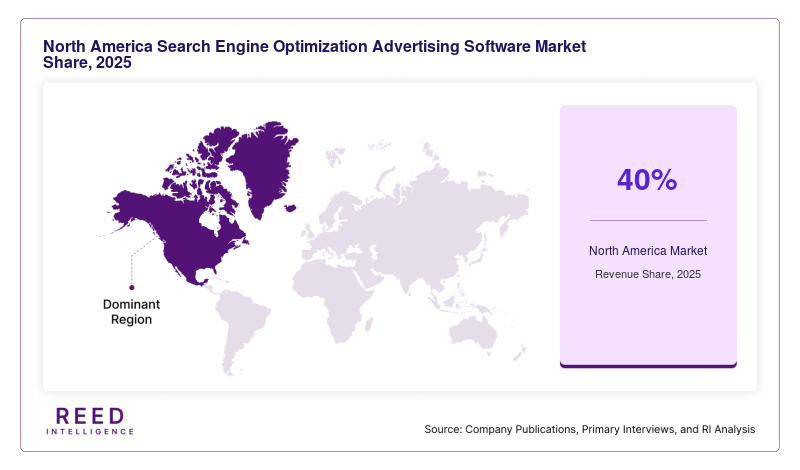
Leads the Search Engine Optimization Advertising Software market, commanding a 40% share, with a revenue of USD 5,139.0 million in 2025. The United States is the primary driver, accounting for 85% of regional demand, driven by the mature digital marketing landscape, high technology adoption, and presence of major software vendors. The North American Search Engine Optimization Advertising Software market is characterized by its focus on innovation and premium products.
Europe Search Engine Optimization Advertising Software Market
Represents the second-largest market, capturing a 30% share with a revenue of USD 3,854.3 million in 2025. The UK, Germany, and France are the primary drivers, collectively accounting for 60% of regional demand, driven by a strong digital economy, high internet penetration, and a focus on digital transformation. The Search Engine Optimization Advertising Software market in Europe is characterized by its focus on quality and compliance.
Asia-Pacific Search Engine Optimization Advertising Software Market
Accounts for 22% of the global Search Engine Optimization Advertising Software market, with a revenue of USD 2,826.5 million in 2025. China, India, and Australia are the primary drivers, together accounting for 70% of regional demand, driven by rapid digitalization, growing SME sector, and increasing online ad spend. The Asia-Pacific Search Engine Optimization Advertising Software market is projected to grow at the fastest CAGR of 13% through 2034.
Middle East & Africa and Latin America Search Engine Optimization Advertising Software Market
Together account for the remaining 8% of the Search Engine Optimization Advertising Software market, with the UAE leading the Middle East market and Brazil leading the Latin American market. Both regions are projected to grow at CAGRs exceeding 12%, driven by increasing internet adoption and digital marketing investments.
Top players in Search Engine Optimization Advertising Software Market
- Semrush Holdings, Inc.
- Ahrefs Pte. Ltd.
- Moz, Inc.
- Similarweb Ltd.
- Google LLC (Google Search Console, Google Ads)
- Microsoft Corporation (Bing Webmaster Tools)
- Screaming Frog SEO Spider
- SE Ranking
- SpyFu
- Majestic
- BuzzSumo
- Ubersuggest
- Yoast (Acquired by Newfold Digital)
- Rank Ranger
- WebCEO
Semrush Holdings, Inc.
Semrush Holdings holds a dominant position in the Search Engine Optimization Advertising Software market, with an estimated 18% global market share, particularly strong in the all-in-one SEO platform segment. The company's portfolio of SEO tools is widely recognized for its comprehensive features, usability, and innovation. Semrush's market leadership is reinforced by its significant R&D investment, its strong brand presence, and its extensive user base. Semrush commands over 20% of the North American market and 15% of the European market, positioning it as a key player in the Search Engine Optimization Advertising Software market.
Ahrefs Pte. Ltd.
Ahrefs is a leading player in the Search Engine Optimization Advertising Software market, commanding approximately 14% of the global market share through its powerful link analysis and SEO toolset. The company's expertise in backlink data and keyword research have solidified its position. Ahrefs' tools are known for their depth, accuracy, and regular updates. The company's commitment to data quality and its strong presence in the North American and European markets have enhanced its competitive advantage.
Moz, Inc. holds a significant 10% market share, with particular strength in SEO software and community. Similarweb Ltd. is a major player in the digital intelligence and SEO market, holding an 8% share.
Recent Developments in Search Engine Optimization Advertising Software Market
- 2025: Semrush launched a new AI-powered content generator and optimization tool, integrating generative AI for SEO content creation.
- 2025: Ahrefs introduced a new keyword difficulty and traffic potential metric, enhancing its keyword research capabilities.
Search Engine Optimization Advertising Software Market Segments
By Product Type
- On-Page SEO Tools
- Off-Page SEO Tools
- Keyword Research Tools
- Rank Tracking Tools
By Application
- Large Enterprises
- Small & Medium Enterprises
- Agencies
By Deployment Mode
- Cloud-Based (SaaS)
- On-Premises
By Region
- North America
- Europe
- APAC
- Middle East and Africa
- LATAM