Search Engine Optimization (SEO) Market Size, Share & Trends Analysis Report By Service Type (On-Page SEO, Technical SEO, Off-Page SEO, Local SEO, E-commerce SEO), By Enterprise Size (Large Enterprises, SMEs), By Application (Content Optimization, Website Optimization, Link Building & Digital PR, Local Search Optimization, Analytics & Reporting), By End User (BFSI, IT & Telecommunications, Retail & E-commerce, Healthcare, Media & Entertainment, Travel & Hospitality, Other Industries) and By Regi
USD 3950
Search Engine Optimization (SEO) Market Market Size
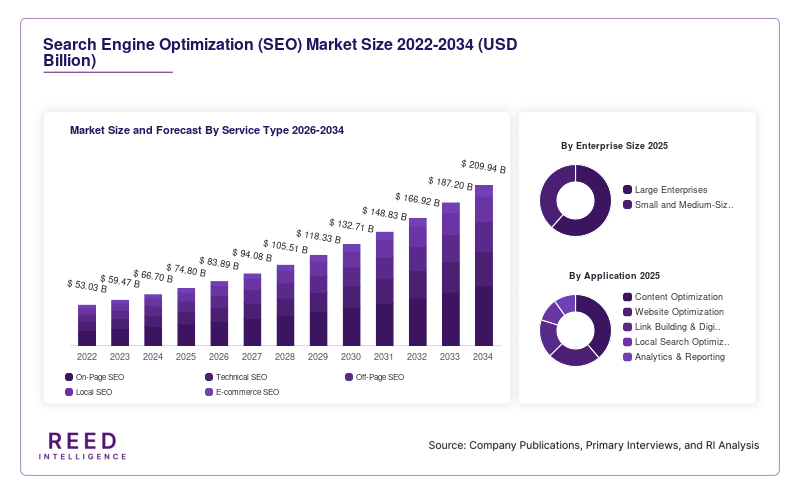
The global Search Engine Optimization (SEO) Market size was valued at USD 74.80 billion in 2025 and is projected to grow from USD 83.88 billion in 2026 to USD 187.14 billion by 2034, registering a CAGR of 12.15% during the forecast period from 2026 to 2034.
The SEO Market is being reshaped by the convergence of conventional search, mobile discovery and generative AI. Google reported in May 2026 that AI Mode had surpassed one billion monthly active users globally, while AI Mode queries had more than doubled every quarter since launch. Google also reported that overall Search queries had reached an all-time high.
This does not eliminate traditional SEO. Instead, it changes what businesses need to optimize. Websites still need to be crawlable, technically accessible and useful to users, but brands increasingly need content that can be understood, cited and surfaced by generative systems. Google has explicitly stated that its SEO guidance remains centered on people-first content and that generative AI can be used to assist content creation when the resulting material provides genuine value.
-market-8117.png)
Search Engine Optimization (SEO) Market Dynamics Drivers
Expansion of AI Search and Generative Discovery
The most important structural change in SEO is the shift from conventional result pages toward AI-mediated discovery. Google expanded AI Overviews and AI Mode throughout 2026, while Microsoft added AI Performance reporting to Bing Webmaster Tools. Google also introduced more direct links and website previews within AI-generated Search experiences.
This changes the commercial mechanism for SEO providers. Historically, the central objective was improving rankings and generating clicks from conventional search results. AI search adds another visibility layer: websites can be cited, mentioned or used as source material even when users do not interact with a conventional blue-link result.
Semrush's 2026 analysis of 126 million U.S. AI-search prompts found substantial brand visibility activity across AI-powered discovery environments, while its commercial-search study found AI Overviews appearing on commercial-intent search results at materially higher rates than six months earlier.
Consequently, businesses are allocating SEO resources toward content authority, entity recognition, structured information and citation visibility in addition to conventional rankings.
Continued Dominance of Search as a Digital Discovery Channel
Despite the emergence of AI assistants, traditional search engines continue to process a massive share of online discovery. Google held approximately 91.1% of worldwide search-engine market share in August 2026, with Bing at 4.5%. On mobile, Google's share reached approximately 95.6%.
The commercial mechanism is particularly strong for businesses whose customers research products, services, locations or brands before purchasing. Search visibility can therefore influence traffic acquisition across retail, financial services, healthcare, travel, software, professional services and local businesses.
Google's Search Essentials continue to emphasize crawlability, relevant terminology, helpful content, internal linking, structured data and other technical foundations.
SEO therefore remains relevant even as the interface changes. Companies must optimize the underlying web presence because both traditional search results and AI-powered systems rely on accessible, interpretable web information.
Growth of Data-Driven and Technical SEO
SEO has become increasingly dependent on technical diagnostics and measurable performance. Google's ranking documentation describes hundreds of billions of indexed pages and multiple automated systems that assess relevance and usefulness at page and site levels.
Technical SEO consequently covers more than metadata. Crawlability, indexation, structured data, JavaScript rendering, internal linking, mobile performance and page experience influence how efficiently search systems understand websites.
Core Web Vitals also continue to form part of Google's page-experience framework, with Interaction to Next Paint (INP) replacing First Input Delay as a Core Web Vital in March 2024.
This supports recurring demand for technical audits, monitoring platforms, log analysis, structured-data implementation and website performance services, particularly among enterprises operating large numbers of pages.
Search Engine Optimization (SEO) Market Restraints
Increasing Difficulty of Producing Search-Eligible Content
The availability of generative AI has reduced the cost of producing large volumes of written material, but it has also increased the volume of competing content. Google explicitly prohibits scaled content abuse when large quantities of pages are produced primarily to manipulate rankings, including AI-generated pages that provide little additional value.
This changes the economics of content-focused SEO. Agencies cannot rely solely on publishing large quantities of keyword-targeted pages. Google recommends original information, research, analysis, first-hand expertise and satisfying user experiences.
As a result, high-quality SEO increasingly requires subject expertise, original research, editorial review, digital PR and content differentiation. These activities have higher labor costs than automated content production.
Fragmentation of Search Visibility Measurement
SEO measurement is becoming more complicated because visibility now exists across conventional rankings, AI Overviews, AI Mode, Bing/Copilot and third-party AI platforms. Google introduced dedicated generative-AI visibility reporting in Search Console in 2026, while Microsoft introduced a comparable AI Performance view in Bing Webmaster Tools.
This creates measurement challenges because impressions, citations, mentions, clicks and conversions do not represent the same commercial outcome. Ahrefs has also noted that there is currently no reliable industry-wide source for measuring AI prompt volume across major AI platforms, requiring providers to use different estimation methodologies.
The result is greater demand for sophisticated analytics but also greater difficulty in comparing SEO performance consistently across platforms.
Search Engine Optimization (SEO) Market Opportunities
AI Visibility Optimization
AI-generated search is creating a new service layer around traditional SEO. Google now provides Search Console reporting for impressions generated through AI Overviews and AI Mode, while Bing Webmaster Tools shows how URLs are cited across Microsoft's AI experiences.
SEO platforms can therefore expand into AI visibility monitoring, citation tracking, entity optimization, content-source analysis and generative-search competitive intelligence.
Semrush's 2026 research analyzed 126 million U.S. AI search prompts, demonstrating the scale at which AI visibility can now be measured.
This opportunity is commercially distinct from conventional rank tracking because brands increasingly need to understand not only where their pages rank but also whether their information is selected as a source in synthesized answers.
Enterprise SEO Automation
Large websites create substantial technical complexity because thousands or millions of URLs may require continuous monitoring. Enterprise SEO platforms can automate crawling, internal-link analysis, indexation monitoring, structured-data validation, keyword tracking, content auditing and technical alerts.
The shift toward AI search adds another layer: platforms can identify which content is being cited, which entities are associated with a brand and which topics create visibility across multiple search interfaces.
This creates opportunities for SEO software providers to integrate AI visibility, technical SEO, content intelligence, analytics and workflow automation into unified platforms rather than selling isolated keyword or backlink tools.
Search Engine Optimization (SEO) Market Segmental Analysis
By Service Type
On-Page SEO represents approximately 31% of the global SEO Market in 2025, making it the largest service category. It includes content optimization, title and heading structures, internal linking, keyword-intent alignment, media optimization and other page-level improvements. Google's Search Essentials specifically emphasizes relevant terminology, crawlable links and content that helps users accomplish their goals.
Technical SEO accounts for approximately 27%, covering crawlability, indexation, site architecture, JavaScript, structured data, mobile performance and page experience.
Off-Page SEO represents approximately 21%, including link acquisition, digital PR, brand mentions and authority development.
Local SEO accounts for approximately 13%, supported by businesses that depend on location-based discovery.
E-commerce SEO represents approximately 8% but is the fastest-growing service type, with a CAGR of approximately 14.8%. The expansion of product discovery, structured product data, merchant listings and AI-assisted shopping search is increasing the technical and content requirements of online retailers.
By Enterprise Size
Large Enterprises represent approximately 61% of the market in 2025. Large organizations operate complex websites, multiple product lines, international domains and extensive content inventories, creating demand for enterprise crawling, technical auditing, international SEO, analytics and workflow management.
SMEs account for approximately 39%. Their requirements tend to be more focused on local discovery, content creation, website optimization and cost-efficient customer acquisition.
SMEs are the faster-growing enterprise category, with a CAGR of approximately 13.7%. Cloud-based SEO platforms, automated audits and AI-assisted content workflows are lowering the operational barrier to adopting professional SEO capabilities.
By Application
Content Optimization accounts for approximately 34% of the market in 2025, reflecting the continued importance of useful, relevant and authoritative information. Google's ranking guidance emphasizes original, helpful and people-first content rather than content created primarily for search traffic.
Website Optimization represents approximately 26%, covering technical architecture, performance, indexation and page experience.
Link Building & Digital PR accounts for approximately 18%, while Local Search Optimization represents approximately 12%.
Analytics & Reporting accounts for approximately 10% but is the fastest-growing application, with a CAGR of approximately 15.1%. The expansion of AI visibility reporting is increasing the need to measure rankings, citations, impressions, referrals and conversions across multiple discovery environments.
By End User
Retail & E-commerce represents approximately 24% of the market in 2025, supported by large product catalogues and strong dependence on organic product discovery.
IT & Telecommunications accounts for approximately 19%, followed by BFSI at 15%, Media & Entertainment at 14%, Healthcare at 11%, Travel & Hospitality at 9%, and Other Industries at 8%.
IT & Telecommunications is the fastest-growing end-user segment, with a CAGR of approximately 14.2%. Technology companies are operating in a particularly competitive discovery environment where product research increasingly occurs through conventional search engines, AI assistants, developer resources, comparison content and community platforms.
Search Engine Optimization (SEO) Market Regional Analysis
North America Search Engine Optimization (SEO) Market
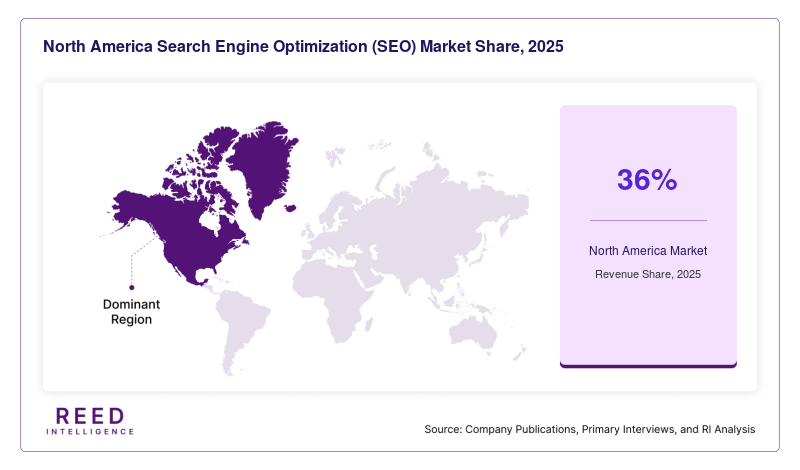
North America represents approximately 36% of the global SEO Market in 2025, making it the largest regional market. The region has a mature digital-advertising ecosystem, high enterprise software adoption and a large concentration of SEO agencies and technology companies.
The United States is also central to the development of AI search. Google introduced AI Mode in the U.S. before expanding it more broadly, and by May 2026 Google reported more than one billion monthly active AI Mode users globally.
The region's SEO demand is increasingly enterprise-oriented. Large retailers, software companies, financial institutions and media organizations require technical optimization across extensive websites while simultaneously adapting content to AI-generated search results.
Microsoft's February 2026 launch of AI Performance in Bing Webmaster Tools further expanded the measurement environment available to North American publishers and businesses.
North America is projected to grow at approximately 10.9% CAGR. The region's mature SEO infrastructure limits the rate of basic adoption, but enterprise automation, AI visibility and sophisticated analytics provide additional growth mechanisms.
Europe Search Engine Optimization (SEO) Market
Europe represents approximately 27% of the global market in 2025, supported by widespread digital commerce, multilingual websites and strong adoption of online customer acquisition.
European businesses face an additional technical challenge because international SEO frequently involves multiple languages, domains, currencies, regulatory environments and country-specific search behavior. This increases demand for international SEO, hreflang implementation, structured data, technical auditing and localized content.
The region is also important for privacy-sensitive analytics and measurement practices, requiring SEO providers to adapt data collection and reporting processes to local regulatory requirements.
Europe is projected to register approximately 11.4% CAGR. Growth is being supported by e-commerce, enterprise digital transformation and AI-search adaptation, while mature markets such as the UK, Germany and France create a large installed base of professional SEO users.
APAC Search Engine Optimization (SEO) Market
APAC accounts for approximately 23% of the global SEO Market in 2025 and is the fastest-growing region, with an estimated CAGR of 15.2%.
The region combines large internet-user populations with expanding e-commerce, mobile usage and digital business formation. Search behavior is also highly fragmented across markets, requiring optimization for Google as well as regionally important platforms such as Baidu, Naver and other local discovery systems.
Mobile search is particularly important. Google held approximately 95.6% of worldwide mobile search-engine share in August 2026, while Baidu and other regional platforms maintain relevance in specific Asian markets.
India, China, Japan, South Korea, Southeast Asia and Australia represent different stages of SEO adoption. International businesses require multilingual and multi-market optimization, while local companies increasingly use organic search to compete for e-commerce and service demand.
APAC's rapid expansion is creating demand for local SEO, multilingual content, technical SEO, mobile optimization and AI-search visibility. The primary constraint is fragmentation: search engines, languages, consumer behavior and regulatory environments vary significantly between countries.
Middle East and Africa Search Engine Optimization (SEO) Market
Middle East and Africa represents approximately 6% of the global SEO Market in 2025 and is projected to grow at approximately 13.4% CAGR.
Digital transformation, e-commerce adoption, tourism development, financial technology and online services are increasing the need for organic search visibility. Gulf markets in particular have high digital adoption and strong investment in online platforms.
SEO demand is also becoming more multilingual. Businesses targeting the region may need Arabic and English content, country-specific landing pages and localized search strategies.
The region has significant room for growth because professional SEO penetration remains below mature North American and European markets. However, SEO providers need to account for differences in language, search behavior, internet infrastructure and business maturity.
AI search presents an additional opportunity because businesses can optimize structured and authoritative information for emerging discovery interfaces rather than relying solely on conventional keyword rankings.
LATAM Search Engine Optimization (SEO) Market
LATAM accounts for approximately 8% of the global SEO Market in 2025 and is projected to grow at approximately 13.0% CAGR.
Brazil, Mexico, Argentina, Colombia and Chile provide important digital markets, supported by e-commerce, financial services, travel, telecommunications and consumer internet platforms.
Spanish and Portuguese localization is particularly important because translating English content directly does not necessarily reproduce local search intent. SEO providers therefore increasingly combine technical optimization with local content development and country-specific keyword research.
E-commerce expansion provides an additional demand mechanism because online retailers compete for product discovery without relying exclusively on paid advertising. Mobile-first search behavior also increases the importance of page performance and local discovery.
The principal constraints are differences in digital maturity, economic conditions and SEO budgets between countries. Nevertheless, the region's expanding digital-commerce base provides a growing customer pool for SEO agencies and software platforms.
Search Engine Optimization (SEO) Market Competitive Landscape
The SEO Market is highly fragmented, with competition spanning global digital-marketing agencies, specialist SEO firms, enterprise software providers and integrated marketing platforms. The competitive basis is shifting from simple keyword tracking toward technical intelligence, content quality, automation, AI-search visibility, enterprise workflows and measurable business outcomes.
Google remains the most important search ecosystem globally, with approximately 91.1% worldwide search-engine share in August 2026. Its Search Central documentation establishes technical, content and spam requirements that influence the services offered by the broader SEO industry.
Key Market Players
- Semrush
- Ahrefs
- BrightEdge
- Conductor
- Moz
- SISTRIX
- Searchmetrics
- SE Ranking
- Yoast
- Similarweb
- WebFX
- NP Digital
- iProspect
- Victorious
Search Engine Optimization (SEO) Market Recent Market Developments
September 2026 – Semrush Expanded AI Search Research
Semrush published a September 2026 study examining AI search and SEO in manufacturing, following its broader 2026 AI Visibility Index based on 126 million U.S. AI search prompts. The research reflects the industry's movement toward measuring brand mentions and citations in AI-generated discovery alongside conventional search rankings.
August 2026 – Google Search Console AI Visibility Reporting Reached Global Availability
Google completed the rollout of Search Generative AI performance insights to websites worldwide on August 31, 2026. The reporting provides visibility into impressions from AI Overviews, AI Mode and generative features in Discover.
Search Engine Optimization (SEO) Market Segments
By Service Type
- On-Page SEO
- Technical SEO
- Off-Page SEO
- Local SEO
- E-commerce SEO
By Enterprise Size
- Large Enterprises
- Small and Medium-Sized Enterprises
By Application
- Content Optimization
- Website Optimization
- Link Building & Digital PR
- Local Search Optimization
- Analytics & Reporting
By End User
- BFSI
- IT & Telecommunications
- Retail & E-commerce
- Healthcare
- Media & Entertainment
- Travel & Hospitality
- Other Industries
A PHP Error was encountered
Severity: Notice
Message: Undefined offset: 4
Filename: reportpages/rd.php
Line Number: 395
Backtrace:
File: /var/www/html/application/views/frontend/reportpages/rd.php
Line: 395
Function: _error_handler
File: /var/www/html/application/controllers/FrontendReportController.php
Line: 420
Function: view
File: /var/www/html/index.php
Line: 315
Function: require_once
By Region
- North America
- Europe
- APAC
- Middle East and Africa
- LATAM