Seaweed Cosmetic Ingredients Market Size, Share & Demand Report By Ingredient Type (Seaweed Extracts, Alginates, Carrageenan, Fucoidan-Based Ingredients, Other Seaweed Derivatives), By Application (Anti-Aging Formulations, Color Cosmetics, Personal Care Products), By Source (Brown Seaweed, Red Seaweed, Green Seaweed), By Region & Segment Forecasts, 2026–2034
USD 3950
Market Overview
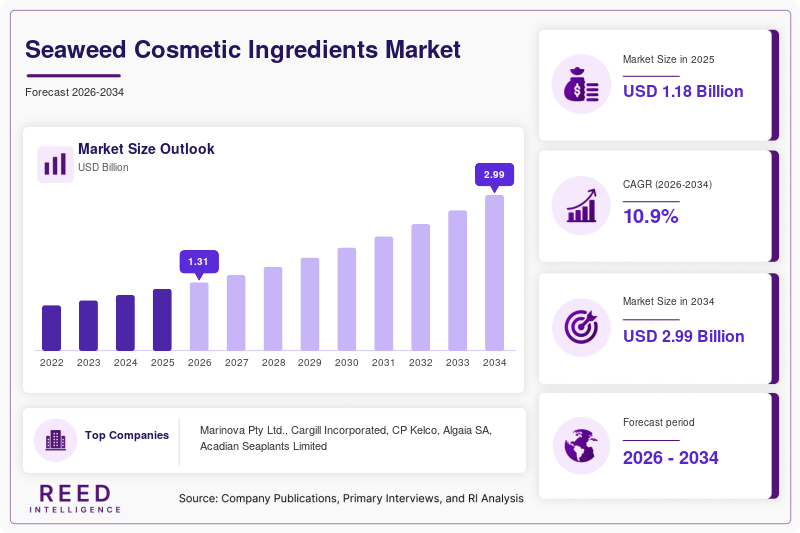
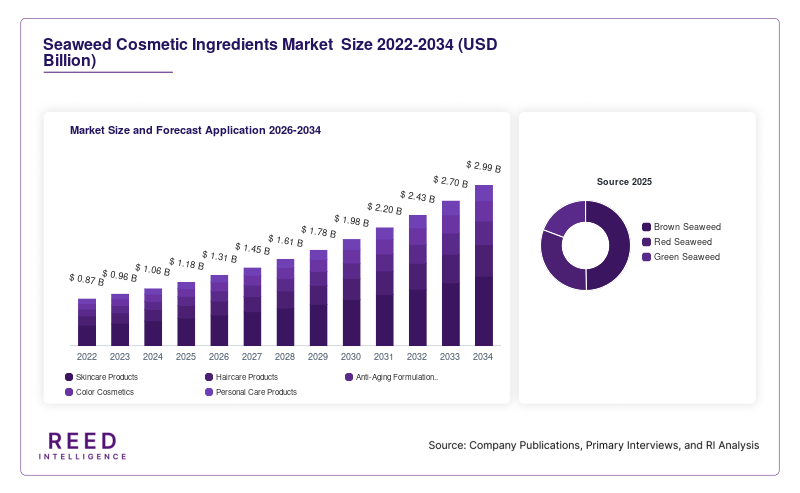
The global Seaweed Cosmetic Ingredients Market size was valued at approximately USD 1.18 billion in 2026 and is projected to reach USD 2.69 billion by 2034, expanding at a CAGR of 10.9% during 2026–2034. The market is experiencing steady expansion as cosmetic manufacturers increasingly incorporate marine-derived ingredients into skincare, haircare, and personal care formulations. Seaweed extracts are widely recognized for their moisturizing, antioxidant, anti-aging, and skin-conditioning properties, making them suitable for premium as well as mass-market cosmetic products.
A major global factor supporting market growth is the rising consumer preference for natural and sustainable beauty solutions. Consumers across developed and emerging economies are actively seeking products formulated with plant-based and marine-derived ingredients that align with clean-label and environmentally responsible purchasing behavior. Seaweed ingredients offer a favorable combination of efficacy, biodegradability, and renewable sourcing potential, encouraging manufacturers to integrate them into new product development pipelines.
Key Highlights
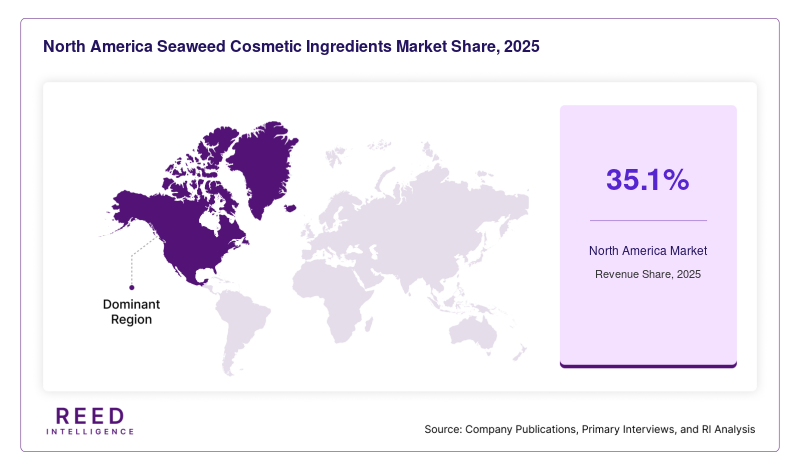
- North America dominated the market with a 35.1% share in 2025.
- Asia Pacific is expected to grow at the fastest CAGR of 12.3% during 2026–2034.
- By ingredient type, seaweed extracts accounted for the largest share of 39.4%.
- while fucoidan-based ingredients are projected to grow at a CAGR of 13.1%.
- By application, skincare products led with a 46.8% share.
- whereas anti-aging formulations are expected to expand at a CAGR of 12.8%.
- By source, brown seaweed held the dominant share of 44.6%.
- while red seaweed is anticipated to grow at a CAGR of 11.9%.
- The United States remained the dominant country, with market values of USD 338 million in 2024 and USD 372 million in 2025.
Market Trends
Growing Adoption of Marine-Based Clean Beauty Formulations
The clean beauty movement continues to influence product development across the cosmetics industry. Manufacturers are increasingly replacing synthetic additives with naturally derived ingredients that provide functional and marketing advantages. Seaweed-derived ingredients fit this requirement due to their high concentration of vitamins, minerals, amino acids, and polysaccharides. Cosmetic brands are highlighting marine sourcing, sustainability claims, and skin wellness benefits in product positioning strategies. Premium skincare products containing kelp, algae extracts, and seaweed bioactives are witnessing stronger demand among consumers seeking transparency and ingredient traceability. This trend is encouraging suppliers to develop refined extraction processes and standardized ingredient portfolios for large-scale cosmetic applications.
Expansion of Biotechnology-Enhanced Seaweed Ingredient Production
Biotechnology is playing a larger role in the commercialization of seaweed cosmetic ingredients. Advanced cultivation systems, controlled marine farming, and bio-refining technologies are helping improve ingredient consistency and production efficiency. Cosmetic companies increasingly prefer standardized active compounds that deliver predictable formulation performance. Research institutions and ingredient manufacturers are developing high-purity extracts targeted toward hydration, anti-aging, and skin barrier enhancement applications. These innovations are expanding the range of functional ingredients available to formulators. The trend is also supporting premium product launches that combine marine biotechnology with sustainability messaging, helping brands differentiate themselves in competitive beauty markets.
Market Drivers
Rising Consumer Demand for Natural and Sustainable Cosmetics
Consumers are becoming more conscious of ingredient safety, environmental impact, and product transparency. This shift has encouraged cosmetic brands to adopt naturally sourced ingredients that align with sustainability objectives. Seaweed ingredients provide an attractive solution because they are renewable, biodegradable, and rich in bioactive compounds. Manufacturers are increasingly promoting seaweed-based formulations as alternatives to synthetic moisturizers, stabilizers, and conditioning agents. The growing popularity of vegan and cruelty-free beauty products is also supporting ingredient adoption. As consumer awareness regarding marine-derived skincare benefits continues to expand, demand for seaweed cosmetic ingredients is expected to strengthen across multiple product categories.
Increasing Use of Functional Ingredients in Premium Skincare
Premium skincare brands are focusing on multifunctional ingredients capable of delivering measurable skin benefits. Seaweed extracts contain antioxidants, minerals, and polysaccharides that support hydration, skin protection, and anti-aging performance. These properties make them suitable for serums, creams, masks, and specialized treatment products. Cosmetic companies are investing heavily in research and development to create differentiated formulations that address consumer concerns related to aging, pollution exposure, and skin sensitivity. As efficacy becomes a central purchasing factor, the integration of seaweed-derived actives into high-value skincare products continues to accelerate market growth and product innovation.
Market Restraint
Supply Chain Variability and Raw Material Availability Challenges
Despite favorable growth prospects, the Seaweed Cosmetic Ingredients Market faces challenges associated with raw material supply consistency. Seaweed production depends heavily on environmental conditions, ocean temperatures, harvesting regulations, and seasonal factors. Variations in these conditions can affect biomass quality, availability, and pricing. Cosmetic manufacturers often require standardized ingredients with consistent functional properties, making supply fluctuations a significant concern. In addition, increasing demand from food, pharmaceutical, nutraceutical, and agricultural industries creates competition for seaweed resources. For example, a period of reduced harvest volumes in major producing regions can increase procurement costs and pressure profit margins for ingredient processors. These supply-side uncertainties may limit production scalability and create challenges for manufacturers seeking long-term sourcing stability. Investments in sustainable aquaculture, controlled cultivation systems, and diversified sourcing networks are helping mitigate these risks, but raw material availability remains an important market restraint.
Market Opportunities
Expansion of Anti-Aging and Skin Wellness Product Categories
The growing global aging population and increasing interest in preventative skincare create substantial opportunities for seaweed cosmetic ingredients. Consumers are seeking products that improve hydration, elasticity, and overall skin appearance while minimizing the use of harsh synthetic chemicals. Seaweed-derived compounds such as fucoidan and marine polysaccharides are being incorporated into advanced anti-aging formulations due to their potential skin-conditioning properties. Cosmetic manufacturers are introducing targeted product lines focused on skin wellness, barrier protection, and long-term skin health. This trend provides ingredient suppliers with opportunities to develop specialized active ingredients tailored to premium skincare applications and emerging consumer needs.
Emerging Demand Across Developing Beauty Markets
Rapid urbanization, rising disposable income, and growing beauty awareness are creating new opportunities in emerging economies. Consumers in Asia Pacific, Latin America, and parts of the Middle East are increasingly purchasing premium personal care products featuring natural ingredients. International cosmetic brands are expanding distribution networks while local manufacturers are introducing region-specific formulations incorporating marine ingredients. Digital retail platforms are further increasing product accessibility and consumer education. As awareness regarding seaweed-based cosmetic benefits continues to improve, ingredient suppliers can establish stronger market positions through strategic partnerships, regional manufacturing investments, and customized product offerings designed for local consumer preferences.
Segmental Analysis
By Ingredient Type
Seaweed extracts represented the dominant subsegment and accounted for approximately 39.4% of market revenue in 2024. Their leadership position is attributed to extensive use across skincare, haircare, and personal care applications. These extracts provide moisturizing, antioxidant, and conditioning properties that enhance product functionality while supporting natural ingredient claims. Cosmetic manufacturers favor seaweed extracts because they can be incorporated into a broad range of formulations without significant processing challenges. The availability of multiple species and extraction methods further supports widespread adoption. Increasing demand for multifunctional cosmetic ingredients has strengthened the position of seaweed extracts across premium and mass-market product categories.
Fucoidan-based ingredients are projected to be the fastest-growing subsegment, expanding at a CAGR of 13.1% during the forecast period. Growth is supported by increasing research regarding the potential skincare benefits of fucoidan-rich marine compounds. Cosmetic brands are exploring these ingredients for anti-aging, hydration, and skin protection applications. The premium skincare segment is particularly driving demand as manufacturers seek differentiated active ingredients capable of supporting product performance claims. Advances in extraction technology are improving ingredient purity and consistency, enabling broader commercialization. As consumer interest in advanced marine-derived bioactives increases, fucoidan-based ingredients are expected to gain significant market traction.
By Application
Skincare products emerged as the dominant application segment and accounted for approximately 46.8% of market revenue in 2024. The segment benefits from the broad functional profile of seaweed ingredients, which support hydration, soothing, antioxidant protection, and skin-conditioning performance. Facial creams, lotions, masks, cleansers, and serums frequently utilize seaweed extracts to enhance product effectiveness and natural positioning. Growing consumer focus on skin health and preventative skincare has contributed to higher demand for marine-derived ingredients. Manufacturers continue to develop innovative formulations that combine seaweed compounds with other botanical actives, further strengthening the segment's market leadership and long-term growth potential.
Anti-aging formulations are expected to register the fastest CAGR of 12.8% through 2034. Consumers increasingly seek products that address fine lines, skin elasticity, and visible aging concerns while maintaining a preference for naturally sourced ingredients. Seaweed-derived compounds are being incorporated into specialized treatment products due to their antioxidant and moisturizing characteristics. Premium beauty brands are actively promoting marine-based anti-aging solutions supported by scientific research and ingredient transparency. Continuous innovation in active ingredient development and increasing consumer willingness to invest in advanced skincare products are expected to drive strong growth within this application category.
By Source
Brown seaweed accounted for the largest market share of approximately 44.6% in 2024, making it the dominant source segment. Brown seaweed varieties are widely utilized because they contain valuable compounds such as alginates, fucoidan, and laminarin. These components provide functional benefits including texture enhancement, moisture retention, and skin-conditioning performance. Ingredient manufacturers rely heavily on brown seaweed due to its established commercial availability and extensive research base. The source segment also benefits from growing demand for multifunctional ingredients that can improve formulation efficiency while supporting natural and marine-based marketing claims across cosmetic product portfolios.
Red seaweed is anticipated to be the fastest-growing source segment, recording a CAGR of 11.9% during the forecast period. Growth is supported by increasing utilization of carrageenan and other bioactive compounds derived from red seaweed species. Cosmetic manufacturers are exploring these materials for applications involving hydration, texture improvement, and formulation stability. Rising investment in marine ingredient research is expanding the commercial potential of red seaweed-derived compounds. As brands continue to develop innovative products that emphasize sustainable sourcing and natural functionality, demand for red seaweed ingredients is expected to increase steadily across multiple cosmetic categories.
Regional Analysis
North America
North America accounted for approximately 35.1% of the global Seaweed Cosmetic Ingredients Market in 2025, making it the largest regional market. The region benefits from high consumer spending on personal care products, strong adoption of premium skincare solutions, and widespread awareness of natural beauty ingredients. Market growth is supported by the presence of established cosmetic manufacturers and ingredient suppliers. The regional market is forecast to expand at a CAGR of 10.2% through 2034 as demand for clean-label formulations continues to increase.
The United States remains the dominant country within North America. A key growth factor is the strong consumer preference for science-backed skincare products that combine natural sourcing with proven performance. Beauty brands are investing in marine biotechnology partnerships and innovative product development programs. Growing interest in sustainable packaging and environmentally responsible ingredients is further encouraging the adoption of seaweed-derived cosmetic components across skincare and haircare product categories.
Europe
Europe represented approximately 27.8% of the global market in 2025 and continues to be a significant consumer of marine-derived cosmetic ingredients. The region benefits from advanced cosmetic manufacturing capabilities and strict regulatory frameworks that encourage ingredient transparency. Demand for organic and naturally sourced beauty products is supporting the integration of seaweed extracts into various formulations. Europe is expected to register a CAGR of 10.5% during the forecast period due to increasing consumer focus on sustainability and product safety.
France serves as the dominant country in the European market. A unique growth factor is the strong influence of luxury beauty brands that continuously seek innovative natural ingredients. French cosmetic companies are actively incorporating marine extracts into premium skincare portfolios. Ongoing investments in formulation research and growing consumer interest in environmentally conscious beauty products continue to create favorable conditions for market expansion across the region.
Asia Pacific
Asia Pacific held nearly 22.6% of the global market in 2025 and is projected to record the fastest growth rate during the forecast period. The region is expected to expand at a CAGR of 12.3% between 2026 and 2034. Rising disposable income, expanding beauty product consumption, and increasing awareness regarding natural ingredients are supporting market growth. The presence of major seaweed-producing countries also strengthens regional supply chains and reduces sourcing challenges for ingredient manufacturers.
China is the dominant country within Asia Pacific. A distinctive growth factor is the integration of traditional botanical and marine ingredients into modern cosmetic formulations. Domestic beauty brands are increasingly incorporating seaweed extracts into skincare products targeting hydration and skin nourishment. The rapid expansion of e-commerce channels and social commerce platforms is also accelerating consumer access to premium beauty products containing marine-derived ingredients.
Middle East & Africa
The Middle East & Africa accounted for around 7.1% of global revenue in 2025. Although relatively smaller than other regions, the market is witnessing gradual expansion driven by growing urban populations and increasing interest in premium personal care products. Rising consumer awareness regarding natural beauty solutions is encouraging manufacturers to introduce innovative skincare formulations. The regional market is anticipated to grow at a CAGR of 9.6% through the forecast period.
Saudi Arabia remains the leading country in the region. A unique growth factor is the increasing demand for high-performance skincare products designed for dry and harsh climatic conditions. Consumers are actively seeking moisturizing and protective formulations that support skin health. Seaweed ingredients are gaining attention because of their hydrating properties and compatibility with premium skincare applications, supporting steady market development.
Latin America
Latin America captured approximately 7.4% of the global market in 2025 and is expected to experience stable growth throughout the forecast period. Expanding beauty and personal care industries, combined with growing consumer interest in naturally sourced products, are contributing to market expansion. Regional manufacturers are introducing formulations that emphasize botanical and marine ingredients to meet changing consumer preferences. The market is forecast to advance at a CAGR of 9.8% through 2034.
Brazil represents the dominant country in Latin America. An important growth factor is the country's strong beauty culture and high per-capita spending on personal care products. Local and international brands are increasingly investing in product innovation and marketing initiatives focused on natural ingredients. The combination of consumer interest in sustainable beauty and expanding retail distribution channels continues to support the adoption of seaweed cosmetic ingredients.
Competitive Landscape
The Seaweed Cosmetic Ingredients Market is characterized by the presence of international ingredient suppliers, marine biotechnology companies, and specialized cosmetic raw material manufacturers. Competition is focused on ingredient innovation, sustainable sourcing practices, extraction efficiency, and strategic partnerships with cosmetic brands. Companies are investing in research and development to create high-value marine-derived ingredients capable of supporting premium product positioning and performance claims.
Marinova Pty Ltd. remains a leading participant in the market due to its strong expertise in fucoidan extraction and marine biotechnology solutions. The company continues to expand its ingredient portfolio to address growing demand from premium skincare manufacturers. Other major participants are focusing on acquisitions, distribution agreements, and sustainable harvesting initiatives to strengthen their competitive positions. A recent industry development involved the commercialization of a new high-purity seaweed bioactive platform designed for advanced skincare formulations. Similar initiatives across the industry are supporting innovation, product differentiation, and broader adoption of seaweed-derived ingredients in global cosmetic markets.
Key Players
- Marinova Pty Ltd.
- Cargill Incorporated
- Gelymar S.A.
- CP Kelco
- Algaia SA
- Acadian Seaplants Limited
- Seaweed & Co.
- Ashland Inc.
- BASF SE
- DSM-Firmenich
- Symrise AG
- Croda International Plc
- Seppic SA
- BiotechMarine
- Algues & Mer
Recent Developments
- Marinova Pty Ltd. expanded production capacity for marine bioactive ingredients to support increasing demand from global skincare manufacturers.
- Several cosmetic ingredient suppliers introduced advanced seaweed extraction technologies aimed at improving ingredient purity, consistency, and formulation performance.
- Leading beauty brands launched new skincare product lines featuring sustainably sourced seaweed extracts and marine polysaccharides as key active ingredients.
- Multiple ingredient manufacturers entered strategic partnerships with marine cultivation companies to strengthen raw material security and sustainability initiatives.
- Research programs focused on fucoidan and marine polysaccharides advanced commercialization opportunities for next-generation anti-aging cosmetic formulations.
Seaweed Cosmetic Ingredients Market Segments
- Seaweed Extracts
- Alginates
- Carrageenan
- Fucoidan-Based Ingredients
- Other Seaweed Derivatives
Application
- Skincare Products
- Haircare Products
- Anti-Aging Formulations
- Color Cosmetics
- Personal Care Products
Source
- Brown Seaweed
- Red Seaweed
- Green Seaweed
By Region
- North America
- Europe
- APAC
- Middle East and Africa
- LATAM