Seed Germination Chamber Market Size, Share & Demand Report By Type (Reach-in Chambers, Walk-in Chambers), By Application (Research Laboratories, Commercial Farming, Seed Testing Facilities), By End-Use (Academic Institutions, Agricultural Biotechnology Companies, Commercial Growers), By Distribution Channel (Direct Sales, Distributors, Online Channels) & Segment Forecasts, 2025–2034
USD 3950
Market Overview
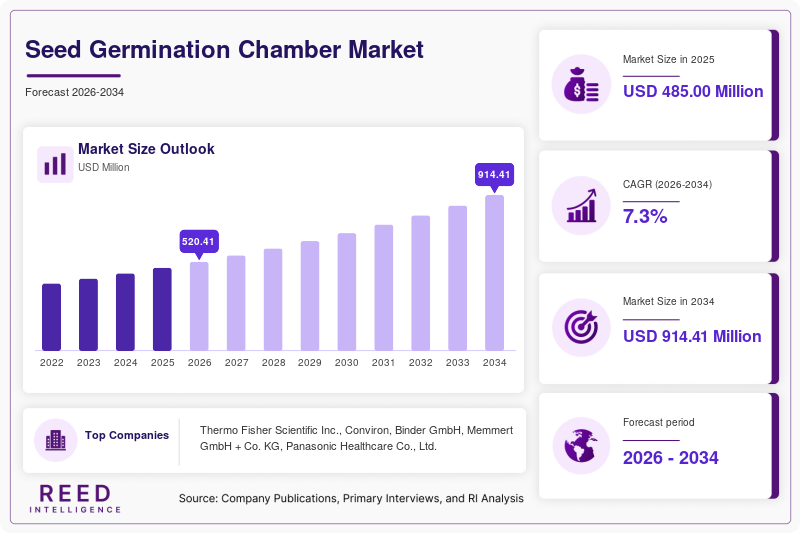
The Seed Germination Chamber Market was valued at approximately USD 485 million in 2025 and is projected to reach USD 915 million by 2034, expanding at a CAGR of 7.3% during the forecast period (2025–2034). The market growth is primarily supported by the increasing global demand for high-yield crops and the adoption of controlled environment agriculture (CEA) practices. As agricultural productivity faces pressure from climate variability, seed germination chambers have become critical tools for ensuring uniform seed development under controlled temperature, humidity, and light conditions.
A significant global factor contributing to market expansion is the rising focus on food security and sustainable agricultural practices. Governments and private institutions are investing in advanced agricultural technologies to improve germination success rates and reduce crop failure risks. This has accelerated the adoption of precision agriculture tools, including germination chambers, particularly in research institutions and commercial farming operations.
Key Highlights:
- North America dominated the market with a 34.2% share, while Asia Pacific is expected to register the fastest CAGR of 8.6% during the forecast period.
- Reach-in chambers accounted for the leading subsegment in type, while walk-in chambers are projected to grow at the fastest CAGR of 8.9%.
- Research laboratories led the application segment, whereas commercial farming applications are expected to expand at a CAGR of 9.1%.
- The United States remained the dominant country, with market values of USD 132 million in 2024 and USD 139 million in 2025.
Market Trends
Integration of Smart Monitoring Systems
The integration of smart technologies such as IoT sensors and cloud-based monitoring systems is transforming the Seed Germination Chamber Market. These systems allow real-time tracking of temperature, humidity, and light intensity, enabling users to optimize germination conditions. Automation features reduce manual intervention and improve accuracy, making them highly preferred in research and commercial settings.
Shift Toward Energy-Efficient Designs
Energy efficiency has emerged as a key trend as end-users seek to reduce operational costs and environmental impact. Manufacturers are focusing on developing chambers with improved insulation, LED lighting systems, and energy-efficient compressors. This shift is particularly evident in regions with high energy costs, where sustainable solutions are gaining traction.
Market Drivers
Growing Demand for Controlled Environment Agriculture
The expansion of controlled environment agriculture is driving the adoption of seed germination chambers. These systems enable precise environmental control, ensuring consistent seed growth regardless of external climatic conditions. This is particularly important for high-value crops and research applications.
Increasing Agricultural Research and Development Activities
The rise in agricultural R&D initiatives by governments, universities, and private organizations is contributing significantly to market growth. Seed germination chambers are essential tools for testing seed viability, genetic traits, and crop performance, thereby supporting innovation in crop science.
Market Restraint
High Initial Investment and Maintenance Costs
One of the primary challenges in the Seed Germination Chamber Market is the high upfront cost associated with advanced systems. These chambers often require significant capital investment, which can be a barrier for small-scale farmers and institutions. Additionally, maintenance and operational costs, including energy consumption and technical servicing, further limit adoption in cost-sensitive regions. The need for skilled personnel to operate and maintain these systems also adds to the overall expense, restricting market penetration in developing economies.
Market Opportunities
Expansion in Emerging Agricultural Economies
Emerging economies in Asia, Africa, and Latin America present significant growth opportunities for the Seed Germination Chamber Market. Increasing investments in modern agricultural practices and government initiatives to improve crop productivity are expected to drive demand in these regions.
Adoption in Vertical Farming and Urban Agriculture
The growing popularity of vertical farming and urban agriculture offers new avenues for market expansion. Seed germination chambers play a crucial role in these systems by ensuring consistent seedling production in controlled indoor environments. This trend is expected to create sustained demand for compact and efficient germination solutions.
Segmental Analysis
By Type
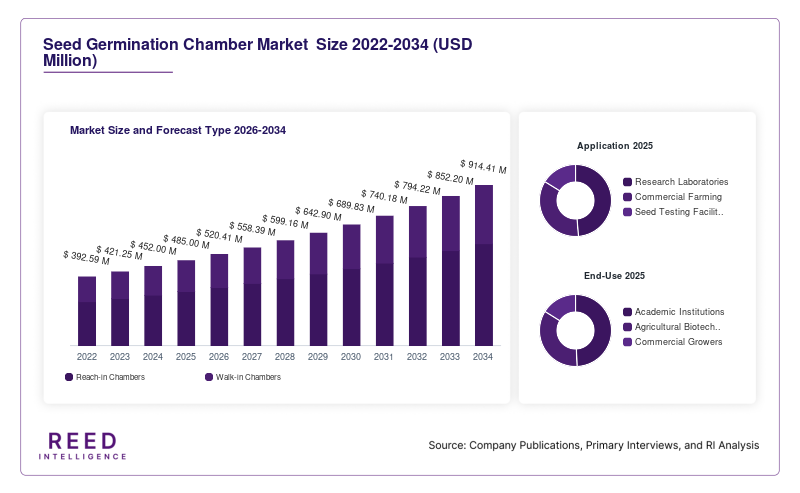
Reach-in chambers dominated the type segment, accounting for approximately 58% of the market share in 2024. Their compact size, ease of use, and cost-effectiveness made them widely adopted across laboratories and small-scale agricultural setups.
Walk-in chambers are expected to grow at the fastest CAGR of 8.9% during the forecast period. Their ability to handle large volumes of seeds and provide uniform environmental conditions will drive their adoption in commercial farming and large research facilities.
By Application
Research laboratories held the largest share of the Seed Germination Chamber Market in 2024, contributing around 46%. These facilities relied heavily on controlled environments for seed testing and experimental studies.
Commercial farming is projected to grow at a CAGR of 9.1%, driven by the need for high-quality seedling production and improved crop yields. Farmers are increasingly adopting advanced technologies to enhance productivity.
By End-Use
Academic institutions dominated the end-use segment, accounting for a significant share in 2024 due to extensive use in teaching and research activities.
Agricultural biotechnology companies are expected to witness the fastest growth, with a projected CAGR of 8.7%, as they focus on developing genetically improved crop varieties.
By Distribution Channel
Direct sales accounted for the largest share in 2024, as manufacturers preferred direct engagement with large clients such as research institutes and commercial farms.
Online distribution channels are expected to grow rapidly at a CAGR of 8.3%, supported by increasing digitalization and ease of product comparison.
Regional Analysis
North America
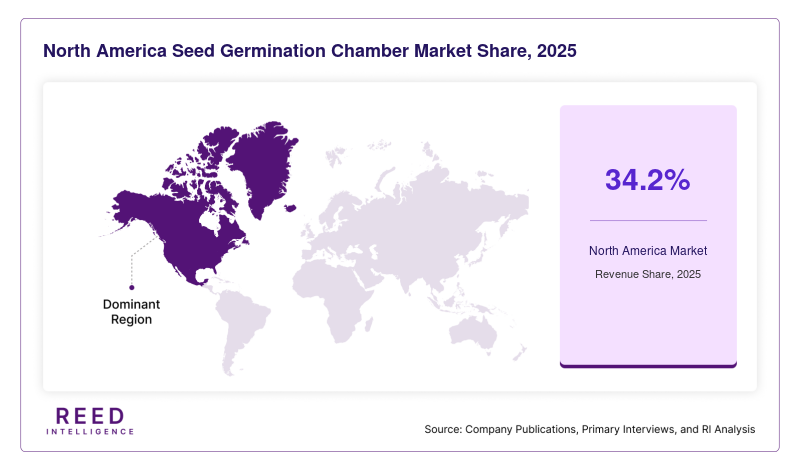
North America accounted for 34.2% of the Seed Germination Chamber Market share in 2025 and is expected to grow at a CAGR of 6.8% during the forecast period. The region’s established agricultural infrastructure and widespread adoption of advanced farming technologies contributed to its dominant position.
The United States led the regional market due to strong investments in agricultural research and technological innovation. The presence of well-established research institutions and commercial farms adopting controlled environment systems supported market growth.
Europe
Europe held a 26.5% share of the Seed Germination Chamber Market in 2025 and is projected to grow at a CAGR of 6.5%. The region’s emphasis on sustainable agriculture and stringent environmental regulations influenced the adoption of energy-efficient germination chambers.
Germany emerged as the dominant country, driven by its advanced agricultural practices and focus on precision farming technologies. The country’s strong research ecosystem further supported market expansion.
Asia Pacific
Asia Pacific accounted for 21.8% of the market share in 2025 and is expected to register the fastest CAGR of 8.6% through 2034. Rapid population growth and increasing food demand drove investments in modern agricultural technologies.
China dominated the regional market due to large-scale agricultural production and government initiatives promoting advanced farming techniques. The country’s focus on improving crop yield efficiency contributed to market growth.
Middle East & Africa
The Middle East & Africa region held a 9.1% share in 2025 and is projected to grow at a CAGR of 7.5%. The adoption of controlled environment agriculture in arid climates supported market development.
The United Arab Emirates led the region, driven by investments in indoor farming and food security initiatives. The use of germination chambers helped overcome environmental limitations in agriculture.
Latin America
Latin America accounted for 8.4% of the Seed Germination Chamber Market share in 2025 and is expected to grow at a CAGR of 7.2%. The region’s agricultural sector modernization contributed to market expansion.
Brazil emerged as the dominant country due to its large agricultural base and increasing adoption of advanced farming technologies. The country’s focus on improving crop productivity supported the use of germination chambers.
Competitive Landscape
The Seed Germination Chamber Market is moderately fragmented, with several global and regional players competing based on product innovation, pricing, and distribution capabilities. Key companies focus on developing advanced chambers with improved energy efficiency and smart monitoring features.
Thermo Fisher Scientific emerged as a leading player, leveraging its strong product portfolio and global presence. The company recently introduced an upgraded germination chamber equipped with IoT-enabled monitoring, enhancing operational efficiency.
Other prominent players include manufacturers specializing in laboratory equipment and agricultural technologies, contributing to continuous product advancements and market competitiveness.
Key Players List
- Thermo Fisher Scientific Inc.
- Conviron
- Binder GmbH
- Memmert GmbH + Co. KG
- Panasonic Healthcare Co., Ltd.
- Percival Scientific Inc.
- Snijders Labs
- Darwin Chambers Company
- Hettich Benelux
- JEIO Tech
- Caron Products & Services
- LabRepCo LLC
- Weiss Technik
- Aralab
- BMT Medical Technology s.r.o.
Recent Developments
- In 2024, Thermo Fisher Scientific launched a new series of smart germination chambers with enhanced environmental control features.
- Conviron expanded its manufacturing capacity to meet rising global demand.
- Binder GmbH introduced energy-efficient models targeting European markets.
- Panasonic Healthcare upgraded its product line with advanced temperature uniformity systems.
- Aralab focused on expanding its presence in emerging markets through strategic partnerships.
Seed Germination Chamber Market Segments
Type
- Reach-in Chambers
- Walk-in Chambers
Application
- Research Laboratories
- Commercial Farming
- Seed Testing Facilities
End-Use
- Academic Institutions
- Agricultural Biotechnology Companies
- Commercial Growers
Distribution Channel
- Direct Sales
- Distributors
- Online Channels
By Region
- North America
- Europe
- APAC
- Middle East and Africa
- LATAM