Seismic Survey Equipment Market Size, Share Demand Report By Equipment Type (Sensors, Data Acquisition Systems, Data Processing Software), By Application (Oil & Gas Exploration, Mining, Environmental Monitoring, Infrastructure Development), By End-Use (Oil & Gas Industry, Mining Industry, Construction Sector, Renewable Energy Sector) By Region & Segment Forecasts, 2026–2034
USD 3950
Market Overview
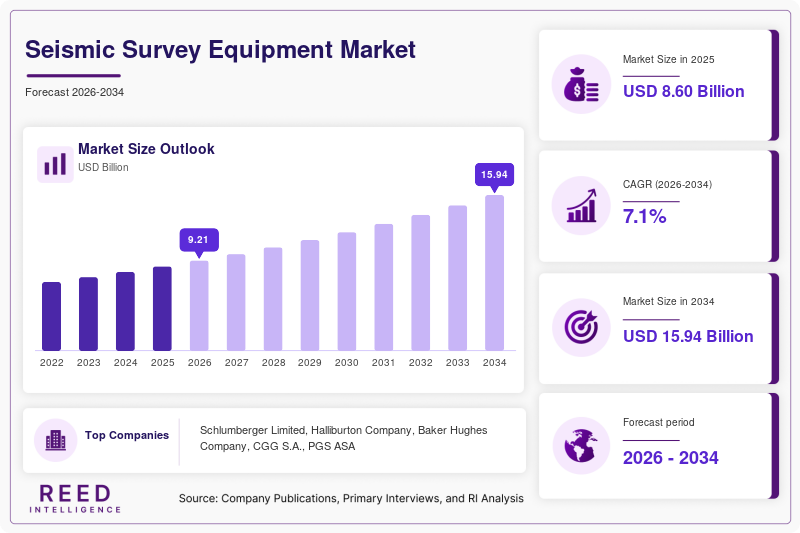
The Seismic Survey Equipment Market size was valued at approximately USD 8.6 billion in 2026 and is projected to reach USD 14.9 billion by 2034, expanding at a CAGR of 7.1% during the forecast period (2026–2034). The market is experiencing steady expansion driven by increasing exploration activities in oil and gas, mineral prospecting, and infrastructure development. Advancements in seismic data acquisition technologies, coupled with the growing demand for accurate subsurface imaging, are contributing to consistent market growth.
A major global factor supporting this growth is the rising demand for energy resources. As countries seek to secure long-term energy supply, investments in offshore and onshore exploration projects have increased. This trend has created sustained demand for advanced seismic equipment capable of delivering high-resolution data in challenging environments.
Key Highlights
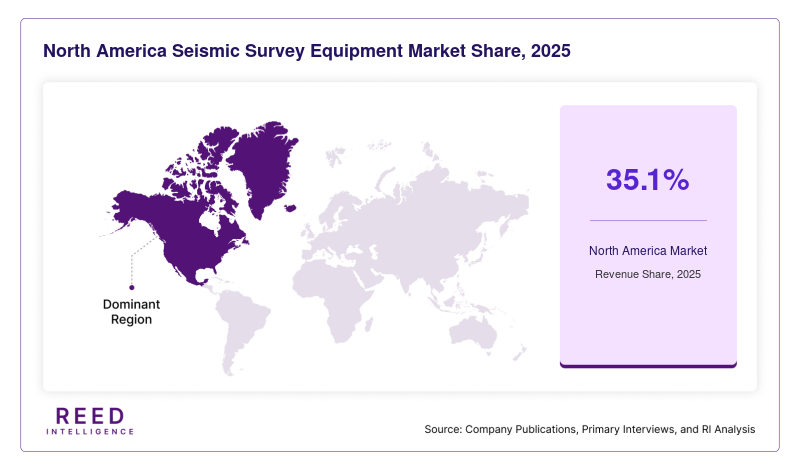
- North America dominated the market with a 35.1% share in 2025.
- Asia Pacific is expected to grow at the fastest CAGR of 8.6% during 2026–2034.
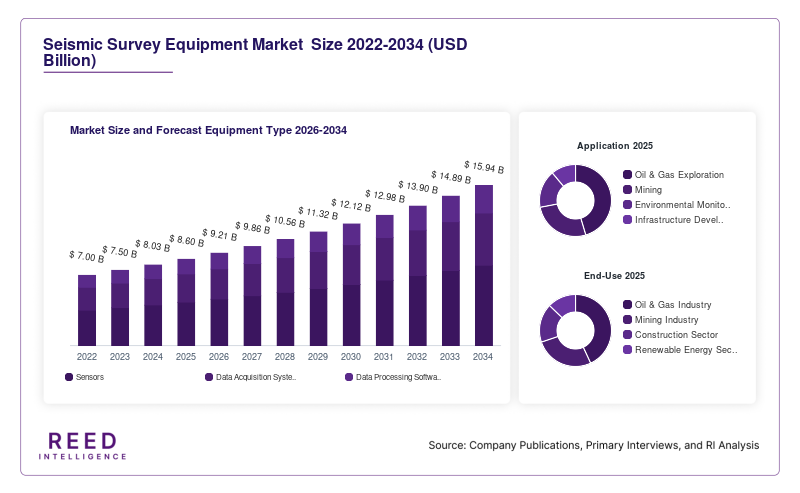
- By equipment type, sensors accounted for the largest share of 39.2%.
- while data processing software is projected to grow at a CAGR of 9.3%.
- By application, oil & gas exploration led with a 46.8% share, whereas environmental monitoring is expected to expand at a CAGR of 8.9%.
- The United States remained the dominant country, with market values of USD 1.02 billion in 2024 and USD 1.10 billion in 2025.
Market Trends
Increasing integration of advanced digital technologies
The seismic survey equipment industry is witnessing a notable shift toward digital transformation. Companies are increasingly integrating artificial intelligence, machine learning, and cloud computing into seismic data acquisition and interpretation processes. These technologies enhance the accuracy of subsurface imaging while reducing processing time significantly. Real-time data analytics allows operators to make faster and more informed decisions during exploration activities. Additionally, automation in seismic equipment reduces dependency on manual intervention, improving operational efficiency and safety. The demand for high-resolution imaging, particularly in complex geological formations, is accelerating the adoption of these digital tools across the market.
Rising focus on environmentally sustainable exploration methods
Environmental concerns and regulatory pressures are encouraging companies to adopt sustainable seismic survey practices. Equipment manufacturers are developing low-impact seismic technologies that minimize ecological disturbance, especially in sensitive regions such as marine ecosystems and protected land areas. Innovations such as nodal seismic systems and wireless sensors are gaining traction due to their reduced environmental footprint. Furthermore, there is an increasing emphasis on energy-efficient equipment and reduced noise emission during surveys. This trend aligns with global sustainability goals and is expected to influence procurement decisions across oil & gas companies and environmental monitoring agencies.
Market Drivers
Growing investments in oil and gas exploration
The increasing global demand for energy continues to drive investments in oil and gas exploration activities. Emerging economies are expanding their energy infrastructure, while developed nations are focusing on enhancing production efficiency from existing reserves. Seismic survey equipment plays a crucial role in identifying potential hydrocarbon reserves, making it an essential component of exploration projects. Offshore exploration, in particular, has seen increased investment due to the discovery of untapped reserves. This has led to higher demand for advanced seismic technologies capable of operating in deepwater conditions and delivering accurate data.
Expansion of infrastructure and mining activities
Beyond oil and gas, seismic survey equipment is increasingly used in infrastructure development and mining operations. Governments worldwide are investing in large-scale infrastructure projects such as highways, railways, and urban development, which require detailed subsurface analysis. Seismic surveys help assess ground stability and identify potential risks before construction begins. Similarly, the mining sector relies on seismic equipment to locate mineral deposits and optimize extraction processes. The growing need for efficient resource management and risk mitigation is driving the adoption of seismic technologies across these sectors.
Market Restraint
High initial investment and operational complexity
One of the primary challenges in the seismic survey equipment market is the high cost associated with equipment procurement and deployment. Advanced seismic systems, including sensors, data acquisition units, and processing software, require substantial capital investment. Additionally, the operation of these systems involves skilled personnel and complex logistics, particularly in remote or offshore locations. Small and mid-sized companies often face financial constraints that limit their ability to invest in such technologies. Furthermore, maintenance and calibration of equipment add to operational expenses. These factors can hinder market growth, especially in regions with limited financial resources or technical expertise. For example, smaller exploration firms may delay or scale down projects due to budget constraints, impacting overall demand for seismic equipment.
Market Opportunities
Growing demand for renewable energy exploration
The transition toward renewable energy sources is creating new opportunities for seismic survey equipment. Geothermal energy exploration, in particular, relies heavily on seismic surveys to identify suitable underground heat reservoirs. As governments and organizations invest in clean energy projects, the demand for seismic technologies is expected to increase. Additionally, offshore wind farm development requires detailed seabed analysis, further expanding the application scope of seismic equipment. This diversification beyond traditional oil and gas applications presents significant growth potential for market players.
Technological advancements in wireless and autonomous systems
The development of wireless and autonomous seismic systems is opening new avenues for market growth. These systems offer greater flexibility and efficiency compared to traditional cable-based setups. Wireless sensors can be deployed quickly over large areas, reducing setup time and operational costs. Autonomous systems, including drones and robotic platforms, are being used for data acquisition in difficult terrains. These innovations enhance data quality while minimizing human intervention and safety risks. As technology continues to evolve, the adoption of these advanced systems is expected to increase across various industries.
Segmental Analysis
By Equipment Type
Sensors dominated the market in 2024, accounting for approximately 39.2% of the total share. These devices are essential for capturing seismic signals and converting them into data for analysis. The demand for high-performance sensors has increased due to the need for accurate subsurface imaging. Technological advancements have led to the development of more sensitive and durable sensors capable of operating in harsh environments. The widespread use of sensors across oil and gas, mining, and infrastructure applications contributes to their dominant position in the market.
Data processing software is expected to be the fastest-growing subsegment, with a projected CAGR of 9.3% during the forecast period. The increasing complexity of seismic data requires advanced software solutions for efficient analysis and interpretation. The integration of artificial intelligence and machine learning enhances data accuracy and reduces processing time. As companies focus on improving exploration efficiency, the demand for advanced data processing software is expected to grow significantly.
By Application
Oil and gas exploration was the dominant application segment in 2024, holding a share of 46.8%. Seismic survey equipment is widely used in this sector to identify potential hydrocarbon reserves and optimize drilling operations. The increasing demand for energy and ongoing exploration activities drive the adoption of seismic technologies. Offshore exploration projects, in particular, require advanced equipment to operate in challenging conditions, contributing to the segment’s dominance.
Environmental monitoring is projected to be the fastest-growing application segment, with a CAGR of 8.9% during the forecast period. The growing emphasis on environmental protection and sustainability is driving the use of seismic technologies for monitoring natural hazards and assessing environmental impact. Governments and organizations are investing in advanced monitoring systems to ensure compliance with environmental regulations, supporting the growth of this segment.
By End-Use
The oil and gas industry dominated the end-use segment in 2024, accounting for a significant share of the market. Seismic survey equipment is a critical component of exploration and production activities in this industry. The need for accurate subsurface data to reduce exploration risks and improve drilling success rates drives demand. The increasing complexity of exploration projects further emphasizes the importance of advanced seismic technologies.
The renewable energy sector is expected to be the fastest-growing end-use segment, with a CAGR of 8.7% during the forecast period. The growing focus on clean energy sources such as geothermal and offshore wind is creating new opportunities for seismic survey equipment. These projects require detailed subsurface analysis to ensure feasibility and efficiency. As investments in renewable energy continue to increase, the demand for seismic technologies is expected to rise.
Regional Analysis
North America
North America accounted for approximately 35.1% of the global market share in 2025 and is expected to grow at a CAGR of 6.8% during the forecast period. The region benefits from well-established oil and gas infrastructure and ongoing exploration activities. Technological advancements and strong investment in research and development contribute to market growth. Additionally, the presence of leading equipment manufacturers supports innovation and adoption of advanced seismic technologies.
The United States dominates the regional market due to its extensive shale gas exploration and offshore drilling projects. A key growth factor is the increasing adoption of advanced seismic imaging technologies to enhance exploration efficiency. The country’s focus on energy independence and resource optimization continues to drive demand for seismic survey equipment.
Europe
Europe held a market share of 21.4% in 2025 and is projected to grow at a CAGR of 6.2% during the forecast period. The region’s growth is driven by ongoing offshore exploration activities in the North Sea and increasing investments in renewable energy projects. Environmental regulations are encouraging the adoption of sustainable seismic technologies.
Norway is the dominant country in the European market, supported by its strong offshore oil and gas sector. A unique growth factor is the country’s focus on advanced seismic technologies for deepwater exploration. Government support and technological innovation play a crucial role in sustaining market growth.
Asia Pacific
Asia Pacific accounted for 24.7% of the market share in 2025 and is expected to grow at the fastest CAGR of 8.6% during the forecast period. Rapid industrialization and increasing energy demand are driving exploration activities in the region. Governments are investing in infrastructure and resource development, boosting demand for seismic equipment.
China leads the regional market due to its large-scale exploration projects and mining activities. A key growth factor is the country’s investment in domestic energy production and resource management. The adoption of advanced seismic technologies is increasing to improve exploration efficiency and reduce dependency on imports.
Middle East & Africa
The Middle East & Africa region held a market share of 11.3% in 2025 and is projected to grow at a CAGR of 7.4% during the forecast period. The region’s abundant oil and gas reserves drive demand for seismic survey equipment. Ongoing exploration and production activities continue to support market growth.
Saudi Arabia dominates the regional market due to its extensive oil reserves and large-scale exploration projects. A unique growth factor is the country’s investment in advanced exploration technologies to enhance production efficiency. Government initiatives aimed at diversifying the economy also contribute to increased demand.
Latin America
Latin America accounted for 7.5% of the market share in 2025 and is expected to grow at a CAGR of 6.9% during the forecast period. The region’s growth is driven by increasing exploration activities in offshore and onshore reserves. Governments are encouraging investment in energy projects to boost economic growth.
Brazil is the dominant country in the region, supported by its offshore oil exploration projects. A key growth factor is the development of deepwater reserves, which require advanced seismic technologies. The country’s focus on expanding energy production continues to drive market demand.
Competitive Landscape
The seismic survey equipment market is moderately consolidated, with several key players competing based on technology innovation, product quality, and service offerings. Leading companies focus on developing advanced solutions to enhance data accuracy and operational efficiency. Strategic partnerships, mergers, and acquisitions are common strategies used to expand market presence and strengthen capabilities.
Schlumberger is considered a leading player in the market due to its extensive product portfolio and strong global presence. The company recently introduced advanced seismic data processing solutions aimed at improving exploration efficiency and reducing operational costs. Other major players are also investing in research and development to introduce innovative products and maintain competitiveness. The increasing demand for high-performance seismic equipment is encouraging companies to focus on technological advancements and customer-centric solutions.
Key Players
- Schlumberger Limited
- Halliburton Company
- Baker Hughes Company
- CGG S.A.
- PGS ASA
- TGS ASA
- Geospace Technologies Corporation
- Sercel SA
- ION Geophysical Corporation
- SAExploration Holdings Inc.
- Dawson Geophysical Company
- Mitcham Industries Inc.
- Wireless Seismic Inc.
- BGP Inc.
- Polaris Seismic International Inc.
Recent Developments
- Schlumberger launched an advanced AI-powered seismic interpretation platform to improve exploration accuracy.
- CGG S.A. expanded its multi-client seismic data library with new offshore survey data.
- Baker Hughes introduced a next-generation wireless seismic acquisition system designed for remote operations.
Seismic Survey Equipment Market Segments
Equipment Type
- Sensors
- Data Acquisition Systems
- Data Processing Software
Application
- Oil & Gas Exploration
- Mining
- Environmental Monitoring
- Infrastructure Development
End-Use
- Oil & Gas Industry
- Mining Industry
- Construction Sector
- Renewable Energy Sector
By Region
- North America
- Europe
- APAC
- Middle East and Africa
- LATAM