Self Lacing Shoes Market Size, Share & Demand Report By Product Type (Sports Self-Lacing Shoes, Casual Self-Lacing Shoes), By End User (Men, Women, Kids), By Distribution Channel (Online Retail, Brand-Owned Stores, Multi-Brand Retail Stores) By Region & Segment Forecasts, 2025–2034
USD 3950
Market Overview
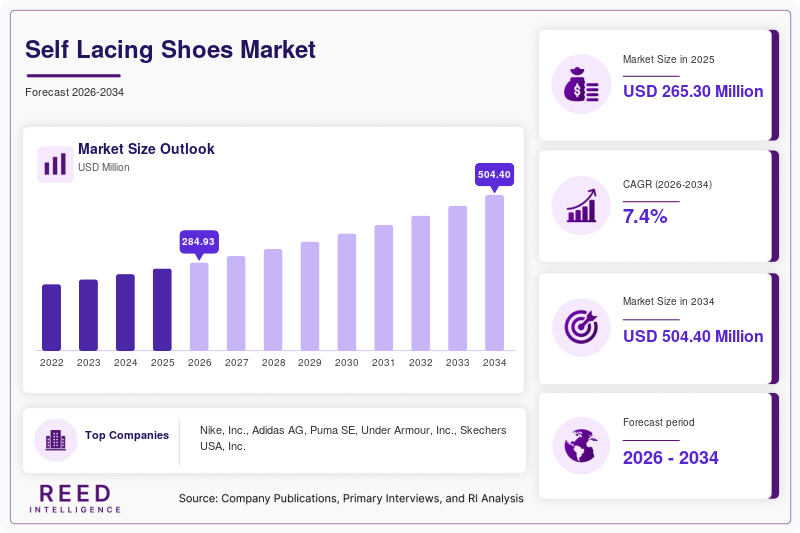
The Self Lacing Shoes Market size was valued at USD 265.3 million in 2025 and is projected to reach USD 487.6 million by 2033, registering a CAGR of 7.4% during the forecast period (2025–2034). The market growth reflects the rising integration of smart technologies in footwear products designed to enhance comfort, personalization, and convenience. Self-lacing shoes use automated lacing systems powered by sensors, micro-motors, or adjustable tension mechanisms that allow users to tighten or loosen footwear without manual laces. These innovations have gained attention among athletes, technology enthusiasts, and consumers seeking advanced wearable products.
One global factor supporting the expansion of the Self Lacing Shoes Market is the increasing adoption of smart wearable technologies within consumer lifestyle products. Consumers have shown strong interest in footwear that integrates digital technology to improve fit, performance, and usability. Footwear manufacturers have introduced automated lacing systems that adapt to foot shape and activity level, creating personalized comfort experiences for users. The growing influence of sports technology and wearable devices has therefore encouraged footwear companies to explore advanced designs incorporating automated lacing features.
Key Highlights
- North America dominated the Self Lacing Shoes Market with a 36.9% share in 2025, while Asia Pacific is projected to grow at the fastest CAGR of 8.2% during the forecast period.
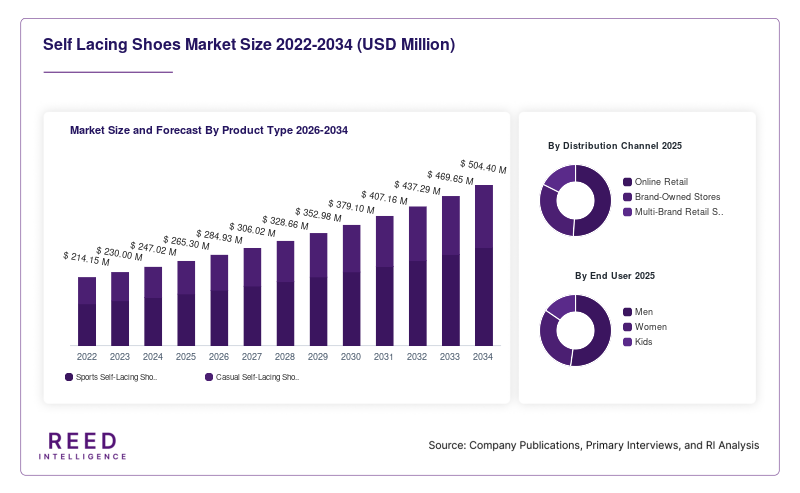
- By product type, sports self-lacing shoes accounted for 47.5% of the market share in 2025, while casual self-lacing shoes are projected to grow at a CAGR of 8.5%.
- By distribution channel, online retail held 52.1% of the market share in 2025, while brand-owned stores are expected to grow at a CAGR of 7.9%.
- The United States represented the dominant country, with the Self Lacing Shoes Market valued at USD 83.6 million in 2025 and estimated to reach USD 88.4 million in 2026.
Market Trends
Integration of Smart Sensors and Mobile Connectivity
One notable trend influencing the Self Lacing Shoes Market is the integration of smart sensors and mobile connectivity in footwear systems. Footwear manufacturers are incorporating Bluetooth connectivity and mobile application support that allow users to adjust lacing tension directly through smartphone interfaces. These connected systems enable personalized fit adjustments and monitoring of footwear performance.
The integration of smart features also allows manufacturers to offer software updates that improve product functionality over time. As wearable technology becomes increasingly integrated into everyday consumer products, smart footwear with automated lacing capabilities has attracted interest from technology-oriented consumers.
Expansion of Athletic Performance Footwear
Another important trend shaping the Self Lacing Shoes Market is the expansion of athletic performance footwear incorporating automated lacing systems. Athletes and sports enthusiasts require footwear that provides secure and adjustable fit during physical activity. Automated lacing mechanisms allow users to adjust tension levels quickly, improving comfort and performance.
Sports footwear brands are therefore exploring advanced lacing technologies that enhance stability and responsiveness during athletic movements. These innovations have supported the adoption of self-lacing technology within performance-oriented footwear products.
Market Drivers
Increasing Consumer Interest in Smart Footwear Technology
A key driver supporting the Self Lacing Shoes Market is the increasing consumer interest in smart footwear technology. Modern consumers often seek products that combine convenience and technology-driven functionality. Self-lacing shoes provide automated fit adjustments that eliminate the need for manual lacing, offering a convenient user experience.
Consumers interested in wearable technology frequently explore products that integrate digital features into everyday items. Footwear brands introducing automated lacing technology have therefore attracted consumers looking for innovative lifestyle products.
Expansion of Premium Footwear Product Segments
Another driver of the Self Lacing Shoes Market is the expansion of premium footwear product segments. High-end footwear brands frequently introduce technologically advanced products designed to differentiate themselves within competitive markets.
Self-lacing shoes represent a premium footwear category that incorporates innovative technology and advanced materials. As consumers continue to purchase premium footwear products offering improved comfort and advanced design features, the demand for self-lacing footwear is expected to increase.
Market Restraint
High Product Cost Compared to Conventional Footwear
One restraint affecting the Self Lacing Shoes Market is the relatively high cost associated with automated footwear systems. Self-lacing shoes require integrated electronic components such as motors, sensors, batteries, and control systems that increase production costs. These components make self-lacing footwear significantly more expensive than traditional shoes.
Consumers in price-sensitive markets may therefore prefer conventional footwear options rather than technologically advanced models. High retail prices may limit adoption among mainstream consumers despite the convenience offered by automated lacing systems.
Manufacturers must also invest in product testing and durability improvements to ensure the reliability of automated mechanisms. These additional development costs contribute to the overall product price and may influence consumer purchasing decisions.
Market Opportunities
Growth of Adaptive Footwear for Accessibility
One emerging opportunity in the Self Lacing Shoes Market is the development of adaptive footwear designed for individuals with mobility limitations. Self-lacing shoes offer significant benefits for people who experience difficulty tying traditional laces due to physical limitations or medical conditions.
Footwear manufacturers developing accessible footwear products can address a growing consumer segment seeking convenient and easy-to-use shoe designs. Adaptive footwear initiatives may therefore expand the potential customer base for self-lacing technology.
Expansion of Smart Apparel Ecosystems
Another opportunity in the Self Lacing Shoes Market is the expansion of smart apparel ecosystems that integrate wearable technologies across clothing and accessories. Smart footwear can become part of connected product ecosystems that include fitness tracking devices, wearable sensors, and smart clothing.
Companies developing integrated wearable solutions may introduce footwear products capable of interacting with other digital devices. This ecosystem approach may support the future development of connected lifestyle products incorporating automated lacing systems.
Segmental Analysis
By Product Type
The sports self-lacing shoes segment dominated the Self Lacing Shoes Market in 2025, accounting for 47.5% of the total market share. Sports footwear frequently incorporates automated lacing systems to improve fit stability and convenience for athletes. Automated tension adjustment enables users to achieve a secure fit without interrupting physical activity.
The casual self-lacing shoes segment will grow at the fastest CAGR of 8.5% during the forecast period. Casual footwear brands will increasingly integrate automated lacing technology into lifestyle products designed for everyday wear. Consumers interested in technology-enabled fashion products may adopt these shoes due to their convenience and design appeal.
By Distribution Channel
The online retail segment dominated the Self Lacing Shoes Market with a 52.1% share in 2025. E-commerce platforms allow footwear brands to reach technology-oriented consumers interested in innovative products. Online channels provide detailed product demonstrations and interactive marketing campaigns that highlight automated lacing features.
The brand-owned retail stores segment will grow at a CAGR of 7.9% during the forecast period. Footwear companies will increasingly introduce specialized retail environments where customers can experience self-lacing technology in person. These retail stores allow consumers to test automated lacing systems and evaluate product performance.
By End User
The men’s segment dominated the Self Lacing Shoes Market with a 55.4% share in 2025. Male consumers frequently purchase athletic and performance footwear that incorporates advanced technological features. Sports footwear brands often introduce new technologies initially within male-focused product lines.
The women’s segment will grow at the fastest CAGR of 8.1% during the forecast period. Footwear companies will expand self-lacing product offerings designed specifically for female consumers seeking technologically advanced footwear with stylish designs. Increasing female participation in sports and fitness activities may contribute to segment growth.
Regional Analysis
North America
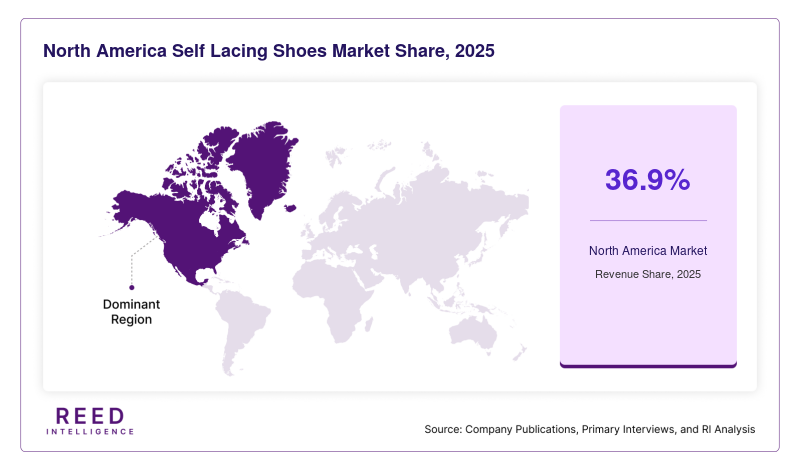
North America accounted for 36.9% of the global Self Lacing Shoes Market share in 2025, and the region is expected to grow at a CAGR of 7.1% during the forecast period. The regional market maintained strong demand due to the presence of major footwear innovation centers and technology-driven consumer markets. Companies operating in the region frequently introduce footwear products incorporating advanced wearable technology features.
The United States dominated the regional market due to its strong consumer demand for technologically advanced footwear and the presence of major athletic footwear companies. Footwear brands in the country continue to invest in research and development to create innovative footwear products that integrate automated lacing systems.
Europe
Europe held 24.6% of the global Self Lacing Shoes Market share in 2025 and is projected to grow at a CAGR of 7.3% between 2025 and 2034. The regional market maintained steady demand due to strong interest in premium footwear and technological innovation within the sports apparel industry.
Germany represented the dominant country in the region due to the presence of global sportswear manufacturers and advanced footwear engineering capabilities. Companies operating in the country frequently develop performance-oriented footwear products incorporating advanced lacing technologies.
Asia Pacific
Asia Pacific represented 25.3% of the global Self Lacing Shoes Market share in 2025 and will grow at the fastest CAGR of 8.2% during the forecast period. Rapid urbanization, increasing disposable income, and growing interest in sportswear products have contributed to the expansion of the footwear industry across the region.
China remained the dominant country due to its large footwear manufacturing industry and expanding consumer market for athletic footwear. Domestic and international brands operating in China frequently introduce technologically advanced footwear products designed to attract technology-oriented consumers.
Middle East & Africa
The Middle East & Africa accounted for 6.8% of the global Self Lacing Shoes Market share in 2025 and will expand at a CAGR of 6.6% during the forecast period. Increasing consumer interest in premium lifestyle products has supported the development of the footwear market in the region.
The United Arab Emirates emerged as the dominant country due to strong retail infrastructure and growing consumer demand for innovative fashion products. International footwear brands frequently introduce premium product lines in the region’s retail markets.
Latin America
Latin America represented 6.4% of the global Self Lacing Shoes Market share in 2025 and is expected to grow at a CAGR of 7.5% during the forecast period. The regional footwear market has experienced gradual expansion supported by increasing interest in sportswear and lifestyle footwear.
Brazil dominated the regional market due to its large footwear consumer base and growing demand for innovative athletic footwear products. Footwear brands operating in the country continue to expand product offerings designed for sports and lifestyle applications.
Competitive Landscape
The Self Lacing Shoes Market features competition among athletic footwear manufacturers and technology-driven apparel companies that invest in advanced product innovation. Companies in the market focus on developing automated lacing systems that improve comfort, fit precision, and durability.
Among leading companies, Nike, Inc. has maintained a strong presence in the market due to its early development of self-lacing footwear technology. The company introduced automated lacing systems integrated into performance footwear products designed for athletes and technology-oriented consumers. Recent developments include the expansion of its smart footwear portfolio featuring improved battery efficiency and customizable fit adjustments.
Other companies operating in the market continue to explore advanced footwear technologies and design innovations to strengthen their presence in the global Self Lacing Shoes Market.
Key Players
- Nike, Inc.
- Adidas AG
- Puma SE
- Under Armour, Inc.
- Skechers USA, Inc.
- Li-Ning Company Limited
- Anta Sports Products Limited
- New Balance Athletics, Inc.
- ASICS Corporation
- Decathlon S.A.
- Wolverine World Wide, Inc.
- VF Corporation
- Peak Sport Products Co., Ltd.
- Brooks Sports, Inc.
- Columbia Sportswear Company
Recent Developments
- In 2024, Nike expanded its portfolio of automated lacing footwear with improved smart connectivity features.
- In 2023, Adidas explored prototype designs integrating advanced tension adjustment systems in performance footwear.
- In 2024, Puma introduced concept designs incorporating adaptive lacing technologies for athletic footwear.
- In 2025, Under Armour invested in research focused on advanced wearable footwear technologies.
- In 2023, Skechers introduced experimental automated lacing footwear prototypes for lifestyle product categories.
Self Lacing Shoes Market Segments
By Product Type
- Sports Self-Lacing Shoes
- Casual Self-Lacing Shoes
By Distribution Channel
- Online Retail
- Brand-Owned Stores
- Multi-Brand Retail Stores
By End User
- Men
- Women
- Kids
By Region
- North America
- Europe
- APAC
- Middle East and Africa
- LATAM