Semiconductor Market Size, Share & Trends Analysis Report By Component (Memory, Logic, Microprocessors, Analog, Discrete Semiconductors, Sensors, Optoelectronics and Others), By Application (Consumer Electronics, Communication, Automotive, Industrial, Data Centers & AI, Aerospace & Defense and Others) and By Region (North America, Europe, Asia Pacific, Latin America, Middle East & Africa) Forecasts, 2026–2034
USD 3950
Semiconductor Market Size
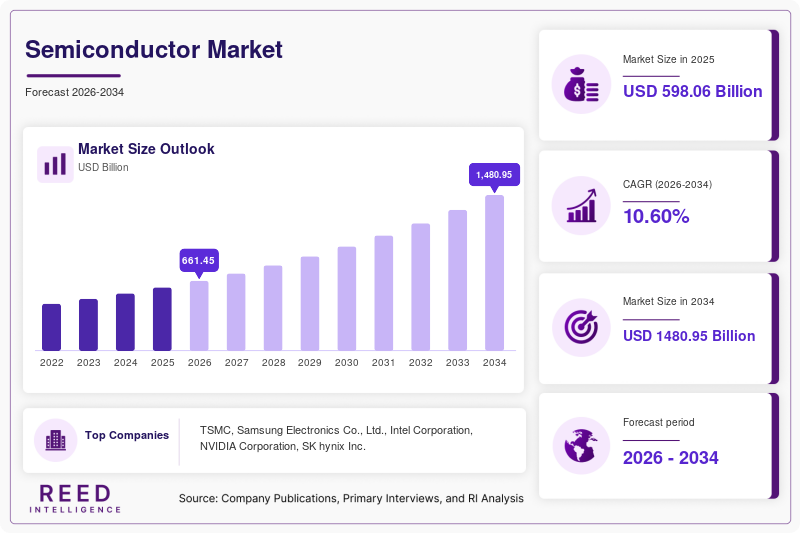
The global semiconductor market size was valued at USD 598.06 billion in 2025 and is projected to grow from USD 659.66 billion in 2026 to USD 1,480.95 billion by 2034, registering a CAGR of 10.60% during the forecast period from 2026 to 2034.
Semiconductors are fundamental components in computing, telecommunications, automobiles, consumer electronics, industrial equipment, aerospace systems, data centers, medical devices, and increasingly AI-enabled products. The industry encompasses memory, logic, microprocessors, analog devices, discrete components, sensors, optoelectronics, and other integrated circuits.
The current industry cycle is unusually concentrated around data-center and AI infrastructure. WSTS's August 2026 update showed Memory growth of 305% year over year in the first half of 2026 and Logic growth of 45%, reflecting the scale of investment in accelerated computing and AI infrastructure.
Semiconductor Market Drivers
Artificial Intelligence and Accelerated Computing
AI workloads require substantially greater computing capacity, memory bandwidth, networking performance, and storage than many conventional workloads. GPUs and AI accelerators require high-performance logic alongside HBM and advanced packaging, increasing semiconductor content per data-center system.
WSTS identified AI infrastructure, HBM and accelerated computing platforms as major contributors to the semiconductor industry's 2026 expansion. Its June 2026 forecast projected the global semiconductor market to exceed USD 1.5 trillion, with Memory forecast to surpass USD 800 billion during the year.
This demand affects multiple layers of the supply chain. Logic manufacturers benefit from accelerator demand, memory producers benefit from HBM requirements, foundries benefit from leading-edge wafer demand, and packaging suppliers benefit from increasingly complex multi-die architectures.
Increasing Semiconductor Content in Vehicles
Modern vehicles increasingly integrate semiconductors for advanced driver-assistance systems, infotainment, connectivity, power management, battery management, electrification, and automated driving.
Electrification increases the number and variety of semiconductor devices required for power conversion, motor control, battery systems, charging infrastructure, and thermal management. At the same time, software-defined vehicle architectures increase demand for high-performance processors and automotive networking components.
The automotive cycle is therefore creating demand across analog, power, microcontroller, sensor, memory, and logic categories rather than concentrating growth in a single semiconductor product group.
Expansion of Data-Center Infrastructure
Cloud computing and AI infrastructure require processors, memory, networking chips, storage controllers, power-management semiconductors, optical components, and specialized accelerators. The resulting system architecture creates a broad semiconductor demand chain.
WSTS's 2026 data indicates that the strongest product growth is concentrated in Memory and Logic, while other categories are also expanding.
The expansion of data centers also increases requirements for energy-efficient semiconductor designs. Improvements in transistor performance, packaging density, memory bandwidth, and power efficiency increasingly determine total system economics.
Semiconductor Market Restraints
High Capital Requirements and Manufacturing Complexity
Leading-edge semiconductor manufacturing requires extremely high capital expenditure for fabrication plants, lithography systems, process-development equipment, cleanrooms, advanced packaging facilities, and testing infrastructure.
The complexity increases further as manufacturers transition toward advanced nodes and three-dimensional architectures. Intel, for example, has been developing 18A, 18A-P and 14A process technologies while expanding advanced-packaging capabilities.
These requirements create substantial barriers to entry. Only a limited number of companies can economically operate leading-edge fabs, while many chip designers remain dependent on foundry partners for manufacturing.
Supply-Chain and Geopolitical Exposure
Semiconductor manufacturing depends on globally distributed suppliers of wafers, chemicals, gases, lithography equipment, packaging materials, electronic-design automation tools, and specialized manufacturing equipment.
Export controls and technology restrictions can alter sourcing strategies and investment decisions. At the same time, governments are encouraging domestic manufacturing to reduce exposure to external disruptions.
The resulting regionalization can improve supply resilience but can also increase duplication of manufacturing capacity and raise production costs. Companies must therefore balance supply security against the economics of global-scale manufacturing.
Semiconductor Market Opportunities
Advanced Packaging and Chiplet Architectures
Advanced packaging is becoming a central part of semiconductor performance because continued scaling increasingly involves combining multiple dies rather than relying exclusively on larger monolithic chips.
Intel's advanced-packaging portfolio includes Foveros, EMIB and EMIB-T technologies designed to connect multiple semiconductor dies within high-performance packages.
The expansion of AI accelerators creates additional demand for high-bandwidth interconnects and heterogeneous integration. This creates opportunities for semiconductor manufacturers, packaging specialists, substrates, testing companies, equipment suppliers, and materials producers.
High-Bandwidth Memory and Custom AI Semiconductors
HBM represents a high-value opportunity because AI accelerators require very high memory bandwidth and increasingly sophisticated memory integration.
Samsung began commercial HBM4 production in February 2026 and later shipped HBM4E samples. The company also announced collaboration with AMD covering HBM4 for AMD Instinct MI455X GPUs and next-generation DDR5 solutions.
The shift toward customer-specific AI accelerators creates additional opportunities for custom memory, chiplets, foundry services, advanced packaging, and application-specific integrated circuits.
Semiconductor Market Segmental Analysis
By Component
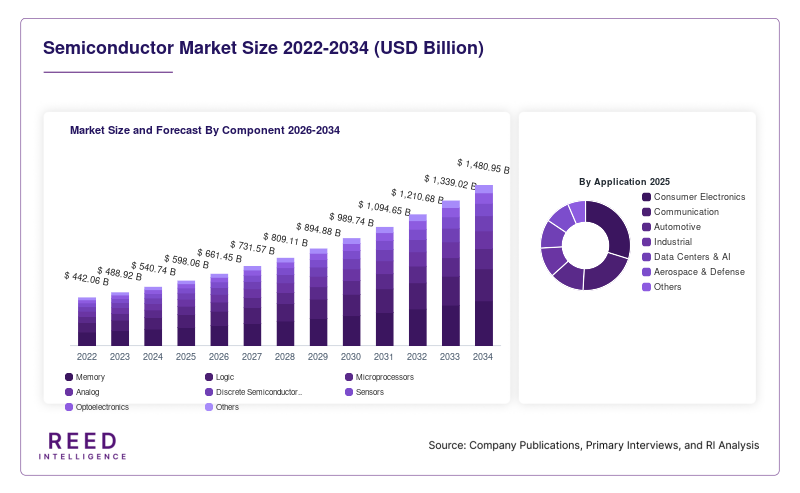
Memory is the dominant component, accounting for approximately 30% share. The segment includes DRAM, NAND and high-bandwidth memory products used in servers, PCs, smartphones, storage systems, AI accelerators and other computing equipment.
Logic is the fastest-growing component, registering an estimated 12.8% CAGR. AI accelerators, high-performance CPUs, GPUs, networking processors, application processors and custom silicon are increasing demand for advanced logic.
Microprocessors account for approximately 16% share and expand at 9.7% CAGR, while Analog represents approximately 13% and grows at 7.8% CAGR. Discrete Semiconductors account for approximately 9%, growing at 6.9% CAGR.
Sensors represent approximately 7% share and register an estimated 8.5% CAGR, supported by automotive sensing, industrial automation and consumer devices. Optoelectronics account for approximately 6% and grow at 7.2% CAGR, while Others account for approximately 19% and grow at 7.0% CAGR.
The strong performance of Memory and Logic is consistent with WSTS's 2026 industry data, which identified these categories as the principal growth contributors.
By Application
Consumer Electronics remains the dominant application, accounting for approximately 28% share, reflecting the extensive semiconductor content of smartphones, computers, televisions, wearables, gaming equipment, home appliances, and other connected devices.
Data Centers & AI is the fastest-growing application, registering an estimated 18.6% CAGR. AI accelerators, server processors, HBM, networking components, optical devices and high-performance storage are increasing semiconductor content in data-center infrastructure.
Communication applications account for approximately 18% share and grow at 9.3% CAGR, supported by 5G infrastructure, networking equipment and high-speed connectivity.
Automotive represents approximately 16% and grows at 11.7% CAGR, driven by electrification, ADAS, vehicle connectivity and increasing computing requirements.
Industrial applications account for approximately 13% share and grow at 8.4% CAGR, while Aerospace & Defense represents approximately 6% and grows at 9.6% CAGR. Others account for approximately 19% and grow at 7.2% CAGR.
Semiconductor Market Regional Analysis
North America Semiconductor Market
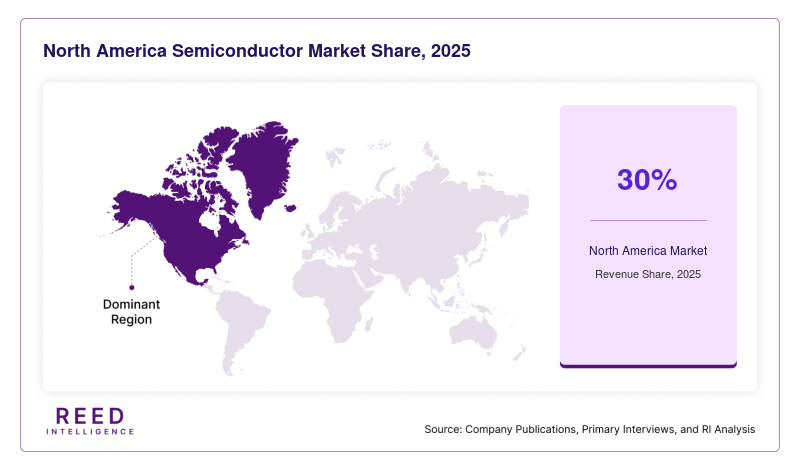
North America is the dominant region, accounting for approximately 30% share. The region benefits from major semiconductor designers, cloud-computing companies, AI accelerator developers, equipment suppliers, research institutions, and expanding domestic fabrication investments.
The U.S. is also strengthening domestic semiconductor manufacturing. Intel's RAMP-C program supported development of domestic leading-edge CMOS technology and manufacturing, while Intel continues to expand its advanced process and packaging roadmap.
North American demand is strongly linked to AI infrastructure, cloud computing, data centers, communications equipment, defense electronics, automotive systems, and advanced computing.
Europe Semiconductor Market
Europe is projected to register approximately 8.1% CAGR during 2026–2034. Automotive semiconductors, industrial electronics, power devices, sensors, communications and specialized embedded systems represent important demand areas.
The region's semiconductor ecosystem is also supported by investments in manufacturing capacity and technology development. Automotive and industrial applications provide a comparatively diversified demand base beyond the AI-driven data-center cycle.
Asia Pacific Semiconductor Market
Asia Pacific is the fastest-growing region, with an estimated 12.4% CAGR. The region combines semiconductor manufacturing, electronics assembly, consumer-device production, memory manufacturing, foundry operations, automotive electronics and expanding data-center infrastructure.
Taiwan remains a critical advanced-manufacturing center. TSMC's manufacturing network exceeded 17 million 12-inch-equivalent wafers of annual capacity in 2025, while its Arizona expansion includes additional fabs and advanced packaging.
South Korea is another major center, particularly for memory and advanced semiconductor technologies. Samsung's HBM4 and HBM4E developments demonstrate the region's growing role in AI-memory supply.
Latin America Semiconductor Market
Latin America is projected to register approximately 9.0% CAGR. Semiconductor consumption is supported by automotive manufacturing, telecommunications, industrial electronics, consumer devices, energy infrastructure, and connected-device deployment.
The region remains more dependent on imported semiconductor components than the principal manufacturing hubs. Consequently, changes in global pricing, logistics, currency conditions and supply availability can influence local procurement patterns.
Middle East & Africa Semiconductor Market
The Middle East & Africa region is projected to grow at approximately 10.2% CAGR. Demand is associated with telecommunications infrastructure, data centers, industrial automation, energy systems, defense electronics, smart-city infrastructure, and consumer electronics.
The expansion of cloud and AI infrastructure creates additional semiconductor demand through servers, networking equipment, storage, power systems and optical connectivity.
Semiconductor Market Competitive Landscape
The semiconductor industry is characterized by a combination of integrated device manufacturers, fabless chip designers, foundries, memory manufacturers, equipment companies, and specialized semiconductor suppliers. Competition increasingly depends on process technology, manufacturing capacity, design capabilities, energy efficiency, packaging, intellectual property, customer relationships, and supply reliability.
TSMC remains a central foundry participant, operating advanced manufacturing facilities across Taiwan and overseas. Its manufacturing capacity and expansion into advanced packaging allow it to serve high-performance computing, smartphone, automotive and AI customers. TSMC's Arizona plans include additional advanced logic fabs and packaging facilities.
Samsung Electronics competes across memory, logic, foundry and advanced packaging. Its HBM4 production and HBM4E development demonstrate the integration of memory technology with AI-computing requirements. The company is also pursuing substantial long-term semiconductor investment in Korea, including HBM manufacturing infrastructure.
Key Market Players
- TSMC
- Samsung Electronics Co., Ltd.
- Intel Corporation
- NVIDIA Corporation
- SK hynix Inc.
- Micron Technology, Inc.
- Broadcom Inc.
- Qualcomm Incorporated
- Advanced Micro Devices, Inc.
- Texas Instruments Incorporated
- MediaTek Inc.
- Infineon Technologies AG
- STMicroelectronics
- NXP Semiconductors N.V.
- Renesas Electronics Corporation
Recent Market Developments
- September 2026 - Intel Corporation: Intel Foundry and ASML reported continued progress in High Numerical Aperture EUV technology, with more than 1 million wafers processed across tool certification, R&D and volume-production activities, including selected layers for Panther Lake processors.
- September 2026 - Samsung Electronics: Samsung announced expanded semiconductor collaborations, including a strategic partnership with Mistral AI for intelligence-driven semiconductor infrastructure and an expanded collaboration with ASML for next-generation semiconductor manufacturing.
Semiconductor Market Segments
By Component
- Memory
- Logic
- Microprocessors
- Analog
- Discrete Semiconductors
- Sensors
- Optoelectronics
- Others
By Application
- Consumer Electronics
- Communication
- Automotive
- Industrial
- Data Centers & AI
- Aerospace & Defense
- Others
By Region
- North America
- Europe
- APAC
- Middle East and Africa
- LATAM