Semiconductor Photoacid Generator Market Size, Share & Demand Report By Type (Ionic Photoacid Generators, Non-Ionic Photoacid Generators), By Material (Sulfonium-based PAGs, Iodonium-based PAGs, Others), By Application (Semiconductor Lithography, EUV Lithography, Microelectronics), By End-Use Industry (Integrated Device Manufacturers (IDMs), Foundries, Research Institutes), By Region & Segment Forecasts, 2026–2034
USD 3950
Market Overview
The Semiconductor Photoacid Generator Market size was valued at approximately USD 1.42 billion in 2026 and is projected to reach USD 3.18 billion by 2034, expanding at a CAGR of 10.6% during the forecast period (2026–2034). The market has been gaining steady traction due to the increasing complexity of semiconductor fabrication processes, particularly in advanced lithography nodes below 7 nm. Photoacid generators (PAGs) play a critical role in chemically amplified resists (CARs), enabling precise pattern transfer during photolithography, which is essential for modern integrated circuit manufacturing.
A major global factor supporting market growth has been the rapid expansion of advanced semiconductor manufacturing capacity, driven by rising demand for high-performance computing, artificial intelligence, and automotive electronics. Governments and private players have significantly increased investments in domestic semiconductor production, strengthening the demand for specialty materials such as photoacid generators.
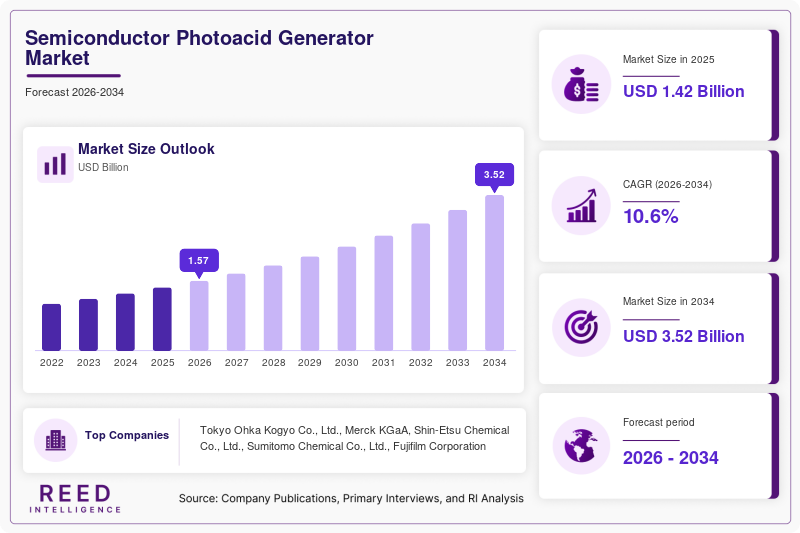
Key Highlights:
- Asia Pacific dominated the market with 48.3% share in 2025, while North America is expected to be the fastest-growing region at a CAGR of 11.4%.
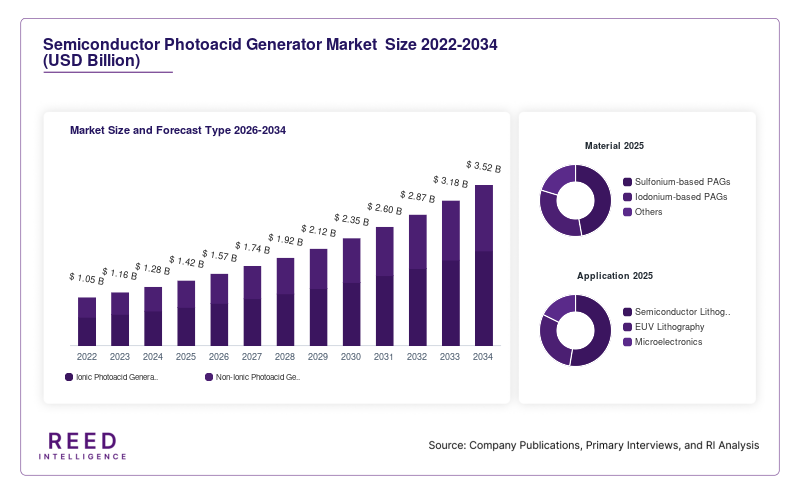
- By type, Ionic Photoacid Generators held the leading share of 54.7% in 2025, whereas Non-Ionic Photoacid Generators are projected to grow fastest at a CAGR of 11.9%.
- By application, Semiconductor Lithography accounted for the largest share at 62.5% in 2025, while EUV Lithography is anticipated to expand at a CAGR of 12.8%.
- The United States led at the country level, with market values of USD 312 million in 2024 and USD 336 million in 2025, supported by strong domestic chip manufacturing initiatives.
Market Trends
Shift Toward EUV-Compatible Photoacid Generators
The transition from deep ultraviolet (DUV) to extreme ultraviolet (EUV) lithography has significantly influenced the Semiconductor Photoacid Generator Market. EUV processes require highly efficient and low outgassing PAGs to maintain pattern fidelity at nanoscale dimensions. Manufacturers are increasingly focusing on developing PAG formulations with improved quantum efficiency and reduced line-edge roughness. This trend is accelerating innovation in molecular design and driving demand for next-generation materials.
Integration of Sustainable and Low-Toxicity Materials
Environmental and safety considerations are shaping the development of photoacid generators. Companies are investing in eco-friendly formulations that reduce hazardous byproducts and improve recyclability. This trend aligns with global sustainability goals and regulatory pressures, especially in developed regions. As a result, greener PAG alternatives are gaining attention among semiconductor fabs seeking to minimize environmental impact.
Market Drivers
Rising Demand for Advanced Semiconductor Nodes
The increasing adoption of advanced nodes such as 5 nm and 3 nm has created a strong demand for high-performance photoacid generators. These nodes require precise lithographic processes, where PAGs play a crucial role in achieving accurate patterning. The proliferation of applications such as artificial intelligence, cloud computing, and high-speed communication is further driving the need for advanced semiconductor devices, thereby boosting the Semiconductor Photoacid Generator Market.
Expansion of Global Semiconductor Manufacturing Capacity
Significant investments in semiconductor fabrication plants across regions have contributed to market growth. Governments are offering incentives to reduce dependency on imports and strengthen domestic production. This expansion has increased the consumption of lithography materials, including photoacid generators, across multiple fabrication stages.
Market Restraint
High Cost of Advanced Lithography Materials
The development and production of high-purity photoacid generators involve complex chemical processes and stringent quality requirements. This results in high costs, which can limit adoption, especially among smaller semiconductor manufacturers. Cost sensitivity remains a challenge for widespread implementation in certain regions.
Market Opportunities
Growth in Emerging Semiconductor Markets
Emerging economies are investing in semiconductor manufacturing infrastructure to support local demand. This creates new opportunities for photoacid generator suppliers to expand their footprint and cater to growing fabrication facilities.
Advancements in Material Science and Customization
Ongoing research in material science is enabling the development of customized PAG solutions tailored to specific lithography processes. This opens avenues for innovation and differentiation, allowing companies to address evolving industry requirements more effectively.
Segmental Analysis
By Type
The Ionic Photoacid Generators segment dominated the Semiconductor Photoacid Generator Market with a 54.7% share in 2025, owing to their high efficiency and stability in conventional lithography processes.
The Non-Ionic Photoacid Generators segment is projected to grow at a CAGR of 11.9%, driven by their compatibility with advanced lithography techniques and reduced contamination risks.
By Material
Sulfonium-based PAGs held the largest share of 49.2% in 2025, supported by their widespread use in chemically amplified resists.
Iodonium-based PAGs are expected to witness the fastest growth at a CAGR of 12.3%, due to their superior photoacid generation efficiency and application in EUV lithography.
By Application
Semiconductor Lithography dominated with a 62.5% share in 2025, as PAGs are integral to photolithography processes.
EUV Lithography is anticipated to grow at a CAGR of 12.8%, driven by the transition toward advanced semiconductor nodes.
By End-Use Industry
The Integrated Device Manufacturers (IDMs) segment held the leading share of 46.8% in 2025, due to their extensive in-house production capabilities.
The Foundries segment is projected to grow at a CAGR of 11.6%, fueled by increasing outsourcing of semiconductor manufacturing.
Regional Analysis
North America
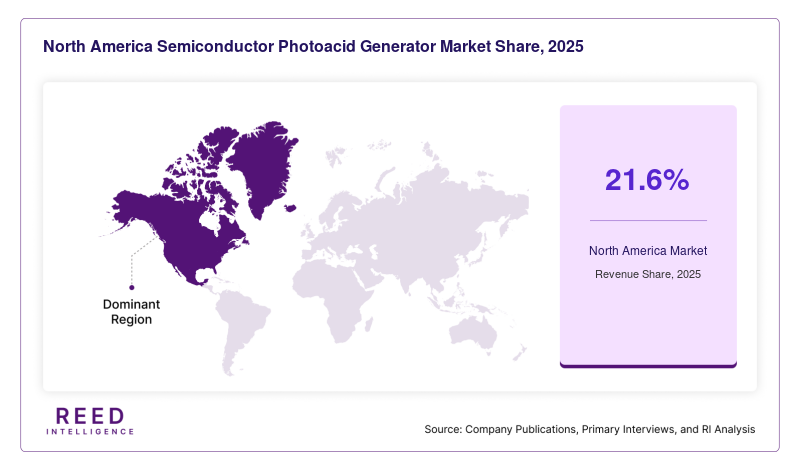
North America accounted for 21.6% of the Semiconductor Photoacid Generator Market share in 2025 and is projected to grow at a CAGR of 11.4% during the forecast period. The region’s growth will be driven by increased investments in semiconductor fabrication and technological advancements.
Dominant Country: The United States will lead due to strong government support for domestic chip production and advancements in semiconductor R&D.
Europe
Europe held a 17.8% share in 2025 and is expected to expand at a CAGR of 9.8% from 2026 to 2034. Growth will be influenced by initiatives to strengthen semiconductor supply chains and reduce reliance on imports.
Dominant Country: Germany will dominate due to its established semiconductor manufacturing base and focus on industrial automation technologies.
Asia Pacific
Asia Pacific dominated with a 48.3% share in 2025 and will grow at a CAGR of 10.9% during the forecast period. The region’s strong presence of semiconductor manufacturing hubs supports sustained demand.
Dominant Country: China will lead due to rapid expansion of domestic semiconductor fabrication facilities and increasing investment in advanced manufacturing technologies.
Middle East & Africa
The Middle East & Africa held a 6.1% share in 2025 and is projected to grow at a CAGR of 8.7%. The region will witness gradual growth due to emerging investments in technology infrastructure.
Dominant Country: United Arab Emirates will drive growth with initiatives to diversify its economy into high-tech industries.
Latin America
Latin America accounted for 6.2% of the market share in 2025 and is expected to grow at a CAGR of 8.9%. The market will expand due to increasing adoption of semiconductor technologies in various industries.
Dominant Country: Brazil will dominate owing to growing electronics manufacturing and industrial development.
Competitive Landscape
The Semiconductor Photoacid Generator Market is moderately consolidated, with key players focusing on product innovation and strategic partnerships. Leading companies include Tokyo Ohka Kogyo Co., Ltd., Merck KGaA, Shin-Etsu Chemical Co., Ltd., Sumitomo Chemical Co., Ltd., and Fujifilm Corporation. Among these, Tokyo Ohka Kogyo Co., Ltd. is a prominent market leader, known for its advanced lithography materials portfolio.
The company recently introduced a new generation of EUV-compatible photoacid generators designed to enhance pattern resolution and reduce defects in semiconductor fabrication. Other players are investing in research and development to improve material efficiency and meet evolving industry requirements. Strategic collaborations with semiconductor manufacturers are also shaping competitive dynamics, enabling companies to strengthen their market presence and expand their product offerings.
Key Players List
- Tokyo Ohka Kogyo Co., Ltd.
- Merck KGaA
- Shin-Etsu Chemical Co., Ltd.
- Sumitomo Chemical Co., Ltd.
- Fujifilm Corporation
- JSR Corporation
- DuPont de Nemours, Inc.
- BASF SE
- LG Chem Ltd.
- Samsung SDI Co., Ltd.
- Dongjin Semichem Co., Ltd.
- Avantor, Inc.
- Brewer Science, Inc.
- Kanto Chemical Co., Inc.
- MicroChem Corp.
Recent Developments
- In 2025, a major materials company launched a new series of EUV-compatible photoacid generators aimed at improving lithographic precision.
- In 2024, a leading semiconductor materials provider expanded its production facility to increase output of high-purity PAGs.
- In 2025, a strategic collaboration between a chemical company and a semiconductor manufacturer focused on developing next-generation PAG formulations.
- In 2024, advancements in low-toxicity PAG materials were introduced to address environmental concerns.
- In 2025, a key player invested in R&D to enhance the performance of PAGs for sub-3 nm semiconductor nodes.
Semiconductor Photoacid Generator Market Segments
Type
- Ionic Photoacid Generators
- Non-Ionic Photoacid Generators
Material
- Sulfonium-based PAGs
- Iodonium-based PAGs
- Others
Application
- Semiconductor Lithography
- EUV Lithography
- Microelectronics
End-Use Industry
- Integrated Device Manufacturers (IDMs)
- Foundries
- Research Institutes
By Region
- North America
- Europe
- APAC
- Middle East and Africa
- LATAM