SerDes Chipsets Automotive Applications Market Size, Share, Demand Report By Type (PCIe-based SerDes, Automotive Ethernet SerDes, Others), By Application (ADAS, Infotainment Systems, Autonomous Driving Platforms, Connectivity Modules, Sensor Fusion Systems), By End-Use (Passenger Vehicles, Commercial Vehicles, Electric Vehicles, Fleet & Mobility Services) & Regional Forecasts, 2026–2034
USD 3950
Market Overview
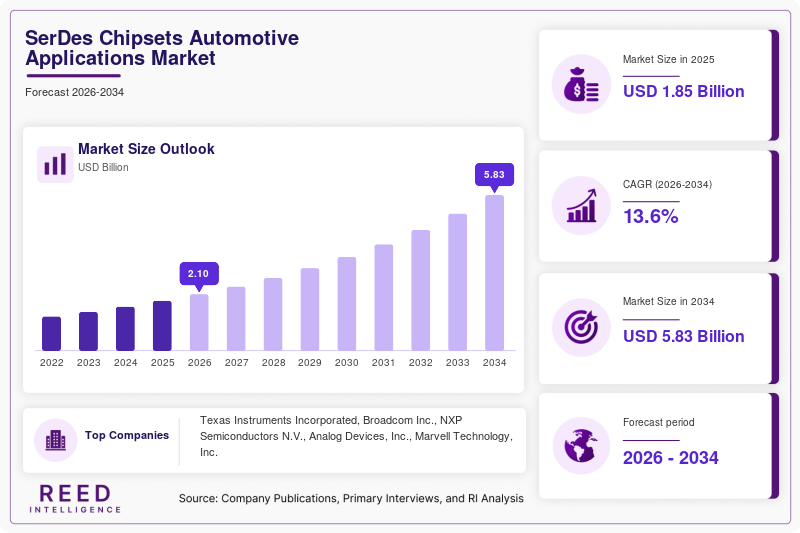
The Serdes Chipsets Automotive Applications Market is valued at approximately USD 1.85 billion in 2026 and is projected to reach around USD 5.12 billion by 2034, expanding at a CAGR of 13.6% (2026–2034). Growth is primarily driven by the rapid transformation of vehicle architectures toward centralized computing systems and high-speed in-vehicle data transmission requirements. As advanced driver assistance systems (ADAS), autonomous driving technologies, and infotainment systems evolve, the need for high-bandwidth, low-latency communication between sensors, processors, and controllers has increased significantly, strengthening SerDes chipset adoption across automotive platforms.
A major global factor supporting market growth is the increasing electrification and digitalization of vehicles. Modern electric and autonomous vehicles rely heavily on real-time sensor fusion, including LiDAR, radar, and high-resolution cameras, all of which require efficient data serialization and deserialization solutions. SerDes chipsets play a critical role in reducing wiring complexity, improving signal integrity, and enabling faster data transfer across electronic control units (ECUs), which directly supports next-generation vehicle performance and safety systems.
Key Highlights
- Dominant region share (2025): North America – 34%, Fastest-growing region: Asia Pacific – 14.2% CAGR
- Type segment: PCIe-based SerDes dominates; Automotive Ethernet SerDes is the fastest-growing subsegment (15.1% CAGR)
- Application segment: ADAS systems dominate; Autonomous driving platforms are fastest-growing
- End-use segment: Passenger vehicles dominate; Commercial EV fleets are fastest-growing
- Dominant country: United States – USD 0.62 billion (2024), USD 0.71 billion (2025)
Market Trends
Shift Toward High-Speed Automotive Ethernet Architectures
One of the most significant trends in the Serdes Chipsets Automotive Applications Market is the increasing adoption of Automotive Ethernet as the backbone of in-vehicle networking. Traditional CAN and LIN protocols are gradually being replaced due to bandwidth limitations, especially in vehicles equipped with multiple high-resolution sensors. Automotive Ethernet combined with SerDes technology enables data transmission speeds exceeding several gigabits per second, making it suitable for ADAS and autonomous driving systems. Automakers are increasingly adopting zonal architecture, where SerDes chipsets help reduce wiring harness complexity and weight. This transition supports energy efficiency in electric vehicles while also improving real-time communication between ECUs. The trend is expected to strengthen further as Level 3 and Level 4 autonomous vehicles become more commercially viable.
Integration of AI-Enabled Edge Computing in Vehicles
Another major trend is the integration of AI-enabled edge computing systems within automotive platforms, requiring ultra-fast data transfer between sensors and processors. SerDes chipsets are becoming critical enablers of these architectures by supporting high-speed data streaming from LiDAR, radar, and camera modules to AI processing units. This trend is particularly visible in premium vehicle segments, where real-time object detection, predictive analytics, and driver monitoring systems are being implemented. Automakers and semiconductor companies are collaborating to develop SerDes solutions optimized for AI workloads, reducing latency and improving safety performance. The increasing deployment of centralized domain controllers further accelerates demand for advanced SerDes architectures.
Market Drivers
Rapid Growth of ADAS and Autonomous Vehicles
The expansion of Advanced Driver Assistance Systems (ADAS) and autonomous vehicle development is a major driver of the Serdes Chipsets Automotive Applications Market. These systems require continuous, high-speed data exchange between multiple sensors and central computing units. Features such as lane detection, adaptive cruise control, automatic emergency braking, and parking assistance depend heavily on real-time processing of large datasets. SerDes chipsets enable high-bandwidth communication while minimizing latency, making them essential for safety-critical applications. As global safety regulations tighten and consumer demand for advanced vehicle features increases, automakers are significantly increasing investment in ADAS-enabled platforms. This directly boosts demand for high-performance SerDes solutions across both OEM and aftermarket installations.
Increasing Vehicle Electrification and Electronic Content
The rising penetration of electric vehicles (EVs) is another strong driver of market growth. EVs typically contain higher electronic content compared to internal combustion engine vehicles, requiring more advanced communication infrastructure. Battery management systems, infotainment units, and power electronics all depend on fast and reliable data transfer systems. SerDes chipsets help optimize space and reduce wiring complexity, which is particularly important in EV platforms where weight reduction is critical for extending driving range. Additionally, the shift toward centralized vehicle architectures increases reliance on high-speed serial communication technologies, further strengthening SerDes adoption in automotive applications.
Market Restraint
High Design Complexity and Integration Challenges
A key restraint in the Serdes Chipsets Automotive Applications Market is the high complexity associated with system design and integration. Automotive SerDes solutions must meet stringent requirements for reliability, electromagnetic compatibility, and temperature resilience, making development cycles longer and more expensive compared to standard semiconductor solutions. Integrating SerDes chipsets into multi-domain automotive architectures requires advanced engineering expertise and extensive validation testing. This complexity often leads to increased production costs, which can limit adoption among cost-sensitive vehicle manufacturers, particularly in emerging markets. Additionally, interoperability issues between different chipset vendors and automotive platforms create challenges in standardization. Automotive OEMs must invest significantly in testing and certification processes to ensure safety compliance, which further slows down deployment cycles. As a result, smaller manufacturers may face barriers to entry, and widespread adoption across all vehicle segments may take longer than expected.
Market Opportunities
Expansion of Autonomous Vehicle Ecosystem
The growing ecosystem of autonomous vehicles presents a significant opportunity for the Serdes Chipsets Automotive Applications Market. As vehicles transition toward higher levels of automation, the need for high-speed, low-latency communication systems becomes more critical. Autonomous vehicles rely on massive data inputs from LiDAR, radar, ultrasonic sensors, and cameras, all of which must be processed in real time. SerDes chipsets provide the backbone for this data transmission, enabling seamless communication between sensors and AI-driven control systems. The development of fully autonomous mobility services, including robotaxis and self-driving logistics fleets, is expected to create long-term demand for advanced SerDes technologies. Semiconductor manufacturers are also investing in next-generation multi-gigabit SerDes solutions to support future autonomous platforms.
Growth of Software-Defined Vehicles
Software-defined vehicles represent another strong growth opportunity for the market. In SDV architectures, vehicle functions are increasingly controlled by software rather than hardware, requiring centralized computing and high-speed internal networks. SerDes chipsets play a crucial role in enabling this architecture by facilitating fast communication between domain controllers and peripheral systems. As automotive OEMs shift toward over-the-air (OTA) updates and cloud-connected vehicle ecosystems, demand for scalable and high-performance SerDes solutions is increasing. This transition is particularly strong in premium and electric vehicle segments, where manufacturers aim to deliver continuous feature upgrades and enhanced user experiences.
Segmental Analysis
By Type
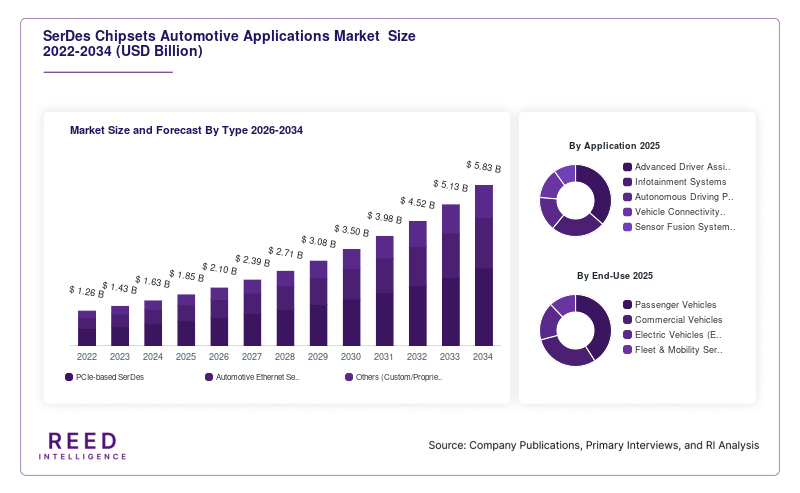
The SerDes Chipsets Automotive Applications Market is segmented into PCIe-based SerDes, Automotive Ethernet SerDes, and others. PCIe-based SerDes held the dominant share of around 41% in 2024, driven by its widespread use in high-speed data communication within ADAS and infotainment systems. Its strong performance, low latency, and compatibility with automotive computing platforms make it highly preferred among OEMs.
Automotive Ethernet SerDes is the fastest-growing subsegment, expected to expand at a CAGR of 15.1%, driven by the shift toward zonal architecture and centralized computing systems. Increasing demand for high-bandwidth data transfer in autonomous driving systems is accelerating adoption.
By Application
ADAS systems dominate the application segment with a 39% share in 2024, supported by growing safety regulations and consumer demand for intelligent driving features. SerDes chipsets enable real-time sensor data transmission critical for these systems.
Autonomous driving applications are the fastest-growing subsegment, with a CAGR of 16.3%, driven by increased investment in self-driving technologies and AI-powered vehicle systems.
By End-Use
Passenger vehicles account for the dominant share of 44% in 2024, due to high production volumes and increasing integration of electronic systems in mid- and high-end cars. SerDes chipsets are widely used in infotainment, ADAS, and connectivity systems.
Commercial EV fleets represent the fastest-growing segment with a CAGR of 15.8%, driven by logistics electrification and adoption of smart fleet management systems requiring real-time communication.
Regional Analysis
North America
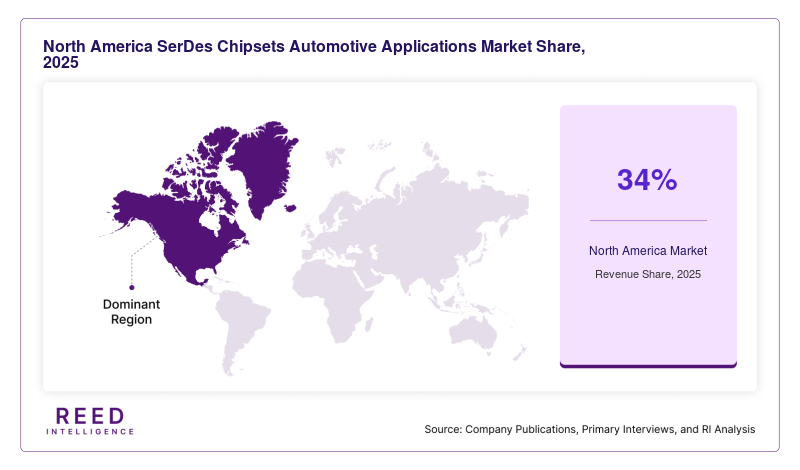
North America accounted for approximately 34% of the SerDes Chipsets Automotive Applications Market share in 2025, and is projected to grow at a CAGR of 12.8% during 2026–2034. The region maintains a strong position due to early adoption of ADAS platforms, high penetration of connected vehicles, and rapid integration of autonomous driving test programs. Increasing demand for high-speed automotive Ethernet and PCIe-based SerDes architectures is further strengthening market expansion across OEMs and Tier-1 suppliers.
The United States dominates the regional market with an estimated USD 0.71 billion in 2025, rising from USD 0.62 billion in 2024. Growth is driven by strong investments in autonomous mobility programs, particularly in states such as California, Texas, and Arizona. Additionally, the presence of leading semiconductor companies and automotive technology firms accelerates innovation in multi-gigabit SerDes solutions tailored for AI-based vehicle computing systems.
Europe
Europe held nearly 27% share of the global market in 2025, with a projected CAGR of 12.4% from 2026–2034. The region benefits from strict automotive safety regulations, strong EV adoption rates, and rapid transition toward software-defined vehicle platforms. Demand for high-bandwidth in-vehicle networking systems is increasing as European automakers shift toward centralized electronic architectures.
Germany leads the European market due to its advanced automotive manufacturing ecosystem and strong OEM base. Growth is supported by increasing deployment of premium electric vehicles from manufacturers such as BMW, Mercedes-Benz, and Volkswagen, all of which require advanced SerDes-based communication systems for ADAS, infotainment, and autonomous driving modules. Regulatory pressure from EU safety mandates is also accelerating adoption of high-speed automotive Ethernet SerDes solutions.
Asia Pacific
Asia Pacific represented approximately 29% market share in 2025, and is expected to be the fastest-growing region with a CAGR of 14.2% (2026–2034). The region’s dominance is supported by large-scale automotive production, expanding EV penetration, and strong semiconductor manufacturing ecosystems in China, Japan, South Korea, and India. Increasing deployment of smart mobility infrastructure and connected vehicle ecosystems is further fueling demand.
China dominates the regional market, contributing the largest share due to its massive EV production base and aggressive autonomous driving initiatives. The country produced over 30 million vehicles annually, with a rapidly growing portion integrating ADAS and high-speed sensor fusion systems. Local government initiatives such as smart city development programs and new energy vehicle incentives are significantly boosting demand for SerDes chipsets in automotive applications.
Middle East & Africa
The Middle East & Africa region accounted for approximately 6% of the global market share in 2025, with a projected CAGR of 11.3% during 2026–2034. Growth is supported by increasing adoption of luxury vehicles, smart transportation infrastructure projects, and early-stage autonomous mobility initiatives in key Gulf countries. Demand for connected vehicle systems is gradually rising across urban centers.
The United Arab Emirates leads the regional market, driven by strong investments in smart city initiatives such as Dubai’s autonomous transportation strategy. The integration of AI-based mobility systems and connected vehicle infrastructure is increasing the requirement for high-speed SerDes chipsets that support real-time data processing in intelligent transport systems.
Latin America
Latin America held around 4% market share in 2025, and is projected to expand at a CAGR of 10.9% through 2034. The market is in a developing phase, driven by increasing automotive production, rising demand for mid-range connected vehicles, and gradual adoption of ADAS technologies. Economic growth and infrastructure modernization are also contributing to market expansion.
Brazil dominates the regional landscape due to its strong automotive manufacturing base and growing consumer preference for vehicles equipped with advanced infotainment and safety systems. Increasing penetration of global automotive OEMs in Brazil and Mexico is further supporting adoption of SerDes-based communication architectures in modern vehicle platforms.
Competitive Landscape
The Serdes Chipsets Automotive Applications Market is moderately consolidated, with key players focusing on high-speed communication solutions and automotive-grade semiconductor innovations. Leading companies include Texas Instruments, Broadcom Inc., NXP Semiconductors, Analog Devices, and Marvell Technology. These companies are investing heavily in next-generation SerDes architectures optimized for autonomous driving and zonal vehicle systems.
Texas Instruments is considered a leading player due to its strong automotive semiconductor portfolio and continuous innovation in high-speed data interfaces. Recent developments include the launch of multi-gigabit SerDes solutions designed for ADAS and camera-based systems, improving bandwidth efficiency and reducing system latency. Strategic partnerships between semiconductor companies and automotive OEMs are increasing, aiming to develop scalable solutions for future autonomous vehicles.
Key Players
- Texas Instruments
- Broadcom Inc.
- NXP Semiconductors
- Analog Devices Inc.
- Marvell Technology
- Renesas Electronics
- Infineon Technologies
- STMicroelectronics
- Microchip Technology
- Maxim Integrated
- ON Semiconductor
- Qualcomm Technologies
- Toshiba Electronic Devices
- Rohm Semiconductor
- Semtech Corporation
Recent Developments
- In 2025, a leading semiconductor company introduced a next-generation 16 Gbps automotive SerDes platform designed for high-resolution camera systems in autonomous vehicles.
- Several OEM partnerships were announced in 2025 to integrate SerDes-based zonal architectures in upcoming EV platforms, improving data efficiency and reducing wiring complexity.
- In early 2026, new AI-optimized SerDes chipsets were launched to support edge computing in vehicles, enabling real-time object detection and predictive safety features.
SerDes Chipsets Automotive Applications Market Segments
By Type
- PCIe-based SerDes
- Automotive Ethernet SerDes
- Others (Custom/Proprietary SerDes Solutions)
By Application
- Advanced Driver Assistance Systems (ADAS)
- Infotainment Systems
- Autonomous Driving Platforms
- Vehicle Connectivity Modules
- Sensor Fusion Systems (LiDAR, Radar, Cameras)
By End-Use
- Passenger Vehicles
- Commercial Vehicles
- Electric Vehicles (EVs)
- Fleet & Mobility Services
By Region
- North America
- Europe
- APAC
- Middle East and Africa
- LATAM