Servo Hydraulic Tables Market Size, Share & Demand Report By Type (Single-Axis Servo Hydraulic Tables, Multi-Axis Servo Hydraulic Tables, Portable Compact Systems), By Application (Automotive Testing, Aerospace and Defense Testing, Seismic Simulation, Railway and Transportation Testing, Industrial Equipment Validation), By End Use (Automotive Manufacturers, Aerospace Companies, Research Laboratories, Civil Engineering Institutions, Industrial Manufacturing Facilities), By Region & Segment Foreca
USD 3950
Market Overview
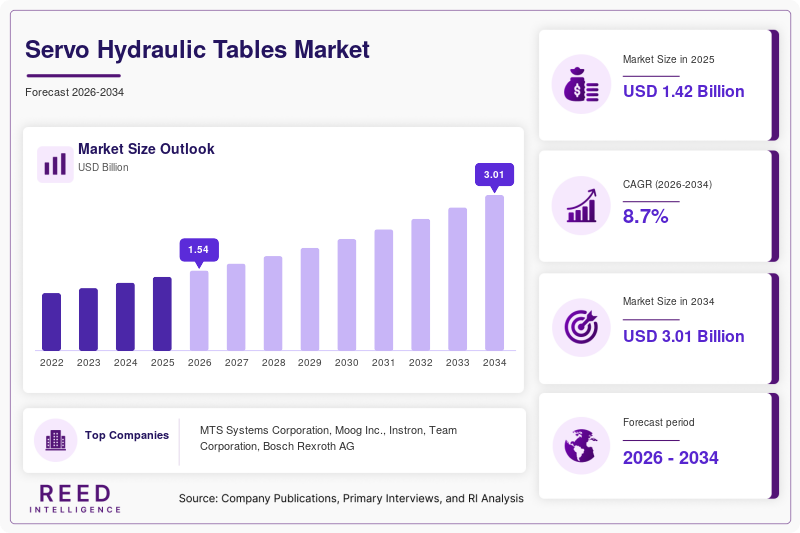
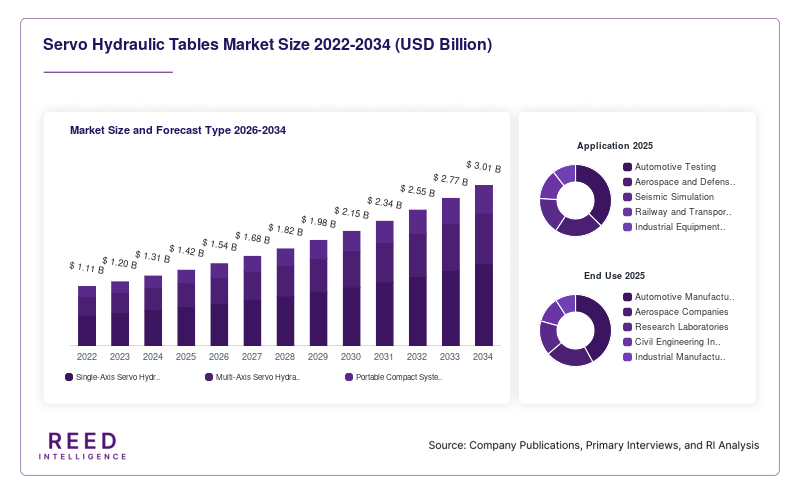
The global Servo Hydraulic Tables Market was valued at approximately USD 1.42 billion in 2026 and is projected to reach nearly USD 2.76 billion by 2034, expanding at a CAGR of 8.7% during the forecast period from 2026 to 2034. Servo hydraulic tables are widely used in vibration testing, seismic simulation, automotive durability testing, aerospace component validation, and industrial research applications. The market continues to grow due to increasing investments in precision engineering, infrastructure safety testing, and advanced manufacturing systems across developed and emerging economies. Rising demand for high-performance testing equipment in automotive electrification and aerospace modernization programs has further strengthened product adoption worldwide.
Manufacturers are increasingly integrating digital monitoring systems, AI-enabled motion control, and automated load-balancing technologies into servo hydraulic tables to improve operational precision and reduce maintenance downtime. Growing emphasis on product reliability and regulatory compliance in aerospace, defense, railway, and construction industries has encouraged testing laboratories and industrial facilities to upgrade existing systems with high-capacity hydraulic platforms. In addition, the expansion of smart factories and Industry 4.0 infrastructure has improved the integration of servo hydraulic testing systems with predictive analytics and cloud-based monitoring tools.
Key Highlights
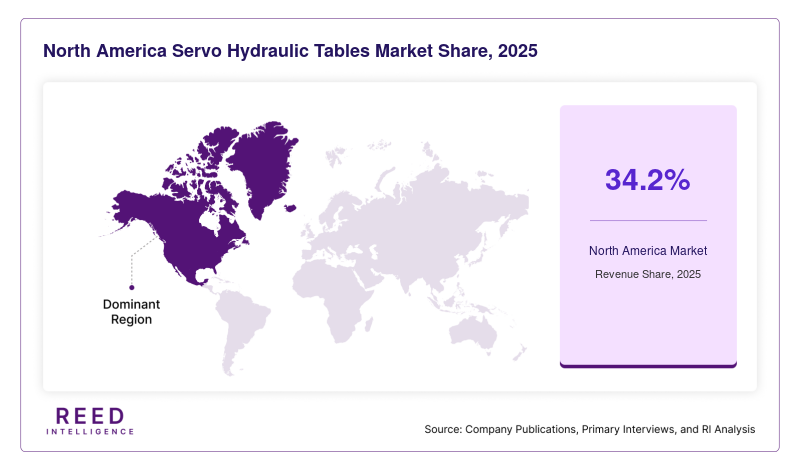
- North America dominated the market with a 34.2% share in 2025.
- Asia Pacific is expected to grow at the fastest CAGR of 10.9% during 2026–2034.
- By type, multi-axis servo hydraulic tables accounted for the largest share of 44.1%, while portable compact systems are projected to grow at a CAGR of 11.6%.
- By application, automotive testing led with a 39.4% share, whereas seismic simulation is expected to expand at a CAGR of 10.8%.
- The United States remained the dominant country, with market values of USD 468 million in 2024 and USD 512 million in 2025.
Market Trends
Integration of Smart Control and Predictive Monitoring Technologies
The Servo Hydraulic Tables Market is witnessing increasing adoption of smart automation technologies designed to improve precision, reliability, and operational efficiency. Manufacturers are integrating predictive maintenance software, IoT-enabled sensors, and AI-based monitoring platforms into testing systems to reduce downtime and optimize hydraulic performance. These technologies allow operators to track vibration levels, pressure fluctuations, and component wear in real time. Industrial users are prioritizing digitally connected testing systems that can improve data accuracy and support automated reporting functions. This trend is particularly visible in aerospace and automotive testing facilities where complex testing operations require synchronized motion control and continuous monitoring. The growing use of cloud-based diagnostics and remote operational management is also helping companies reduce maintenance costs and improve equipment utilization across multi-location facilities.
Growing Demand for High-Capacity Multi-Axis Testing Systems
Industrial sectors are increasingly demanding advanced multi-axis servo hydraulic tables capable of simulating real-world operating conditions with greater accuracy. Aerospace manufacturers, railway infrastructure developers, and automotive companies require high-load systems for durability testing, fatigue analysis, and structural validation. Multi-axis platforms provide more realistic motion simulation compared to traditional single-axis systems, making them suitable for high-performance testing applications. Demand has also increased due to stricter safety regulations and growing emphasis on structural reliability in transportation and civil engineering projects. Research institutions and testing laboratories are investing in advanced vibration simulation systems to support innovation in electric vehicles, autonomous mobility, and earthquake-resistant construction materials. This trend is expected to encourage technological advancements in load-bearing capacity, motion synchronization, and energy-efficient hydraulic control systems during the forecast period.
Market Drivers
Expansion of Automotive and Electric Vehicle Testing Activities
The rapid expansion of the automotive industry, particularly electric vehicle manufacturing, is supporting demand growth in the Servo Hydraulic Tables Market. Automotive manufacturers rely heavily on vibration and durability testing systems to validate vehicle safety, battery stability, suspension performance, and structural integrity. Servo hydraulic tables provide precise motion control and load simulation capabilities necessary for evaluating components under different operating conditions. As electric vehicle production increases globally, testing requirements for lightweight materials, battery systems, and electronic components are becoming more complex. Automotive companies are investing in advanced testing laboratories to accelerate product development cycles and meet regulatory standards. In addition, autonomous vehicle technologies require extensive durability and performance validation, further increasing demand for high-precision testing platforms capable of simulating extreme road and environmental conditions.
Rising Infrastructure Safety and Seismic Testing Requirements
Growing investments in infrastructure development and public safety are significantly contributing to market growth. Governments and engineering firms are increasingly using servo hydraulic tables for seismic simulation and structural testing applications. High-rise buildings, bridges, rail networks, and industrial facilities require rigorous testing to ensure structural resilience against earthquakes and dynamic load conditions. Countries located in seismic zones are strengthening safety regulations, encouraging research institutions and civil engineering laboratories to adopt advanced testing platforms. Servo hydraulic systems help engineers analyze material fatigue, vibration behavior, and structural response under simulated earthquake conditions. The growing focus on resilient infrastructure and disaster preparedness is expected to sustain demand for large-scale testing systems. Increased funding for transportation modernization and smart city development projects is also contributing to broader adoption across civil engineering and construction sectors.
Market Restraint
High Initial Investment and Maintenance Complexity
The Servo Hydraulic Tables Market faces challenges related to high installation costs and complex maintenance requirements. Advanced servo hydraulic systems require sophisticated hydraulic units, precision control software, vibration monitoring equipment, and specialized structural foundations, resulting in substantial capital expenditure for end users. Small and medium-sized testing laboratories often face budget limitations that restrict adoption of high-capacity systems. In addition, ongoing maintenance costs associated with hydraulic pumps, valves, actuators, and electronic control systems can increase operational expenses over time. Skilled technicians are required to maintain calibration accuracy and system efficiency, creating additional workforce-related costs for industrial facilities.
The complexity of integrating these systems into existing industrial environments can also slow purchasing decisions. Industries operating in cost-sensitive markets may postpone upgrades due to uncertain returns on investment and fluctuating economic conditions. Furthermore, hydraulic fluid leakage, energy consumption concerns, and system downtime during maintenance can affect operational productivity. Some companies are exploring alternative electrodynamic testing technologies for smaller applications, which may slightly limit market penetration for hydraulic platforms in specific use cases. Despite strong long-term demand, these cost-related barriers continue to influence procurement strategies among industrial and research organizations.
Market Opportunities
Increasing Investments in Aerospace and Defense Testing Infrastructure
The aerospace and defense sectors present substantial growth opportunities for the Servo Hydraulic Tables Market. Aircraft manufacturers and defense agencies are increasing investments in structural testing systems to validate aircraft components, missile systems, and defense equipment under extreme operating conditions. Servo hydraulic tables are widely used for fatigue testing, vibration analysis, and dynamic simulation of aerospace structures. Rising global defense budgets and ongoing modernization programs are encouraging procurement of advanced testing equipment with higher force capacity and multi-axis motion control capabilities. In addition, the expansion of commercial aviation fleets and next-generation aircraft development programs is driving demand for precise testing systems that can ensure compliance with strict safety regulations. Testing laboratories are also adopting automated simulation technologies to improve operational efficiency and reduce testing cycle durations.
Growth of Research Laboratories and Academic Testing Facilities
The increasing establishment of research laboratories and engineering institutions across emerging economies is creating favorable opportunities for market expansion. Universities, industrial research centers, and government-funded laboratories are investing in advanced testing systems to support innovation in materials science, civil engineering, transportation, and robotics. Servo hydraulic tables are becoming important tools for experimental research involving vibration analysis, structural dynamics, and fatigue testing. Countries focusing on industrial modernization and technological advancement are increasing funding for laboratory infrastructure and scientific research activities. Academic collaborations with automotive, aerospace, and renewable energy companies are also supporting equipment demand. Moreover, growing interest in earthquake engineering and infrastructure resilience research is encouraging the adoption of servo hydraulic testing systems capable of replicating complex environmental and mechanical conditions with high accuracy.
Segmental Analysis
By Type
Multi-axis servo hydraulic tables accounted for the largest share of the global Servo Hydraulic Tables Market in 2024, representing nearly 44.1% of total revenue. These systems are widely adopted across aerospace, automotive, and seismic testing applications due to their ability to simulate complex real-world motion conditions with high precision. Multi-axis systems enable simultaneous movement across several directions, improving vibration analysis and structural durability testing accuracy. Automotive manufacturers increasingly use these platforms for suspension testing, crash simulation, and electric vehicle battery validation. Aerospace companies also rely on multi-axis testing systems to evaluate aircraft structures under dynamic operational conditions. The growing emphasis on product reliability and safety compliance has further strengthened demand for advanced hydraulic testing platforms with synchronized motion control and high-load capacity.
Portable compact systems are projected to register the fastest CAGR of 11.6% during the forecast period due to increasing demand from small research laboratories, educational institutions, and field-testing applications. These systems offer lower installation costs, reduced energy consumption, and easier mobility compared to conventional large-scale platforms. Industrial users are increasingly adopting compact hydraulic tables for localized testing operations and rapid prototype validation. The expansion of decentralized testing facilities and growing investments in academic engineering research are contributing to segment growth. In addition, manufacturers are introducing compact systems integrated with digital monitoring software and automated calibration features, improving operational flexibility and reducing maintenance complexity. Rising adoption among emerging economies with developing industrial infrastructure is expected to further accelerate demand for portable servo hydraulic solutions.
By Application
Automotive testing emerged as the dominant application segment in 2024, accounting for approximately 39.4% of the global Servo Hydraulic Tables Market share. Automotive manufacturers extensively use servo hydraulic tables for vibration analysis, durability assessment, suspension testing, and electric vehicle component validation. The transition toward electric mobility has significantly increased the need for advanced testing systems capable of evaluating lightweight materials, battery stability, and electronic control modules under simulated operating conditions. Vehicle safety regulations and consumer demand for improved reliability continue to encourage investments in high-performance testing laboratories. Automotive companies are increasingly integrating automated testing systems with digital data analytics platforms to improve testing accuracy and reduce product development timelines. This trend has strengthened demand for multi-axis hydraulic systems across both passenger and commercial vehicle manufacturing sectors.
Seismic simulation is expected to witness the fastest growth during the forecast period, expanding at a CAGR of 10.8%. Rising concerns regarding infrastructure resilience and earthquake safety are driving adoption of advanced structural testing systems worldwide. Governments and engineering institutions are increasingly investing in seismic research laboratories to evaluate the structural performance of bridges, tunnels, rail networks, and high-rise buildings under earthquake conditions. Servo hydraulic tables provide accurate simulation of ground motion and vibration patterns, enabling engineers to analyze material fatigue and structural stability effectively. Growing urbanization and increasing investments in smart city development are also contributing to demand for seismic testing systems. Countries located in earthquake-prone regions are strengthening safety standards, further encouraging procurement of high-capacity hydraulic simulation platforms.
By End Use
Automotive manufacturers held the largest share of the Servo Hydraulic Tables Market in 2024, contributing nearly 36.8% of overall revenue. The automotive industry remains one of the largest users of hydraulic testing platforms due to the increasing complexity of vehicle engineering and performance validation requirements. Manufacturers require advanced vibration and durability testing systems to improve product quality, passenger safety, and compliance with international automotive standards. The rapid growth of electric vehicles and autonomous driving technologies has expanded the scope of testing applications involving battery systems, lightweight chassis materials, and electronic control components. Automotive companies are investing heavily in automated testing laboratories equipped with real-time monitoring and predictive analytics capabilities to accelerate product innovation and reduce testing errors. This ongoing technological transition continues to support strong demand from the automotive manufacturing sector.
Research laboratories are anticipated to record the fastest CAGR of 10.5% during the forecast period due to rising investments in engineering research and scientific innovation. Universities, government-funded institutions, and private industrial laboratories are increasingly adopting servo hydraulic tables for advanced material testing, structural dynamics analysis, and vibration simulation studies. Growing collaboration between academic institutions and industrial manufacturers is accelerating the development of new testing methodologies and high-performance engineering materials. In addition, expanding research activities related to earthquake engineering, renewable energy infrastructure, and transportation safety are contributing to segment growth. Many laboratories are upgrading older testing equipment with digitally connected servo hydraulic systems that offer enhanced data accuracy and automated control functions. Emerging economies are also increasing funding for laboratory modernization initiatives, creating favorable opportunities for market expansion across research-focused end users.
Regional Analysis
North America
North America accounted for approximately 34.2% of the global Servo Hydraulic Tables Market in 2025 and continues to maintain a leading position due to strong industrial testing infrastructure and technological advancement. The region is projected to grow at a CAGR of 7.9% during the forecast period. Demand remains high across aerospace, automotive, defense, and infrastructure testing sectors. Companies in the region are increasingly adopting digitally integrated hydraulic systems with predictive maintenance capabilities. The presence of advanced research laboratories and stringent product validation standards continues to support long-term market demand across industrial and academic applications.
The United States remains the dominant country in the region due to significant investments in aerospace testing and electric vehicle development. Automotive manufacturers and defense contractors continue to upgrade vibration testing facilities to improve product reliability and regulatory compliance. Growing federal funding for infrastructure modernization and earthquake resilience projects has also increased demand for seismic simulation systems. In addition, collaborations between universities and industrial manufacturers are supporting innovation in testing technologies and expanding the use of advanced servo hydraulic platforms across multiple engineering disciplines.
Europe
Europe represented nearly 27.1% of the global market share in 2025 and is expected to register a CAGR of 8.1% during the forecast period. The region benefits from strong automotive engineering capabilities, strict safety standards, and extensive industrial research activities. European manufacturers continue to invest in high-precision testing systems to support electric mobility and advanced aerospace programs. Increasing focus on sustainable transportation and smart infrastructure development is also contributing to demand for vibration and structural testing solutions. The region’s well-established engineering ecosystem supports steady adoption of advanced hydraulic testing technologies.
Germany remains the leading country within Europe due to its large automotive manufacturing base and industrial automation expertise. Automotive companies are increasingly investing in advanced durability testing systems for electric vehicles and autonomous driving technologies. The country’s engineering research institutes are also expanding their use of seismic simulation and fatigue testing equipment. Furthermore, government support for green mobility initiatives and railway modernization projects is encouraging procurement of advanced multi-axis servo hydraulic platforms for infrastructure and transportation testing applications.
Asia Pacific
Asia Pacific is projected to record the fastest CAGR of 10.9% during 2026–2034 due to rapid industrialization, infrastructure development, and expanding automotive production. The region accounted for approximately 24.8% of the global market in 2025. Countries across Asia Pacific are increasing investments in manufacturing modernization, industrial automation, and research infrastructure. Demand for servo hydraulic tables is rising in automotive testing laboratories, construction engineering facilities, and transportation safety centers. The expansion of electric vehicle manufacturing and railway infrastructure projects is creating strong demand for advanced vibration simulation and durability testing systems.
China remains the dominant country in Asia Pacific due to its large industrial base and substantial infrastructure investment programs. The country is expanding testing capabilities in automotive, aerospace, and civil engineering sectors to meet growing domestic and international quality standards. Increasing adoption of electric mobility technologies and high-speed rail development projects has accelerated the use of advanced testing equipment. Government support for industrial innovation and research laboratory development is also encouraging procurement of digitally integrated servo hydraulic systems with higher operational precision and automation capabilities.
Middle East & Africa
The Middle East & Africa region accounted for nearly 7.2% of the global Servo Hydraulic Tables Market in 2025 and is projected to grow at a CAGR of 7.6% through 2034. Infrastructure development, oil and gas investments, and transportation modernization projects are supporting demand for advanced testing systems across the region. Governments are increasingly focusing on structural safety and engineering validation for large-scale construction initiatives. Research institutions and industrial laboratories are gradually adopting servo hydraulic tables for material testing, seismic simulation, and vibration analysis applications.
Saudi Arabia remains the dominant country in the regional market due to ongoing infrastructure diversification programs and industrial expansion projects. The country is investing heavily in smart city development, transportation infrastructure, and renewable energy facilities, creating demand for advanced structural testing technologies. Large-scale construction projects require reliable testing systems capable of evaluating material durability and seismic performance. Additionally, the growing presence of engineering research centers and industrial testing laboratories is contributing to increased procurement of high-capacity hydraulic platforms.
Latin America
Latin America represented approximately 6.7% of the global market in 2025 and is anticipated to grow at a CAGR of 7.4% during the forecast period. The market is benefiting from gradual industrial recovery, infrastructure development, and increasing investments in automotive manufacturing facilities. Demand for servo hydraulic tables is rising in material testing laboratories and transportation engineering projects. Regional governments are emphasizing product safety and structural reliability, encouraging adoption of advanced testing technologies across industrial and academic institutions.
Brazil continues to dominate the Latin American market due to its large automotive industry and expanding industrial engineering sector. Automotive manufacturers are investing in durability testing and vibration simulation systems to improve vehicle safety and product quality. Infrastructure development projects related to transportation and urban modernization are also supporting demand for structural testing equipment. In addition, collaborations between universities and industrial organizations are strengthening engineering research capabilities and increasing adoption of advanced hydraulic testing platforms.
Competitive Landscape
The Servo Hydraulic Tables Market is moderately consolidated, with several international and regional manufacturers competing based on technological innovation, testing precision, customization capabilities, and after-sales support services. Leading companies are focusing on expanding multi-axis testing systems, integrating AI-enabled control software, and improving hydraulic energy efficiency to strengthen market positioning. Strategic collaborations with automotive manufacturers, aerospace companies, and engineering research institutions remain common across the industry. Companies are also increasing investments in digital monitoring platforms and predictive maintenance technologies to improve operational performance and customer retention.
MTS Systems Corporation remains one of the leading players in the global market due to its extensive portfolio of high-capacity servo hydraulic testing systems and strong presence across aerospace and automotive sectors. The company recently introduced an advanced digital control platform designed to improve real-time motion synchronization and testing accuracy for complex durability simulations. Other major participants are expanding regional manufacturing operations and strengthening service networks to improve customer support capabilities.
Key Players
- MTS Systems Corporation
- Moog Inc.
- Instron
- Team Corporation
- Bosch Rexroth AG
- Servotest Testing Systems Ltd.
- IMV Corporation
- Data Physics Corporation
- Dongling Technologies
- Saginomiya Seisakusho Inc.
- Shore Western Manufacturing
- ACTIDYN Systems
- Tokyo Testing Machine Inc.
- TIRA GmbH
- ETS Solutions
Recent Developments
- MTS Systems Corporation launched a new AI-enabled servo hydraulic control platform in 2025 for advanced multi-axis durability testing applications.
- Moog Inc. expanded its European testing solutions facility to improve production capacity for aerospace vibration simulation systems in 2024.
- Bosch Rexroth AG introduced an energy-efficient hydraulic power unit designed to reduce operating costs in large-scale industrial testing systems during 2025.
Servo Hydraulic Tables Market Segments
Type
- Single-Axis Servo Hydraulic Tables
- Multi-Axis Servo Hydraulic Tables
- Portable Compact Systems
Application
- Automotive Testing
- Aerospace and Defense Testing
- Seismic Simulation
- Railway and Transportation Testing
- Industrial Equipment Validation
End Use
- Automotive Manufacturers
- Aerospace Companies
- Research Laboratories
- Civil Engineering Institutions
- Industrial Manufacturing Facilities
By Region
- North America
- Europe
- APAC
- Middle East and Africa
- LATAM