Sesame Seed Oil Market Size, Share & Trends Analysis Report By Product Type (Refined Sesame Oil, Virgin & Cold-Pressed Sesame Oil, Blended Sesame Oil), By Application (Food & Beverages, Cosmetics & Personal Care, Pharmaceuticals, Industrial), By Distribution Channel (Supermarkets & Hypermarkets, Specialty Stores, Online Channels, Foodservice & B2B), By End Use (Household, Food Processing, Cosmetic Manufacturers, Pharmaceutical & Other Industrial Users) and By Region (North America, Europe, APAC,
USD 3950
Sesame Seed Oil Market Size
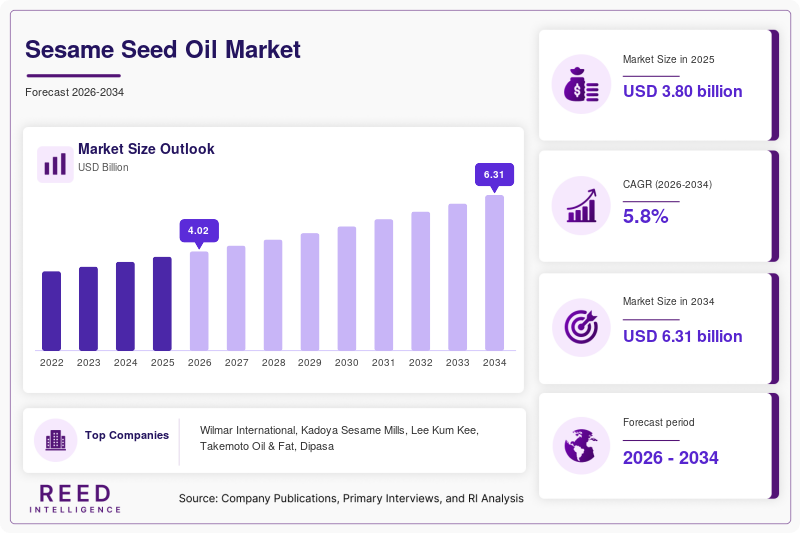
The global sesame seed oil market size was valued at USD 3.80 billion in 2025 and is projected to grow from USD 4.02 billion in 2026 to USD 6.31 billion by 2034, registering a CAGR of 5.80% during the forecast period from 2026 to 2034.
The market is supported by sesame oil's established role in Asian, Middle Eastern and African cooking, expanding demand for premium cold-pressed oils, applications in personal care formulations, and increasing processing activity in major sesame-producing economies. FAOSTAT continues to track sesame oil as a processed crop product, while FAO data show that oil crops have been among the agricultural commodities with the strongest production increases over the longer term.
Sesame seed oil is moving beyond its traditional role as a cooking ingredient into a broader specialty oil category covering food processing, cosmetics, personal care, pharmaceuticals and selected industrial applications. The underlying supply chain remains closely linked to sesame cultivation because the seed contains roughly 50% oil and is primarily processed for edible oil, with the remaining meal providing a secondary revenue stream.
Asia remains the center of the sesame-oil value chain because sesame cultivation, processing and consumption are deeply established across India, China, Japan, Korea and Southeast Asia. India is particularly relevant to supply: the Indian government identifies sesame among the country's major traditionally cultivated oilseeds and states that India ranks first globally in sesame production.
Sesame Seed Oil Market Drivers
Expansion of premium and cold-pressed edible oils
Consumer demand is creating a wider price and quality ladder within edible oils. Conventional refined sesame oil remains important for everyday cooking and food manufacturing, while virgin and cold-pressed products appeal to buyers seeking minimally processed ingredients, distinctive flavor and natural positioning. Sesame oil also has naturally occurring tocopherols and lignans such as sesamin and sesamolin, which contribute to oxidative stability.
This distinction allows processors to address different purchasing requirements rather than competing solely on commodity pricing. Premium brands can emphasize origin, extraction method, organic certification and traceability, while mass-market producers can optimize refining, packaging and distribution costs. India's government-backed National Mission on Edible Oils–Oilseeds is also focused on increasing oilseed production and extraction efficiency, strengthening the underlying domestic raw-material base.
The counterbalance is that premium positioning requires higher-quality seed sourcing, controlled processing and stronger certification, increasing costs relative to standard refined products.
Food and culinary demand remains the core volume mechanism
Sesame oil has an established role in Asian and Middle Eastern cuisines, where it is used for cooking, frying, dressing, seasoning and flavor enhancement. Sesame seeds themselves are also widely incorporated into bakery, confectionery and specialty foods.
This established culinary base gives sesame oil a recurring consumption mechanism that is less dependent on short-term health trends. Growth in packaged Asian foods, sauces, dressings, ready-to-eat meals and restaurant cuisine also creates opportunities for food manufacturers to use sesame oil as both a cooking medium and flavor ingredient.
The commercial effect extends through foodservice and B2B channels, where processors purchase oil in larger formats than household consumers. However, demand remains sensitive to sesame-seed availability and edible-oil prices because oil producers must compete for raw material with whole-seed food applications.
Expansion into cosmetics and personal care
Sesame oil is increasingly relevant as a natural-origin formulation ingredient. Cosmetic suppliers use Sesamum indicum seed oil for skin conditioning, spreading, moisturizing and hair-care applications. Croda, for example, lists its Cropure Sesame ingredient for skin care, hair care, sun care and color cosmetics, with applications including face color, lip color and hair conditioners.
SOPHIM markets sesame oil for skincare, body care, makeup and haircare formulations and highlights its omega-6 fatty acids and naturally occurring antioxidants. Clarins also identifies organically sourced sesame oil as a cosmetic ingredient and reports sourcing from Burkina Faso, Guinea, Mexico, Mali, Senegal and Uganda.
This creates demand for refined, deodorized, organic and specialty grades with consistent specifications. The constraint is that cosmetic customers require tighter quality, documentation and batch consistency than some conventional food applications.
Sesame Seed Oil Market Restraints
Sesame seed supply and agricultural variability
Sesame oil production is directly exposed to agricultural conditions because the raw material is concentrated in specific producing regions. Weather, rainfall, planted area, crop disease, geopolitical disruption and farmer economics can affect seed availability and therefore processing margins.
India illustrates the variability. Official crop data showed 8.38 million hectares of sesame planted during the 2025–26 kharif season as of August 1, 2025, compared with 9.00 million hectares in 2024–25. At the same time, summer sesame planting in India reached 5.07 lakh hectares by May 2026, slightly above the corresponding 2025 level.
The result is a market where processors must manage procurement timing, inventory and supplier diversification. Smaller processors can be particularly exposed to sharp raw-material movements.
Allergen and quality-compliance requirements
Sesame's status as a major food allergen creates additional compliance requirements for processors, food manufacturers and retailers. In the U.S., sesame became the ninth major food allergen effective January 1, 2023, and packaged foods containing sesame must declare it under applicable federal requirements.
The FDA's 2025 allergen guidance also addresses sesame labeling, manufacturing controls and cross-contact considerations. These requirements can increase segregation, cleaning, testing and documentation costs, particularly for plants processing sesame alongside other food ingredients.
Sesame Seed Oil Market Opportunities
Organic, traceable and specialty sesame oil
The premium segment provides opportunities for processors to differentiate through organic certification, geographic origin, cold pressing, low-temperature processing, deodorization, sustainable sourcing and traceability. Cosmetic buyers are particularly interested in standardized oils with known fatty-acid profiles, purity specifications and documentation.
Clarins identifies organic sesame oil sourced from several African and Latin American countries, while Croda Beauty markets a refined sesame ingredient with regional availability in Asia and North America.
This creates a value-added route for producing countries that historically export sesame seeds rather than higher-value processed oil. The opportunity is particularly relevant where processors can combine local seed procurement with modern extraction, filtration, certification and export capabilities.
Expansion of processing capacity and value-added exports
Increasing local processing can retain more value within producing economies. India's government is pursuing higher domestic oilseed production and extraction efficiency through the National Mission on Edible Oils–Oilseeds, with a seven-year implementation period from 2024–25 to 2030–31 and an outlay of INR 10,103 crore.
Recent private-sector investment also shows smaller processors entering the category. In February 2025, Ambar Protein Industries announced installation of machinery and planned trials for cold-pressed sesame oil alongside other cold-pressed edible oils.
The commercial mechanism is straightforward: processing converts locally produced seed into a higher-value finished product, while oil cake creates a secondary revenue stream. Export-oriented processors can additionally serve food manufacturers and cosmetic-ingredient buyers.
Segmental Analysis
By Product Type
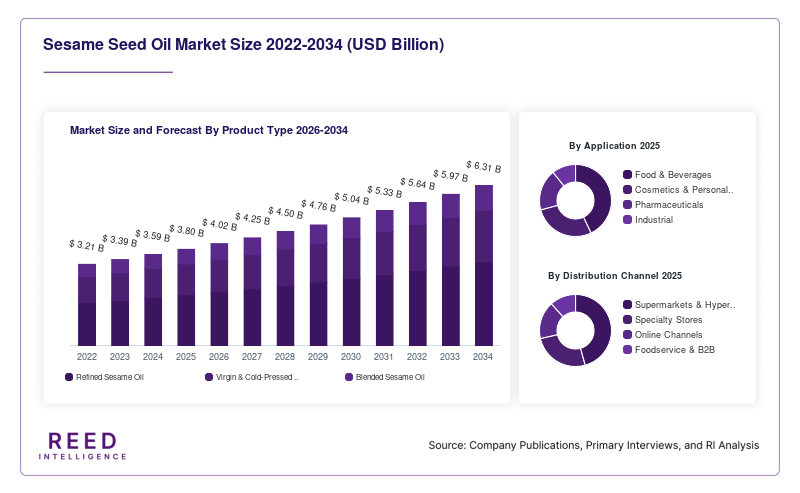
Refined Sesame Oil represents approximately 58% of the global market in 2025, supported by its wider use in cooking, food processing and commercial foodservice. Refining provides consistent color, odor and performance characteristics, making the product easier to standardize for large-volume applications.
Virgin & Cold-Pressed Sesame Oil represents approximately 30% and is the fastest-growing product category at about 7.0% CAGR. Its growth is linked to premium food positioning, natural-product demand and increased use in cosmetic formulations. Cold pressing preserves the characteristic flavor and allows producers to position the product around minimally processed attributes.
Blended Sesame Oil represents approximately 12%, serving consumers and food manufacturers seeking specific flavor, cost or nutritional characteristics. Blending also gives producers flexibility when sesame seed and oil prices fluctuate.
By Application
Food & Beverages represents approximately 67% of the global market in 2025, making it the largest application. Sesame oil's established culinary role in Asian and Middle Eastern cuisine, along with use in dressings, sauces, prepared foods, bakery products and foodservice, provides the largest recurring demand base.
Cosmetics & Personal Care accounts for approximately 20% and is the fastest-growing application at about 7.4% CAGR. Cosmetic formulators use sesame oil in skincare, haircare, bodycare and makeup because of its emollient and conditioning properties.
Pharmaceuticals accounts for approximately 8%, supported by sesame oil's use as a pharmaceutical vehicle and excipient.
Industrial Applications represent approximately 5%, covering selected specialty formulations, soaps and other technical applications.
By Distribution Channel
Supermarkets & Hypermarkets account for approximately 39% of the global market in 2025, supported by their broad household reach and ability to stock multiple oil grades and package sizes.
Specialty Stores represent approximately 21%, serving premium, organic, natural-food and culturally specific products.
Online Channels account for approximately 18% and are the fastest-growing distribution channel at about 8.2% CAGR. E-commerce allows brands to sell niche cold-pressed, organic and origin-specific oils without requiring extensive physical distribution.
Foodservice & B2B represents approximately 22%, covering restaurants, food processors, ingredient buyers and bulk users.
By End Use
Household represents approximately 46% of the market in 2025, reflecting the established culinary use of sesame oil in Asian, Middle Eastern and other cuisines.
Food Processing represents approximately 31% and is the fastest-growing end-use category at about 6.5% CAGR. Food manufacturers increasingly use sesame oil as a flavoring, cooking ingredient and specialty vegetable oil in sauces, dressings, prepared meals and snack products.
Cosmetic Manufacturers account for approximately 15%, with growth supported by natural-origin formulations and demand for standardized plant oils. Croda, SOPHIM and Clarins all maintain sesame-oil applications or sourcing programs for personal-care products.
Pharmaceutical & Other Industrial Users represent approximately 8%, supported by pharmaceutical-grade applications and specialty formulations.
Regional Analysis
North America Sesame Seed Oil Market
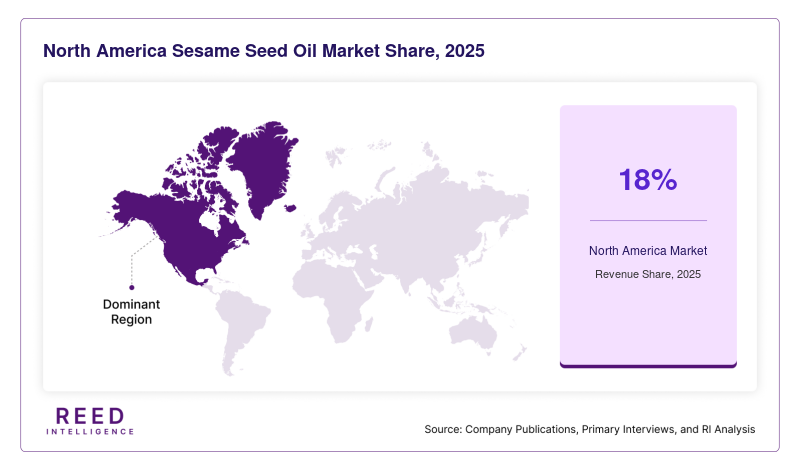
North America represents approximately 18% of the global market in 2025 and is growing at about 5.0% CAGR. Demand is concentrated around packaged food, Asian cuisine, specialty edible oils, food manufacturing, cosmetics and pharmaceutical applications. The region is also important for premium and organic products because consumers can access multiple grades through specialty retailers and online channels.
The U.S. regulatory environment makes allergen management a material operating consideration. Sesame has been recognized as the ninth major food allergen since January 1, 2023, and applicable packaged foods must identify sesame appropriately on labels.
The market therefore favors suppliers capable of maintaining clear ingredient documentation, segregation and traceability. Food manufacturers are also potential growth customers because sesame oil can serve both culinary and flavoring roles.
Cosmetics provide another demand channel. Specialty ingredient suppliers offer sesame oil for skin and hair formulations, while pharmaceutical applications benefit from established pharmacopeial recognition.
The main constraint is that sesame oil competes with a broad range of vegetable and specialty oils, making differentiation through flavor, origin, processing method, organic status and formulation performance increasingly important.
Europe Sesame Seed Oil Market
Europe accounts for approximately 21% of the global market in 2025 and is growing at about 4.8% CAGR. Demand comes from food manufacturing, ethnic and premium cuisine, natural cosmetics, personal care and specialty ingredient markets.
The European cosmetics industry provides a clear value-added pathway. Sesame oil is listed under the INCI name Sesamum Indicum Seed Oil and is used in skin-care and hair-care formulations. Suppliers increasingly offer organic, deodorized and refined grades that meet specific cosmetic formulation requirements.
The region also has an established market for certified natural and organic ingredients. Clarins, for example, sources organic sesame oil from several African and Latin American origins and links its sourcing program with organic farming and sustainable agricultural practices.
Food applications remain the larger volume base, but personal-care ingredients provide stronger value differentiation. European buyers are generally more demanding on documentation, traceability, certification and sustainability, which raises compliance costs but can create higher-value niches for qualified suppliers.
APAC Sesame Seed Oil Market
APAC represents approximately 47% of the global market in 2025 and is the largest and fastest-growing region at about 6.4% CAGR. India, China, Japan, South Korea and Southeast Asia combine large sesame-consuming populations with established processing and culinary traditions.
India has a particularly strong supply position. The Indian government states that the country ranks first in sesame production and includes sesame within the nine oilseed crops targeted under the National Mission on Edible Oils–Oilseeds. Government data also show extensive sesame cultivation across both kharif and summer seasons.
China and other East Asian markets provide large consumption bases, particularly for roasted and aromatic sesame oil used as a flavor ingredient. Japan and South Korea also support premium consumption and specialized food applications.
APAC's growth mechanism therefore combines raw-material availability, traditional consumption, expanding packaged-food markets, premium edible oils and personal-care applications. The region also has a large base of smaller oil processors, allowing cold-pressed and specialty products to enter local markets.
The primary constraint is supply variability. Changes in sesame acreage, rainfall and farm economics can affect seed prices and processor margins.
Middle East and Africa Sesame Seed Oil Market
The Middle East and Africa represent approximately 9% of the global market in 2025 and are growing at about 6.0% CAGR. The region has long-established sesame consumption and a substantial production base in parts of Africa, while Middle Eastern cuisine creates consistent demand for sesame-based food products.
African origins are increasingly relevant to higher-value cosmetic supply chains. Clarins identifies Burkina Faso, Guinea, Mali, Senegal and Uganda among its sesame sourcing countries, while European trade research has documented imports of African sesame oil for cosmetic applications.
The opportunity is to increase local processing rather than exporting only raw sesame seed. Domestic crushing, filtration, refining and packaging can capture additional value while creating supply for regional food manufacturers and international ingredient buyers.
However, infrastructure, financing, quality certification and export logistics remain important constraints in several producing countries. Sudan also demonstrates how geopolitical instability can affect agricultural supply and processing: FAO estimated its 2023/24 sesame production at approximately 600,091 tonnes, well below the previous year and its five-year average.
LATAM Sesame Seed Oil Market
LATAM represents approximately 5% of the global market in 2025 and is growing at about 5.7% CAGR. Mexico is an important sesame-producing and consuming market, while regional demand is supported by food processing, bakery, sauces, dressings and specialty edible oils.
The region can also participate in the premium ingredient supply chain. Clarins identifies Mexico as one of its sourcing origins for organic sesame oil, demonstrating that Latin American production can serve international cosmetic-ingredient requirements rather than only domestic food demand.
Growth is therefore linked to improved processing, organized retail, specialty food products and export opportunities. Producers able to meet organic, quality and traceability requirements can access higher-value international customers.
The main limitation is the smaller regional consumption base compared with APAC and the competitive pressure from major Asian and African supply origins.
Competitive Landscape
The sesame seed oil market is fragmented across agricultural processors, edible-oil companies, specialty ingredient suppliers, cosmetic-ingredient manufacturers and regional brands. Competition is determined by access to sesame seed, extraction technology, refining capability, product consistency, certifications, packaging and distribution reach.
Large processors compete through procurement scale and standardized products, while smaller companies can differentiate through cold pressing, organic sourcing, geographic origin and premium packaging. The distinction is particularly important because the same raw material can be sold into several markets with very different specifications.
In cosmetics, ingredient suppliers compete on purity, odor, color, oxidation stability, certification and formulation performance. Croda Beauty offers Cropure Sesame for multiple beauty categories, while SOPHIM provides conventional and organic deodorized grades for skincare, bodycare, makeup and haircare.
Key Market Players
- Wilmar International
- Kadoya Sesame Mills
- Lee Kum Kee
- Takemoto Oil & Fat
- Dipasa
- Sesajal
- CJ CheilJedang
- Ottogi
- Kuki Sangyo
- Croda
- SOPHIM
- Vantage Specialty Chemicals
Recent Market Developments
- May 2026 – India examined standardized pack sizes for edible oils. The Department of Consumer Affairs held an industry stakeholder meeting on May 20, 2026 and considered standard pack sizes from 200 ml to 20 liters/20 kg to improve price transparency and comparison. The initiative could influence packaging practices for sesame oil alongside other edible oils.
- February 2025 – Ambar Protein Industries installed machinery for cold-pressed sesame oil. The company announced the installation of new machinery and planned trials for cold-pressed sesame oil, adding sesame to a broader cold-pressed edible-oil portfolio.
Sesame Seed Oil Market Segments
By Product Type
- Refined Sesame Oil
- Virgin & Cold-Pressed Sesame Oil
- Blended Sesame Oil
By Application
- Food & Beverages
- Cosmetics & Personal Care
- Pharmaceuticals
- Industrial
By Distribution Channel
- Supermarkets & Hypermarkets
- Specialty Stores
- Online Channels
- Foodservice & B2B
By End Use
- Household
- Food Processing
- Cosmetic Manufacturers
- Pharmaceutical & Other Industrial Users
By Region
- North America
- Europe
- APAC
- Middle East and Africa
- LATAM