Sexual Wellness Market Size, Share & Trends Analysis Report By Product Type (Sexual Pleasure Products, Condoms & Barrier Products, Personal Lubricants, Sexual Health Products, Intimate Care), By Gender (Men, Women, Unisex), By Distribution Channel (Online, Specialty Stores, Pharmacies & Drugstores, Supermarkets & Hypermarkets), By End User (Adults, Couples, LGBTQ+ Consumers) and By Region (North America, Europe, APAC, Middle East and Africa, LATAM) Forecasts, 2026–2034
USD 3950
Sexual Wellness Market Size
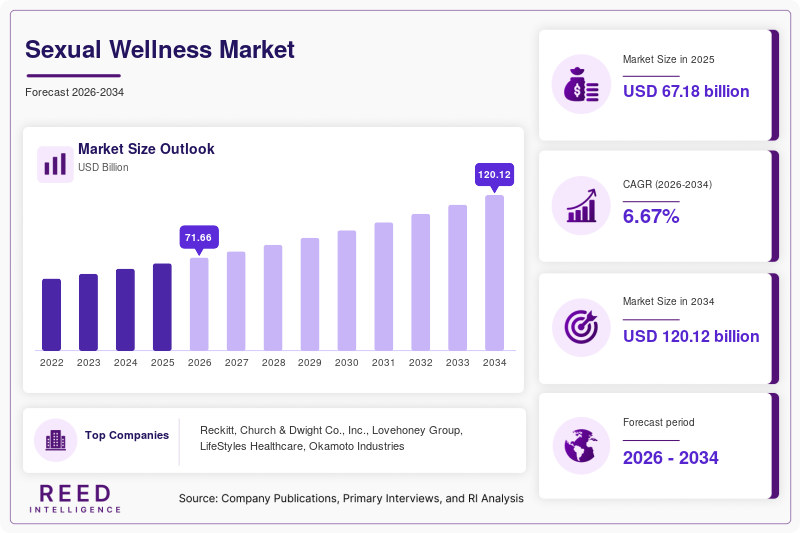
The global Sexual Wellness Market size was valued at USD 67.18 billion in 2025 and is projected to grow from USD 71.66 billion in 2026 to USD 120.25 billion by 2034, registering a CAGR of 6.67% during the forecast period from 2026 to 2034.
The Sexual Wellness Market covers products and consumer-health solutions intended to support sexual health, protection, comfort, intimacy and sexual wellbeing. Because “sexual wellness” is a broad commercial category rather than one standardized regulatory classification, the market includes condoms and barrier products, personal lubricants, sexual pleasure products, intimate-care products and related sexual-health solutions.
The health component provides a durable demand base. WHO reports that more than 1 million curable sexually transmitted infections are acquired every day among people aged 15–49, while condoms remain one of the most effective methods for preventing most STIs and HIV when used correctly and consistently. WHO also estimates that 1.1 billion women of reproductive age had a need for family planning in 2021, including 164 million with unmet need for contraception.
Lubricants increasingly sit at the intersection of sexual health and pleasure. WHO identifies personal lubricants as products supporting sexual functioning and wellbeing and notes their availability through pharmacies and health facilities.
Commercial competition is moving toward premium materials, product personalization, digital distribution and evidence-backed intimate-care claims. Reckitt's Durex Intensity, launched in Europe in 2025, uses nitrile to address sensation and latex-free preferences, while Church & Dwight's Trojan G.O.A.T. uses a proprietary non-latex material.
Sexual Wellness Market Drivers
Sexual Health and STI Prevention Sustain Core Product Demand
Sexual wellness has a strong health-protection component because condoms and certain lubricants are directly connected with STI prevention, pregnancy prevention and safer sexual practices. WHO estimates that 374 million new infections with chlamydia, gonorrhoea, syphilis or trichomoniasis occurred among people aged 15–49 in 2020.
Condoms therefore serve two overlapping consumer needs: protection and sexual comfort. WHO states that condoms are the only contraceptive method that simultaneously provides protection against pregnancy and most STIs, including HIV. Lubricants can also reduce condom breakage and slippage when compatible products are used correctly.
This creates recurring demand through pharmacies, supermarkets, sexual-health programs, specialist retailers and online channels. UNFPA provides an additional institutional demand signal: in 2024 it procured 1.36 billion condoms as part of its reproductive-health commodity purchasing.
The counterbalance is that condom use remains affected by affordability, availability, stigma, misinformation and inconsistent use. WHO specifically identifies reduced access to lubricants, weak demand-generation programs and social norms as continuing barriers.
Premiumization Is Increasing the Value of Individual Products
Manufacturers are increasingly competing on material science, comfort, sensation, fit and product-specific functionality rather than treating condoms and lubricants as standardized commodities.
Reckitt's 2025 annual report highlights Durex Intensity, a nitrile male condom launched in Europe to address reduced sensation and latex-free preferences. The company reports that the product became one of the best-selling products in its portfolio shortly after launch.
Church & Dwight's Trojan G.O.A.T. uses an ultra-flex non-latex material and was launched with positioning around softness, flexibility and body-heat transfer. The company reported that the product became its highest-rated Trojan condom on Amazon after the Q4 2025 launch.
Lubricants are also becoming more specialized. FDA classifications include personal lubricants as regulated medical devices in certain applications, while commercial products increasingly differentiate by water-based, silicone-based, fertility-compatible, moisturizing and sensate formulations.
The commercial mechanism is higher value per purchase: differentiated materials and formulations can support premium pricing while giving established brands a way to defend market share against private-label products.
Online Distribution Is Expanding Access to a Previously Sensitive Category
Digital commerce changes how consumers discover and purchase sexual-wellness products because it offers privacy, product breadth and direct comparison without requiring in-store interaction.
This is particularly important for categories affected by stigma or embarrassment. Online channels allow consumers to purchase condoms, lubricants, sexual pleasure products and intimate-care products through discreet packaging and delivery.
The shift is visible in broader consumer-goods behavior. Church & Dwight reported that global online sales represented 23% of total consumer sales in its third-quarter 2025 results, illustrating the growing importance of e-commerce within its consumer portfolio.
For specialist sexual-wellness companies, digital distribution also enables direct-to-consumer subscriptions, education-led product discovery, reviews and targeted product recommendations. The counterbalance is increasing competition, marketplace advertising costs, payment restrictions and differing rules around adult-product promotion across countries.
Sexual Wellness Market Restraints
Regulatory Differences and Product-Claim Restrictions Increase Market Complexity
Sexual-wellness products do not operate under one global regulatory framework. Condoms and certain lubricants can be regulated as medical devices, while other products may fall under consumer-product, cosmetics or general retail rules depending on their composition and claims.
In the U.S., FDA classifications identify condoms and personal lubricants under medical-device regulations, with condoms generally classified as Class II devices.
This affects product development, labeling, testing, quality systems and claims. A product marketed primarily for pleasure may face different requirements from one making medical or fertility-related claims.
International companies therefore need country-specific regulatory and compliance capabilities. This increases time-to-market and can limit how quickly new products can be commercialized across multiple regions.
Social Stigma and Unequal Access Restrict Consumer Adoption
Despite increasing acceptance of sexual-health discussions, stigma remains a barrier to purchasing and using sexual-wellness products. WHO identifies gender inequality, negative perceptions of condoms, limited affordability and lack of comprehensive sexuality education as barriers to condom use.
These barriers are particularly relevant in lower-income markets and among younger consumers who may lack access to confidential sexual-health information. WHO's 2026 comprehensive sexuality-education guidance emphasizes scientifically accurate information, informed decision-making and healthy relationships.
The commercial implication is that market expansion depends not only on product availability but also on education, discreet distribution and culturally appropriate communication.
Sexual Wellness Market Opportunities
Premium Non-Latex Condoms and Material Innovation
Non-latex materials are creating a premium product-development pathway. Durex Intensity uses nitrile, while Trojan G.O.A.T. uses a proprietary non-latex material designed around flexibility and sensation.
This provides manufacturers with opportunities to address consumers who prefer different sensory characteristics or cannot use natural-rubber-latex products. Premium materials also give established brands a mechanism to differentiate products in a highly competitive category.
Specialized Lubricants and Intimate Care
WHO recognizes personal lubricants as part of sexual functioning and wellbeing, while FDA classifications cover several lubricant applications.
Product development can therefore extend into fertility-compatible lubricants, moisturizing formulations, pH-focused intimate care, menopause-related comfort products and products designed for compatibility with different condom materials.
Reckitt's research into the effect of Durex and K-Y lubricants on the vaginal microbiome illustrates the movement toward more science-led intimate-wellness products. The company's 2024 annual report stated that its research found the tested lubricants did not negatively affect the healthy vaginal microbiome under the study conditions.
Emerging-Market Penetration
Large populations with unmet reproductive-health needs provide a substantial commercial and public-health opportunity. WHO estimates that 164 million women had an unmet need for contraception in 2021, while UNFPA's 2025 data show global modern-method demand satisfaction at 77%.
Reckitt specifically identifies India, Africa and Latin America as markets with additional Durex penetration opportunities and notes that Durex reaches less than 1% of global sexual occasions according to its internal estimates.
The opportunity depends on affordability, distribution, education and regulatory access rather than simply increasing premium-product availability.
Segmental Analysis
By Product Type
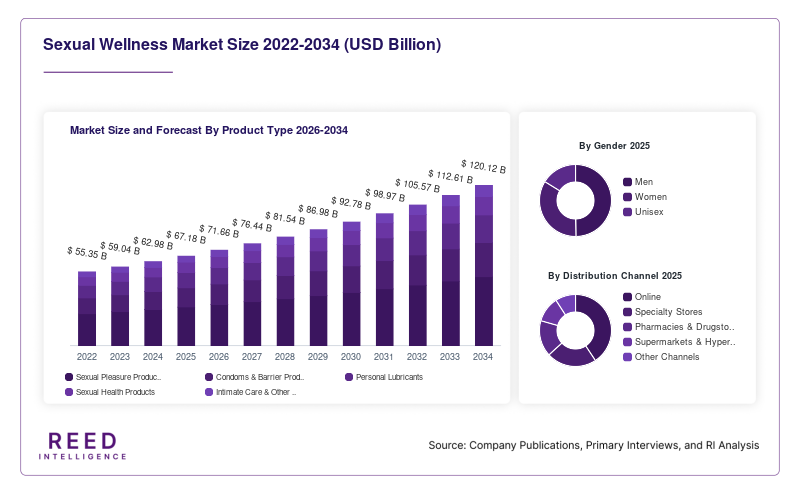
Sexual Pleasure Products represent approximately 42% of the global market in 2025. The category includes a broad range of adult-use products and benefits strongly from specialist retail, online commerce, product innovation and premiumization. Lovehoney Group describes itself as a sexual-wellbeing company and continues to invest in responsible sourcing, packaging and product sustainability.
Condoms & Barrier Products account for approximately 24%, supported by both sexual-health and contraception demand. WHO identifies condoms as a key STI and pregnancy-prevention technology.
Personal Lubricants represent approximately 14%, while Sexual Health Products account for 11% and Intimate Care & Other Products 9%.
Personal Lubricants are the fastest-growing product segment, with approximately 8.1% CAGR, supported by their dual role in comfort and sexual-health applications. WHO specifically identifies lubricants as products supporting sexual functioning and wellbeing.
By Gender
Women account for approximately 44% of the market in 2025. Demand is supported by intimate care, lubricants, sexual pleasure products, fertility-related products and broader women's sexual-health needs.
Men represent approximately 34%, with condoms, lubricants, sexual-health products and pleasure products forming major demand categories.
Unisex products account for approximately 22%.
Women are also the fastest-growing gender segment, with approximately 7.4% CAGR, reflecting greater commercialization of female-focused sexual wellness, intimate comfort and sexual-health products.
Reckitt's Durex research illustrates this product-development direction: the company reported that women accounted for more than one-third of buyers of its Durex Fetherlite HA condom in China, above the rate for its broader condom portfolio.
By Distribution Channel
Online represents approximately 39% of the market in 2025 and is the fastest-growing distribution channel, with approximately 10.2% CAGR.
Digital purchasing is particularly important because consumers can access broader product ranges with greater privacy. Specialist sexual-wellness companies can also use direct-to-consumer channels to provide product education, reviews, subscriptions and personalized recommendations.
Specialty Stores account for approximately 27%, supported by specialist product knowledge and broad adult-product assortments.
Pharmacies & Drugstores represent approximately 19%, particularly for condoms, lubricants and sexual-health products.
Supermarkets & Hypermarkets account for approximately 11%, while other channels represent approximately 4%.
By End User
Adults represent approximately 48% of the market in 2025 and remain the broadest end-user group.
Couples account for approximately 29%, reflecting joint purchases of condoms, lubricants and sexual pleasure products.
LGBTQ+ Consumers represent approximately 16%, while other users account for approximately 7%.
Couples are the fastest-growing end-user segment, with approximately 7.5% CAGR, supported by product positioning around intimacy, communication, comfort and shared sexual experiences.
Regional Analysis
North America Sexual Wellness Market
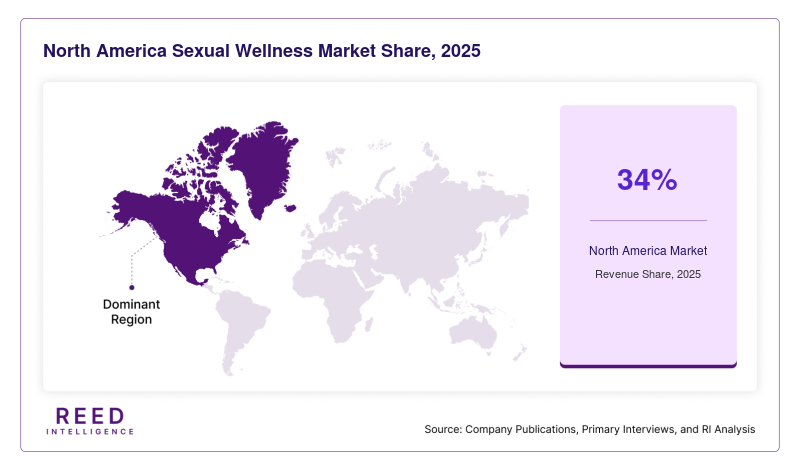
North America represents approximately 34% of the global Sexual Wellness Market in 2025, supported by established consumer-health brands, high e-commerce penetration, specialist retail infrastructure and broad product availability.
The U.S. market also has a relatively mature regulatory environment. FDA classifications identify condoms, synthetic condoms, personal lubricants and related products within the medical-device framework.
Major companies have continued to invest in product innovation. Church & Dwight reported that Trojan condoms contributed to consumer domestic growth in 2025, while its 2026 results highlighted the continued rollout of Trojan G.O.A.T. non-latex condoms.
The region is projected to grow at approximately 5.9% CAGR through 2034. Online purchasing, premium condoms, specialized lubricants and sexual-health products remain important growth mechanisms.
The principal constraint is market maturity. Consumers have extensive brand and product choices, making incremental growth increasingly dependent on innovation, distribution gains and premiumization.
Europe Sexual Wellness Market
Europe accounts for approximately 29% of the global market in 2025. The region benefits from strong condom penetration, established pharmacy and supermarket distribution, specialist retailers and major global brands.
Durex has particularly strong European presence and remains Reckitt's flagship sexual-wellness brand. Reckitt identifies Durex as the world's leading condom brand based on its cited global sales data.
Product innovation is moving toward premium materials. Durex Intensity's European launch demonstrates how manufacturers are using non-latex materials to address sensory preferences and expand premium condom consumption.
Europe is projected to expand at approximately 6.1% CAGR. The region's mature consumer base supports premium lubricants, specialized condoms and intimate-care products, while regulatory requirements and sustainability expectations increasingly influence packaging and product development.
APAC Sexual Wellness Market
APAC represents approximately 23% of the global market in 2025 and is the fastest-growing region, with approximately 9.0% CAGR.
The region combines a large population base, increasing digital commerce, rising consumer awareness and substantial room for category penetration. Reckitt's 2024 reporting specifically highlighted China as an important Durex growth market and identified India and other emerging markets as areas with additional penetration potential.
China has also become a significant innovation market. Durex launched Fetherlite HA in China with a hyaluronic-acid-containing lubricant and reported strong consumer uptake.
India and Southeast Asia offer further distribution opportunities as consumers gain access to online specialist retailers, pharmacies and modern retail.
APAC's growth mechanism is therefore a combination of category penetration, premiumization and digital access rather than population growth alone.
The main constraints include cultural stigma, differing regulations, uneven access to sexual-health products and significant price differences between countries.
Middle East and Africa Sexual Wellness Market
Middle East and Africa represents approximately 6% of the global market in 2025 and is projected to grow at approximately 7.8% CAGR.
The region has substantial unmet sexual and reproductive-health needs, but commercial development varies considerably by country because regulations, cultural norms and product accessibility differ.
Condoms and lubricants represent the clearest health-linked opportunity. WHO identifies affordability, access outside health facilities and social norms as barriers to condom use, while UNFPA continues to procure and distribute condoms and lubricants through reproductive-health programs.
Commercial expansion is therefore likely to depend on discreet retail and e-commerce channels, pharmacy availability, public-health procurement and culturally appropriate sexual-health education.
The principal constraints remain regulatory restrictions, affordability, stigma and uneven distribution infrastructure.
LATAM Sexual Wellness Market
LATAM represents approximately 8% of the global market in 2025 and is projected to grow at approximately 7.4% CAGR.
Brazil and Mexico provide important consumer markets because of their population size, modern retail infrastructure and established consumer-health categories. Reckitt identifies Latin America as one of the regions with additional Durex penetration potential.
Online retail is becoming particularly relevant because it allows consumers to access specialized products with greater privacy. Condoms, lubricants and intimate-care products can also benefit from pharmacy and supermarket distribution.
The main commercial constraints are currency volatility, affordability differences and uneven regulatory treatment of sexual-wellness products across individual markets.
Competitive Landscape
The Sexual Wellness Market contains several competitive groups: global consumer-health companies, condom manufacturers, specialist sexual-wellness companies, medical-device manufacturers, pharmacy brands and digital-first retailers.
Reckitt competes through Durex and K-Y. Durex is positioned as the world's leading condom brand, while the company continues to invest in polymer science, premium materials and lubricant research. Its 2025 annual report highlights Durex Intensity as a material-innovation platform rather than simply a new product launch.
Church & Dwight competes through Trojan and related sexual-health products. Its 2025–2026 results show an emphasis on non-latex material innovation, with Trojan G.O.A.T. launched to improve flexibility, softness and sensory performance.
Lovehoney Group represents the specialist sexual-wellbeing segment and operates across online sexual-wellness retail and product categories. Its sustainability program covers responsible sourcing, carbon reduction and packaging improvements.
Key Market Players
- Reckitt
- Church & Dwight Co., Inc.
- Lovehoney Group
- LifeStyles Healthcare
- Okamoto Industries
- Karex Berhad
- Ansell
- Humanwell Healthcare
- LELO
- WOW Tech Group
- TENGA Co., Ltd.
- Bijoux Indiscrets
- Doc Johnson
- Pjur Group
- BioFilm
Recent Market Developments
- September 2026 – FDA product-classification database continued to list condoms and personal lubricants under the U.S. medical-device framework. The September 21, 2026 database includes external condoms, synthetic condoms, internal condoms and personal lubricants under relevant classifications. This reinforces the regulatory requirements affecting manufacturers making health-related product claims.
- 2026 – Church & Dwight continued the rollout of Trojan G.O.A.T. condoms. The product uses a proprietary ultra-flex non-latex material and was reported as the highest-rated Trojan branded condom on Amazon following its Q4 2025 launch.
Sexual Wellness Market Segments
By Product Type
- Sexual Pleasure Products
- Condoms & Barrier Products
- Personal Lubricants
- Sexual Health Products
- Intimate Care & Other Products
By Gender
- Men
- Women
- Unisex
By Distribution Channel
- Online
- Specialty Stores
- Pharmacies & Drugstores
- Supermarkets & Hypermarkets
- Other Channels
By End User
- Adults
- Couples
- LGBTQ+ Consumers
- Other Users
By Region
- North America
- Europe
- APAC
- Middle East and Africa
- LATAM