Sexual Wellness Products Market Size, Share & Trends Analysis Report By Product Type (Condoms, Personal Lubricants, Sexual Wellness Devices, Sexual Enhancement Products, Intimate Care Products), By Gender (Men, Women, Unisex), By Distribution Channel (Offline, Online), By Price Range (Mass, Premium) and By Region (North America, Europe, APAC, Middle East and Africa, LATAM) Forecasts, 2026-2034
USD 3950
Sexual Wellness Products Market Size
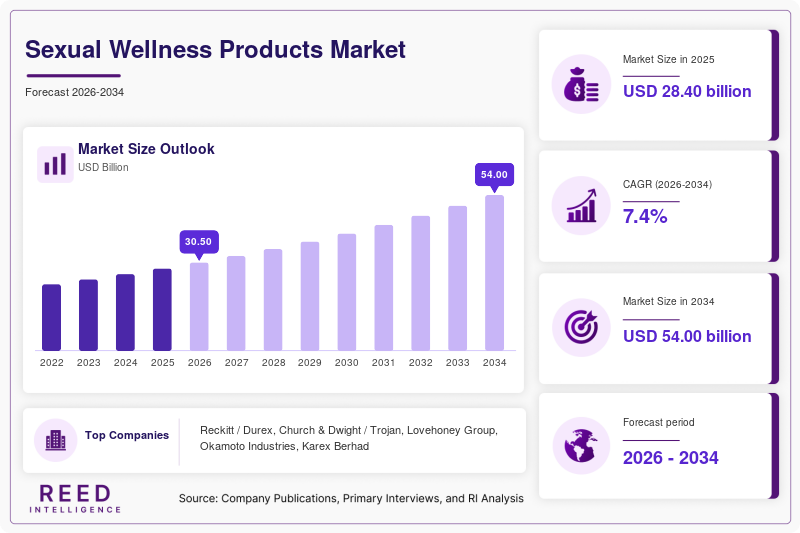
The global Sexual Wellness Products Market was valued at USD 28.40 billion in 2025 and is estimated to reach USD 30.50 billion in 2026. Based on the supplied forecast, the market is projected to reach USD 54.00 billion by 2034, representing a 7.40% CAGR during 2026–2034.
The market covers products designed around sexual health, protection, intimacy, comfort and sexual wellbeing. WHO defines sexual health broadly as physical, emotional, mental and social wellbeing related to sexuality, including the possibility of safe and pleasurable sexual experiences.
Demand is supported by both health-related needs and consumer-oriented intimate wellness. Condoms remain an important part of sexual and reproductive health because they can reduce the risk of most STIs and unintended pregnancy when used correctly and consistently. WHO reported that 374 million new infections with four curable STIs occurred globally among adults aged 15–49 in 2020, underscoring the continuing relevance of prevention products
The sexual wellness market is increasingly moving from a narrow focus on contraception toward a broader category covering protection, lubrication, intimate care, sexual wellness devices and products positioned around comfort and personal wellbeing.
This shift is visible in the strategies of major companies. Reckitt describes Durex as its global sexual-wellbeing brand and has expanded product innovation around condom materials, sensation and intimate wellness. In its 2025 annual report, Reckitt highlighted Durex Intensity, a nitrile condom developed to address consumer demand for greater sensation while maintaining protection.
The market also has a strong public-health component. UNFPA reported distributing more than 1.09 billion male condoms, 4.7 million female condoms and 140.2 million units of personal lubricant in 2025, demonstrating the continuing scale of protection and lubricant demand through public-health procurement channels.
Sexual Wellness Products Market Drivers
Sexual Health Awareness Supports Protection-Product Demand
Sexual-health education and STI prevention remain important demand mechanisms for condoms and related products. WHO states that condoms are among the most effective methods for preventing most STIs, including HIV, while also helping prevent unintended pregnancy.
This creates a structural demand base that is less dependent on discretionary consumer spending than purely lifestyle-oriented products. However, access, affordability, social norms and availability remain barriers in several markets.
Product Innovation Is Moving Toward Comfort and User Experience
Manufacturers are increasingly differentiating products through material technology, fit, lubrication, sensation and comfort rather than competing only on basic protection. Reckitt's 2025 annual report highlighted Durex Intensity, a nitrile-based condom designed to improve sensation and body-heat transfer.
Church & Dwight similarly launched TROJAN G.O.A.T. condoms using a flexible non-latex material. The company reported that the product had become its highest-rated TROJAN-branded condom on Amazon following its late-2025 launch.
The commercial mechanism is premium differentiation: new materials and product characteristics allow brands to create higher-value propositions instead of competing only on unit price.
Lubricants Are Expanding Beyond a Supporting Product
Personal lubricants are increasingly positioned as standalone sexual-wellness products rather than simply accessories to condoms. WHO specifically identifies lubricants as useful for reducing condom breakage and improving comfort, while also recommending water- or silicone-based lubricants in relevant condom-use situations.
UNFPA's 2025 procurement figures also demonstrate the scale of lubricant distribution alongside condoms and other contraceptive products.
Sexual Wellness Is Becoming More Inclusive
The market is gradually moving toward products and communications designed for different genders, orientations, relationship types and sexual-health needs. Reckitt's Durex business has expanded sexual-health education and inclusion initiatives, while Church & Dwight's Trojan brand reported support for LGBTQ+ health organizations and condom-access programs in 2025.
This broadens the addressable consumer base and reduces reliance on traditional male-focused condom positioning.
Sexual Wellness Products Market Restraints
Regulatory Requirements Increase Product-Development Complexity
Some sexual wellness products fall under medical-device regulation depending on their intended use and claims. In the United States, FDA classifies external condoms as Class II medical devices, with premarket review requirements, while personal lubricants can also fall under medical-device regulation depending on their intended use.
This creates additional requirements for manufacturers involving product testing, labeling, quality systems and regulatory submissions. Products making health-related claims can face greater compliance requirements than products positioned solely around general wellness.
Social Stigma Limits Category Visibility in Some Markets
WHO identifies social and gender norms, affordability and limited access as barriers to condom use.
In markets where sexual-health discussions remain culturally sensitive, consumers may be less willing to seek information or purchase products through visible retail channels. This can limit category penetration even when underlying need exists.
Unequal Access Remains a Market Constraint
Condom and lubricant access is affected by affordability, distribution infrastructure and public-health funding. WHO notes that limited accessibility outside health facilities and insufficient demand-generation programs remain barriers to effective condom programming.
This means market growth is not determined only by consumer willingness to purchase. Product availability and education can materially influence adoption.
Sexual Wellness Products Market Opportunities
Premium and Non-Latex Products Create Value Expansion
Material innovation provides an opportunity for companies to move beyond conventional latex products. Durex's nitrile-based Intensity condom and Trojan's non-latex G.O.A.T. product illustrate how manufacturers are using material properties to address comfort and sensation.
Premium products can increase average selling prices while also addressing consumers who experience preferences or sensitivities associated with traditional products.
Online Distribution Can Improve Category Accessibility
Online channels allow consumers to purchase intimate products with greater privacy and access to broader product selections. This is particularly important in markets where physical retail environments can create embarrassment or stigma.
Digital channels also allow brands to combine product sales with educational content, customer reviews and discreet fulfillment, creating a more integrated consumer journey.
Sexual-Health Education Can Expand Product Adoption
Education remains an important market-development mechanism because awareness influences correct product selection and usage. Reckitt reported that its Durex social-impact programs reached millions of individuals through sexual-health education initiatives in 2025.
This suggests that education is commercially relevant as well as socially important: greater knowledge can reduce stigma and increase informed adoption of protection and wellness products.
Segmental Analysis
By Product Type
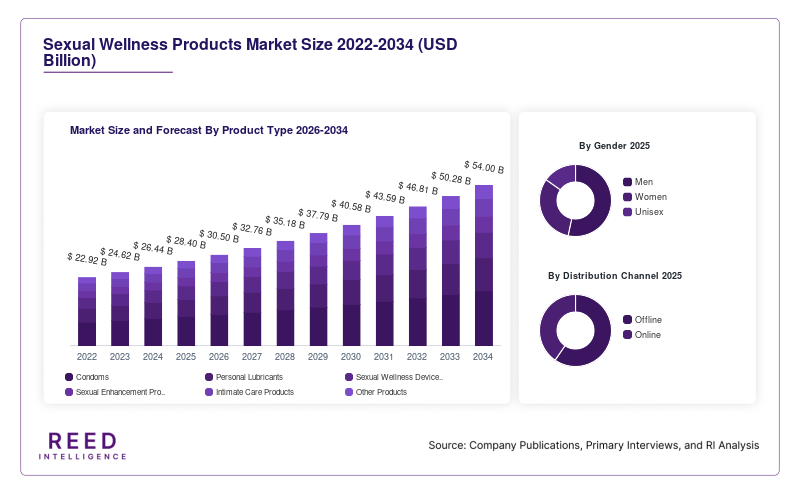
Condoms represent approximately 31% of the 2025 market, equivalent to about USD 8.80 billion under the internal analytical allocation. They are modeled at approximately 6.40% CAGR through 2034, producing an indicative 2034 value of about USD 15.36 billion. Condoms retain a structural role because they address both contraception and STI prevention, while manufacturers are differentiating products through thinner materials, non-latex formulations, lubrication and sensory characteristics. WHO identifies condoms as the only contraceptive method that can simultaneously help prevent pregnancy and STI transmission.
Personal Lubricants account for approximately 16%, or USD 4.54 billion, of the 2025 market under the internal allocation. They are modeled at approximately 7.50% CAGR through 2034, reaching an indicative USD 8.75 billion. The segment benefits from increasing awareness of sexual comfort and from its use alongside condoms and other sexual-wellness products. UNFPA's 2025 procurement data also shows the substantial role of personal lubricants within sexual and reproductive-health programs.
Sexual Wellness Devices represent approximately 25%, equivalent to USD 7.10 billion, of the 2025 market under the internal analytical allocation. They are modeled at approximately 8.50% CAGR through 2034, producing an indicative value of about USD 14.72 billion. The category benefits from greater normalization of sexual wellness, discreet e-commerce access, product innovation and broader consumer acceptance. Reckitt's 2024 Global Sex Survey reported that the number of people purchasing sex toys had increased 46% since 2017.
By Gender
Men represent approximately 40% of the 2025 market, equivalent to about USD 11.36 billion under the internal analytical allocation. The segment is modeled at approximately 6.80% CAGR through 2034, reaching an indicative USD 20.78 billion. Demand includes condoms, lubricants, sexual wellness devices, intimate care and other products positioned around male sexual health and wellbeing.
Women account for approximately 35%, or USD 9.94 billion, of the 2025 market under the internal allocation. They are modeled at approximately 7.70% CAGR through 2034, producing an indicative USD 18.83 billion. Growth is supported by greater attention to female sexual health, comfort, lubrication and sexual wellness, as well as products designed specifically around women's needs.
Unisex products represent approximately 25%, equivalent to USD 7.10 billion, of the 2025 market and are modeled at approximately 7.80% CAGR through 2034. The segment benefits from products positioned around shared intimacy, protection and wellness rather than gender-specific use.
By Distribution Channel
Offline channels represent approximately 58% of the 2025 market, equivalent to USD 16.47 billion under the internal analytical allocation. The segment is modeled at approximately 5.90% CAGR through 2034, reaching an indicative USD 27.79 billion. Offline distribution includes pharmacies, supermarkets, specialty stores, healthcare channels and other physical retail outlets. These channels remain important for protection products because consumers can access established brands and healthcare-related products through familiar retail networks.
Online channels account for approximately 42%, or USD 11.93 billion, of the 2025 market. The segment is modeled at approximately 9.20% CAGR through 2034, producing an indicative USD 26.48 billion. Online purchasing benefits from privacy, discreet delivery, broader product selection and direct access to specialized brands. Digital channels are particularly relevant for products where consumers may prefer not to make an in-person purchase.
By Price Range
Mass products represent approximately 64% of the 2025 market, equivalent to about USD 18.18 billion under the internal analytical allocation. The segment is modeled at approximately 6.80% CAGR through 2034, reaching an indicative USD 33.10 billion. Mass-market products benefit from wider distribution, accessible pricing and established consumer awareness, particularly in condoms and lubricants.
Premium products account for approximately 36%, or USD 10.22 billion, of the 2025 market. The segment is modeled at approximately 8.50% CAGR through 2034, producing an indicative USD 20.90 billion. Premiumization is supported by new materials, specialized designs, advanced product features, brand positioning and discreet digital purchasing. Recent product launches by Durex and Trojan demonstrate how material and experience-based innovation is being used to create premium propositions.
Regional Analysis
North America Sexual Wellness Products Market
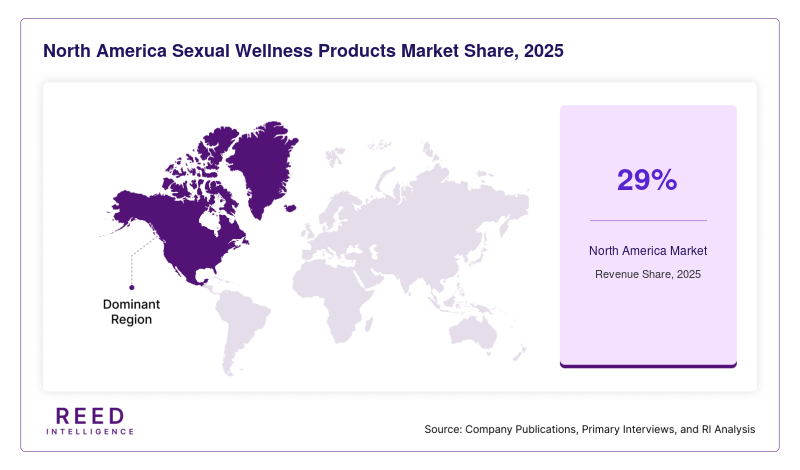
North America represents approximately 29% of the 2025 market, equivalent to about USD 8.24 billion under the internal allocation. It is modeled at approximately 6.80% CAGR through 2034, producing an indicative value of about USD 15.00 billion.
The region has an established consumer market for condoms, lubricants and sexual wellness devices, supported by strong brand recognition and developed retail infrastructure. The U.S. also has specific regulatory requirements for certain sexual wellness products. FDA classifies external condoms as Class II medical devices, while personal lubricants can also fall under medical-device regulation depending on intended use.
Europe Sexual Wellness Products Market
Europe accounts for approximately 27%, or USD 7.67 billion, of the 2025 market under the internal analytical allocation. It is modeled at approximately 6.90% CAGR through 2034, reaching about USD 14.04 billion.
The region has strong consumer acceptance of sexual wellness products and established brands such as Durex. Product innovation is increasingly focused on materials, comfort and premium experiences. Reckitt's Durex Intensity launch illustrates the use of material innovation to address consumer preferences around sensation and protection.
APAC Sexual Wellness Products Market
APAC represents approximately 28% of the 2025 market, equivalent to USD 7.95 billion, under the internal allocation. It is modeled at approximately 8.10% CAGR through 2034, producing an indicative value of about USD 15.97 billion.
The region provides substantial expansion potential because of its large population, increasing urbanization, expanding e-commerce infrastructure and gradual changes in attitudes toward sexual health. India is particularly relevant: Reckitt previously reported strong Durex growth in India as distribution expanded and social-media-led communication addressed previously underserved segments.
Middle East and Africa Sexual Wellness Products Market
Middle East and Africa represents approximately 7%, equivalent to USD 1.99 billion, of the 2025 market under the internal allocation. It is modeled at approximately 7.00% CAGR through 2034, reaching an indicative USD 3.66 billion.
The region has a substantial unmet sexual and reproductive-health need, but access can vary significantly by country because of cultural attitudes, healthcare infrastructure, affordability and availability. WHO identifies social norms and accessibility as important barriers to condom use.
Latin America Sexual Wellness Products Market
Latin America accounts for approximately 9%, or USD 2.56 billion, of the 2025 market under the internal analytical allocation. It is modeled at approximately 7.40% CAGR through 2034, producing an indicative value of approximately USD 4.89 billion.
The market benefits from established condom use, growing consumer awareness and increasing access through pharmacies, supermarkets and online platforms. Public-health programs also provide an important channel for protection products.
Competitive Landscape
The competitive landscape combines global consumer-health companies, sexual-wellness specialists, condom manufacturers and digitally native brands.
Reckitt operates Durex, which it describes as the world's leading condom brand, while continuing to invest in material innovation, sexual-health education and intimate-wellness products. Reckitt
Church & Dwight operates Trojan across condoms, lubricants and vibrators and continues to invest in new condom materials and sexual-wellness products. Church & Dwight
Lovehoney Group represents the specialist sexual-wellbeing model, with a portfolio centered on sexual wellness and direct consumer engagement. Its 2025 sustainability reporting describes the company as a sexual-wellbeing company and highlights responsible sourcing, packaging and social-impact initiatives.
Key Market Players
- Reckitt / Durex
- Church & Dwight / Trojan
- Lovehoney Group
- Okamoto Industries
- Karex Berhad
- LELO
- Bayer
- Church & Dwight Co., Inc.
- HLL Lifecare Limited
- Cupid Limited
- Tantus
- Reckitt Benckiser Group
Recent Market Developments
April 2026 – Church & Dwight Highlighted TROJAN G.O.A.T. Performance
In April 2026, Church & Dwight reported that TROJAN G.O.A.T. condoms, launched in the fourth quarter of 2025, were outperforming the company's previous successful TROJAN RAW launch and had become the highest-rated TROJAN-branded condom on Amazon, with a 4.7-star rating. The product uses a flexible non-latex material designed to provide a softer and more natural-feeling experience.
February 2025 – WHO Updated Global Condom Evidence
In February 2025, WHO published updated guidance and evidence on condoms, reporting that 374 million new infections occurred globally in 2020 among adults aged 15–49 with one of four curable STIs. WHO also highlighted the continuing role of condoms in preventing STIs and unintended pregnancy.
Sexual Wellness Products Market Segments
By Product Type
- Condoms
- Personal Lubricants
- Sexual Wellness Devices
- Sexual Enhancement Products
- Intimate Care Products
- Other Products
By Gender
- Men
- Women
- Unisex
By Distribution Channel
- Offline
- Online
By Price Range
- Mass
- Premium
By Region
- North America
- Europe
- APAC
- Middle East and Africa
- LATAM