Shed Design Software Market Size, Share & Demand Report By Deployment Type (Cloud-Based Software, On-Premise Software), By Application (Residential Shed Design, Commercial Shed Design), By End-User (Individual Users, Professional Users), By Feature Type (Basic Design Tools, Advanced Design Tools Including 3D, AR & AI), By Region & Segment Forecasts, 2025–2034
USD 3950
Market Overview
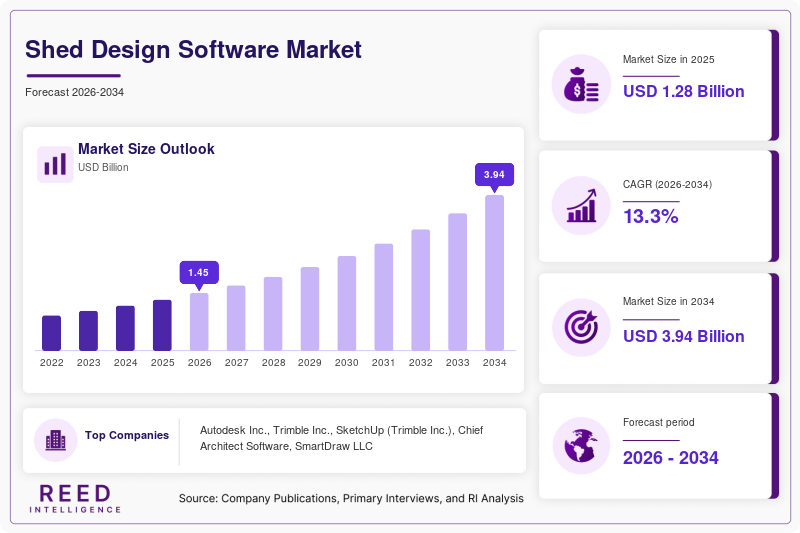
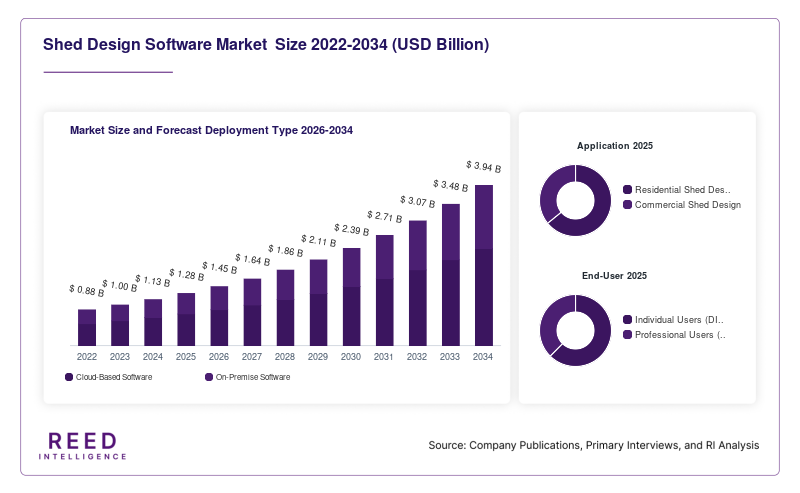
The global Shed Design Software Market was valued at approximately USD 1.28 billion in 2025 and is projected to reach USD 3.94 billion by 2034, expanding at a compound annual growth rate (CAGR) of 13.3% during the forecast period (2025–2034). The market has experienced consistent expansion due to increasing digitalization across construction and home improvement industries. Software tools that enable visualization, customization, and cost estimation of sheds have become integral for both professionals and DIY consumers.
A key global factor supporting the growth of the Shed Design Software Market is the rising adoption of cloud-based design tools. These platforms provide accessibility, scalability, and real-time collaboration, enabling users to design structures efficiently without requiring high-end hardware. This has significantly broadened the user base, particularly among small contractors and individual homeowners.
Key Highlights:
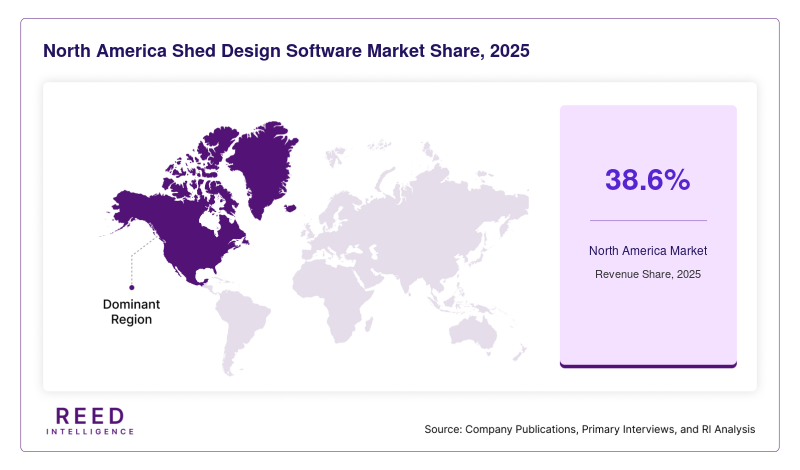
- North America dominated the market with 38.6% share, while Asia Pacific is projected to be the fastest-growing region with a CAGR of 15.2%.
- Cloud-based software emerged as the leading segment, accounting for 61.4% share, while AI-integrated tools are expected to grow at a CAGR of 16.8%.
- Residential end-use led with 57.9% share, whereas commercial applications are forecasted to grow at a CAGR of 14.6%.
- The U.S. remained the dominant country, with market values of USD 412 million in 2024 and USD 465 million in 2025.
Market Trends
Integration of AI and Automation in Design Tools
Artificial intelligence is increasingly transforming the Shed Design Software Market. Advanced platforms now offer automated layout suggestions, material optimization, and cost estimation based on user inputs. AI-powered features reduce design time and improve accuracy, making the software more appealing to both professionals and DIY users. This trend is also enabling predictive modeling, allowing users to visualize structural durability and environmental impact before construction.
Growing Adoption of Cloud-Based Collaborative Platforms
Cloud-based solutions are gaining traction due to their flexibility and accessibility. These platforms allow multiple users to collaborate in real time, improving workflow efficiency for architects, contractors, and clients. The ability to access designs from any device without installation requirements has driven adoption across small and medium enterprises. Additionally, cloud integration supports automatic updates, secure data storage, and seamless integration with other construction management tools, further enhancing productivity.
Market Drivers
Rising Demand for DIY Home Improvement Solutions
The increasing popularity of do-it-yourself (DIY) home projects has significantly boosted the Shed Design Software Market. Consumers are increasingly seeking user-friendly tools to design sheds tailored to their specific needs. Software platforms that offer drag-and-drop interfaces, customizable templates, and real-time cost calculations are particularly appealing. This trend has expanded the market beyond professionals to include homeowners and hobbyists.
Expansion of Modular and Prefabricated Construction
The growing adoption of modular construction techniques has driven demand for design software capable of precise planning and visualization. Shed design tools play a crucial role in optimizing layouts, reducing material waste, and ensuring structural accuracy. As construction companies increasingly adopt prefabrication methods, the need for efficient digital design solutions continues to rise, supporting market growth.
Market Restraint
High Initial Cost and Learning Curve for Advanced Software
Despite its growth, the Shed Design Software Market faces challenges related to the high cost of advanced software solutions and the associated learning curve. Professional-grade software often requires substantial investment, which can deter small businesses and individual users. Additionally, complex interfaces and technical requirements may limit adoption among non-technical users.
While entry-level tools are available, they often lack advanced features such as 3D rendering, structural analysis, and integration capabilities. This creates a gap between affordability and functionality, restricting widespread adoption. Furthermore, training requirements and the need for skilled professionals to operate sophisticated software add to operational costs, particularly for small enterprises.
Market Opportunities
Integration with Augmented and Virtual Reality
The integration of augmented reality (AR) and virtual reality (VR) presents significant opportunities for the Shed Design Software Market. These technologies enable users to visualize shed designs in real-world environments, enhancing decision-making and customer satisfaction. As AR/VR technology becomes more accessible, software providers can differentiate their offerings through immersive design experiences.
Expansion in Emerging Markets
Emerging economies offer substantial growth potential due to increasing urbanization and rising disposable incomes. The demand for affordable housing and outdoor structures is growing, creating opportunities for shed design software providers. Localized solutions tailored to regional construction practices and materials can further accelerate adoption in these markets.
Segmental Analysis
By Deployment Type
Cloud-based solutions dominated the Shed Design Software Market, accounting for 61.4% share in 2024. These platforms gained popularity due to their accessibility, scalability, and lower upfront costs. Users benefited from real-time collaboration, automatic updates, and integration with other tools, making cloud-based software the preferred choice.
AI-integrated cloud solutions are expected to be the fastest-growing subsegment, with a projected CAGR of 16.8%. The integration of artificial intelligence enhances design accuracy and efficiency, enabling automated recommendations and predictive analysis. This capability will drive adoption among professionals seeking advanced design functionalities.
By Application
The residential segment held the largest share of the Shed Design Software Market, accounting for 57.9% in 2024. The increasing popularity of DIY projects and home improvement activities has driven demand for user-friendly design tools. Homeowners increasingly rely on software to visualize and customize shed designs.
The commercial segment is expected to grow at the fastest rate, with a CAGR of 14.6%. The expansion of commercial construction projects and the need for efficient design solutions will drive adoption. Software tools that offer advanced features such as cost estimation and project management will be particularly востребованы.
By End-User
Individual users dominated the market, accounting for 52.3% share in 2024. The availability of easy-to-use software with intuitive interfaces has attracted homeowners and hobbyists. These users benefit from customizable templates and visualization tools.
Professional users, including architects and contractors, are expected to grow at a CAGR of 14.1%. The need for precision and efficiency in construction projects will drive adoption of advanced software solutions. Features such as 3D modeling and integration with building information modeling (BIM) systems will support growth.
By Feature Type
Basic design tools accounted for the largest share, with 48.7% in 2024, due to their affordability and ease of use. These tools cater to a broad audience, including beginners and DIY users.
Advanced features such as 3D rendering and AR visualization are expected to grow at a CAGR of 15.5%. These capabilities enhance user experience by providing realistic visualizations and interactive design options, driving adoption among professional users.
Regional Analysis
North America
North America accounted for 38.6% of the Shed Design Software Market share in 2025 and is expected to grow at a CAGR of 12.4% during the forecast period. The region’s mature construction industry and high adoption of digital tools have contributed to its dominant position. The presence of established software providers and strong demand for home improvement solutions have further supported growth.
The United States led the regional market due to widespread adoption of advanced design technologies. The increasing popularity of backyard renovations and outdoor living spaces has driven demand for shed design software. Additionally, the integration of digital tools in construction workflows has enhanced efficiency and accuracy, supporting market expansion.
Europe
Europe held a significant share of the Shed Design Software Market in 2025 and is projected to grow steadily at a CAGR of 11.8% through 2034. The region’s focus on sustainable construction practices and energy-efficient designs has encouraged the adoption of digital design tools.
Germany emerged as the dominant country in the region, driven by its strong engineering sector and emphasis on precision in construction. The adoption of design software in small and medium enterprises has increased, supported by government initiatives promoting digitalization in the construction industry.
Asia Pacific
Asia Pacific represented a considerable share of the Shed Design Software Market in 2025 and is expected to register the fastest growth, with a CAGR of 15.2% during the forecast period. Rapid urbanization and infrastructure development have driven demand for efficient design solutions.
China dominated the regional market due to its large construction sector and increasing adoption of digital technologies. The growing middle-class population and rising interest in home improvement projects have further boosted demand for shed design software. Additionally, government initiatives supporting smart construction practices have accelerated market growth.
Middle East & Africa
The Middle East & Africa region accounted for a moderate share of the Shed Design Software Market in 2025 and is anticipated to grow at a CAGR of 10.6% through 2034. The region’s expanding construction industry and increasing adoption of digital tools have contributed to market growth.
The United Arab Emirates led the regional market, driven by large-scale construction projects and a focus on modern infrastructure. The adoption of advanced design software has improved project planning and execution, supporting market expansion.
Latin America
Latin America held a smaller share of the Shed Design Software Market in 2025 and is expected to grow at a CAGR of 11.2% during the forecast period. The region’s growing construction sector and increasing adoption of digital solutions have driven demand.
Brazil emerged as the dominant country, supported by rising investments in residential construction and home improvement projects. The availability of cost-effective software solutions has further encouraged adoption, particularly among small contractors and individual users.
Competitive Landscape
The Shed Design Software Market is characterized by the presence of both established software providers and emerging startups. Companies focus on innovation, user experience, and integration capabilities to gain a competitive edge.
SketchUp emerged as a leading player due to its user-friendly interface and extensive feature set. The company recently introduced enhanced cloud collaboration features, enabling seamless teamwork across devices. Other players are investing in AI and AR technologies to differentiate their offerings.
Competition is intensifying as new entrants introduce cost-effective solutions targeting small businesses and individual users. Strategic partnerships, product launches, and technological advancements are key strategies adopted by market participants to strengthen their positions.
Key Players List
- SketchUp
- Autodesk Inc.
- Trimble Inc.
- Chief Architect Software
- SmartDraw LLC
- Cedreo
- RoomSketcher AS
- Floorplanner
- Planner 5D
- Home Designer Software
- TurboCAD
- SolidWorks
- Rhino3D
- Vectorworks Inc.
- Procore Technologies
Recent Developments
- 2025: SketchUp launched an upgraded cloud collaboration module for real-time editing.
- 2025: Autodesk introduced AI-driven design recommendations in its software suite.
- 2024: Cedreo expanded its platform with AR visualization features.
- 2024: Planner 5D integrated cost estimation tools for enhanced project planning.
- 2023: Chief Architect Software released a new version with improved 3D rendering capabilities.
Shed Design Software Market Segments
Deployment Type
- Cloud-Based Software
- On-Premise Software
Application
- Residential Shed Design
- Commercial Shed Design
End-User
- Individual Users (DIY/Homeowners)
- Professional Users (Architects, Contractors)
Feature Type
- Basic Design Tools
- Advanced Design Tools (3D Modeling, AR, AI Integration)
By Region
- North America
- Europe
- APAC
- Middle East and Africa
- LATAM