Shipboard Incineration Market Size, Share & Demand Report By Type (Marine Diesel Oil-Fired Incinerators, Electrically Heated Incinerators, Hybrid Incinerators), By Application (Commercial Shipping, Offshore, Naval), By End-Use (Cargo Vessels, Tankers, Cruise Ships, Offshore Support Vessels), By Region & Segment Forecasts, 2025–2034
USD 3950
Market Overview
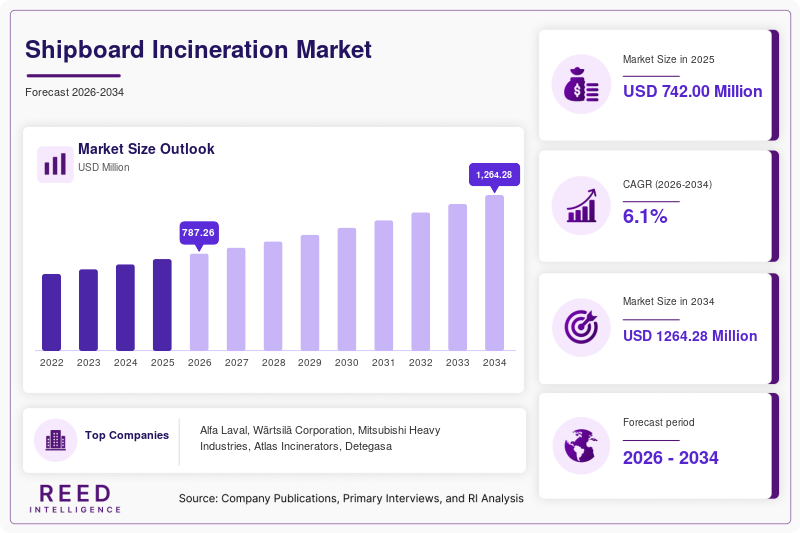
The Shipboard Incineration Market size is estimated at USD 742 million, and it is projected to reach approximately USD 785 million in 2026. Over the forecast period from 2025 to 2034, the market is expected to grow at a compound annual growth rate (CAGR) of 6.1%, reaching a projected value of USD 1.32 billion by 2034. This growth reflects the increasing demand for efficient onboard waste disposal solutions across commercial shipping, naval fleets, and offshore platforms.
The market is driven by the enforcement of strict environmental regulations, particularly those related to marine pollution prevention. Shipboard incinerators are designed to handle various types of waste, including sludge oil, plastics, food waste, and hazardous materials, thereby reducing the environmental footprint of vessels. Regulatory bodies continue to impose guidelines on emissions and waste handling, encouraging ship operators to adopt advanced incineration technologies.
Key Highlights
- Market size is estimated at USD 742 million in 2025 and is expected to reach USD 785 million in 2026. This steady increase reflects consistent demand for onboard waste management solutions across commercial and offshore fleets.
- The market is projected to reach USD 1.32 billion by 2034, expanding at a CAGR of 6.1% during the forecast period. This growth trajectory indicates stable long-term expansion supported by regulatory and operational requirements.
- Growth is primarily driven by strict regulatory compliance, increasing global fleet size, and rising sustainability initiatives. These factors are encouraging ship operators to invest in efficient onboard waste disposal technologies.
- There is a growing adoption of advanced and automated incineration systems with improved efficiency and monitoring capabilities. These systems enhance operational reliability while ensuring compliance with environmental standards.
Market Trends
Integration of Advanced Automation and Digital Monitoring Systems
One prominent trend shaping the Shipboard Incineration Market is the integration of advanced automation and digital monitoring systems. Modern shipboard incinerators are increasingly equipped with smart control panels, sensors, and real-time monitoring capabilities. These features enable operators to optimize combustion processes, reduce fuel consumption, and ensure compliance with emission standards. Automation reduces human intervention, enhances safety, and minimizes operational errors. The integration of Internet of Things (IoT) technologies is also gaining traction, allowing remote diagnostics and predictive maintenance. This trend is particularly relevant for large commercial vessels and cruise ships, where efficiency and reliability are critical to operations.
Shift Toward Environmentally Sustainable Incineration Technologies
Another key trend is the shift toward environmentally sustainable incineration technologies. Manufacturers are focusing on developing systems that produce lower emissions and improve energy efficiency. Innovations such as multi-stage combustion chambers and exhaust gas cleaning systems are being widely adopted. These technologies help reduce harmful pollutants such as dioxins and particulate matter. Additionally, there is a growing emphasis on waste-to-energy solutions, where heat generated during incineration is utilized for onboard applications. This trend aligns with the broader maritime industry's goal of reducing carbon emissions and improving energy utilization, making sustainable incineration systems increasingly attractive to ship operators.
Market Drivers
Stringent International Maritime Regulations
A major driver of the Shipboard Incineration Market is the implementation of stringent international maritime regulations. Regulatory frameworks governing marine pollution and waste disposal require vessels to manage waste effectively while minimizing environmental impact. Compliance with these regulations necessitates the installation of efficient onboard incineration systems. Ship operators are compelled to upgrade or replace outdated systems to meet evolving standards. This regulatory pressure ensures consistent demand for advanced incineration technologies across various vessel types, including cargo ships, tankers, and offshore support vessels.
Expansion of Global Maritime Trade and Shipping Activities
Another significant driver is the expansion of global maritime trade and shipping activities. The increase in international trade volumes has led to a rise in the number of active vessels and extended voyage durations. As ships operate longer at sea, the need for reliable onboard waste management systems becomes more critical. Shipboard incinerators provide a practical solution for handling waste without relying on port facilities. This capability enhances operational efficiency and reduces logistical challenges. The growing demand for efficient waste disposal systems in expanding fleets continues to support market growth.
Market Restraint
High Initial Cost and Maintenance Requirements
One of the primary restraints affecting the Shipboard Incineration Market is the high initial cost and maintenance requirements associated with advanced incineration systems. Modern incinerators with enhanced efficiency and emission control features involve significant capital investment, which can be a challenge for small and medium-sized shipping companies. In addition to the upfront cost, ongoing maintenance, spare parts, and operational expenses add to the financial burden. These factors may discourage some operators from adopting new systems, particularly in cost-sensitive segments of the maritime industry.
The impact of this restraint is evident in the slower adoption rate among older fleets and smaller operators. For example, vessels operating in regional or short-haul routes may rely on port-based waste disposal rather than investing in expensive onboard systems. This limits market penetration in certain segments. Furthermore, technical complexities and the need for skilled personnel to operate and maintain advanced incinerators can create additional barriers. As a result, despite the growing demand, cost-related challenges continue to influence purchasing decisions and market growth.
Market Opportunities
Increasing Adoption of Retrofitting Solutions for Existing Vessels
An emerging opportunity in the Shipboard Incineration Market lies in the increasing adoption of retrofitting solutions for existing vessels. A large portion of the global fleet consists of aging ships that require upgrades to meet current environmental standards. Retrofitting older vessels with modern incineration systems offers a cost-effective alternative to new installations. This trend is gaining momentum as shipowners seek to extend the operational life of their assets while ensuring compliance. Manufacturers are developing compact and modular systems specifically designed for retrofitting, creating new revenue streams within the market.
Growing Demand for Integrated Waste Management Systems
Another opportunity is the growing demand for integrated waste management systems in the maritime sector. Ship operators are increasingly looking for comprehensive solutions that combine incineration with other waste treatment technologies. Integrated systems can handle various waste streams more efficiently and reduce overall operational complexity. This approach is particularly beneficial for large vessels such as cruise ships and naval fleets, where waste generation is substantial. The development of hybrid systems that incorporate recycling, compaction, and incineration capabilities is expected to drive innovation and open new growth avenues in the market.
Segmental Analysis
By Type
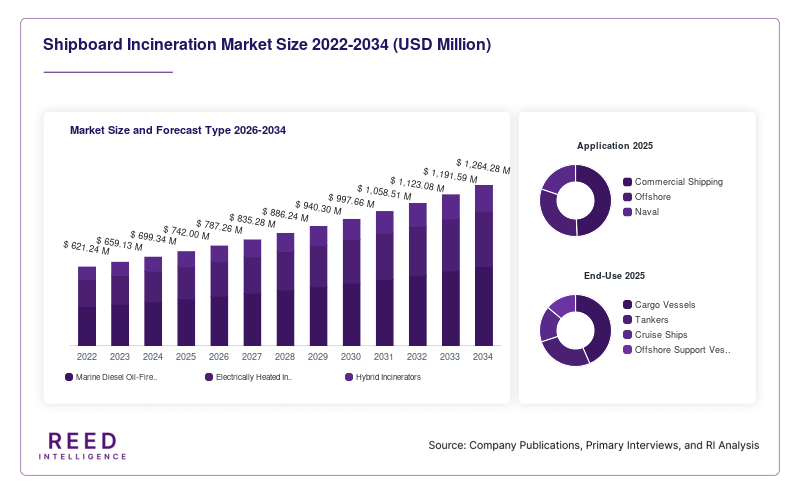
The marine diesel oil-fired incinerator segment dominated the market in 2024, accounting for approximately 46% of the total share. These systems are widely used due to their reliability and compatibility with existing onboard fuel systems. Ship operators prefer this type as it ensures consistent performance and efficient waste combustion. The widespread adoption across commercial vessels and tankers contributes to its leading position. Additionally, these incinerators are designed to handle a variety of waste types, making them a versatile solution for onboard waste management.
The electrically heated incinerator segment is expected to be the fastest-growing, with a CAGR of 7.2% during the forecast period. Growth is driven by the increasing adoption of energy-efficient and environmentally friendly technologies. These systems reduce reliance on fossil fuels and produce lower emissions. The rising demand for sustainable solutions in the maritime sector is encouraging the adoption of electric incinerators. Technological advancements and improved energy efficiency further support the growth of this segment.
By Application
The commercial shipping segment held the largest share in 2024, accounting for around 52% of the market. This dominance is attributed to the high number of cargo vessels and tankers operating globally. These ships generate significant amounts of waste, necessitating efficient onboard disposal systems. Shipboard incinerators are essential for maintaining operational efficiency and compliance with environmental regulations. The continuous expansion of global trade supports the growth of this segment.
The offshore segment is projected to be the fastest-growing, with a CAGR of 6.9%. Growth is driven by increasing offshore exploration and production activities. Offshore platforms and support vessels require reliable waste management systems due to their remote locations. Shipboard incinerators provide an effective solution for handling waste without relying on external facilities. The expansion of offshore energy projects is expected to drive demand in this segment.
By End-Use
The cargo vessels segment dominated the market in 2024, accounting for approximately 48% of the total share. The large number of cargo ships and their extended operational periods contribute to significant waste generation. Shipboard incinerators are essential for managing this waste efficiently. The segment’s growth is supported by the increasing volume of global trade and the need for compliance with environmental regulations.
The cruise ships segment is expected to grow at the fastest rate, with a CAGR of 7.5%. Growth is driven by the rising popularity of cruise tourism and the increasing number of passengers. Cruise ships generate large volumes of waste, requiring advanced waste management systems. The adoption of modern incineration technologies helps improve efficiency and reduce environmental impact. The focus on sustainability in the cruise industry further supports the growth of this segment.
Regional Analysis
North America
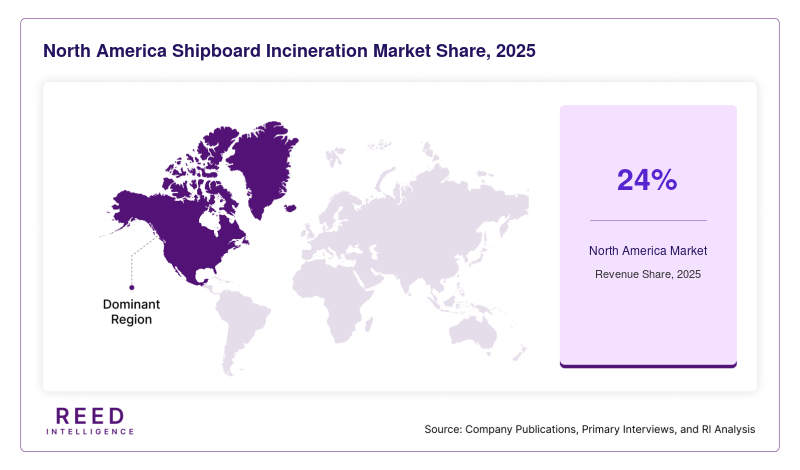
North America accounted for approximately 24% of the Shipboard Incineration Market share in 2025, with a projected CAGR of 5.8% through 2034. The region benefits from a well-established maritime infrastructure and strict environmental regulations governing waste disposal. The presence of advanced shipbuilding facilities and technological expertise further supports market growth. Demand is driven by both commercial shipping and naval applications, with increasing investments in sustainable maritime solutions contributing to steady expansion.
The United States dominates the regional market, driven by its extensive naval fleet and focus on environmental compliance. A unique growth factor in this region is the adoption of advanced emission control technologies integrated with incineration systems. These systems are designed to meet stringent national standards while improving operational efficiency. The emphasis on technological innovation and sustainability continues to support the market in North America.
Europe
Europe held around 22% of the global market share in 2025 and is expected to grow at a CAGR of 5.9% during the forecast period. The region is characterized by strict environmental regulations and a strong commitment to reducing marine pollution. European shipowners are increasingly investing in advanced waste management systems to comply with regulatory requirements. The presence of leading shipbuilding nations also contributes to the demand for shipboard incinerators.
Germany leads the European market, supported by its robust maritime engineering sector. A unique growth factor is the region’s focus on green shipping initiatives, which encourage the adoption of eco-friendly technologies. Investments in research and development for low-emission incineration systems are further driving market growth. These efforts align with broader environmental goals and enhance the adoption of advanced systems.
Asia Pacific
Asia Pacific is the largest regional market, accounting for approximately 34% of the global share in 2025, with a projected CAGR of 6.8%. The region’s dominance is attributed to its extensive shipbuilding industry and high volume of maritime trade. Countries in this region are rapidly expanding their fleets, increasing the demand for onboard waste management systems. The availability of cost-effective manufacturing also supports market growth.
China is the dominant country in the region, driven by its large-scale shipbuilding activities. A unique growth factor is the increasing adoption of domestically manufactured incineration systems, which reduces costs and enhances accessibility. Government initiatives to improve environmental standards in maritime operations further contribute to market expansion. The combination of industrial growth and regulatory support drives the Asia Pacific market.
Middle East & Africa
The Middle East & Africa region held approximately 10% of the market share in 2025 and is expected to grow at a CAGR of 5.6%. The region’s growth is supported by increasing offshore exploration activities and expanding maritime trade routes. Shipboard incineration systems are essential for managing waste generated during offshore operations, contributing to steady demand.
The United Arab Emirates leads the regional market, driven by its strategic position in global shipping routes. A unique growth factor is the increasing investment in port infrastructure and maritime services. These developments create a favorable environment for the adoption of advanced waste management technologies. The focus on enhancing operational efficiency and environmental compliance supports market growth.
Latin America
Latin America accounted for around 10% of the global market share in 2025, with a projected CAGR of 5.7%. The region is experiencing gradual growth due to increasing maritime trade and improvements in port infrastructure. Ship operators are adopting onboard incineration systems to enhance waste management capabilities and comply with environmental standards.
Brazil dominates the Latin American market, supported by its extensive coastline and growing shipping activities. A unique growth factor is the expansion of offshore oil and gas operations, which require efficient waste management solutions. The demand for shipboard incinerators in offshore support vessels is contributing to market growth. This trend is expected to continue as energy exploration activities increase.
Competitive Landscape
The Shipboard Incineration Market is moderately competitive, with several established players focusing on technological innovation and product development. Leading companies are investing in research and development to enhance the efficiency and environmental performance of their incineration systems. Strategic partnerships and collaborations are also common, enabling companies to expand their market presence and improve their product offerings.
Alfa Laval is recognized as a leading player in the market, known for its advanced marine solutions and strong global presence. The company has recently introduced upgraded incineration systems with improved automation and emission control features. Other key players are also focusing on expanding their product portfolios and entering new markets. The competitive landscape is characterized by continuous innovation and efforts to meet evolving regulatory requirements.
Key Players
- Alfa Laval
- Wärtsilä Corporation
- Mitsubishi Heavy Industries
- Atlas Incinerators
- Detegasa
- Inciner8 Limited
- TeamTec AS
- Kangrim Heavy Industries
- Sunflame Co. Ltd.
- Scanship Holding ASA
- China Deyuan Marine Fitting
- Jiangsu Wanlong Shipbuilding
- Hyundai Heavy Industries
- MacGregor
- Rolls-Royce Marine
Recent Developments
- A leading manufacturer launched a next-generation incinerator with enhanced emission control and automated monitoring features.
- A major shipbuilding company partnered with a technology provider to integrate advanced waste management systems into new vessels.
- An industry player introduced a compact incineration system designed specifically for retrofitting older ships, improving compliance and efficiency.
Shipboard Incineration Market Segments
Type
- Marine Diesel Oil-Fired Incinerators
- Electrically Heated Incinerators
- Hybrid Incinerators
Application
- Commercial Shipping
- Offshore
- Naval
End-Use
- Cargo Vessels
- Tankers
- Cruise Ships
- Offshore Support Vessels
By Region
- North America
- Europe
- APAC
- Middle East and Africa
- LATAM