Shipyard Trailer Market Size, Share, Demand Report By Trailer Type (Modular Hydraulic Trailers, Self-Propelled Modular Transporters, Platform Trailers), By Application (Shipbuilding Operations, Offshore Construction, Repair and Maintenance), By End Use (Commercial Shipyards, Defense Shipyards, Offshore Fabrication Yards), Regional Outlook and Segment Forecasts, 2026–2034
USD 3950
Market Overview
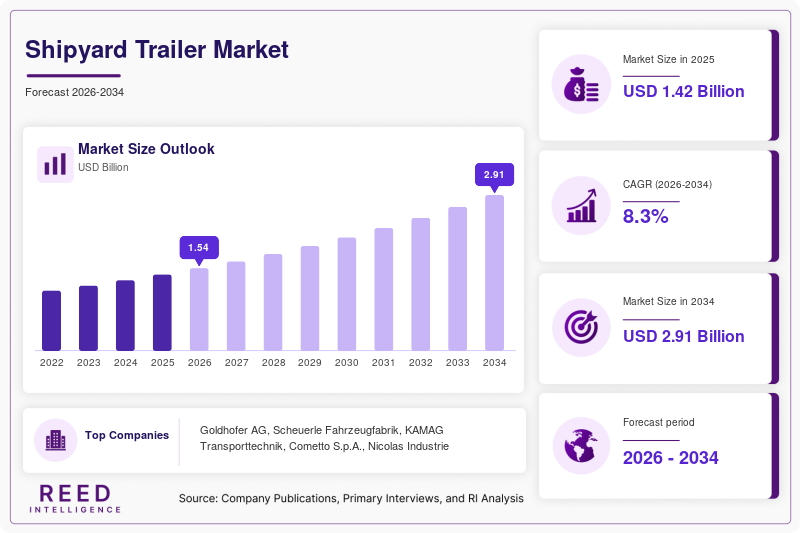
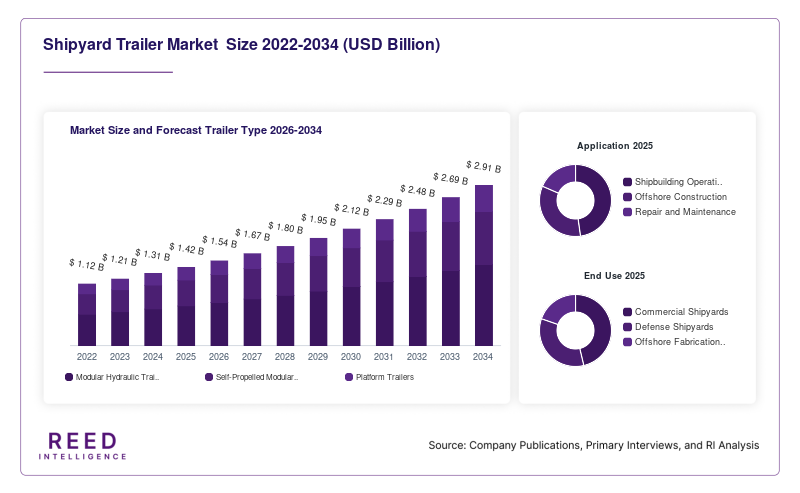
The global Shipyard Trailer Market size is valued at approximately USD 1.42 billion in 2026 and is projected to reach USD 2.68 billion by 2034, expanding at a CAGR of 8.3% during 2026–2034. Growth in this market is primarily driven by increasing global shipbuilding activity, expansion of naval modernization programs, and rising demand for efficient heavy-load transportation systems within shipyards. Shipyard trailers play a critical role in transporting ship modules, hull sections, and heavy marine components across dry docks and fabrication yards, supporting operational efficiency and reducing manual handling risks.
One major global factor supporting market expansion is the accelerated investment in maritime infrastructure and offshore energy projects. Countries across Asia Pacific and the Middle East are expanding shipbuilding facilities and repair yards, which has increased the demand for high-capacity modular trailers and self-propelled transporters. Additionally, automation trends in material handling systems are enhancing the adoption of technologically advanced shipyard trailers equipped with hydraulic steering and remote-control systems.
Key Highlights
- North America dominated the market with a 34.2% share in 2025.
- Asia Pacific is expected to grow at the fastest CAGR of 11.2% during 2026–2034.
- By trailer type, modular hydraulic trailers accounted for the largest share of 40.1%.
- while self-propelled modular transporters are projected to grow at a CAGR of 12.6%.
- By application, shipbuilding operations led with a 44.3% share, whereas offshore construction is expected to expand at a CAGR of 11.5%.
- The United States remained the dominant country, with market values of USD 510 million in 2024 and USD 560 million in 2025.
Market Trends
Integration of Smart Hydraulic and Remote-Control Systems
The Shipyard Trailer Market is witnessing a growing shift toward smart hydraulic systems integrated with digital control technologies. Manufacturers are increasingly embedding sensors, IoT-based monitoring systems, and automated steering controls into trailers used in shipyards. This integration helps operators achieve precise maneuverability while transporting heavy ship components across complex yard layouts. Remote-controlled trailers are also reducing dependency on manual labor, improving safety, and enhancing operational accuracy. The adoption of smart hydraulic systems is particularly strong in advanced shipbuilding facilities in Europe and North America, where automation standards are more mature and safety compliance requirements are stringent.
Shift Toward High-Capacity Modular Transport Solutions
Another significant trend is the increasing preference for high-capacity modular transport solutions capable of handling oversized and heavy marine structures. Shipyards are gradually replacing conventional towing systems with modular trailers that offer flexible configuration and scalability. These systems allow operators to combine multiple axle lines to handle varying load requirements, improving efficiency in large-scale shipbuilding projects. Demand is particularly rising in offshore wind and naval shipbuilding projects, where components are significantly heavier and more complex. This trend is also supported by rising investments in port modernization and dry dock expansion projects across emerging economies.
Market Drivers
Expansion of Global Shipbuilding and Repair Activities
The steady expansion of global shipbuilding and repair activities is a key driver of the Shipyard Trailer Market. Increasing international trade and maritime logistics demand has resulted in higher vessel production rates, particularly in Asia Pacific countries such as China, South Korea, and India. Shipyards require efficient internal transportation systems to handle large hull sections, engines, and structural components. Shipyard trailers enable smooth intra-yard movement, reducing production delays and improving operational throughput. Additionally, growing naval defense budgets in several countries are accelerating demand for advanced shipyard infrastructure, further supporting trailer adoption.
Rising Investments in Offshore Energy and Marine Infrastructure
Rising investments in offshore oil, gas, and wind energy projects are significantly driving demand for shipyard trailers. Offshore platforms require heavy structural components that must be assembled and transported within shipyards before installation. This has increased reliance on high-load-capacity trailers with precision steering capabilities. Governments across Europe and Asia are actively promoting offshore wind installations, which require large fabrication yards equipped with advanced material handling systems. As a result, shipyard trailers are becoming essential equipment for supporting construction efficiency and ensuring safe transportation of oversized components.
Market Restraint
High Capital Investment and Maintenance Costs
One of the primary restraints in the Shipyard Trailer Market is the high capital investment required for procurement and maintenance of advanced trailer systems. Modular hydraulic trailers and self-propelled transporters involve complex mechanical and electronic components, making them expensive to purchase and maintain. Small and medium-sized shipyards often face budget constraints, limiting their ability to adopt advanced systems. Additionally, periodic maintenance, calibration of hydraulic systems, and replacement of high-load components add to operational costs. This financial burden slows down adoption rates in price-sensitive regions, particularly in developing economies where shipyard modernization is still in progress.
Market Opportunities
Growing Automation in Shipyard Operations
The increasing adoption of automation in shipyard operations presents a significant opportunity for the Shipyard Trailer Market. Shipbuilders are integrating automated logistics systems to enhance productivity and reduce human error. Automated shipyard trailers equipped with GPS tracking, load sensors, and AI-based navigation systems are gaining traction. These innovations allow real-time monitoring of load distribution and movement paths, improving safety and efficiency. As digital transformation accelerates across industrial sectors, shipyard operators are expected to increasingly invest in intelligent transport systems that integrate seamlessly with automated production workflows.
Expansion of Shipbuilding Infrastructure in Emerging Economies
Emerging economies are investing heavily in expanding shipbuilding infrastructure, creating strong opportunities for trailer manufacturers. Countries in Southeast Asia, the Middle East, and Latin America are developing new shipyards and upgrading existing facilities to support commercial and defense vessel production. These developments require modern material handling equipment capable of managing large-scale operations. Shipyard trailers, particularly modular and high-capacity variants, are expected to see rising demand as new facilities come online. Government incentives and foreign direct investments in maritime infrastructure further strengthen market potential in these regions.
Segmental Analysis
By Trailer Type
Modular hydraulic trailers dominated the market with a 42.8% share in 2024. These trailers are widely used in shipyards due to their flexibility, high load-bearing capacity, and ability to be configured for different operational requirements. Their adoption is particularly strong in large shipbuilding facilities where heavy hull sections and offshore modules must be transported with precision.
Self-propelled modular transporters are the fastest-growing subsegment, expected to expand at a CAGR of 12.6%. Growth is driven by automation trends and increasing demand for remote-controlled transportation systems. These trailers reduce dependency on towing equipment and improve maneuverability in complex shipyard layouts.
By Application
Shipbuilding operations accounted for the dominant 45.1% share in 2024. Shipyard trailers are extensively used in assembling and transporting vessel components during construction phases. Large shipyards rely on these systems to improve production efficiency and reduce handling time.
Offshore construction is the fastest-growing application, projected to grow at a CAGR of 11.5%. Increasing offshore wind and oil platform installations are driving demand for high-capacity trailers capable of handling oversized structures.
By End Use
Commercial shipyards held a 47.6% share in 2024, driven by global trade expansion and increasing cargo vessel production. These shipyards require continuous material handling support for efficient production cycles.
Defense shipyards are expected to grow at a CAGR of 10.9%, supported by rising naval modernization programs and increased defense spending across major economies. Advanced transport systems are essential for handling complex military vessel components.
Regional Analysis
North America
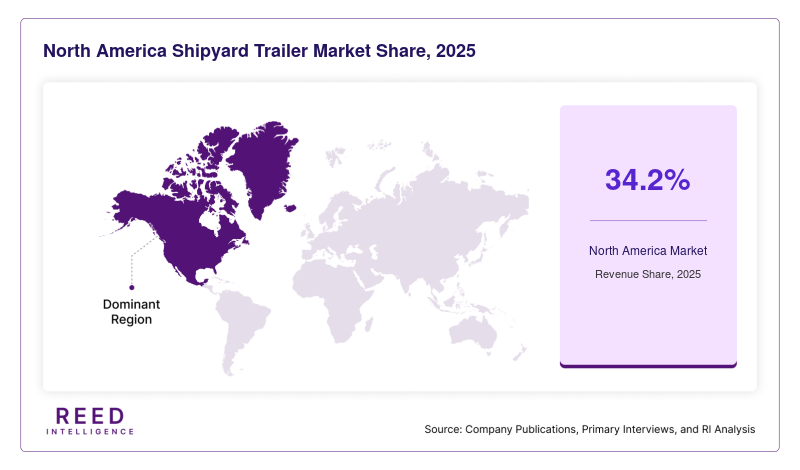
North America accounted for approximately 34.2% market share in 2025 and is expected to grow at a CAGR of 7.9% through 2034. The region benefits from advanced shipbuilding infrastructure and strong naval defense programs. The United States and Canada are key contributors to market demand due to their established shipyards and modernization initiatives.
The United States dominates the regional market, driven by continuous naval fleet expansion and upgrades in shipyard logistics systems. A key growth factor is the integration of automation technologies in defense shipyards, improving operational precision and reducing turnaround time for vessel construction projects.
Europe
Europe held around 26.5% market share in 2025, with a projected CAGR of 7.5% through 2034. Strong maritime trade activities and offshore wind energy expansion are supporting market growth. The region emphasizes advanced engineering solutions and sustainability in shipbuilding operations.
Germany leads the European market due to its advanced marine engineering capabilities and strong industrial base. Growth is further supported by increasing offshore wind farm projects in the North Sea, requiring efficient transport systems for heavy structural components.
Asia Pacific
Asia Pacific captured 28.7% market share in 2025 and is expected to register the highest CAGR of 11.2% during 2026–2034. Rapid industrialization and large-scale shipbuilding activities in China, South Korea, and Japan are driving regional expansion.
China dominates the regional landscape due to its extensive shipbuilding capacity and government-backed maritime development programs. A key growth factor is the expansion of large commercial shipyards capable of producing container vessels and LNG carriers at scale.
Middle East & Africa
The Middle East & Africa accounted for 6.3% market share in 2025, growing at a CAGR of 8.6% through 2034. Investments in port infrastructure and offshore oil projects are supporting market demand.
The United Arab Emirates leads the region, driven by its strategic maritime trade hubs and expanding ship repair facilities. Growth is further supported by diversification into offshore energy projects requiring advanced heavy-load handling systems.
Latin America
Latin America held 4.3% market share in 2025, with a projected CAGR of 7.8% through 2034. Growth is supported by modernization of naval fleets and port infrastructure development.
Brazil is the dominant country in the region due to its strong offshore oil exploration activities. The demand for shipyard trailers is increasing as offshore platforms require efficient assembly and transportation solutions within coastal fabrication yards.
Competitive Landscape
The Shipyard Trailer Market is moderately consolidated, with key players focusing on technological innovation, capacity expansion, and strategic partnerships. Leading companies include Goldhofer AG, Scheuerle Fahrzeugfabrik, KAMAG Transporttechnik, Cometto, and Nicolas Industrie. These companies are investing in automation-enabled trailers and expanding their global distribution networks. Goldhofer AG remains a leading player due to its strong product portfolio and advanced modular transport solutions. Recent developments include the launch of digitally controlled SPMT systems designed for enhanced precision and load optimization in shipyard environments.
Key Players
- Goldhofer AG
- Scheuerle Fahrzeugfabrik
- KAMAG Transporttechnik
- Cometto S.p.A.
- Nicolas Industrie
- TII Group
- DOLL Fahrzeugbau
- Mammoet
- FAUN Group
- SCHEUERLE Africa
- HYDRO Mobile
- Liebherr Group
- Enerpac Heavy Lifting Technology
- Sarens Group
- ALMAC Industrial Systems
Recent Developments
- Manufacturers are increasingly introducing AI-enabled navigation systems in shipyard trailers to enhance precision handling of heavy marine structures. These systems improve route optimization and reduce operational downtime within large shipbuilding facilities.
- Several leading companies have expanded production facilities in Asia Pacific to meet rising demand from Chinese and South Korean shipyards, strengthening regional supply chains.
- Strategic collaborations between trailer manufacturers and shipyard operators are increasing, focusing on integrated logistics solutions that combine digital monitoring with heavy-load transportation systems.
Shipyard Trailer Market Segments
Trailer Type
- Modular Hydraulic Trailers
- Self-Propelled Modular Transporters
- Platform Trailers
Application
- Shipbuilding Operations
- Offshore Construction
- Repair and Maintenance
End Use
- Commercial Shipyards
- Defense Shipyards
- Offshore Fabrication Yards
By Region
- North America
- Europe
- APAC
- Middle East and Africa
- LATAM