Short Wave IR LED Market Size, Share & Demand Report By Wavelength (700–900 nm, 900–1200 nm, 1200–1700 nm), By Application (Industrial Imaging, Surveillance & Security, Biomedical Applications, Optical Communication), By End-Use Industry (Automotive, Healthcare, Consumer Electronics, Industrial Manufacturing), By Packaging Type (Surface-Mount Device, Chip-on-Board, Through-Hole), By Region & Segment Forecasts, 2025–2034
USD 3950
Market Overview
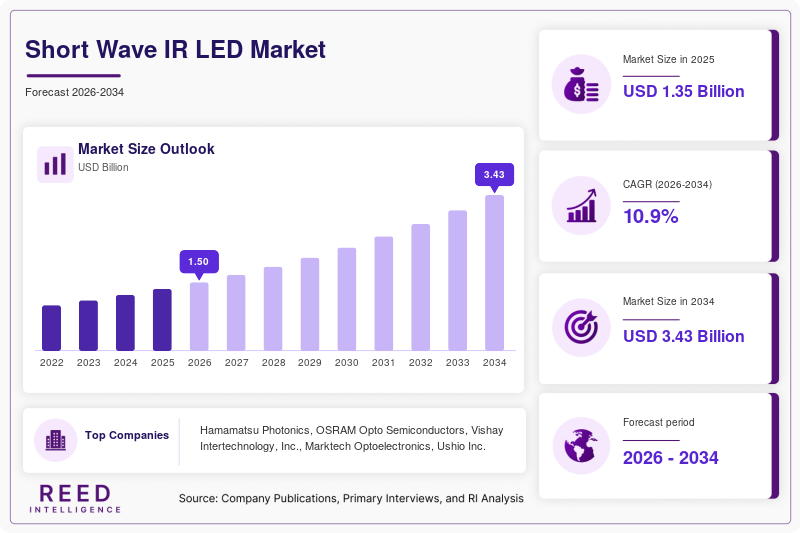
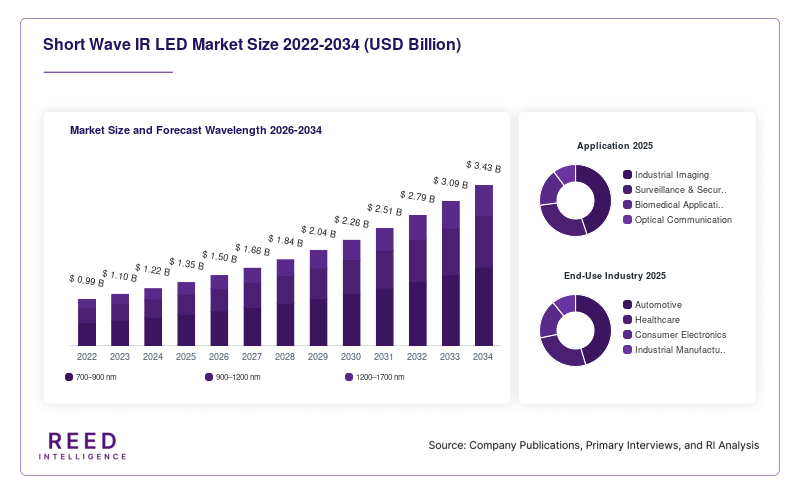
The Short Wave IR LED Market size was valued at approximately USD 1.35 billion in 2025 and is projected to reach USD 3.42 billion by 2034, expanding at a CAGR of 10.9% during 2025–2034. The market has experienced consistent expansion driven by the increasing adoption of infrared-based sensing technologies across industrial automation, consumer electronics, and automotive systems. Short wave infrared (SWIR) LEDs, typically operating in the 700–1700 nm wavelength range, are widely used for imaging, spectroscopy, and optical communication due to their efficiency and precision.
A key global factor supporting the growth of the Short Wave IR LED Market is the rapid advancement in machine vision and automation systems, particularly in manufacturing environments. The growing need for non-contact sensing, quality inspection, and process optimization has led to a surge in demand for SWIR LEDs, which provide superior performance in low-light and high-contrast environments.
Key Highlights
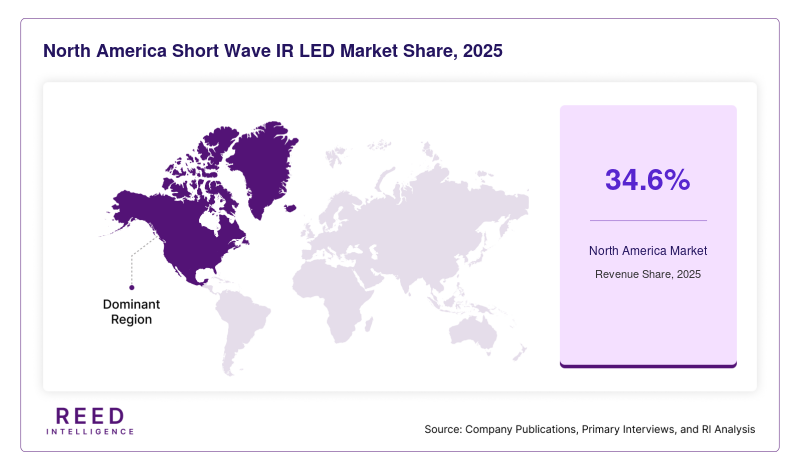
- North America dominated the market with a share of 34.6% in 2025, while Asia Pacific is expected to register the fastest CAGR of 12.4%.
- By wavelength, the 900–1200 nm segment led with a share of 41.2%, whereas the 1200–1700 nm segment is projected to grow at a CAGR of 11.8%.
- By application, industrial imaging accounted for the largest share at 36.5%, while biomedical applications are anticipated to grow at a CAGR of 12.7%.
- The United States recorded market values of USD 420 million in 2025 and USD 455 million in 2026, maintaining its dominance globally.
Market Trends
Integration of SWIR LEDs in Advanced Imaging Systems
The Short Wave IR LED Market is witnessing strong momentum due to the increasing integration of SWIR LEDs in advanced imaging systems. These LEDs offer enhanced penetration through materials such as silicon and plastics, enabling precise inspection in electronics and semiconductor manufacturing. Their ability to function under challenging lighting conditions makes them highly suitable for industrial and defense imaging applications.
Rising Adoption in Consumer Electronics and Wearables
Another notable trend shaping the Short Wave IR LED Market is the growing use of SWIR LEDs in consumer electronics and wearable devices. These LEDs are being incorporated into biometric authentication systems, gesture recognition technologies, and health monitoring devices. As device manufacturers focus on improving functionality and user experience, SWIR LEDs are gaining traction due to their compact size, low power consumption, and improved sensing capabilities.
Market Drivers
Increasing Demand for Industrial Automation
The growing adoption of automation across manufacturing sectors has significantly driven the Short Wave IR LED Market. Industries are increasingly relying on machine vision systems for quality control, defect detection, and process monitoring. SWIR LEDs provide high-resolution imaging and reliable performance, making them ideal for such applications. This trend is particularly strong in automotive, electronics, and packaging industries.
Expanding Applications in Healthcare and Biotechnology
The healthcare sector has emerged as a key driver for the Short Wave IR LED Market. SWIR LEDs are widely used in medical imaging, diagnostics, and spectroscopy applications due to their ability to penetrate biological tissues with minimal scattering. The increasing demand for non-invasive diagnostic techniques and precision medicine is contributing to the adoption of SWIR LED-based technologies.
Market Restraint
High Production Costs and Technical Complexity
One of the major challenges limiting the growth of the Short Wave IR LED Market is the high production cost associated with these devices. The manufacturing of SWIR LEDs requires specialized materials such as indium gallium arsenide (InGaAs), which are expensive and complex to process. Additionally, maintaining consistent performance across varying wavelengths adds to the technical challenges.
These cost constraints restrict widespread adoption, particularly in price-sensitive markets. Moreover, the need for advanced packaging and thermal management solutions further increases the overall cost of deployment. As a result, small and medium-scale enterprises may face barriers in integrating SWIR LED technologies into their operations.
Market Opportunities
Growth in Autonomous Vehicles and ADAS Systems
The increasing development of autonomous vehicles and advanced driver-assistance systems (ADAS) presents significant opportunities for the Short Wave IR LED Market. SWIR LEDs are used in LiDAR systems, night vision cameras, and object detection technologies, enabling improved safety and navigation. As automotive manufacturers invest in next-generation mobility solutions, the demand for SWIR LEDs is expected to rise substantially.
Emerging Use in Agricultural Monitoring and Food Inspection
Another promising opportunity lies in the agricultural and food processing sectors. SWIR LEDs are being used for crop monitoring, moisture detection, and quality assessment of food products. These technologies help improve yield, reduce waste, and ensure product quality. The increasing adoption of precision agriculture practices is likely to create new growth avenues for market players.
Segmental Analysis
By Wavelength
The 900–1200 nm segment dominated the Short Wave IR LED Market with a share of 41.2% in 2025. This segment benefited from its widespread use in industrial imaging and sensing applications due to its optimal balance between cost and performance.
The 1200–1700 nm segment is expected to grow at the fastest CAGR of 11.8% during the forecast period. Its growth will be driven by increasing applications in spectroscopy and biomedical imaging, where deeper penetration and higher sensitivity are required.
By Application
Industrial imaging held the largest share of 36.5% in 2025, driven by extensive use in quality inspection and machine vision systems. The demand for accurate and efficient imaging solutions supported this segment’s dominance.
The biomedical applications segment is projected to grow at a CAGR of 12.7%. The increasing adoption of non-invasive diagnostic technologies and advancements in medical imaging will drive this segment’s growth.
By End-Use Industry
The automotive sector accounted for the largest share of 29.4% in 2025, supported by the integration of SWIR LEDs in ADAS and safety systems.
The healthcare sector is anticipated to grow at the fastest CAGR of 12.9%, driven by rising demand for advanced diagnostic and imaging technologies.
By Packaging Type
The surface-mount device (SMD) segment dominated with a share of 52.1% in 2025, owing to its compact size and ease of integration in electronic systems.
The chip-on-board (COB) segment is expected to grow at a CAGR of 11.6%, supported by its high efficiency and improved thermal management capabilities.
Regional Analysis
North America
North America accounted for 34.6% of the Short Wave IR LED Market share in 2025 and is projected to grow at a CAGR of 9.8% during the forecast period. The region’s growth is driven by strong technological infrastructure and high adoption of advanced imaging systems across industries.
The United States remained the dominant country due to its well-established semiconductor industry and extensive use of SWIR LEDs in defense and aerospace applications. Increased investment in research and development has further strengthened the country’s position.
Europe
Europe held a market share of 25.3% in 2025 and is expected to expand at a CAGR of 10.2% through 2034. The region benefits from strong industrial automation and increasing focus on sustainability and precision manufacturing.
Germany led the regional market due to its advanced manufacturing ecosystem and adoption of Industry 4.0 technologies. The demand for high-performance sensing solutions in automotive and industrial sectors contributed to market growth.
Asia Pacific
Asia Pacific represented 21.7% of the Short Wave IR LED Market in 2025 and is anticipated to grow at the fastest CAGR of 12.4%. Rapid industrialization and increasing investments in electronics manufacturing are key growth drivers.
China emerged as the dominant country, supported by its large-scale semiconductor production and growing demand for consumer electronics. Government initiatives promoting technological innovation further boosted market expansion.
Middle East & Africa
The Middle East & Africa accounted for 9.1% of the market share in 2025 and is projected to grow at a CAGR of 10.6%. The region is gradually adopting advanced technologies in sectors such as oil & gas and security.
The United Arab Emirates led the region due to increasing investments in smart city projects and surveillance systems. The demand for infrared-based imaging solutions supported market growth.
Latin America
Latin America held 9.3% of the Short Wave IR LED Market share in 2025 and is expected to grow at a CAGR of 10.1%. The region is witnessing increased adoption of automation and digital technologies.
Brazil dominated the market due to its expanding industrial base and growing demand for quality inspection systems. The adoption of SWIR LEDs in agriculture and food processing also contributed to growth.
Competitive Landscape
The Short Wave IR LED Market is moderately competitive, with several global and regional players focusing on innovation and product development. The market leader, Hamamatsu Photonics, has maintained its dominance through continuous investment in advanced optoelectronic technologies and expansion of its product portfolio.
Other key players are actively pursuing strategic partnerships, mergers, and product launches to strengthen their market position. Companies are also focusing on improving efficiency and reducing production costs to gain a competitive edge.
A recent development includes the introduction of high-efficiency SWIR LED modules by Hamamatsu Photonics, designed for industrial and medical applications, enhancing performance and reliability.
Key Players
- Hamamatsu Photonics
- OSRAM Opto Semiconductors
- Vishay Intertechnology
- Marktech Optoelectronics
- Ushio Inc.
- Epileds Technologies
- Everlight Electronics
- ROHM Semiconductor
- Excelitas Technologies
- Kyocera Corporation
- Lumileds Holding B.V.
- Broadcom Inc.
- Nichia Corporation
- TT Electronics
- Lextar Electronics
Recent Developments
- 2024: Hamamatsu Photonics launched a new SWIR LED series for high-resolution imaging applications.
- 2024: OSRAM introduced energy-efficient infrared LEDs for automotive sensing systems.
- 2023: Vishay expanded its IR LED portfolio with improved wavelength precision products.
- 2023: Lumileds developed compact SWIR LED modules for wearable devices.
- 2024: Broadcom enhanced its optoelectronic solutions for industrial automation systems.
Short Wave IR LED Market Segments
Wavelength
- 700–900 nm
- 900–1200 nm
- 1200–1700 nm
Application
- Industrial Imaging
- Surveillance & Security
- Biomedical Applications
- Optical Communication
End-Use Industry
- Automotive
- Healthcare
- Consumer Electronics
- Industrial Manufacturing
Packaging Type
- Surface-Mount Device (SMD)
- Chip-on-Board (COB)
- Through-Hole
By Region
- North America
- Europe
- APAC
- Middle East and Africa
- LATAM