Shotcrete Accelerator Market Size, Share Demand Report By Type (Alkali-Free Accelerators, Alkaline Accelerators), By Form (Liquid, Powder), By Application (Underground Construction, Mining, Water Retaining Structures, Repair Works), By End-Use Industry (Construction, Mining, Infrastructure) By Region & Segment Forecasts, 2026–2034
USD 3950
Market Overview
The global Shotcrete Accelerator Market size was valued at approximately USD 1.05 billion in 2026 and is projected to reach USD 1.78 billion by 2034, expanding at a CAGR of 6.8% during the forecast period (2026–2034). Shotcrete accelerators are critical admixtures used in sprayed concrete applications to enhance early strength development and reduce setting time, making them indispensable in tunneling, mining, and underground construction.
A key global factor supporting market growth has been the expansion of underground infrastructure projects, particularly metro rail systems, hydroelectric tunnels, and mining developments. Governments and private stakeholders have increasingly invested in resilient and rapid construction solutions, where shotcrete accelerators play a vital role in improving productivity and structural stability.
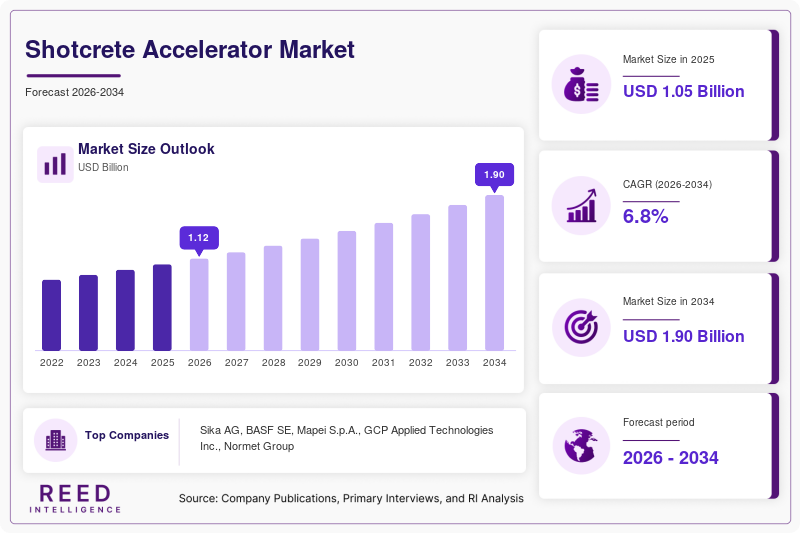
Key Highlights:
- The global Shotcrete Accelerator Market was primarily driven by infrastructure modernization projects, with tunnel rehabilitation and urban transit expansion contributing significantly to demand.
- Liquid accelerators dominated the market with over 63% share in 2025, supported by their compatibility with automated spraying systems and consistent performance in large-scale projects.
- Mining end-use industry emerged as a high-impact segment, contributing substantially to overall demand due to increasing safety requirements in underground excavation.
- Asia Pacific remained the leading region, while Middle East infrastructure investments accelerated demand, particularly in large-scale urban development projects.
- China and India collectively accounted for a significant share of regional consumption, with India witnessing rising adoption due to metro rail expansion and tunnel construction projects.
- Technological advancements in robotic shotcrete application systems enhanced the efficiency and precision of accelerator usage, influencing product innovation.
- The market experienced increasing preference for low-alkaline and sustainable formulations, aligning with environmental compliance and worker safety standards.
- Infrastructure segment is expected to register strong growth, driven by government-backed public works and smart city initiatives globally.
Market Trends
Shift Toward Alkali-Free Accelerators
The market has seen a transition from traditional alkaline accelerators to alkali-free variants due to their improved safety profile, reduced environmental impact, and enhanced durability. These products minimize health risks for workers and reduce corrosion in reinforced concrete, making them increasingly preferred in modern construction practices.
Integration of Advanced Construction Technologies
The adoption of automated shotcrete systems and robotic spraying equipment has influenced the demand for high-performance accelerators. These technologies require precise and consistent admixture performance, driving innovation in formulations tailored for mechanized applications.
Market Drivers
Rising Underground Construction Activities
The increasing number of tunneling and underground infrastructure projects has significantly contributed to the demand for shotcrete accelerators. Urbanization has led to the expansion of metro rail networks, underground highways, and utility tunnels. Shotcrete accelerators enable faster project completion by improving early strength gain, which is critical in confined underground environments.
Growth in Mining and Resource Extraction
The expansion of mining activities, particularly in developing economies, has driven the adoption of shotcrete accelerators for ground stabilization. These materials are essential for reinforcing mine walls and preventing collapses. As demand for minerals and metals rises globally, mining companies are investing in efficient and safe construction techniques, boosting the market.
Market Restraint
Environmental and Regulatory Challenges
Strict environmental regulations regarding chemical admixtures have limited the use of certain types of shotcrete accelerators. Concerns related to groundwater contamination and worker safety have led to compliance requirements that increase production costs and restrict market entry for some manufacturers.
Market Opportunities
Development of Sustainable and Eco-Friendly Products
There is a growing opportunity for manufacturers to develop environmentally friendly shotcrete accelerators with reduced toxicity and lower carbon footprints. Innovations in green chemistry and bio-based additives are expected to create new growth avenues.
Expansion in Emerging Infrastructure Markets
Rapid urban development in emerging economies presents significant opportunities for market expansion. Governments in regions such as Southeast Asia and Africa are investing heavily in infrastructure projects, creating demand for efficient construction materials, including shotcrete accelerators.
Segmental Analysis
By Type
The market is segmented into alkali-free accelerators and alkaline accelerators.
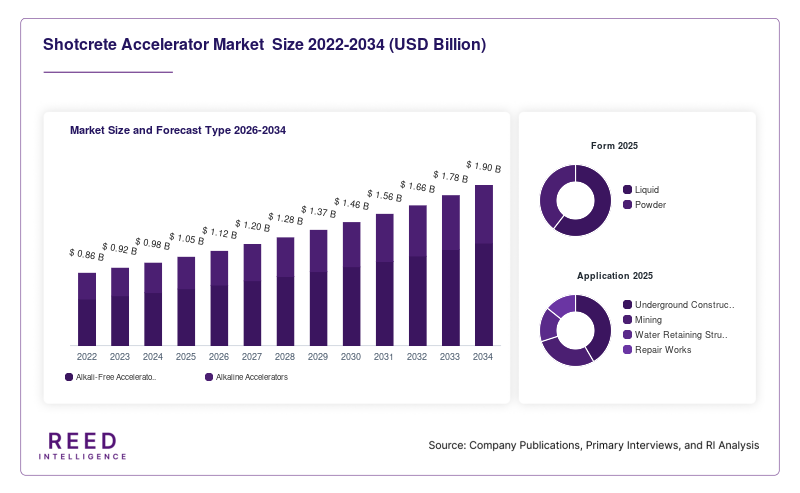
- Dominant subsegment: Alkali-free accelerators held 54.2% share in 2025, driven by their improved safety and performance characteristics.
- Fastest-growing subsegment: Alkali-free accelerators are projected to grow at a CAGR of 7.4%, supported by increasing environmental compliance and demand for durable construction materials.
By Form
The market includes liquid and powder forms.
- Dominant subsegment: Liquid accelerators accounted for 63.5% share in 2025, owing to their ease of application and compatibility with automated systems.
- Fastest-growing subsegment: Liquid accelerators will grow at a CAGR of 7.1%, driven by advancements in spraying technology and improved consistency in performance.
By Application
Key applications include underground construction, mining, water retaining structures, and repair works.
- Dominant subsegment: Underground construction captured 47.8% share in 2025, reflecting widespread use in tunnels and metro systems.
- Fastest-growing subsegment: Mining applications are expected to grow at a CAGR of 7.6%, due to increasing resource extraction activities and safety requirements.
By End-Use Industry
The market is categorized into construction, mining, and infrastructure.
- Dominant subsegment: Construction accounted for 49.3% share in 2025, supported by urban development projects.
- Fastest-growing subsegment: Infrastructure is projected to grow at a CAGR of 7.3%, driven by government investments in public works.
Regional Analysis
North America
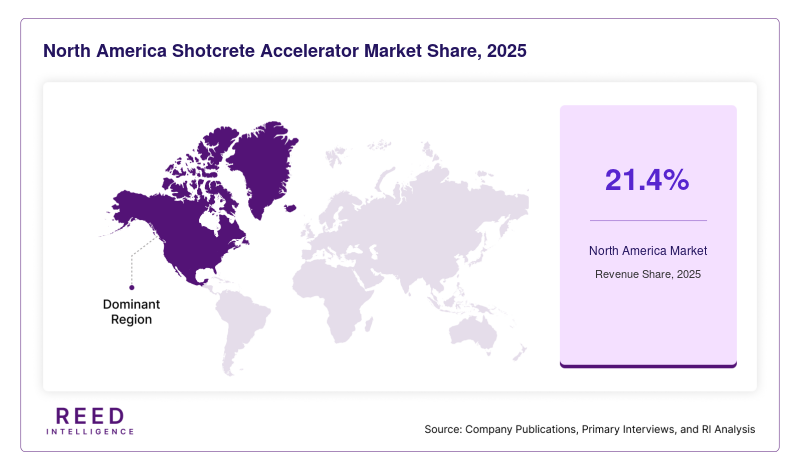
North America held 21.4% of the global market share in 2025 and is projected to grow at a CAGR of 6.2% during the forecast period. The region’s market was driven by infrastructure rehabilitation and tunneling projects.
Dominant country: The United States benefited from increased investments in transportation infrastructure, particularly in underground transit systems.
Europe
Europe accounted for 18.7% market share in 2025 and will expand at a CAGR of 6.0% from 2026 to 2034. The region experienced steady demand due to modernization of existing infrastructure and strict quality standards.
Dominant country: Germany showed consistent growth supported by advanced engineering practices and tunnel construction expertise.
Asia Pacific
Asia Pacific captured 38.6% share in 2025 and is expected to grow at a CAGR of 7.5% through 2034. The region’s dominance was attributed to large-scale infrastructure projects and rapid urbanization.
Dominant country: China led the market due to extensive metro rail and hydropower tunnel construction.
Middle East & Africa
The Middle East & Africa region held 11.2% market share in 2025 and is forecasted to grow at a CAGR of 7.9%. The growth trajectory is supported by investments in mega infrastructure and mining projects.
Dominant country: Saudi Arabia experienced notable growth driven by large-scale urban development initiatives.
Latin America
Latin America accounted for 10.1% of the market in 2025 and is expected to expand at a CAGR of 6.5% during the forecast period. The region’s growth was supported by mining activities and infrastructure upgrades.
Dominant country: Brazil demonstrated steady expansion due to increased mining operations and construction projects.
Competitive Landscape
The Shotcrete Accelerator Market is moderately competitive, with several global and regional players focusing on product innovation and strategic partnerships. Leading companies are investing in research and development to introduce eco-friendly and high-performance accelerators tailored for modern construction techniques.
The market leader, Sika AG, has maintained its position through a strong global distribution network and continuous product innovation. Recently, the company introduced advanced alkali-free accelerator solutions designed for high-performance tunneling applications, enhancing early strength and durability. Other key players are expanding their presence in emerging markets to capitalize on infrastructure growth. Competitive strategies include mergers, acquisitions, and collaborations with construction firms to strengthen market positioning. Companies are also focusing on sustainability initiatives to meet regulatory requirements and customer expectations, which is expected to shape the competitive dynamics in the coming years.
Key Players List
- Sika AG
- BASF SE
- Mapei S.p.A.
- GCP Applied Technologies Inc.
- Normet Group
- CHRYSO Group
- Fosroc International Ltd.
- CICO Technologies Ltd.
- Denka Company Limited
- Euclid Chemical Company
- Chryso SAS
- MC-Bauchemie Müller GmbH
- Thermax Limited
- Sobute New Materials Co., Ltd.
- MUHU (China) Construction Materials Co., Ltd.
Recent Developments
- 2025: A major manufacturer launched a next-generation alkali-free accelerator with enhanced early strength performance for tunnel construction.
- 2024: Strategic collaboration between a construction chemical company and a mining firm to develop customized shotcrete solutions.
- 2024: Expansion of production facilities in Asia Pacific to meet growing regional demand.
- 2023: Introduction of eco-friendly formulations aimed at reducing environmental impact and improving worker safety.
- 2023: Acquisition of a regional player to strengthen distribution networks in emerging markets.
Shotcrete Accelerator Market Segments
Type
- Alkali-Free Accelerators
- Alkaline Accelerators
Form
- Liquid
- Powder
Application
- Underground Construction
- Mining
- Water Retaining Structures
- Repair Works
End-Use Industry
- Construction
- Mining
- Infrastructure
By Region
- North America
- Europe
- APAC
- Middle East and Africa
- LATAM