SiC on Insulator Substrate Market Size, Share & Demand Report By Type (Thin-Film SiC Substrates, Bonded SiC Substrates), By Application (Power Electronics, RF Devices, Sensors, Optoelectronics), By End-Use (Automotive, Industrial, Aerospace & Defense, Telecommunications) & Segment Forecasts, 2026–2034
USD 3950
Market Overview
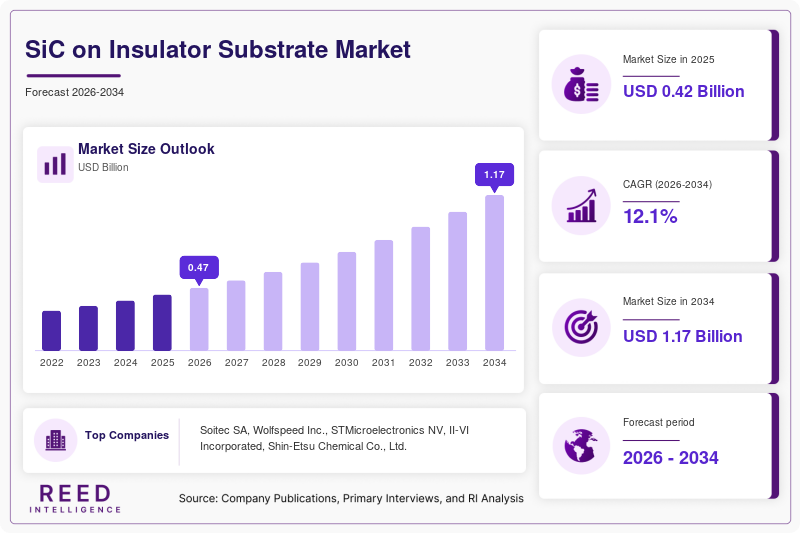
The SiC on Insulator Substrate Market was valued at approximately USD 0.42 billion in 2026 and is projected to reach USD 1.05 billion by 2034, expanding at a compound annual growth rate (CAGR) of 12.1% during 2026–2034. The market is experiencing steady expansion due to the increasing demand for high-performance semiconductor materials in advanced electronics, particularly in power electronics, RF devices, and next-generation communication systems.
A key global factor supporting market growth is the rapid transition toward energy-efficient and high-frequency electronic components. Silicon carbide (SiC) on insulator substrates offers superior thermal conductivity, high breakdown voltage, and improved reliability compared to conventional silicon-based substrates. These advantages make them highly suitable for applications such as electric vehicles, 5G infrastructure, and industrial automation systems. As industries seek to reduce power loss and improve efficiency, the adoption of SiC-based solutions continues to accelerate across multiple sectors.
Key Highlights
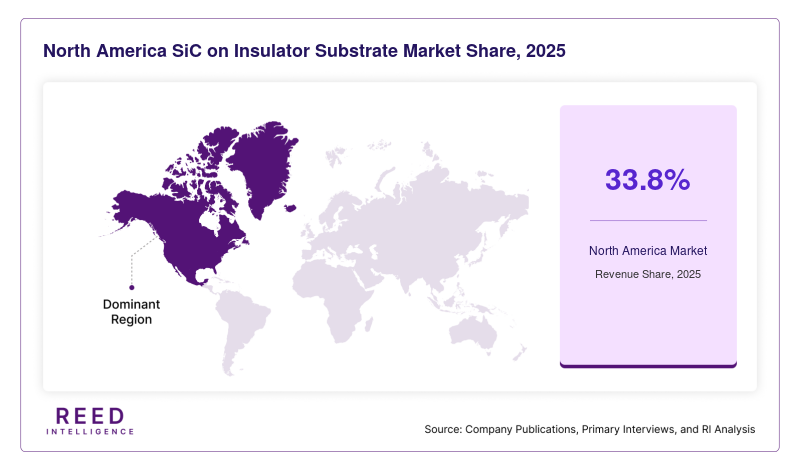
- North America dominated the market with a 33.8% share in 2025.
- Asia Pacific is expected to grow at the fastest CAGR of 13.4% during 2026–2034.
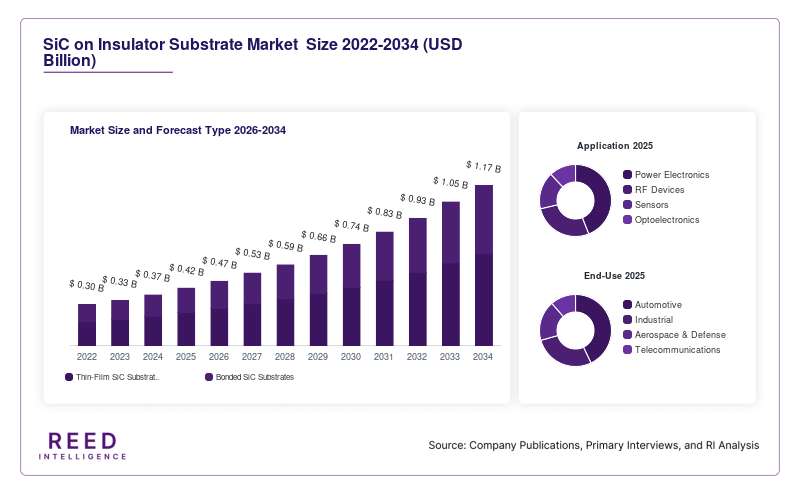
- By type, thin-film SiC substrates accounted for the largest share of 39.6%, while bonded substrates are projected to grow at a CAGR of 13.1%.
- By application, power electronics led with a 44.2% share, whereas RF devices are expected to expand at a CAGR of 12.8%.
- The United States remained the dominant country, with market values of USD 190 million in 2024 and USD 215 million in 2025.
Market Trends
Integration of SiC Substrates in Advanced RF and 5G Applications
The increasing deployment of 5G infrastructure and high-frequency communication systems is driving the integration of SiC on insulator substrates in RF applications. These substrates provide enhanced signal integrity, reduced noise, and improved thermal stability, making them ideal for high-power RF amplifiers and base station components. As telecom operators expand network coverage, the need for reliable and efficient semiconductor materials is rising. SiC on insulator technology enables higher frequency operation while minimizing energy losses, which is critical for maintaining network efficiency. Furthermore, the miniaturization of electronic components has increased the demand for substrates that can handle higher power densities without compromising performance, thereby strengthening this trend.
Growing Adoption in Electric Vehicle Power Systems
The automotive industry is witnessing a shift toward electrification, which is boosting the demand for SiC on insulator substrates in electric vehicle (EV) power systems. These substrates are increasingly used in inverters, onboard chargers, and power control units due to their ability to handle high voltages and temperatures efficiently. Automakers are focusing on improving vehicle range and reducing energy losses, which aligns with the performance characteristics of SiC materials. Additionally, advancements in manufacturing processes are lowering production costs, making these substrates more accessible for large-scale automotive applications. This trend is expected to continue as governments promote EV adoption and invest in charging infrastructure.
Market Drivers
Rising Demand for High-Efficiency Power Electronics
The demand for energy-efficient power electronics is a primary driver of the SiC on insulator substrate market. Industries such as renewable energy, automotive, and industrial automation require components that can operate at high voltages and temperatures with minimal energy loss. SiC substrates offer superior efficiency compared to traditional silicon, enabling better performance in power conversion systems. As energy consumption regulations become stricter, manufacturers are adopting advanced materials to meet compliance standards. This shift is particularly evident in solar inverters and wind power systems, where efficiency directly impacts overall energy output and operational cost savings.
Expansion of Semiconductor Manufacturing Capabilities
The expansion of semiconductor manufacturing facilities worldwide is significantly contributing to market growth. Governments and private organizations are investing heavily in domestic semiconductor production to reduce supply chain dependencies. This has led to increased demand for advanced substrate materials, including SiC on insulator wafers. Additionally, improvements in fabrication technologies, such as wafer bonding and polishing techniques, are enhancing production efficiency and yield rates. As semiconductor devices become more complex, the need for high-quality substrates that can support advanced architectures is increasing, further driving the adoption of SiC on insulator technology.
Market Restraint
High Production Costs and Technical Complexity
One of the major challenges in the SiC on insulator substrate market is the high production cost associated with manufacturing these advanced materials. The fabrication process involves complex techniques such as wafer bonding, epitaxial growth, and precision polishing, which require specialized equipment and expertise. These factors significantly increase the overall cost of production compared to conventional silicon substrates. As a result, smaller manufacturers may find it difficult to enter the market, limiting competition and slowing down innovation.
Additionally, maintaining consistent quality and low defect density remains a technical challenge. Even minor imperfections in the substrate can affect device performance, leading to reduced efficiency and reliability. This is particularly critical in high-power and high-frequency applications where performance standards are stringent. For example, in electric vehicle power systems, any defect in the substrate can lead to energy losses or system failure. These challenges not only impact production scalability but also influence pricing, making it difficult for widespread adoption in cost-sensitive applications. Addressing these issues requires continuous investment in research and development, which further adds to operational costs.
Market Opportunities
Increasing Investments in Renewable Energy Infrastructure
The growing focus on renewable energy presents significant opportunities for the SiC on insulator substrate market. Solar and wind energy systems require efficient power conversion technologies to maximize output and minimize losses. SiC substrates are well-suited for these applications due to their high efficiency and thermal stability. Governments across the globe are investing in renewable energy projects to reduce carbon emissions, which is expected to drive demand for advanced semiconductor materials. Additionally, the integration of smart grid technologies is creating new opportunities for SiC-based components, further expanding the market potential.
Emerging Applications in Aerospace and Defense
The aerospace and defense sector is emerging as a promising area for SiC on insulator substrates. These applications require materials that can withstand extreme environmental conditions, including high temperatures and radiation exposure. SiC substrates offer the durability and reliability needed for such demanding environments. They are increasingly being used in radar systems, satellite communication, and avionics. As defense budgets increase and technological advancements continue, the demand for high-performance semiconductor materials is expected to rise. This creates a strong opportunity for manufacturers to expand their presence in this niche but high-value segment.
Segmental Analysis
By Type
The thin-film SiC substrate segment held the dominant share of 39.6% in 2024, driven by its superior performance characteristics and widespread adoption in high-frequency applications. Thin-film substrates offer better thermal conductivity and reduced defect density, making them suitable for advanced semiconductor devices. Their ability to support miniaturized components without compromising efficiency has made them a preferred choice among manufacturers. Additionally, advancements in fabrication technologies have improved the quality and scalability of thin-film substrates, further strengthening their market position.
The bonded SiC substrate segment is expected to grow at the fastest CAGR of 13.1% during the forecast period. This growth is attributed to the increasing demand for cost-effective and high-performance substrates. Bonded substrates offer improved flexibility in design and enable the integration of multiple materials, enhancing overall device performance. The growing adoption of these substrates in power electronics and RF applications is a key factor driving their rapid growth.
By Application
Power electronics emerged as the leading application segment, accounting for 44.2% of the market share in 2024. The demand for efficient power conversion systems in industries such as automotive, renewable energy, and industrial automation is driving this segment. SiC on insulator substrates are widely used in inverters, converters, and power modules due to their high efficiency and reliability. The increasing adoption of electric vehicles and renewable energy systems further supports the growth of this segment.
RF devices are expected to witness the fastest growth, with a CAGR of 12.8% during the forecast period. The expansion of 5G networks and high-frequency communication systems is driving the demand for advanced RF components. SiC substrates provide superior performance in high-frequency applications, making them ideal for RF devices. The increasing need for efficient communication infrastructure is a key factor contributing to the growth of this segment.
By End-Use
The automotive sector held the largest share of 36.4% in 2024, driven by the increasing adoption of electric vehicles and advanced driver assistance systems. SiC on insulator substrates are used in various automotive applications, including power electronics and sensors. Their ability to operate at high temperatures and voltages makes them suitable for demanding automotive environments. The growing focus on vehicle efficiency and performance is further driving the demand for these substrates.
The aerospace and defense segment is projected to grow at the fastest CAGR of 12.6% during the forecast period. The demand for high-performance materials that can withstand extreme conditions is driving the adoption of SiC substrates in this sector. Applications such as radar systems, satellite communication, and avionics require reliable and durable materials, making SiC on insulator substrates an ideal choice.
Regional Analysis
North America
North America accounted for approximately 33.8% of the global market share in 2025 and is expected to maintain steady growth with a CAGR of around 11.5% during the forecast period. The region benefits from a well-established semiconductor ecosystem and strong demand for advanced electronic components. The presence of leading technology companies and continuous investments in research and development contribute to the adoption of SiC on insulator substrates. Additionally, the growing focus on energy-efficient solutions across industries supports market expansion.
The United States dominates the regional market due to its strong semiconductor manufacturing base and high adoption of advanced technologies. A key growth factor is the increasing investment in electric vehicle infrastructure and renewable energy projects. Government initiatives aimed at boosting domestic semiconductor production are also driving demand for advanced substrate materials, including SiC on insulator wafers.
Europe
Europe held a 24.6% market share in 2025 and is projected to grow at a CAGR of 10.9% during 2026–2034. The region is characterized by strong regulatory frameworks promoting energy efficiency and sustainability. These regulations encourage the adoption of advanced semiconductor materials in various applications, including automotive and industrial sectors. The presence of established automotive manufacturers further supports the demand for SiC-based solutions.
Germany is the dominant country in this region, driven by its robust automotive industry and focus on electric mobility. A unique growth factor is the increasing collaboration between semiconductor companies and automotive manufacturers to develop high-performance power electronics. This collaboration is accelerating the integration of SiC on insulator substrates in next-generation vehicles.
Asia Pacific
Asia Pacific captured around 28.9% of the market share in 2025 and is expected to grow at the fastest CAGR of 13.4% during the forecast period. The region is witnessing rapid industrialization and expansion of semiconductor manufacturing facilities. Countries such as China, Japan, and South Korea are investing heavily in advanced electronics production, which drives demand for high-quality substrates.
China leads the regional market due to its large-scale semiconductor manufacturing capabilities. A key growth factor is the government’s focus on achieving self-sufficiency in semiconductor production. This has resulted in increased investments in advanced materials, including SiC on insulator substrates, to support domestic manufacturing.
Middle East & Africa
The Middle East & Africa region accounted for 6.1% of the market share in 2025 and is expected to grow at a CAGR of 9.8%. The market is gradually expanding due to increasing investments in infrastructure and industrial development. The adoption of advanced semiconductor technologies is still in the early stages but shows significant potential.
The United Arab Emirates is a leading country in this region. A unique growth factor is the growing focus on smart city projects and renewable energy initiatives. These projects require efficient power management systems, creating demand for SiC-based substrates.
Latin America
Latin America held a 6.6% market share in 2025 and is projected to grow at a CAGR of 10.2%. The region is experiencing moderate growth due to increasing industrialization and adoption of advanced technologies. The demand for energy-efficient solutions is driving the use of SiC substrates in various applications.
Brazil dominates the regional market due to its expanding industrial base. A key growth factor is the increasing investment in renewable energy projects, particularly in solar and wind power. This is creating opportunities for the adoption of advanced semiconductor materials.
Competitive Landscape
The SiC on insulator substrate market is moderately consolidated, with key players focusing on technological innovation and strategic partnerships to strengthen their market position. Leading companies are investing in research and development to improve substrate quality and reduce production costs. The market is characterized by the presence of established semiconductor manufacturers as well as emerging players.
Among the top companies, Soitec SA is recognized as a market leader due to its advanced wafer bonding technology and strong product portfolio. The company has recently expanded its production capacity to meet the growing demand for SiC substrates in power electronics and RF applications. Other key players are also focusing on expanding their manufacturing capabilities and forming partnerships with end-use industries to enhance their market presence.
Key Players
- Soitec SA
- Wolfspeed Inc.
- STMicroelectronics NV
- II-VI Incorporated
- Shin-Etsu Chemical Co., Ltd.
- SK Siltron Co., Ltd.
- Coherent Corp.
- ROHM Co., Ltd.
- Infineon Technologies AG
- ON Semiconductor Corporation
- GlobalWafers Co., Ltd.
- Sumitomo Electric Industries, Ltd.
- Fuji Electric Co., Ltd.
- TankeBlue Semiconductor Co., Ltd.
- Norstel AB
Recent Developments
- In 2025, Soitec SA announced the expansion of its SiC substrate production facility to support increasing demand from the automotive sector.
- In 2024, Wolfspeed Inc. introduced a new generation of SiC wafers designed for high-efficiency power applications.
- In 2025, STMicroelectronics NV collaborated with automotive manufacturers to develop advanced power modules using SiC on insulator substrates.
SiC on Insulator Substrate Market Segments
Type
- Thin-Film SiC Substrates
- Bonded SiC Substrates
Application
- Power Electronics
- RF Devices
- Sensors
- Optoelectronics
End-Use
- Automotive
- Industrial
- Aerospace & Defense
- Telecommunications
By Region
- North America
- Europe
- APAC
- Middle East and Africa
- LATAM