Signal Source Module Market Size, Share & Demand Report By Module Type (RF Signal Source Modules, Microwave Signal Source Modules, Arbitrary Waveform Signal Modules, Frequency Synthesizer Modules, Pulse Signal Modules), By Application (Telecommunications Infrastructure, Automotive Electronics, Semiconductor Testing, Industrial Automation, Aerospace and Defense Systems, Medical Electronics), By End-Use Industry (Consumer Electronics, Aerospace and Defense, Automotive, Telecommunications, Industri
USD 3950
Market Overview
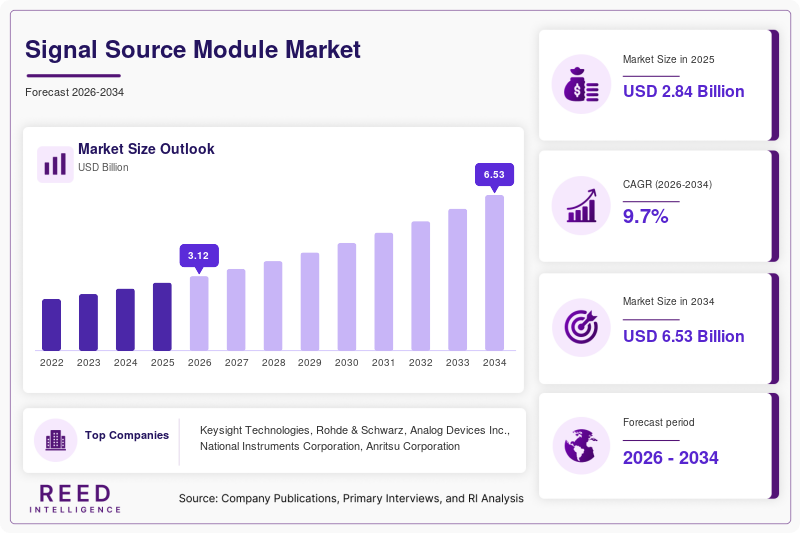
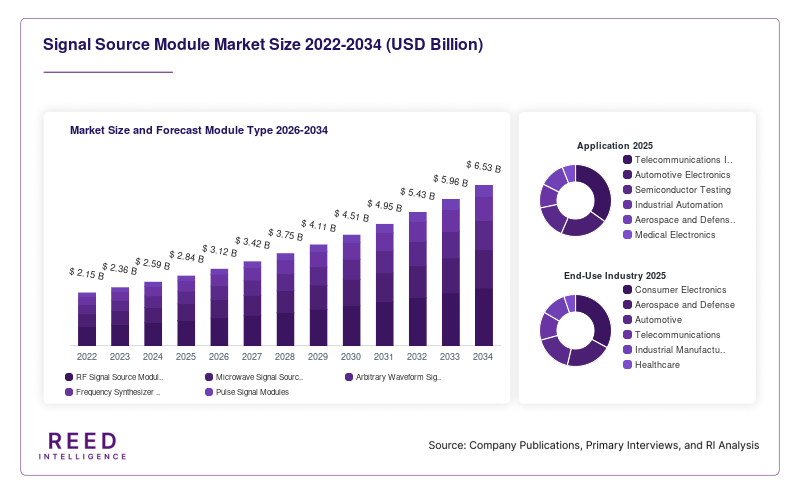
The global Signal Source Module Market size was valued at USD 2.84 billion in 2026 and is projected to reach USD 5.96 billion by 2034, expanding at a compound annual growth rate (CAGR) of 9.7% during the forecast period from 2026 to 2034. Signal source modules are critical electronic components used to generate stable and precise signal frequencies across communication systems, radar equipment, industrial automation platforms, aerospace electronics, and advanced testing instruments. Increasing deployment of high-frequency communication infrastructure and rising demand for precision-based signal generation in semiconductor manufacturing continue to support long-term market expansion.
One of the major global factors supporting the growth of the Signal Source Module Market is the rapid modernization of wireless communication infrastructure. Telecommunications providers and network equipment manufacturers are investing heavily in next-generation connectivity solutions, including 5G and emerging 6G development programs. Signal source modules play an important role in these systems by enabling accurate frequency generation, signal synchronization, and low-noise signal transmission. Demand has also increased from automotive electronics manufacturers integrating advanced driver assistance systems, connected mobility technologies, and vehicle-to-everything communication platforms.
Key Highlights
- North America dominated the market with a 35.1% share in 2025, while Asia Pacific is expected to grow at the fastest CAGR of 11.4% during 2026–2034.
- By module type, RF signal source modules accounted for the largest share of 39.4%, while microwave signal source modules are projected to grow at a CAGR of 12.1%.
- By application, telecommunications infrastructure led with a 36.8% share, whereas automotive electronics is expected to expand at a CAGR of 11.8%.
- By end-use industry, consumer electronics held the dominant share of 33.5%, while aerospace and defense is projected to register a CAGR of 10.9% during the forecast period.
- The United States remained the dominant country, with market values of USD 620 million in 2024 and USD 685 million in 2025.
Market Trends
Integration of High-Frequency Technologies in Communication Infrastructure
The Signal Source Module Market is experiencing substantial transformation due to the increasing adoption of high-frequency communication technologies across both commercial and industrial environments. Telecommunication providers are accelerating investments in advanced network architectures that require precise signal generation for enhanced transmission reliability and network efficiency. Signal source modules capable of operating at microwave and millimeter-wave frequencies are becoming increasingly important in 5G base stations, satellite communication systems, and wireless broadband equipment. Manufacturers are responding by developing compact modules with improved thermal management and lower phase noise characteristics.
The growing use of connected devices and cloud-based applications is also contributing to the need for stable signal transmission systems. Enterprise networking infrastructure, smart factories, and intelligent transportation systems require reliable frequency generation to maintain operational consistency. As communication standards continue to evolve, component manufacturers are focusing on programmable and software-defined signal source modules that can support multiple frequency bands and flexible deployment requirements. This trend is expected to strengthen market competition while encouraging continued product innovation across global markets.
Expansion of Automated Testing and Semiconductor Manufacturing Applications
The increasing complexity of semiconductor devices and electronic systems is creating strong demand for precision testing solutions, supporting growth in the Signal Source Module Market. Semiconductor fabrication facilities are deploying advanced signal generators and automated test equipment to ensure consistent quality control during chip manufacturing processes. Signal source modules are widely used in calibration systems, oscilloscopes, spectrum analyzers, and electronic testing platforms that require highly accurate signal output.
Automation trends within industrial manufacturing are further contributing to market growth. Robotics systems, industrial sensors, and machine control technologies require stable signal generation for synchronization and performance monitoring. Companies are increasingly adopting modular testing platforms that integrate programmable signal source modules for improved flexibility and faster operational adjustments. In addition, the development of electric vehicles and advanced battery management systems is increasing the need for sophisticated testing infrastructure, creating additional opportunities for signal source module manufacturers across automotive and industrial electronics sectors.
Market Drivers
Rising Demand for Advanced Wireless Communication Systems
The rapid expansion of wireless communication infrastructure continues to drive strong demand for signal source modules worldwide. Telecommunications operators are investing in high-speed data networks to support increasing internet traffic, connected devices, and low-latency applications. Signal source modules are essential for maintaining accurate frequency generation and synchronization in wireless communication equipment, including routers, antennas, base stations, and satellite systems. As network coverage expands into remote and densely populated urban areas, manufacturers are increasing production of high-performance modules designed for reliable signal stability.
The transition toward next-generation communication standards is also supporting market expansion. Emerging 6G research programs and private industrial network deployments require advanced electronic components capable of handling higher frequencies and improved bandwidth efficiency. Demand for compact and energy-efficient communication hardware is encouraging innovation in module miniaturization and integration. In addition, increasing adoption of Internet of Things devices across healthcare, logistics, and manufacturing industries is creating a broader application base for signal source modules, supporting sustained revenue growth throughout the forecast period.
Growing Investments in Aerospace and Defense Electronics
Aerospace and defense organizations are significantly increasing investments in radar systems, electronic warfare technologies, and secure communication infrastructure, contributing to the growth of the Signal Source Module Market. Modern defense systems rely on highly stable and low-noise signal generation for mission-critical applications, including surveillance, navigation, targeting, and satellite communication. Signal source modules are widely used in military testing equipment and advanced avionics platforms that require precise frequency control under demanding operating conditions.
Government initiatives aimed at strengthening national security and upgrading aging defense infrastructure are further supporting market demand. Several countries are increasing budgets for defense modernization programs focused on unmanned aerial vehicles, missile guidance systems, and advanced radar technologies. Aerospace manufacturers are also integrating more sophisticated communication and navigation electronics into commercial aircraft systems. These developments are encouraging suppliers to produce ruggedized and high-frequency signal modules capable of operating in extreme environmental conditions, creating long-term opportunities across both defense and commercial aerospace sectors.
Market Restraint
High Development Costs and Complex Design Requirements
The Signal Source Module Market faces challenges related to high product development costs and increasingly complex design requirements. Advanced signal source modules require sophisticated semiconductor materials, precision engineering processes, and extensive testing procedures to ensure stable performance across varying operational environments. Manufacturers often invest heavily in research and development activities to improve signal accuracy, reduce phase noise, and support wider frequency ranges. These investments can increase production expenses and create barriers for small and medium-sized companies attempting to enter the market.
The complexity of integrating signal source modules into modern communication and industrial systems also creates operational difficulties for end users. High-frequency modules often require advanced calibration, thermal management, and electromagnetic compatibility measures to maintain performance reliability. In sectors such as aerospace and defense, strict certification standards further increase deployment timelines and engineering costs. Supply chain disruptions affecting semiconductor components and specialty electronic materials can additionally impact production schedules and pricing stability. These factors may limit adoption among cost-sensitive industries and reduce profit margins for manufacturers operating in highly competitive environments.
Market Opportunities
Increasing Adoption of Electric Vehicles and Connected Mobility Systems
The rapid growth of electric vehicles and connected transportation technologies is creating substantial opportunities for the Signal Source Module Market. Modern vehicles increasingly rely on sophisticated communication systems, radar sensors, battery management platforms, and advanced driver assistance technologies that require precise signal generation and synchronization. Signal source modules are widely integrated into automotive testing systems, infotainment platforms, and vehicle communication networks to improve operational accuracy and system reliability.
Automotive manufacturers are also investing in autonomous driving technologies that depend on radar and wireless communication systems for real-time data exchange and environmental monitoring. These systems require stable frequency generation and low-noise performance to ensure safe and efficient operation. Governments across several countries are supporting electric mobility adoption through incentives and infrastructure investments, encouraging automotive electronics suppliers to expand production capabilities. As vehicle connectivity continues to evolve, demand for compact and energy-efficient signal source modules is expected to increase significantly across the automotive sector.
Growth of Industrial IoT and Smart Manufacturing Infrastructure
The expansion of industrial Internet of Things infrastructure and smart manufacturing technologies presents significant opportunities for signal source module manufacturers. Factories are increasingly adopting connected machinery, intelligent sensors, and automated control systems to improve operational efficiency and reduce production downtime. Signal source modules play an important role in maintaining synchronization, communication accuracy, and performance testing across industrial automation environments.
Manufacturers are also deploying predictive maintenance systems and remote monitoring technologies that depend on stable wireless communication and sensor calibration. This is increasing the demand for programmable signal generation equipment capable of supporting multiple industrial protocols and operating frequencies. Smart energy grids, digital healthcare systems, and intelligent logistics networks are creating additional application areas for advanced signal source modules. Companies focusing on miniaturized designs, energy-efficient architectures, and integrated software control capabilities are expected to benefit from the growing adoption of smart manufacturing infrastructure during the forecast period.
Segmental Analysis
By Module Type
RF signal source modules accounted for the largest share of the Signal Source Module Market in 2024, representing 39.4% of total revenue. These modules are widely used in wireless communication systems, industrial testing equipment, and satellite communication infrastructure due to their ability to deliver stable frequency output and low signal distortion. Telecommunications providers continue to rely on RF modules for network deployment and maintenance activities associated with high-speed connectivity systems. In addition, RF signal source modules are increasingly integrated into automated testing environments across semiconductor manufacturing facilities.
The microwave signal source modules segment is projected to register the fastest CAGR of 12.1% during the forecast period. Growth is primarily driven by rising demand for high-frequency communication systems, radar applications, and aerospace electronics. Microwave modules are increasingly used in advanced defense systems and next-generation satellite communication equipment that require precise signal generation at higher frequency bands. Manufacturers are investing in compact module designs with improved thermal efficiency and lower phase noise characteristics. The growing adoption of millimeter-wave technologies in 5G and emerging 6G networks is also accelerating demand for microwave signal source modules across global markets.
By Application
Telecommunications infrastructure represented the dominant application segment in 2024, accounting for 36.8% of the global Signal Source Module Market share. Signal source modules are widely used in base stations, antennas, network analyzers, and signal testing equipment that support wireless communication systems. The rapid deployment of 5G infrastructure across developed and emerging economies continues to increase demand for precise signal generation technologies. Telecommunication companies are also upgrading existing network equipment to improve transmission reliability and reduce operational downtime, supporting sustained growth within this application segment.
Automotive electronics is expected to emerge as the fastest-growing application segment, registering a CAGR of 11.8% during 2026–2034. The increasing adoption of electric vehicles, connected mobility systems, and advanced driver assistance technologies is creating strong demand for sophisticated electronic testing and communication solutions. Signal source modules are essential for radar calibration, vehicle communication systems, and battery management testing platforms. Automotive manufacturers are investing heavily in autonomous driving technologies that require highly accurate signal generation and synchronization. The growing integration of wireless connectivity features into passenger and commercial vehicles is expected to further strengthen market demand.
By End-Use Industry
Consumer electronics accounted for the largest share of the Signal Source Module Market in 2024, contributing 33.5% of total revenue. The segment benefits from rising global demand for smartphones, wearable devices, smart home products, and wireless entertainment systems. Signal source modules are essential for product testing, wireless connectivity validation, and semiconductor calibration within consumer electronics manufacturing processes. Electronics companies are increasingly focusing on compact product designs and high-speed connectivity features, which require advanced signal generation capabilities for quality assurance and performance optimization.
Aerospace and defense is projected to witness the fastest growth during the forecast period, with an estimated CAGR of 10.9%. Increasing investment in advanced radar systems, electronic warfare technologies, and satellite communication infrastructure is driving demand for precision signal generation solutions. Defense agencies and aerospace manufacturers require highly reliable modules capable of operating under extreme environmental conditions. Signal source modules are widely used in avionics testing, secure communication systems, and military surveillance equipment. Rising government spending on defense modernization programs and the growing use of unmanned aerial systems are expected to create long-term growth opportunities for suppliers serving this industry segment.
Regional Analysis
North America
North America accounted for 35.1% of the global Signal Source Module Market share in 2025 and is expected to maintain a steady growth trajectory with a forecast CAGR of 8.9% during 2026–2034. The region benefits from strong investments in telecommunications infrastructure, aerospace technologies, and semiconductor manufacturing capabilities. Major technology companies are actively deploying advanced wireless communication systems and cloud computing networks that require high-performance signal generation equipment. Demand from defense modernization programs and industrial automation initiatives further supports regional market expansion.
The United States remains the dominant country within the North American market due to its strong defense electronics industry and advanced research ecosystem. Increasing investment in radar modernization, satellite communication systems, and semiconductor fabrication facilities is supporting demand for precision signal source modules. The country also benefits from the presence of leading electronic component manufacturers and testing equipment suppliers. Rising deployment of private 5G networks across manufacturing and logistics industries represents a unique growth factor contributing to continued market development.
Europe
Europe held a considerable share of the Signal Source Module Market in 2025 and is projected to expand at a CAGR of 8.4% during the forecast period. The region benefits from strong industrial automation adoption, growing electric vehicle production, and increasing investments in advanced communication infrastructure. European manufacturers are focusing on improving production efficiency through connected industrial systems and precision electronic testing equipment. Demand for signal source modules is also supported by the expansion of renewable energy systems and intelligent transportation networks across several countries.
Germany represents the leading country within the European market due to its strong automotive manufacturing base and advanced industrial engineering capabilities. The country is investing heavily in factory automation, electric mobility technologies, and semiconductor research initiatives. German automotive manufacturers are integrating sophisticated radar and connectivity systems into next-generation vehicles, increasing the need for stable signal generation technologies. A unique growth factor in the country is the rapid implementation of Industry 4.0 infrastructure, which continues to create demand for programmable testing and communication equipment.
Asia Pacific
Asia Pacific is projected to register the fastest growth in the Signal Source Module Market, with a forecast CAGR of 11.4% during 2026–2034. The region benefits from expanding consumer electronics production, rapid deployment of wireless communication infrastructure, and strong semiconductor manufacturing activity. Countries across Asia Pacific are investing in smart city projects, industrial automation systems, and high-speed connectivity networks that require advanced signal generation technologies. The presence of large-scale electronics manufacturing facilities also contributes to increasing demand for testing and calibration equipment.
China remains the dominant country in the Asia Pacific market due to its extensive electronics manufacturing ecosystem and growing investments in telecommunications infrastructure. The country is actively expanding 5G coverage, semiconductor production capabilities, and industrial robotics deployment. Domestic technology companies are increasingly developing advanced communication equipment and automotive electronics systems, driving demand for high-frequency signal modules. A unique growth factor supporting the Chinese market is government-backed investment in semiconductor self-sufficiency initiatives aimed at strengthening local electronic component production.
Middle East & Africa
The Middle East & Africa region is witnessing gradual growth in the Signal Source Module Market and is expected to expand at a CAGR of 7.6% during the forecast period. Investments in communication infrastructure, defense modernization, and energy sector automation are contributing to regional market development. Several countries are deploying advanced wireless networks and industrial monitoring systems to support economic diversification programs. Demand for electronic testing equipment and signal generation systems is increasing across telecommunications, oil and gas, and transportation industries.
Saudi Arabia represents the leading country in the regional market due to its increasing investment in smart infrastructure and defense technologies. The country is expanding digital connectivity projects and industrial automation initiatives as part of long-term economic transformation plans. Growth in satellite communication projects and energy infrastructure modernization is creating additional opportunities for signal source module providers. A unique growth factor in Saudi Arabia is the rapid development of large-scale smart city projects that require advanced wireless communication and monitoring systems.
Latin America
Latin America accounted for a smaller but steadily expanding share of the Signal Source Module Market in 2025 and is projected to grow at a CAGR of 7.9% during 2026–2034. Increasing investment in telecommunication networks, industrial digitization, and automotive manufacturing activities is supporting regional demand. Companies across the region are upgrading network infrastructure and deploying advanced testing systems to improve communication reliability. Growth in renewable energy projects and intelligent transportation systems is also contributing to increased adoption of signal generation technologies.
Brazil remains the dominant country within the Latin American market due to its expanding industrial sector and growing telecommunications investments. The country is focusing on improving digital connectivity and supporting modernization within manufacturing industries. Automotive production facilities and industrial automation projects are creating sustained demand for electronic testing and signal generation equipment. A unique growth factor supporting the Brazilian market is the expansion of rural broadband infrastructure projects, which require reliable communication systems and advanced network testing technologies.

Competitive Landscape
The Signal Source Module Market is characterized by strong competition among global electronics manufacturers, semiconductor companies, and communication technology providers. Market participants are focusing on product innovation, frequency range expansion, and improved signal stability to strengthen their competitive positioning. Companies are also investing in research and development activities aimed at supporting high-frequency applications across telecommunications, aerospace, automotive, and industrial automation sectors.
Keysight Technologies remains one of the leading companies in the market due to its extensive portfolio of electronic testing and signal generation solutions. The company continues to expand its microwave and RF testing capabilities to address increasing demand from 5G infrastructure and semiconductor manufacturing applications. Rohde & Schwarz, Analog Devices, National Instruments, and Anritsu Corporation also maintain strong market positions through continuous product development and strategic collaborations with communication equipment manufacturers.
Key Players
- Keysight Technologies
- Rohde & Schwarz
- Analog Devices Inc.
- National Instruments Corporation
- Anritsu Corporation
- Tektronix Inc.
- Texas Instruments Incorporated
- Qorvo Inc.
- Infineon Technologies AG
- Murata Manufacturing Co., Ltd.
- NXP Semiconductors
- Renesas Electronics Corporation
- Cobham Limited
- Mini-Circuits
- Teledyne Technologies Incorporated
Recent Developments
- In February 2026, Keysight Technologies introduced a new microwave signal source module platform designed for high-frequency 6G research and advanced semiconductor testing applications.
- In August 2025, Rohde & Schwarz expanded its manufacturing operations in Southeast Asia to strengthen production capacity for programmable RF signal generation systems.
- In November 2025, Analog Devices announced a collaboration with an automotive electronics manufacturer to develop compact signal source modules for autonomous driving radar systems.
- In January 2026, Anritsu Corporation launched an upgraded signal testing solution featuring enhanced phase noise reduction capabilities for satellite communication applications.
- In April 2026, National Instruments introduced integrated software-defined control functionality within its industrial signal source module portfolio to support smart factory automation systems.
Signal Source Module Market Segments
Module Type
- RF Signal Source Modules
- Microwave Signal Source Modules
- Arbitrary Waveform Signal Modules
- Frequency Synthesizer Modules
- Pulse Signal Modules
Application
- Telecommunications Infrastructure
- Automotive Electronics
- Semiconductor Testing
- Industrial Automation
- Aerospace and Defense Systems
- Medical Electronics
End-Use Industry
- Consumer Electronics
- Aerospace and Defense
- Automotive
- Telecommunications
- Industrial Manufacturing
- Healthcare
By Region
- North America
- Europe
- APAC
- Middle East and Africa
- LATAM