Silicon Drift Detectors Market Size, Share & Demand Report By Type (Standard Silicon Drift Detectors, Large-Area Silicon Drift Detectors), By Application (X-ray Spectroscopy, Electron Microscopy, Nuclear Spectroscopy, Environmental Monitoring), By End-Use Industry (Electronics & Semiconductor, Healthcare, Industrial Manufacturing, Research & Academia, Mining & Environmental), By Cooling Technology (Thermoelectric Cooling, Cryogenic Cooling), By Region & Segment Forecasts, 2025–2034
USD 3950
Market Overview
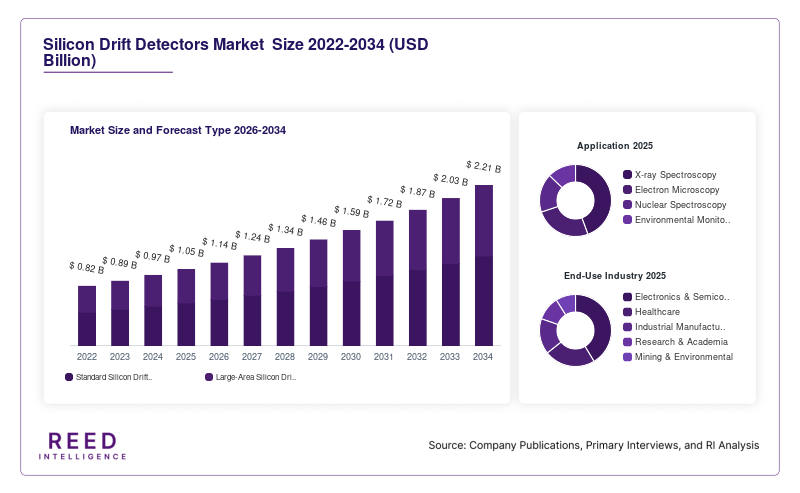
The global Silicon Drift Detectors Market size was valued at approximately USD 1.05 billion in 2025 and is projected to reach USD 2.21 billion by 2034, expanding at a CAGR of 8.6% during the forecast period (2025–2034). The market has been witnessing steady expansion due to the increasing demand for high-resolution X-ray spectroscopy across industrial, medical, and research applications.
A key global factor supporting market growth has been the rising adoption of advanced analytical instrumentation in semiconductor manufacturing and material science research. Silicon drift detectors (SDDs) offer superior energy resolution, faster signal processing, and compact design, making them suitable for modern high-throughput analytical systems. This has encouraged their integration into X-ray fluorescence (XRF), electron microscopy, and nuclear instrumentation.
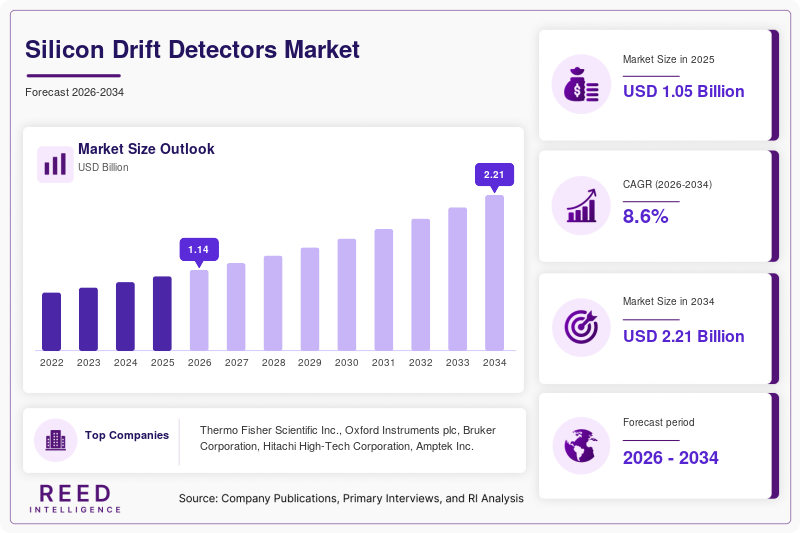
Key Highlights:
- North America dominated the market with a share of 38.2% in 2025, while Asia Pacific is expected to register the fastest CAGR of 10.2%.
- By type, standard silicon drift detectors led with a share of 61.5%, while large-area SDDs are projected to grow fastest at a CAGR of 9.4%.
- By application, X-ray spectroscopy accounted for the largest share, whereas electron microscopy integration is anticipated to grow at a CAGR of 9.8%.
- The United States remained the dominant country, with market values of USD 320 million in 2024 and USD 347 million in 2025.
Market Trends
Integration of SDDs in Advanced Imaging Systems
A significant trend shaping the Silicon Drift Detectors Market is the increasing integration of SDDs into advanced imaging and analytical systems. These detectors are being embedded in electron microscopes, portable XRF analyzers, and synchrotron-based systems to enhance resolution and speed. The growing need for real-time elemental analysis in industries such as aerospace and electronics is accelerating this trend. Manufacturers are focusing on compact designs that can be seamlessly integrated into multi-modal systems.
Shift Toward Portable and Field-Deployable Devices
Another notable trend is the rising demand for portable and handheld analytical devices. Silicon drift detectors are increasingly used in portable XRF instruments for environmental monitoring, mining exploration, and on-site quality control. Improvements in power efficiency and detector sensitivity have enabled the development of lightweight devices without compromising performance. This shift is expanding the application scope of SDDs beyond laboratory settings to field-based operations.
Market Drivers
Rising Demand for High-Resolution Spectroscopy
The increasing need for precise material characterization is a major driver of the Silicon Drift Detectors Market. Industries such as electronics, pharmaceuticals, and metallurgy require accurate elemental analysis to ensure product quality and compliance. Silicon drift detectors provide high energy resolution and faster processing, making them ideal for such applications. This demand is further supported by the growth of advanced manufacturing technologies.
Expansion of Semiconductor and Electronics Industry
The rapid expansion of the global semiconductor and electronics sector is significantly driving market growth. Silicon drift detectors are widely used in wafer inspection and failure analysis processes. As chip manufacturing becomes more complex, the demand for accurate and efficient analytical tools is increasing. The proliferation of consumer electronics, electric vehicles, and IoT devices is further boosting the need for semiconductor production, indirectly supporting the market.
Market Restraint
High Cost of Advanced Detector Systems
One of the major restraints in the Silicon Drift Detectors Market is the high cost associated with advanced detector systems. Silicon drift detectors, especially those integrated into sophisticated analytical instruments, involve significant manufacturing and calibration costs. The need for specialized electronics, cooling systems, and precision engineering increases overall expenses.
This cost factor limits adoption among small and medium-sized enterprises and research institutions with constrained budgets. Additionally, maintenance and operational costs can further add to the financial burden, making it challenging for end users to justify the investment.
While technological advancements are gradually reducing costs, affordability remains a key concern in emerging markets. The lack of cost-effective alternatives with comparable performance further restricts widespread adoption. As a result, market growth may face limitations in price-sensitive regions.
Market Opportunities
Growth in Environmental Monitoring Applications
The increasing focus on environmental sustainability is creating new opportunities in the Silicon Drift Detectors Market. SDDs are widely used in portable XRF analyzers for detecting pollutants and hazardous elements in soil, water, and air. Government regulations and environmental safety standards are encouraging the adoption of advanced monitoring tools. This trend is expected to drive demand for SDD-based devices in environmental applications.
Advancements in Medical Diagnostics
Emerging applications in medical diagnostics present another significant opportunity. Silicon drift detectors are being explored for use in X-ray imaging and radiation detection systems in healthcare. Their high sensitivity and fast response times make them suitable for advanced diagnostic tools. As healthcare infrastructure improves globally and demand for accurate diagnostics increases, the adoption of SDDs in medical applications is expected to grow steadily.
Segmental Analysis
By Type
Standard silicon drift detectors dominated the market with a 61.5% share in 2024, owing to their widespread use in general-purpose analytical instruments. Their balanced performance and cost-effectiveness made them suitable for a wide range of applications.
Large-area silicon drift detectors will grow at the fastest CAGR of 9.4%, driven by their ability to capture higher signal intensities. These detectors will be increasingly used in high-end spectroscopy applications where enhanced sensitivity is required.
By Application
X-ray spectroscopy held the largest share of 54.2% in 2024, as silicon drift detectors are extensively used in XRF and energy-dispersive spectroscopy systems. Their high resolution and fast processing capabilities supported their dominance.
Electron microscopy integration will grow at a CAGR of 9.8%, driven by the increasing use of advanced microscopes in research and industrial applications. The need for precise elemental mapping will support this segment’s growth.
By End-Use Industry
The electronics and semiconductor industry accounted for 33.7% of the market share in 2024, due to the widespread use of SDDs in wafer inspection and failure analysis. The growing complexity of electronic components supported this segment’s dominance.
The healthcare sector will witness the fastest growth at a CAGR of 9.1%, driven by the increasing adoption of advanced diagnostic tools. The integration of SDDs in medical imaging systems will contribute to this growth.
By Cooling Technology
Thermoelectric cooling systems dominated with a 58.9% share in 2024, as they offer compact design and low maintenance. These systems are widely used in portable and laboratory instruments.
Cryogenic cooling systems will grow at a CAGR of 8.7%, driven by their superior performance in high-precision applications. Their ability to reduce noise levels will support their adoption in advanced research setups.
Regional Analysis
North America
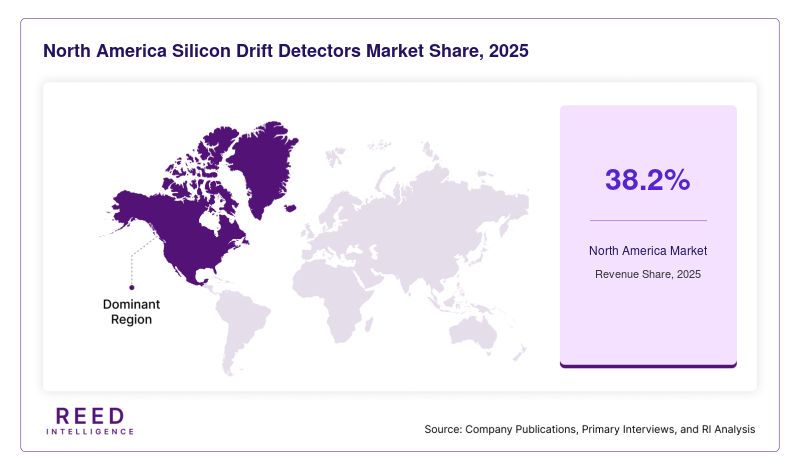
North America accounted for 38.2% of the Silicon Drift Detectors Market share in 2025 and maintained a strong presence due to its advanced technological infrastructure. The region will grow at a CAGR of 7.8% during the forecast period. The presence of well-established research institutions and a strong semiconductor industry supported market expansion.
The United States dominated the regional market due to high investments in scientific research and defense applications. The country’s focus on advanced material analysis and strong funding for innovation contributed significantly to market growth.
Europe
Europe held a 26.5% market share in 2025 and will expand at a CAGR of 8.1% through 2034. The region’s growth was driven by strong demand for analytical instruments in industrial and research sectors. Regulatory standards for material testing and quality assurance supported the adoption of silicon drift detectors.
Germany emerged as the dominant country, driven by its robust manufacturing sector and focus on precision engineering. The country’s emphasis on industrial automation and quality control played a key role in driving demand.
Asia Pacific
Asia Pacific captured 21.8% of the market share in 2025 and is projected to grow at the fastest CAGR of 10.2%. The region’s rapid industrialization and increasing investments in semiconductor manufacturing fueled market growth. Rising adoption of advanced analytical technologies in developing economies also contributed to expansion.
China dominated the region due to its large-scale electronics manufacturing base. The country’s focus on expanding semiconductor production and research capabilities supported strong demand for silicon drift detectors.
Middle East & Africa
The Middle East & Africa region accounted for 7.1% of the market share in 2025 and is expected to grow at a CAGR of 7.3%. Growth was supported by increasing investments in industrial development and resource exploration. The adoption of analytical instruments in mining and oil industries contributed to market expansion.
Saudi Arabia led the region, driven by its focus on industrial diversification and technological advancement. Investments in research and development supported the adoption of advanced detection systems.
Latin America
Latin America held a 6.4% share in 2025 and will grow at a CAGR of 7.6% during the forecast period. The region’s growth was driven by increasing demand for material analysis in mining and environmental monitoring applications.
Brazil emerged as the dominant country due to its strong mining industry and growing focus on environmental compliance. The need for accurate elemental analysis supported the adoption of silicon drift detectors.
Competitive Landscape
The Silicon Drift Detectors Market is moderately consolidated, with key players focusing on technological innovation and product development. Companies are investing in improving detector resolution, reducing noise, and enhancing portability.
One leading player in the market is Thermo Fisher Scientific, which continues to strengthen its position through product innovation and strategic partnerships. The company recently introduced advanced SDD solutions with improved energy resolution for spectroscopy applications.
Other major players are focusing on expanding their global presence and enhancing their product portfolios. Collaborations with research institutions and investments in R&D are common strategies adopted by market participants to maintain competitiveness.
Key Players
- Thermo Fisher Scientific Inc.
- Oxford Instruments plc
- Bruker Corporation
- Hitachi High-Tech Corporation
- Amptek Inc.
- KETEK GmbH
- PNDetector GmbH
- Canberra Industries (Mirion Technologies)
- HORIBA Ltd.
- Rigaku Corporation
Recent Developments
- In 2024, leading manufacturers introduced next-generation silicon drift detectors with enhanced signal processing capabilities.
- In 2025, companies expanded their product lines to include compact SDDs for portable analytical devices.
- Strategic collaborations between detector manufacturers and research institutions increased significantly to drive innovation.
- Several players invested in AI-integrated spectroscopy systems to improve analytical accuracy.
Silicon Drift Detectors Market Segments
Type
- Standard Silicon Drift Detectors
- Large-Area Silicon Drift Detectors
Application
- X-ray Spectroscopy
- Electron Microscopy
- Nuclear Spectroscopy
- Environmental Monitoring
End-Use Industry
- Electronics & Semiconductor
- Healthcare
- Industrial Manufacturing
- Research & Academia
- Mining & Environmental
Cooling Technology
- Thermoelectric Cooling
- Cryogenic Cooling
By Region
- North America
- Europe
- APAC
- Middle East and Africa
- LATAM