Silicone Impression Material Market Size, Share & Demand Report By Product Type (Addition Silicone Impression Materials, Condensation Silicone Impression Materials), By Application (Restorative Dentistry, Orthodontics, Prosthodontics), By End-Use (Dental Clinics, Hospitals, Dental Laboratories, Academic and Research Institutes), By Distribution Channel (Direct Sales, Distributors and Wholesalers, Online Sales Channels) By Region & Segment Forecasts, 2026–2034
USD 3950
Market Overview
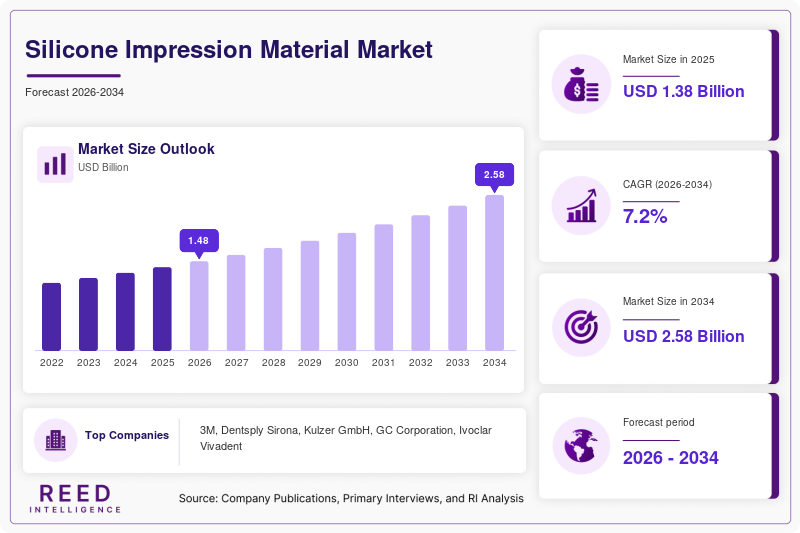
The Silicone Impression Material Market size was valued at USD 1.38 billion in 2026 and is projected to reach USD 2.41 billion by 2034, expanding at a CAGR of 7.2% during the forecast period from 2026 to 2034. The global Silicone Impression Material Market growth has been supported by the increasing global demand for restorative and cosmetic dental procedures, along with growing adoption of advanced dental impression technologies. Rising awareness regarding oral healthcare and expanding access to modern dental treatment facilities have further accelerated market development.
Silicone impression materials are widely used in dentistry to create accurate dental impressions for crowns, bridges, dentures, implants, orthodontic devices, and restorative applications. These materials offer dimensional stability, high precision, tear resistance, and improved elasticity, making them suitable for complex dental procedures. Increasing preference for precision-based restorative dentistry and prosthodontic treatments has strengthened demand for silicone-based dental impression products across hospitals, dental clinics, and specialized laboratories.
Key Highlights
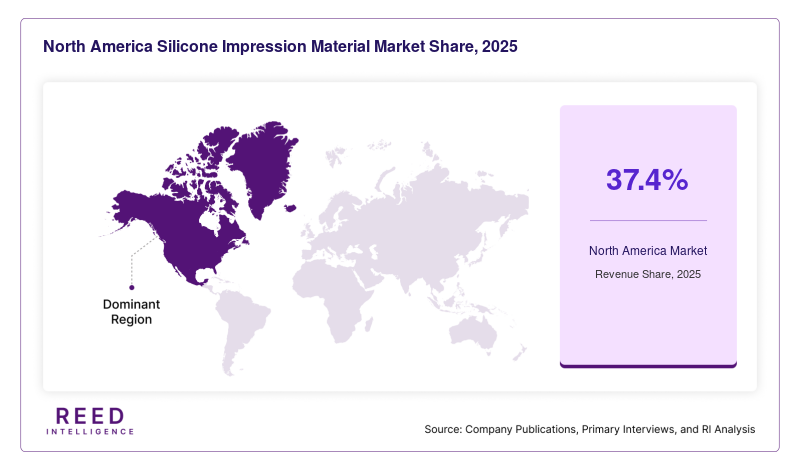
- North America accounted for 37.4% of the global Silicone Impression Material Market share in 2025, while Asia Pacific is expected to register the fastest CAGR of 8.1% during 2026–2034.
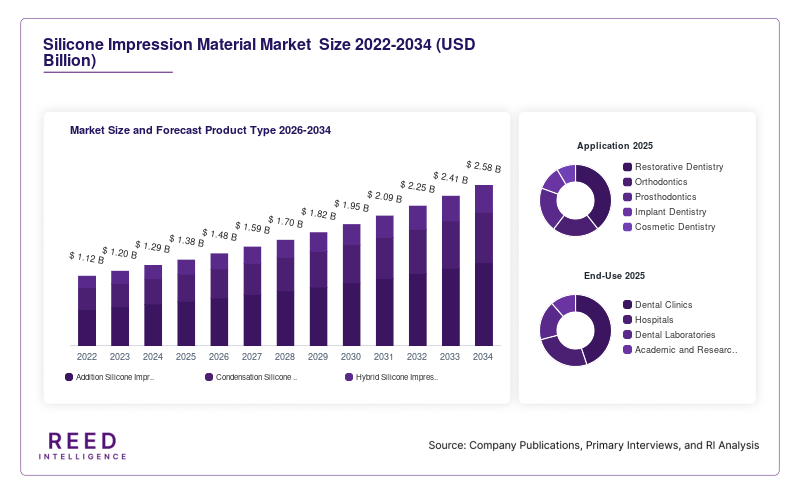
- By product type, addition silicone impression materials held the largest share of 56.8% in 2025, whereas hybrid silicone impression materials are projected to expand at the fastest CAGR of 8.5% through 2034.
- By application, restorative dentistry represented the largest share of 41.2% in 2025, while implant dentistry is expected to grow at a CAGR of 8.4%.
- By end-use, dental clinics led the market with 52.6% share in 2025, whereas dental laboratories are projected to witness the fastest CAGR of 7.9%.
- By distribution channel, direct sales accounted for the highest share of 47.3% in 2025, while online distribution channels are forecast to grow at a CAGR of 8.7%.
- The United States remained the dominant country in the market and was valued at USD 364.5 million in 2024, increasing to USD 389.8 million in 2025 due to rising cosmetic dentistry procedures and growing adoption of advanced restorative dental materials.
Market Trends
Increasing Adoption of Digital Dentistry Integration
The Silicone Impression Material Market has been witnessing increasing integration of digital dentistry workflows across dental practices and laboratories. Dental professionals are combining conventional silicone impression materials with digital scanning technologies to improve treatment accuracy and streamline restorative procedures. Hybrid workflows that integrate physical impressions with CAD/CAM systems are gaining traction in modern prosthodontics and implantology applications.
Growing Demand for Fast-Setting Impression Materials
The increasing preference for fast-setting dental impression materials has emerged as another important trend shaping the Silicone Impression Material Market. Dental practitioners are emphasizing reduced chairside treatment time and improved patient comfort during restorative procedures. Manufacturers are introducing rapid-curing silicone formulations with enhanced flow properties and dimensional stability to improve clinical efficiency.
Market Drivers
Rising Demand for Cosmetic and Restorative Dentistry
The increasing demand for cosmetic and restorative dental procedures has significantly supported the growth of the Silicone Impression Material Market. Rising consumer awareness regarding dental aesthetics and oral functionality has accelerated the adoption of crowns, bridges, veneers, dentures, and implants. Dentists require high-precision impression materials to ensure accurate prosthetic fabrication and successful restorative outcomes.
Expansion of Global Dental Healthcare Infrastructure
The rapid expansion of dental healthcare infrastructure across developed and developing economies has accelerated market growth. Governments and private healthcare providers are investing in advanced dental clinics, specialized oral care centers, and prosthodontic laboratories. Increasing accessibility to professional dental care services has strengthened procurement of advanced silicone impression products.
Market Restraint
Rising Adoption of Intraoral Scanning Technologies
One of the major restraints affecting the Silicone Impression Material Market is the increasing adoption of intraoral scanning technologies and digital impression systems. Advanced digital scanning devices reduce the need for conventional dental impression materials in certain restorative procedures. Large dental clinics and technologically advanced healthcare facilities are increasingly transitioning toward fully digital workflows.
Market Opportunities
Development of Biocompatible and Hydrophilic Materials
The growing focus on biocompatible and hydrophilic dental materials presents favorable opportunities for the Silicone Impression Material Market. Manufacturers are developing advanced silicone formulations designed to improve moisture tolerance, patient comfort, and impression accuracy. Increasing demand for patient-friendly dental materials is expected to support future product innovation.
Expansion of Dental Tourism in Emerging Economies
The expansion of dental tourism across emerging economies is creating another important opportunity for market participants. Countries offering cost-effective restorative and cosmetic dental procedures are attracting international patients, increasing demand for advanced dental consumables and impression materials. Rising investments in private dental clinics and specialized treatment centers will continue supporting market penetration.
Segmental Analysis
By Product Type
Based on product type, the Silicone Impression Material Market is segmented into addition silicone impression materials, condensation silicone impression materials, and hybrid silicone impression materials.
Addition silicone impression materials dominated the market with a 56.8% share in 2025 due to their superior dimensional stability, high accuracy, and excellent tear resistance. Dental professionals widely preferred addition silicone products for implant impressions, prosthodontics, and precision restorative procedures.
Hybrid silicone impression materials are expected to witness the fastest CAGR of 8.5% during the forecast period. The growth will be driven by increasing demand for materials that combine enhanced elasticity, moisture tolerance, and improved setting characteristics.
By Application
Based on application, the market is categorized into restorative dentistry, orthodontics, prosthodontics, implant dentistry, and cosmetic dentistry.
Restorative dentistry accounted for the largest market share of 41.2% in 2025 owing to increasing demand for crowns, bridges, fillings, and occlusal correction procedures. Dental practitioners relied heavily on silicone impression materials for accurate restoration fabrication and treatment planning.
Implant dentistry is projected to grow at the fastest CAGR of 8.4% from 2026 to 2034. The segment growth will be supported by increasing global dental implant procedures and growing adoption of advanced implant-supported prosthetic systems.
By End-Use
Based on end-use, the Silicone Impression Material Market is segmented into dental clinics, hospitals, dental laboratories, and academic and research institutes.
Dental clinics held the dominant market share of 52.6% in 2025 due to increasing patient visits for restorative and cosmetic dental procedures. Clinics extensively utilized silicone impression materials for routine prosthodontic and implantology treatments.
Dental laboratories are anticipated to grow at the fastest CAGR of 7.9% during the forecast period. Increasing demand for customized prosthetics and digital dental restoration workflows will strengthen future segment growth.
By Distribution Channel
Based on distribution channel, the market is divided into direct sales, distributors and wholesalers, online sales channels, and dental supply retailers.
Direct sales dominated the market with a 47.3% share in 2025 because manufacturers increasingly focused on direct partnerships with large dental clinics and hospital networks. Direct distribution models improved product accessibility and strengthened customer relationships.
Online sales channels are expected to expand at the fastest CAGR of 8.7% through 2034. Increasing digital procurement practices and growing availability of dental consumables through e-commerce platforms will support market expansion across online distribution networks.
Regional Analysis
North America
North America held 37.4% of the global Silicone Impression Material Market share in 2025 and is expected to expand at a CAGR of 6.7% during the forecast period. The region benefited from advanced dental healthcare infrastructure, increasing cosmetic dentistry procedures, and growing adoption of digital restorative workflows. The United States dominated the regional market due to rising dental implant procedures and strong demand for precision restorative materials.
Europe
Europe accounted for 29.1% of the global Silicone Impression Material Market share in 2025 and is projected to grow at a CAGR of 6.5% from 2026 to 2034. The region experienced stable market growth due to increasing oral healthcare awareness and expanding prosthodontic treatment services. Germany emerged as the dominant country because of its advanced dental manufacturing industry and strong adoption of modern restorative technologies.
Asia Pacific
Asia Pacific represented 22.3% of the global Silicone Impression Material Market share in 2025 and is forecast to register the fastest CAGR of 8.1% through 2034. The region benefited from expanding healthcare expenditure, increasing dental tourism, and growing private dental clinic networks. China dominated the regional market owing to rapid urban healthcare expansion and increasing demand for cosmetic dentistry solutions.
Middle East & Africa
The Middle East & Africa accounted for 6.0% of the global Silicone Impression Material Market share in 2025 and is anticipated to grow at a CAGR of 7.0% during the forecast period. Market expansion in the region was supported by improving access to specialized dental treatment services and increasing healthcare investments. Saudi Arabia emerged as the leading country due to expanding dental clinic infrastructure and rising patient demand for restorative procedures.
Latin America
Latin America held 5.2% of the global Silicone Impression Material Market share in 2025 and is projected to grow at a CAGR of 6.8% from 2026 to 2034. The region witnessed gradual market expansion due to increasing demand for prosthodontic and cosmetic dental treatments. Brazil dominated the regional market because of growing oral healthcare awareness and increasing modernization of private dental practices.
Competitive Landscape
The Silicone Impression Material Market remains competitive with the presence of dental material manufacturers and oral healthcare companies focusing on advanced material innovation and digital dentistry integration. Companies are investing in fast-setting formulations, hydrophilic materials, and enhanced dimensional stability technologies to strengthen market positioning.
3M emerged as one of the leading players in the market due to its broad dental consumables portfolio and extensive global distribution network. The company recently expanded its silicone impression material product line with improved moisture-resistant formulations designed for implantology and restorative applications.
Dentsply Sirona continued to strengthen its market presence through digital dentistry integration and CAD/CAM-compatible impression solutions. Kulzer GmbH focused on advanced prosthodontic materials for high-precision restorative procedures. GC Corporation expanded its dental consumables portfolio with improved patient-comfort formulations, while Ivoclar Vivadent invested in next-generation restorative workflow solutions.
Manufacturers are increasingly emphasizing hybrid digital workflows, rapid-setting materials, and customized restorative solutions. Strategic collaborations with dental laboratories and healthcare institutions are also supporting technological innovation across the Silicone Impression Material Market.
Key Players List
- 3M
- Dentsply Sirona
- Kulzer GmbH
- GC Corporation
- Ivoclar Vivadent
- Kerr Corporation
- Zhermack SpA
- Coltene Holding AG
- DMG Chemisch-Pharmazeutische Fabrik GmbH
- Tokuyama Dental Corporation
- Septodont Holding
- VOCO GmbH
- Shofu Dental Corporation
- Ultradent Products Inc.
- DETAX GmbH & Co. KG
Recent Developments
- In February 2026, 3M launched advanced hydrophilic silicone impression materials designed for high-precision implant dentistry procedures.
- In July 2025, Dentsply Sirona expanded its CAD/CAM-compatible restorative workflow solutions integrated with silicone impression systems.
- In October 2025, Kulzer GmbH introduced rapid-setting silicone materials focused on reducing dental procedure time and improving patient comfort.
- In January 2026, GC Corporation invested in advanced dental material research to improve dimensional stability and moisture resistance.
- In April 2026, Ivoclar Vivadent expanded its restorative dentistry solutions portfolio with next-generation hybrid silicone impression products.
Silicone Impression Material Market Segments
Product Type
- Addition Silicone Impression Materials
- Condensation Silicone Impression Materials
- Hybrid Silicone Impression Materials
Application
- Restorative Dentistry
- Orthodontics
- Prosthodontics
- Implant Dentistry
- Cosmetic Dentistry
End-Use
- Dental Clinics
- Hospitals
- Dental Laboratories
- Academic and Research Institutes
Distribution Channel
- Direct Sales
- Distributors and Wholesalers
- Online Sales Channels
- Dental Supply Retailers
By Region
- North America
- Europe
- APAC
- Middle East and Africa
- LATAM