Silicone in Electric Vehicle Market Size, Share & Demand Report By Product Type (Silicone Elastomers, Silicone Fluids, Silicone Resins, Silicone Gels), By Application (Battery Pack Protection, Thermal Management Systems, Power Electronics, Lighting Systems), By Vehicle Type (Battery Electric Vehicles, Plug-in Hybrid Electric Vehicles), By End-Use (Passenger Vehicles, Commercial Vehicles, Electric Buses) By Region & Segment Forecasts, 2026–2034
USD 3950
Market Overview
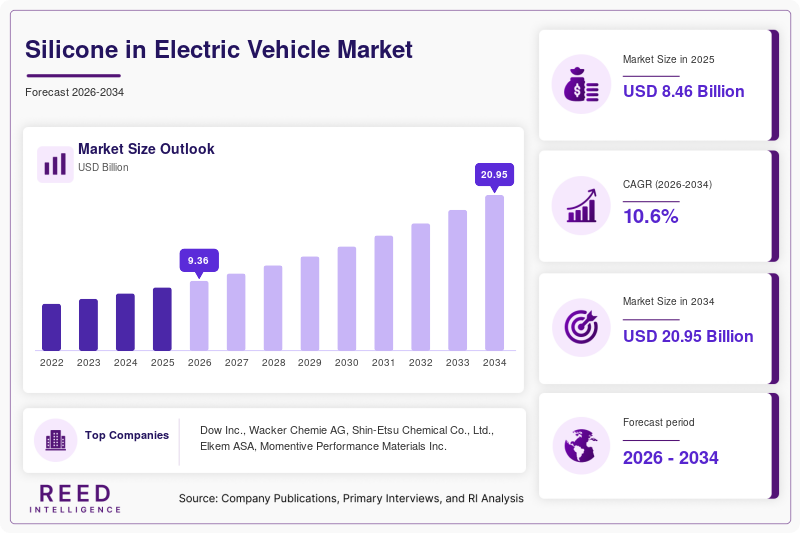
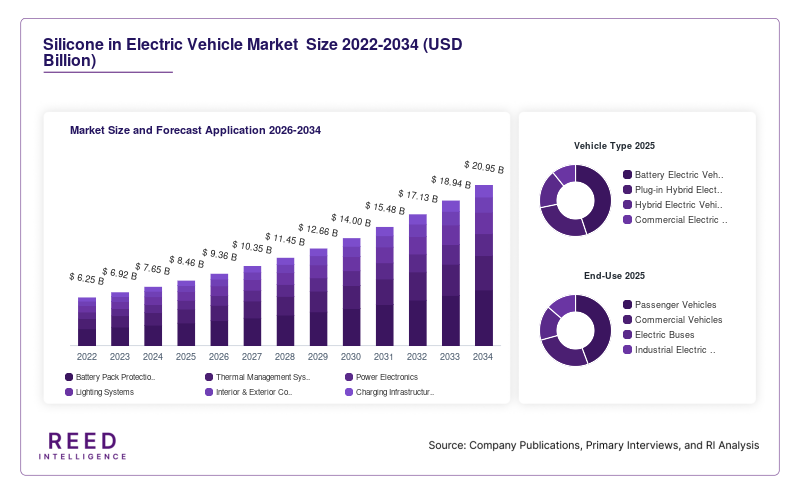
The Silicone in Electric Vehicle Market size was valued at USD 8.46 billion in 2026 and is projected to reach USD 18.92 billion by 2034, expanding at a CAGR of 10.6% during the forecast period from 2026 to 2034. The market growth has been strongly supported by the global transition toward sustainable transportation and the rapid adoption of electric mobility solutions across passenger and commercial vehicle segments. Governments worldwide are implementing stricter emission regulations and offering incentives for electric vehicle production, which has accelerated the demand for advanced silicone materials in EV manufacturing.
Silicone materials play a critical role in electric vehicles due to their thermal stability, electrical insulation, weather resistance, and lightweight characteristics. These materials are widely used in battery packs, power electronics, charging systems, sensors, sealing applications, thermal interface materials, and cable insulation. The increasing complexity of EV battery systems and the growing need for efficient thermal management solutions are significantly contributing to the expansion of the Silicone in Electric Vehicle Market. Manufacturers are increasingly focusing on high-performance silicone formulations that improve vehicle safety, energy efficiency, and durability under demanding operating conditions.
Key Highlights
- Asia Pacific accounted for 44.8% of the Silicone in Electric Vehicle Market share in 2025, while Europe is projected to expand at a CAGR of 11.4% during 2026–2034.
- By product type, silicone elastomers dominated with a 36.9% share in 2025, while silicone thermal interface materials are projected to grow at a CAGR of 12.1%.
- By application, battery protection and thermal management accounted for 39.7% of the market share in 2025, while EV charging systems are expected to expand at a CAGR of 11.8%.
- By vehicle type, battery electric vehicles held 62.4% of the market share in 2025, while electric commercial vehicles are projected to witness a CAGR of 12.5%.
- China dominated the market with a value of USD 2.48 billion in 2024 and USD 2.79 billion in 2025 due to large-scale electric vehicle manufacturing and battery production expansion.
Market Trends
Rising Adoption of Silicone-Based Thermal Management Solutions
Electric vehicle manufacturers are increasingly using silicone-based thermal management materials to improve battery efficiency and operational safety. High-capacity EV batteries generate significant heat during charging and vehicle operation, creating demand for advanced heat dissipation materials. Silicone gels, pads, and thermal interface compounds are being integrated into battery modules and power electronics to maintain temperature stability and reduce performance degradation. This trend is supporting the development of advanced silicone formulations optimized for high-voltage electric mobility applications.
Growing Use of Lightweight Silicone Components in EV Design
Automotive manufacturers are emphasizing lightweight vehicle construction to improve driving range and energy efficiency. Silicone materials are gaining popularity because they offer flexibility, durability, and lower weight compared to traditional materials. Silicone elastomers and sealants are increasingly used in cable assemblies, gaskets, connectors, and vibration control systems. The growing focus on vehicle weight reduction and enhanced component reliability is expected to strengthen the Silicone in Electric Vehicle Market outlook over the forecast period.
Market Drivers
Expansion of Global Electric Vehicle Production
The rapid increase in electric vehicle manufacturing worldwide is a major factor driving the Silicone in Electric Vehicle Market growth. Automotive companies are expanding EV production lines to meet rising consumer demand and comply with environmental regulations. Silicone materials are essential for improving battery performance, electrical insulation, and sealing efficiency in electric vehicles. Increasing investments in gigafactories and battery production facilities are further accelerating demand for advanced silicone products across the automotive industry.
Increasing Demand for Advanced Battery Safety Systems
Battery safety has become a critical focus area for EV manufacturers due to rising concerns related to overheating, short circuits, and thermal runaway incidents. Silicone-based materials provide effective thermal resistance, flame retardancy, and insulation properties that improve battery reliability and passenger safety. The growing integration of high-energy-density battery systems is expected to increase the use of silicone adhesives, encapsulants, and thermal interface materials in electric vehicles.
Market Restraint
Fluctuating Raw Material Costs
Volatility in the prices of silicon metal and specialty chemical feedstocks remains a major challenge for manufacturers operating in the Silicone in Electric Vehicle Market. Rising raw material costs can affect production margins and increase the overall cost of silicone-based EV components. Supply chain disruptions and energy price fluctuations may also impact material availability and manufacturing efficiency.
Market Opportunities
Development of Fast-Charging Infrastructure
The rapid expansion of EV charging infrastructure is creating new opportunities for silicone material suppliers. Fast-charging systems require high-performance insulation, sealing, and thermal management solutions capable of operating under elevated temperatures and voltage conditions. Silicone-based materials are increasingly being used in charging connectors, cables, and power modules to improve durability and charging efficiency.
Growth in Electric Commercial Vehicle Adoption
The increasing deployment of electric buses, trucks, and delivery vehicles is expected to generate strong demand for silicone materials. Commercial EVs require robust thermal management and vibration-resistant systems due to intensive operational cycles. Silicone solutions are being adopted to improve battery protection, electrical insulation, and long-term vehicle reliability in heavy-duty electric transportation applications.
Segmental Analysis
By Product Type
Silicone elastomers dominated the Silicone in Electric Vehicle Market with a 36.9% share in 2025 due to their extensive use in seals, gaskets, connectors, and insulation systems. These materials offer high flexibility, durability, and resistance to extreme temperatures, making them suitable for demanding EV applications. Automotive manufacturers increasingly adopted silicone elastomers to improve component reliability and long-term vehicle performance.
Silicone thermal interface materials are projected to grow at the fastest CAGR of 12.1% during the forecast period. Increasing demand for battery cooling systems and advanced thermal management solutions is expected to accelerate segment growth. These materials help improve heat transfer efficiency and battery safety in high-performance electric vehicles.
By Application
Battery protection and thermal management accounted for 39.7% of the market share in 2025 due to increasing use of silicone materials in battery modules and electronic control systems. Effective thermal regulation is essential for maintaining battery efficiency, charging performance, and operational safety. Silicone-based materials provide insulation and thermal conductivity required for advanced EV battery architectures.
EV charging systems are projected to witness the fastest CAGR of 11.8% during 2026–2034. The expansion of fast-charging infrastructure and increasing deployment of high-power charging stations are expected to create significant demand for silicone insulation and sealing materials. These products improve charging safety and operational durability under high-voltage conditions.
By Vehicle Type
Battery electric vehicles dominated the market with a 62.4% share in 2025 because fully electric vehicles require extensive use of silicone materials across battery packs, electronics, sensors, and cable systems. Rising global EV sales and expansion of battery manufacturing facilities strongly supported segment growth.
Electric commercial vehicles are expected to grow at a CAGR of 12.5% during the forecast period. Increasing adoption of electric buses, logistics vehicles, and commercial fleets is anticipated to accelerate demand for durable silicone-based thermal and electrical protection systems. Fleet operators are increasingly prioritizing vehicle reliability and energy efficiency.
By End Use
Passenger vehicles represented the largest end-use segment in 2025 with a share of 68.1% due to growing consumer adoption of electric cars and expanding EV production capacities worldwide. Automotive manufacturers increasingly integrated advanced silicone materials to improve driving range, safety, and electronic reliability.
Commercial transportation is projected to grow at a CAGR of 11.9% during the forecast period. The increasing electrification of logistics fleets and public transportation systems is expected to support demand for advanced silicone components in heavy-duty EV applications.
Regional Analysis
North America
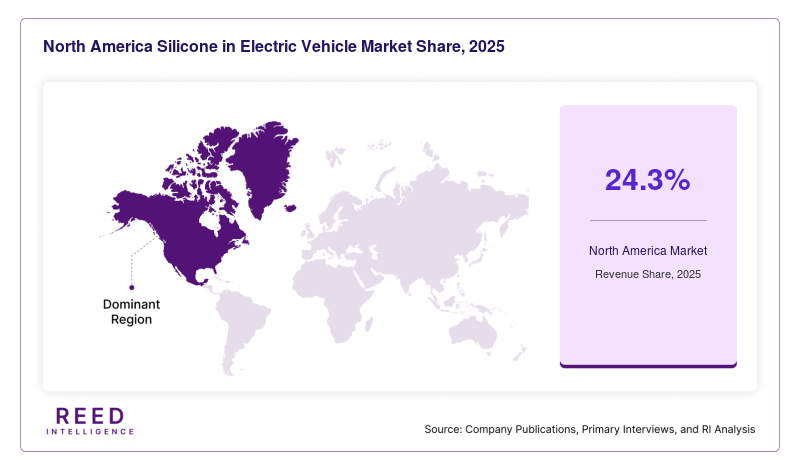
North America held 24.3% of the Silicone in Electric Vehicle Market share in 2025 due to rising investments in electric vehicle production and battery manufacturing facilities. The region witnessed strong adoption of advanced EV technologies supported by government incentives and emission reduction policies. Increasing investments in charging infrastructure and automotive electronics also contributed to regional market growth.
The United States dominated the regional market due to expanding EV manufacturing capacity and increasing deployment of high-performance battery systems. Automotive manufacturers in the country focused on improving thermal management technologies and lightweight vehicle materials to enhance EV efficiency.
Europe
Europe accounted for 28.1% of the Silicone in Electric Vehicle Market share in 2025 and is expected to expand at a CAGR of 11.4% during the forecast period. The region experienced significant growth due to stringent carbon emission regulations and increasing electric vehicle adoption across passenger and commercial transportation sectors. Rising investments in battery production and sustainable automotive technologies supported regional market expansion.
Germany emerged as the leading country in Europe due to strong automotive manufacturing capabilities and extensive investments in EV battery innovation. The country emphasized high-performance thermal management systems and energy-efficient vehicle technologies.
Asia Pacific
Asia Pacific represented 44.8% of the Silicone in Electric Vehicle Market share in 2025 and is projected to witness the fastest CAGR of 11.7% during 2026–2034. The region benefited from large-scale electric vehicle production, rapid industrialization, and expanding battery manufacturing capacity. Government incentives supporting electric mobility and increasing investments in EV supply chains significantly contributed to market growth.
China dominated the regional market due to extensive electric vehicle production and strong battery manufacturing infrastructure. The country focused on improving EV charging networks, battery technologies, and domestic material production capabilities to strengthen its electric mobility ecosystem.
Middle East & Africa
The Middle East & Africa accounted for 4.2% of the Silicone in Electric Vehicle Market share in 2025 and is anticipated to grow at a CAGR of 8.2% during the forecast period. Increasing investments in sustainable transportation and renewable energy infrastructure supported regional market development. Several countries in the region initiated EV adoption programs to reduce fuel dependency and improve environmental sustainability.
The United Arab Emirates emerged as the leading country in the region due to growing investments in electric mobility infrastructure and smart transportation projects. The country also focused on developing advanced charging networks and clean energy initiatives.
Latin America
Latin America held 3.6% of the Silicone in Electric Vehicle Market share in 2025 and is projected to expand at a CAGR of 7.9% during 2026–2034. Rising adoption of electric buses and increasing government initiatives supporting sustainable transportation contributed to regional market growth.
Brazil dominated the regional market due to expanding investments in electric mobility programs and automotive manufacturing modernization. The country emphasized the adoption of energy-efficient transportation systems and advanced vehicle materials.
Competitive Landscape
The Silicone in Electric Vehicle Market is characterized by strong competition among specialty chemical manufacturers and advanced material suppliers focused on automotive electrification. Companies are investing heavily in research and development to introduce high-performance silicone products designed for battery safety, thermal management, and electronic protection. Strategic partnerships with automotive OEMs and battery manufacturers remain a key competitive strategy across the market.
Dow Inc. maintained a strong market position due to its extensive silicone materials portfolio and advanced automotive solutions. The company continued expanding its EV-focused product offerings through the development of thermal interface materials, battery encapsulants, and silicone sealants designed for high-voltage applications. Its latest development involved the launch of advanced silicone technologies optimized for next-generation EV battery systems and fast-charging infrastructure.
Wacker Chemie AG focused on expanding silicone production capacity and strengthening its automotive material solutions business. Shin-Etsu Chemical Co., Ltd. emphasized high-performance silicone products for EV electronics and battery protection applications. Elkem ASA invested in advanced silicone formulations for thermal management systems, while Momentive Performance Materials expanded its product portfolio for electric mobility and autonomous vehicle applications.
The competitive environment is expected to intensify further as companies continue investing in lightweight materials, sustainable production technologies, and advanced thermal management innovations. Manufacturers are also focusing on long-term collaborations with EV battery producers and automotive OEMs to strengthen supply chain integration and market presence.
Key Players List
- Dow Inc.
- Wacker Chemie AG
- Shin-Etsu Chemical Co., Ltd.
- Elkem ASA
- Momentive Performance Materials Inc.
- Evonik Industries AG
- KCC Corporation
- Henkel AG & Co. KGaA
- 3M Company
- Saint-Gobain S.A.
- Rogers Corporation
- DuPont de Nemours, Inc.
- ACC Silicones Ltd.
- Siltech Corporation
- Reiss Manufacturing Inc.
Recent Developments
- In February 2025, Dow Inc. launched advanced silicone thermal management materials for high-capacity EV battery systems.
- In May 2025, Wacker Chemie AG expanded silicone production capacity to support rising electric vehicle demand.
- In September 2024, Shin-Etsu Chemical Co., Ltd. introduced new silicone encapsulants for EV power electronics.
- In January 2025, Momentive Performance Materials developed silicone solutions for fast-charging infrastructure applications.
- In August 2024, Elkem ASA expanded its automotive silicone product portfolio for electric commercial vehicles.
- In March 2025, Henkel AG & Co. KGaA introduced silicone adhesive technologies for battery pack assembly applications.
- In November 2024, Rogers Corporation launched advanced thermal interface materials designed for EV battery cooling systems.
Silicone in Electric Vehicle Market Segments
Product Type
A PHP Error was encountered
Severity: Notice
Message: Undefined offset: 0
Filename: reportpages/rd.php
Line Number: 400
Backtrace:
File: /var/www/html/application/views/frontend/reportpages/rd.php
Line: 400
Function: _error_handler
File: /var/www/html/application/controllers/FrontendReportController.php
Line: 420
Function: view
File: /var/www/html/index.php
Line: 315
Function: require_once
- Silicone Elastomers
- Silicone Fluids
- Silicone Resins
- Silicone Gels
- Silicone Adhesives and Sealants
Application
- Battery Pack Protection
- Thermal Management Systems
- Power Electronics
- Lighting Systems
- Interior & Exterior Components
- Charging Infrastructure Components
Vehicle Type
- Battery Electric Vehicles (BEVs)
- Plug-in Hybrid Electric Vehicles (PHEVs)
- Hybrid Electric Vehicles (HEVs)
- Commercial Electric Vehicles
End-Use
- Passenger Vehicles
- Commercial Vehicles
- Electric Buses
- Industrial Electric Mobility
Distribution Channel
- OEM Supply
- Aftermarket
- Direct Sales
- Third-Party Distributors
By Region
- North America
- Europe
- APAC
- Middle East and Africa
- LATAM