Silicone Masterbatch Market Size, Share, Demand Report By Type (Processing Aids, Flow & Release, Lubrication, Mold Release, Performance Enhancers, Anti-Scratch, Slip & Anti-Block, Abrasion Resistance), By Application (Packaging, Automotive, Electrical & Electronics, Wire & Cable, Consumer Goods, Construction, Other Applications), By Region & Segment Forecasts, 2026–2034
USD 3950
Silicone Masterbatch Market Size
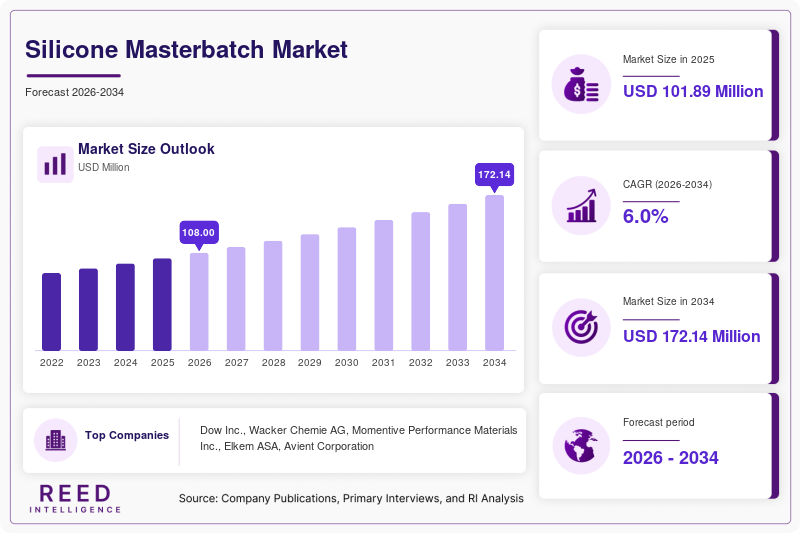
Global Silicone Masterbatch market size is projected at USD 108.0 million in 2026 and is expected to hit USD 172.14 million by 2034 with a CAGR of 6.0%. The market is supported by growing demand for high-performance thermoplastics, particularly in packaging, automotive, electrical and electronics, wire and cable, and consumer goods. Detailed segmentation, production volumes, application-level demand, regional penetration, and competitive positioning are increasingly important for manufacturers and investors evaluating capacity expansion and product development.
Key takeaways
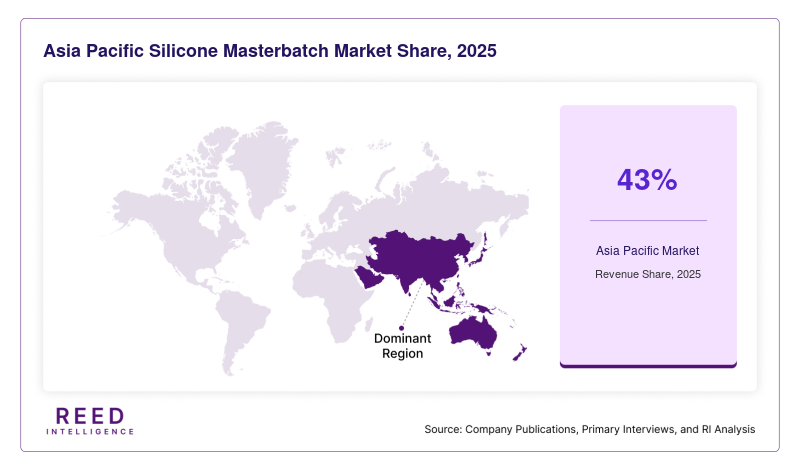
- Asia Pacific dominated the market with an estimated 43% share in 2025 and is expected to remain the largest regional market, while its approximately 6.6% CAGR makes it one of the fastest-growing regions through 2034.
- Processing aids represented approximately 56% of global demand in 2025, supported by widespread use in extrusion and injection molding. Performance enhancers are projected to grow faster at approximately 6.7% CAGR.
- Packaging was the leading application, accounting for nearly 31% of market revenue in 2025, while automotive applications are expected to expand at approximately 6.8% CAGR through 2034.
- China remained the largest country market in Asia Pacific, while India is emerging as a high-growth market with an estimated 7.9% CAGR during 2026–2034.
- Global silicone masterbatch production was approximately 60,500 metric tons in 2024 and is estimated to exceed 68,000 metric tons by 2026 as demand for specialty polymer additives increases.
Silicone masterbatch is a concentrated polymer additive in which high-molecular-weight silicone materials are dispersed within a compatible thermoplastic carrier resin. Typical formulations contain approximately 30%–50% silicone active material and are designed to improve melt flow, mold release, lubrication, coefficient of friction, surface appearance, scratch resistance, and abrasion performance. The products are commonly supplied in pelletized form for incorporation into PE, PP, PA, and other thermoplastics through conventional extrusion, injection molding, blow molding, and film-processing equipment. Global production reached approximately 60,515 metric tons in 2024, with Asia Pacific representing the largest manufacturing and consumption base. Processing-aid applications account for the largest share of consumption, while performance-enhancing grades are gaining penetration in automotive interiors, electronics housings, consumer products, and specialty packaging.
Silicone Masterbatch Market Trends
Shift toward multifunctional and high-performance formulations
Silicone masterbatch technology is moving from basic lubrication toward multifunctional formulations that combine processing efficiency with permanent surface performance. Manufacturers are developing grades with improved dispersion, higher silicone loading, lower dosing requirements, and better compatibility with recycled polymers. Silicone-based processing aids are also gaining attention as alternatives to conventional additives in applications where lower friction, reduced melt fracture, improved surface quality, and easier processing are required.
Sector-specific demand is particularly strong in flexible packaging, automotive components, wire and cable compounds, electrical housings, and engineering plastics. Packaging converters increasingly require additives that reduce die build-up, improve film appearance, and maintain high extrusion throughput. Automotive manufacturers are adopting silicone-enhanced polymers for interior trims and other components requiring improved scratch and mar resistance. Electrical and electronics applications are also encouraging development of grades capable of maintaining performance under elevated temperatures and demanding processing conditions.
Silicone Masterbatch Market Drivers
Rising demand for high-performance plastics
Growing use of lightweight, durable, and highly processable plastics is the primary market driver. Silicone masterbatches allow processors to improve flow, reduce extrusion torque, facilitate mold release, and enhance surface durability without substantially changing the underlying polymer formulation. Automotive lightweighting, high-speed packaging production, and increasing consumption of engineered plastic components are therefore creating sustained demand.
Silicone Masterbatch Market Restraints
Raw material price volatility and formulation complexity
Fluctuations in silicone and carrier-resin costs can increase production expenses and create pricing pressure for masterbatch manufacturers. Formulation development also requires careful control of silicone concentration, carrier compatibility, dispersion, dosing, and processing temperature. In regulated applications such as food contact, healthcare, and electronics, additional testing and compliance requirements can lengthen qualification cycles.
Silicone Masterbatch Market Opportunities
Expansion of sustainable and specialty polymer formulations
The shift toward recycled plastics, recyclable packaging, lightweight automotive materials, and halogen-free wire and cable compounds is creating opportunities for specialized silicone masterbatches. Demand is also increasing for multifunctional products that combine processing benefits with scratch resistance, slip control, abrasion resistance, and flame-retardant support. EV components, high-end consumer electronics, and advanced packaging provide additional opportunities for premium grades.
Challenges in Silicone Masterbatch Market
Maintaining consistent dispersion and application performance
Achieving consistent silicone dispersion throughout different carrier resins remains a key technical challenge. Poor dispersion can result in inconsistent surface properties, processing defects, or reduced mechanical performance. Manufacturers must also balance silicone loading with compatibility, cost, dosing accuracy, and end-use requirements while responding to increasingly stringent environmental and product-safety regulations.
Silicone Masterbatch Market Segmentation Analysis
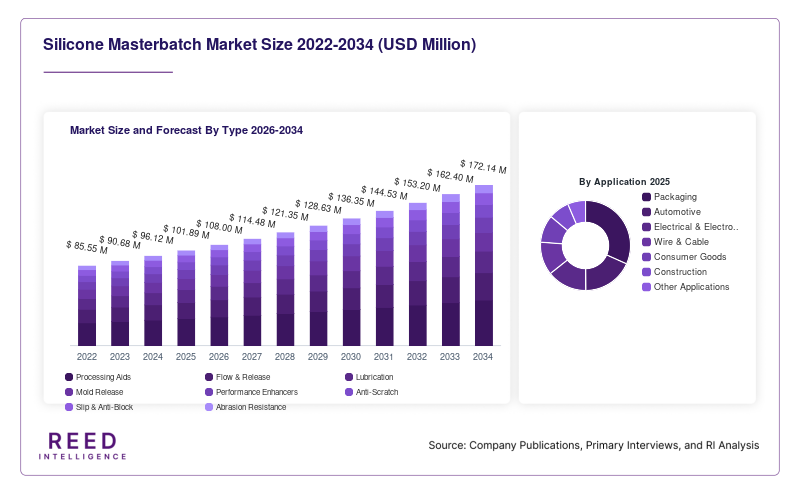
The market is segmented primarily by functionality and application. Processing aids accounted for approximately 56% of global market revenue in 2025 because of their broad use in extrusion, injection molding, film production, and compounding. Performance enhancers represented approximately 44% and are expected to record faster growth as manufacturers prioritize long-term surface durability and premium aesthetics.
By Type
Processing Aids – Flow & Release: This segment held approximately 25% of the total market in 2025. These formulations typically use high-molecular-weight silicone dispersed in PE, PP, or PA carriers and are designed to improve melt flow, mold filling, and release. Estimated global production attributable to this segment was approximately 16,000 metric tons in 2025. Typical addition rates range from about 0.5% to 5%, depending on the resin and required performance.
Lubrication: Lubricating silicone masterbatches accounted for approximately 17% of market revenue. They reduce internal friction, extruder torque, and processing resistance while improving throughput and surface smoothness. Production was estimated at approximately 10,900 metric tons in 2025. These grades are widely used with PE, PP, EVA, and engineering thermoplastics and can deliver lower coefficient of friction and improved processing stability.
Mold Release: Mold-release formulations represented nearly 14% of the market. Their primary function is to improve demolding efficiency and reduce sticking during injection molding and extrusion-related processes. Estimated production reached approximately 9,000 metric tons in 2025. These grades are particularly relevant to automotive, consumer goods, electrical components, and complex molded plastic parts.
Anti-Scratch, Slip, Anti-Block and Abrasion Resistance: Performance-enhancing grades collectively represented approximately 44% of market demand. These products improve scratch resistance, surface slip, anti-blocking characteristics, abrasion resistance, and tactile properties. Combined production was estimated at approximately 28,000 metric tons in 2025. High-value automotive interiors, consumer electronics, appliances, films, and specialty packaging are major users.
By Application
Packaging represented approximately 31% of global silicone masterbatch demand in 2025, equivalent to nearly 20,000 metric tons of production. Flexible films, bags, caps, closures, and multilayer packaging use silicone additives to improve slip, reduce coefficient of friction, minimize melt fracture, and enhance extrusion productivity. Demand is supported by high-speed film processing and the increasing need for recyclable and downgauged packaging structures.
Automotive applications accounted for approximately 24% of consumption, representing about 15,500 metric tons in 2025. Silicone masterbatches are incorporated into polypropylene, polyamide, ABS, and other engineering polymers used for interior trims, dashboards, connectors, and molded components. Anti-scratch and abrasion-resistant grades are particularly important as vehicle manufacturers seek durable surfaces and lightweight polymer components.
Electrical and electronics applications contributed approximately 18% of global demand, corresponding to nearly 11,600 metric tons in 2025. Silicone-enhanced compounds are used in housings, connectors, wire and cable systems, and other components where processing stability, thermal resistance, surface durability, and reliable insulation performance are required.
Consumer goods, construction, healthcare, agriculture, footwear, and industrial products together represented approximately 27% of demand, with estimated production of more than 17,000 metric tons in 2025. Increasing use of specialty thermoplastics and recycled polymer compounds is expected to support growth in these applications.
Silicone Masterbatch Market Regional Analysis
Asia Pacific Silicone Masterbatch Market
Asia Pacific accounted for approximately 43% of the global market in 2025 and remained the largest regional market. China represented the largest country contributor, supported by extensive plastics processing, packaging, automotive, electronics, and consumer-goods manufacturing. India, Japan, South Korea, and Southeast Asian economies also contribute substantially to regional consumption. Packaging and automotive represent the largest sector split, followed by electrical and electronics applications.
The region is projected to record approximately 6.6% CAGR through 2034. India is expected to be among the fastest-growing country markets as domestic plastics processing, automotive manufacturing, electronics production, and specialty-compounding capacity expand.
North America Silicone Masterbatch Market
North America represented approximately 25% of the market in 2025, led by the United States. Demand is concentrated in high-value packaging, automotive components, electrical systems, wire and cable, and engineering plastics. The region places greater emphasis on performance consistency, regulatory compliance, and specialty grades, supporting relatively high-value silicone masterbatch consumption.
Europe Silicone Masterbatch Market
Europe held approximately 21% of global revenue in 2025, with Germany, Italy, France, the United Kingdom, and Spain among the major contributors. Automotive and industrial plastics remain important demand centers, while packaging and electrical applications provide additional volume. Sustainability requirements are encouraging suppliers to develop formulations compatible with recycled and recyclable polymers.
Latin America Silicone Masterbatch Market
Latin America accounted for approximately 6% of global demand in 2025. Brazil and Mexico are the leading contributors because of their packaging, automotive, consumer-product, and industrial manufacturing bases. Increasing investment in polymer processing and flexible packaging is expected to support moderate regional growth through 2034.
Middle East & Africa Silicone Masterbatch Market
The Middle East & Africa represented approximately 5% of the global market. Saudi Arabia, the UAE, South Africa, and other manufacturing hubs support demand through packaging, construction, electrical, and consumer-product applications. Availability of polymer feedstocks and investments in downstream plastics manufacturing provide opportunities for regional expansion.
Top players in Silicone Masterbatch Market
- Dow Inc.
- Wacker Chemie AG
- Momentive Performance Materials Inc.
- Elkem ASA
- Avient Corporation
- Ampacet Corporation
- Americhem Inc.
- Plastika Kritis S.A.
- Plastiblends India Limited
- GCR Group
- Astra Polymers
- Alok Masterbatches
- RTP Company
- Chengdu Silike Technology Co., Ltd.
- Matrix Polytech Pvt. Ltd.
Recent Developments in Silicone Masterbatch Market
- February 2026: Plastindia 2026 brought together major plastics and masterbatch manufacturers, highlighting continued investment in advanced polymer processing, sustainable materials, and specialty additive technologies.
- November 2025: WACKER showcased its GENIOPLAST silicone-based additives and production aids for thermoplastics and engineering polymers at Compounding World Expo North America, emphasizing processing and performance improvements.
- September 2025: Dow introduced DOWSIL 5-1050 Polymer Processing Aid, a silicone additive in a polyethylene carrier designed as a fluoropolymer-free processing solution for polyethylene film applications.
- April 2025: Elkem expanded its SILCOLEASE portfolio with recycled silicone products, reinforcing the industry's movement toward circular and lower-impact silicone technologies.
- 2025: Manufacturers increasingly expanded silicone-based additive portfolios for packaging, wire and cable, automotive, engineering plastics, and other applications requiring higher processing efficiency and surface durability.
Silicone Masterbatch Market Segments
By Type
- Processing Aids
- Flow & Release
- Lubrication
- Mold Release
- Performance Enhancers
- Anti-Scratch
- Slip & Anti-Block
- Abrasion Resistance
By Application
- Packaging
- Automotive
- Electrical & Electronics
- Wire & Cable
- Consumer Goods
- Construction
- Other Applications
By Region
- North America
- Europe
- APAC
- Middle East and Africa
- LATAM