Silicone Modified Polyester Resin Market Size, Share & Demand Report By Product Type (Water-Based Silicone Modified Polyester Resin, Powder Coating Grade Silicone Modified Polyester Resin), By Application (Industrial Coatings, Architectural Coatings, Automotive Coatings), By End-Use Industry (Automotive, Industrial Manufacturing, Renewable Energy Equipment, Consumer Appliances, Marine & Transportation), By Region & Segment Forecasts, 2026–2034
USD 3950
Market Overview
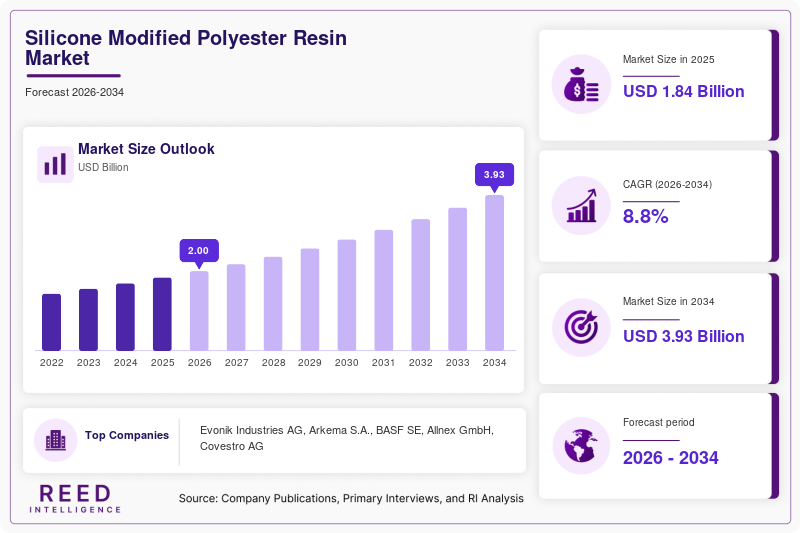
The global Silicone Modified Polyester Resin Market size was valued at USD 1.84 billion in 2026 and is projected to reach USD 3.62 billion by 2034, expanding at a CAGR of 8.8% during 2026–2034. The market continues to gain momentum as manufacturers across coatings, industrial finishes, construction materials, and specialty applications seek resin systems that combine durability, weather resistance, flexibility, and thermal stability. Silicone modified polyester resins are increasingly utilized in high-performance coating formulations due to their ability to enhance gloss retention, corrosion resistance, and long-term outdoor performance.
A major global factor supporting market expansion is the growing demand for durable and sustainable coating technologies across industrial and infrastructure sectors. Governments and private organizations are increasing investments in transportation networks, commercial buildings, renewable energy facilities, and industrial manufacturing plants. These projects require advanced coating solutions capable of maintaining performance under harsh environmental conditions. Silicone modified polyester resins offer enhanced protection against UV radiation, moisture, temperature fluctuations, and chemical exposure, making them suitable for long-life applications.
Key Highlights
- North America dominated the market with a 35.4% share in 2025.
- while Asia Pacific is expected to grow at the fastest CAGR of 10.9% during 2026–2034.
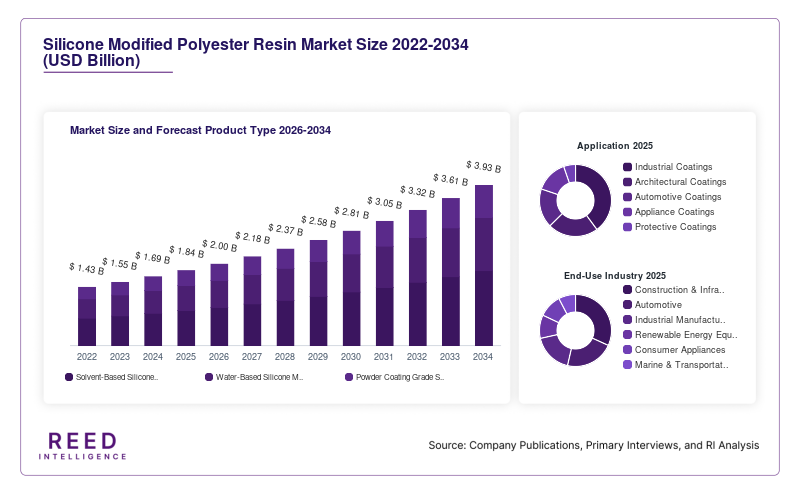
- By product type, solvent-based silicone modified polyester resins accounted for the largest share of 44.1%.
- while water-based silicone modified polyester resins are projected to grow at a CAGR of 11.6%.
- By application, industrial coatings led with a 39.8% share.
- whereas architectural coatings are expected to expand at a CAGR of 10.8%.
- By end-use industry, construction and infrastructure held the largest share of 34.6%.
- while renewable energy equipment is anticipated to grow at a CAGR of 12.2%.
- The United States remained the dominant country, with market values of USD 462 million in 2024 and USD 508 million in 2025.
Market Trends
Growing Adoption of Sustainable Coating Technologies
The transition toward environmentally responsible manufacturing practices is shaping the development of silicone modified polyester resin products. Industries are increasingly selecting coating materials that offer lower emissions while maintaining high-performance standards. Regulatory agencies across developed and emerging economies continue to encourage the use of environmentally compliant coating systems. As a result, manufacturers are investing in research activities focused on reducing solvent content and improving resin efficiency. Water-based and hybrid formulations are gaining attention because they help coating producers meet environmental requirements without compromising durability. This trend is particularly evident in construction, industrial equipment, and consumer appliance applications where sustainability objectives are becoming part of procurement decisions.
Increasing Demand for High-Durability Protective Coatings
Industrial operators are focusing on extending the service life of assets and reducing maintenance costs. This objective has increased the demand for advanced coating materials capable of resisting harsh environmental conditions. Silicone modified polyester resins provide superior weatherability, heat resistance, and corrosion protection compared with conventional alternatives. These characteristics make them suitable for industrial machinery, transportation equipment, energy infrastructure, and commercial buildings. The trend is especially visible in regions experiencing rapid infrastructure expansion where long-lasting protective systems are preferred. As maintenance budgets become more critical across industries, demand for coatings based on silicone modified polyester resin technology is expected to remain strong throughout the forecast period.
Market Drivers
Expansion of Global Construction and Infrastructure Activities
Rising investments in infrastructure development continue to create significant demand for advanced coating materials. Governments are allocating substantial funding toward transportation systems, public facilities, energy projects, and urban development programs. These assets require coatings capable of withstanding environmental stress and prolonged exposure to moisture, sunlight, and pollutants. Silicone modified polyester resins improve coating durability and contribute to longer maintenance intervals. Their ability to enhance gloss retention and surface protection makes them suitable for bridges, industrial buildings, airports, and commercial complexes. As infrastructure modernization initiatives continue across both developed and developing economies, demand for these resin systems is expected to increase steadily during the forecast period.
Rising Need for Performance Enhancement in Industrial Applications
Manufacturing industries are increasingly emphasizing operational efficiency and product longevity. Equipment producers and industrial coating manufacturers seek materials that improve performance while minimizing lifecycle costs. Silicone modified polyester resins provide valuable characteristics such as thermal stability, chemical resistance, and flexibility. These properties help industrial equipment maintain appearance and structural integrity under demanding operating conditions. Sectors including automotive components, machinery manufacturing, metal fabrication, and electrical equipment are adopting advanced coating solutions to improve competitiveness. The growing emphasis on reliability and asset protection is supporting widespread utilization of silicone modified polyester resin technologies across multiple industrial environments.
Market Restraint
Volatility in Raw Material Prices and Production Costs
Fluctuations in the prices of silicone intermediates, polyester feedstocks, and petrochemical derivatives remain a significant challenge for market participants. Manufacturing costs are highly sensitive to changes in raw material availability, energy prices, and global supply chain conditions. When feedstock prices increase, resin producers often face pressure on profit margins, particularly when long-term customer contracts limit pricing flexibility. This situation can affect investment decisions, production planning, and expansion strategies. Smaller manufacturers may experience greater challenges due to limited purchasing power and lower economies of scale. For example, periods of supply disruption in specialty chemical markets can result in higher procurement costs, causing delays in production schedules and reducing competitiveness. Such uncertainties may restrict adoption among price-sensitive end users and create short-term market instability despite strong long-term demand fundamentals.
Market Opportunities
Expanding Applications in Renewable Energy Infrastructure
The global transition toward renewable energy systems presents substantial opportunities for silicone modified polyester resin manufacturers. Wind turbines, solar installations, and energy storage facilities require protective coatings capable of withstanding harsh environmental exposure for extended periods. Silicone modified polyester resins provide resistance against ultraviolet radiation, temperature fluctuations, and moisture penetration, making them suitable for these demanding applications. As governments continue to implement decarbonization initiatives and increase renewable energy investments, demand for high-performance coating materials is expected to rise. Manufacturers that develop specialized resin formulations for renewable energy infrastructure can benefit from long-term growth opportunities and expanding project pipelines across global markets.
Growth Potential in Emerging Economies
Rapid industrialization and urbanization in emerging markets are creating favorable conditions for market expansion. Countries across Asia Pacific, Latin America, and parts of Africa are witnessing increasing investments in manufacturing facilities, transportation networks, residential construction, and commercial developments. These activities require durable coatings and advanced material technologies that support long-term asset protection. Silicone modified polyester resins are increasingly recognized for their ability to enhance coating performance under challenging climatic conditions. As local industries adopt higher quality standards and modern production techniques, demand for premium resin solutions is expected to accelerate. This opportunity is likely to attract both domestic manufacturers and international suppliers seeking to strengthen their presence in high-growth regions.
Segmental Analysis
By Product Type
Solvent-based silicone modified polyester resins represented the dominant subsegment and accounted for approximately 44.1% of market share in 2024. These products remain widely used because they provide excellent film formation, strong adhesion, and reliable performance across industrial coating applications. Manufacturers prefer solvent-based systems in environments where demanding durability requirements are essential. Their ability to deliver consistent coating quality under varying operating conditions supports continued adoption. Industries including heavy equipment manufacturing, transportation, metal fabrication, and infrastructure maintenance continue to utilize solvent-based formulations due to their proven effectiveness and established application processes. Strong compatibility with existing production systems also contributes to their leadership position.
Water-based silicone modified polyester resins are expected to be the fastest-growing subsegment, registering a CAGR of 11.6% during the forecast period. Growth is driven by increasing environmental awareness and stricter regulations regarding coating emissions. Manufacturers are developing advanced water-based formulations capable of delivering performance characteristics comparable to traditional alternatives. End users are increasingly adopting these products to meet sustainability objectives and improve workplace safety. Technological advancements in resin chemistry have enhanced durability, weather resistance, and application efficiency. As industries continue transitioning toward environmentally responsible production practices, water-based solutions are expected to gain significant market share across multiple end-use sectors.
By Application
Industrial coatings held the largest share of the Silicone Modified Polyester Resin Market, accounting for approximately 39.8% in 2024. This dominance reflects the extensive use of high-performance coatings in manufacturing equipment, metal structures, machinery, and industrial infrastructure. Silicone modified polyester resins improve corrosion resistance, thermal stability, and weatherability, making them suitable for demanding industrial environments. Companies increasingly prioritize asset protection and lifecycle cost reduction, leading to greater adoption of advanced coating technologies. Continued investment in industrial modernization and equipment upgrades supports strong demand from this application segment. The ability of these resins to enhance coating longevity remains a major factor contributing to their widespread utilization.
Architectural coatings are projected to be the fastest-growing application segment, expanding at a CAGR of 10.8% through 2034. Urbanization and increasing construction activity are key growth drivers. Commercial buildings, residential developments, and public infrastructure projects require coatings capable of maintaining appearance and performance over extended periods. Silicone modified polyester resins provide enhanced UV resistance, gloss retention, and environmental protection. Growing awareness regarding building maintenance costs is encouraging developers and property owners to adopt premium coating solutions. Furthermore, the expansion of green building initiatives and sustainable construction practices creates additional opportunities for advanced resin technologies within the architectural coatings segment.
By End-Use Industry
Construction and infrastructure emerged as the dominant end-use industry, accounting for approximately 34.6% of market share in 2024. Large-scale investments in transportation systems, commercial complexes, industrial facilities, and residential projects continue to generate significant demand for protective coating materials. Silicone modified polyester resins help improve durability and weather resistance, making them valuable for structures exposed to challenging environmental conditions. Governments and private organizations increasingly prioritize long-lasting infrastructure solutions that reduce maintenance requirements and lifecycle costs. The growing focus on asset preservation and structural reliability supports sustained demand from the construction and infrastructure sector across global markets.
Renewable energy equipment is anticipated to be the fastest-growing end-use industry, advancing at a CAGR of 12.2% during 2026–2034. The rapid expansion of wind, solar, and energy storage projects is creating demand for advanced protective coatings capable of withstanding harsh operating conditions. Silicone modified polyester resins offer resistance to ultraviolet radiation, moisture, temperature variation, and chemical exposure. These characteristics make them suitable for protecting renewable energy assets and extending operational lifespan. Government incentives supporting clean energy deployment, combined with increasing private-sector investment, are expected to drive strong growth. Manufacturers focusing on specialized formulations for renewable energy applications are likely to benefit from expanding market opportunities.
Regional Analysis
North America
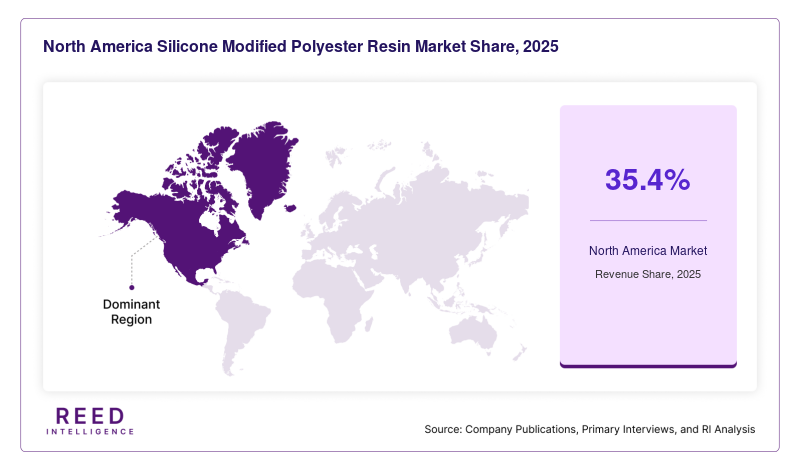
North America accounted for approximately 35.4% of the global Silicone Modified Polyester Resin Market in 2025, making it the largest regional market. The region is projected to expand at a CAGR of 7.9% through 2034. Growth is supported by strong demand from industrial coatings, construction materials, and transportation applications. The presence of established chemical manufacturers and advanced research capabilities enables continuous product innovation. Market participants are increasingly introducing environmentally compliant resin technologies to meet evolving industry requirements and regulatory expectations.
The United States represents the dominant country within the region. One unique growth factor is the ongoing modernization of aging infrastructure assets, including bridges, highways, industrial facilities, and public buildings. These projects require durable protective coatings capable of delivering extended service life and reduced maintenance costs. Demand from industrial manufacturing and energy infrastructure sectors further strengthens market performance. Continued investment in advanced coating technologies supports long-term growth prospects across the country.
Europe
Europe held an estimated 27.8% market share in 2025 and is expected to register a CAGR of 7.6% during the forecast period. The region benefits from stringent environmental standards and strong demand for high-performance industrial coatings. Manufacturers are focusing on innovative resin technologies that reduce emissions while maintaining durability and weather resistance. Increasing renovation activities in commercial and residential buildings also contribute to steady demand. Growth is further supported by advanced automotive and industrial manufacturing industries.
Germany remains the leading country in the European market. A unique growth factor is the country's emphasis on advanced industrial production and engineering excellence. Manufacturers continuously seek coating systems that improve equipment durability and operational efficiency. The demand for premium protective coatings in machinery, transportation equipment, and industrial infrastructure supports silicone modified polyester resin consumption. Ongoing investments in sustainable manufacturing technologies also create favorable market conditions throughout the forecast period.
Asia Pacific
Asia Pacific represented approximately 23.6% of global revenue in 2025 and is anticipated to record the fastest CAGR of 10.9% through 2034. Rapid industrialization, infrastructure development, and urban expansion are driving demand for advanced coating materials. Countries across the region are investing heavily in transportation networks, industrial facilities, and commercial construction projects. These developments increase the need for durable resin systems capable of delivering long-term performance. The region is also becoming a major manufacturing hub for coatings and specialty chemicals.
China dominates the Asia Pacific market due to its extensive manufacturing base and large-scale infrastructure investments. A unique growth factor is the country's continued expansion of industrial production facilities and renewable energy projects. These sectors require high-performance coatings that can withstand challenging operating environments. Rising adoption of advanced material technologies and increasing focus on product quality are expected to strengthen demand for silicone modified polyester resins over the coming years.
Middle East & Africa
The Middle East & Africa accounted for approximately 7.2% of global market revenue in 2025 and is projected to grow at a CAGR of 8.3% during 2026–2034. Market growth is supported by increasing investments in commercial infrastructure, industrial facilities, and energy projects. Countries across the region are seeking advanced coating technologies to protect assets from harsh environmental conditions, including high temperatures and sand exposure. Demand for durable protective coatings continues to increase across multiple industries.
Saudi Arabia remains the dominant country within the regional market. A unique growth factor is the implementation of large-scale economic diversification and infrastructure development programs. Industrial cities, transportation projects, and commercial developments require advanced coating systems capable of maintaining long-term performance in demanding climates. The need for corrosion-resistant materials in industrial and energy applications further supports adoption of silicone modified polyester resin products across the country.
Latin America
Latin America captured an estimated 6.0% share of the global market in 2025 and is expected to expand at a CAGR of 8.1% through 2034. The region benefits from growing industrial activity, increasing construction investments, and gradual modernization of manufacturing infrastructure. Demand for high-performance coating materials is rising as businesses focus on extending asset life and reducing maintenance expenses. Improved economic conditions in several countries are also encouraging investments in commercial and industrial projects.
Brazil represents the largest national market in Latin America. A unique growth factor is the expansion of industrial manufacturing and transportation infrastructure development. Local industries increasingly utilize advanced protective coatings to improve equipment reliability and operational efficiency. Growth in commercial construction and energy-related projects further supports resin demand. As modernization initiatives continue, the country is expected to remain a key contributor to regional market expansion.
Competitive Landscape
The Silicone Modified Polyester Resin Market is moderately consolidated, with leading participants focusing on product innovation, capacity expansion, strategic partnerships, and regional market penetration. Competition is influenced by technological capabilities, formulation expertise, distribution networks, and long-term customer relationships. Companies continue investing in research and development to improve resin performance, sustainability characteristics, and application efficiency.
Evonik Industries AG remains one of the leading market participants due to its extensive specialty chemicals portfolio and strong presence across global coating markets. The company recently expanded its focus on sustainable resin technologies aimed at supporting environmentally compliant coating applications. Other major competitors are strengthening their positions through investments in advanced manufacturing capabilities and product diversification strategies.
Market participants are also pursuing collaborations with coating manufacturers to develop customized solutions tailored to specific industry requirements. Increasing demand from construction, industrial coatings, renewable energy, and transportation sectors is encouraging companies to introduce innovative products with enhanced weather resistance and durability characteristics. As competition intensifies, differentiation through performance improvements and sustainability benefits is expected to remain a primary strategic focus.
Key Players
- Evonik Industries AG
- Arkema S.A.
- BASF SE
- Allnex GmbH
- Covestro AG
- DSM Coating Resins
- Wacker Chemie AG
- Dow Inc.
- Mitsubishi Chemical Group
- Huntsman Corporation
- Eternal Materials Co., Ltd.
- DIC Corporation
- Synthomer plc
- Polynt Group
- Reichhold LLC
Recent Developments
- Evonik Industries AG introduced a new silicone modified polyester resin formulation designed to improve weather resistance and lower coating maintenance requirements for industrial applications.
- Allnex GmbH expanded production capacity for specialty resin products to address increasing demand from infrastructure and architectural coating manufacturers across Asia Pacific.
- Arkema S.A. launched an advanced low-emission resin platform focused on supporting sustainable coating technologies and compliance with evolving environmental standards.
- BASF SE announced collaborative development programs with coating manufacturers to enhance durability and application efficiency in industrial protective coatings.
- Wacker Chemie AG expanded research initiatives targeting high-performance resin systems for renewable energy infrastructure and advanced construction applications.
Silicone Modified Polyester Resin Market Segments
Product Type
- Solvent-Based Silicone Modified Polyester Resin
- Water-Based Silicone Modified Polyester Resin
- Powder Coating Grade Silicone Modified Polyester Resin
Application
- Industrial Coatings
- Architectural Coatings
- Automotive Coatings
- Appliance Coatings
- Protective Coatings
End-Use Industry
- Construction & Infrastructure
- Automotive
- Industrial Manufacturing
- Renewable Energy Equipment
- Consumer Appliances
- Marine & Transportation
By Region
- North America
- Europe
- APAC
- Middle East and Africa
- LATAM