Silver Nanowire Market Size, Share Demand Report By Type (Coated Silver Nanowires, Ultra-Thin Silver Nanowires, Standard Silver Nanowires), By Application (Transparent Electrodes, Flexible Displays, Solar Cells, Sensors), By End-Use Industry (Consumer Electronics, Automotive, Healthcare, Energy), By Region & Segment Forecasts, 2026–2034
USD 3950
Market Overview
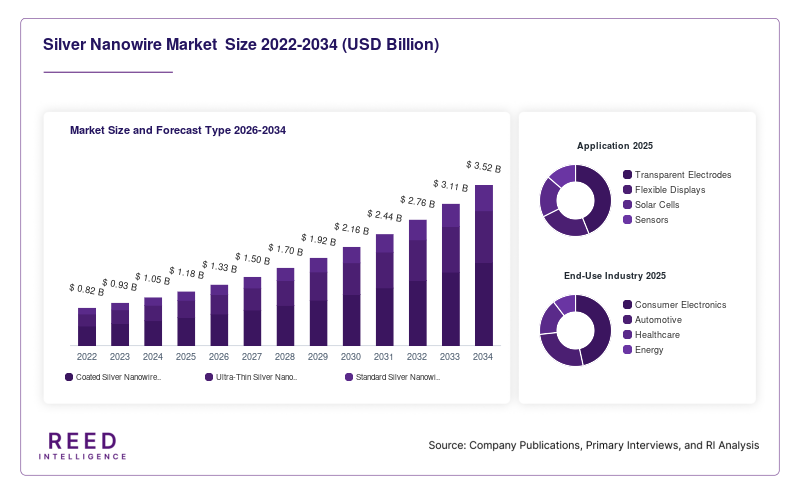
The global Silver Nanowire Market size was valued at approximately USD 1.18 billion in 2026 and is projected to reach USD 3.12 billion by 2034, expanding at a CAGR of 12.9% during the forecast period (2026–2034). Silver nanowires are increasingly used as conductive materials in transparent electrodes, flexible electronics, and next-generation display technologies. Their superior electrical conductivity, flexibility, and optical transparency position them as a viable alternative to traditional materials such as indium tin oxide (ITO).
One major global factor supporting market growth is the rapid expansion of flexible and wearable electronics. As consumer demand rises for foldable smartphones, smart textiles, and advanced touchscreens, manufacturers are actively adopting silver nanowire-based solutions to improve device durability and performance. Additionally, the growing focus on energy-efficient technologies, including solar panels and smart windows, has further strengthened demand across multiple industries.
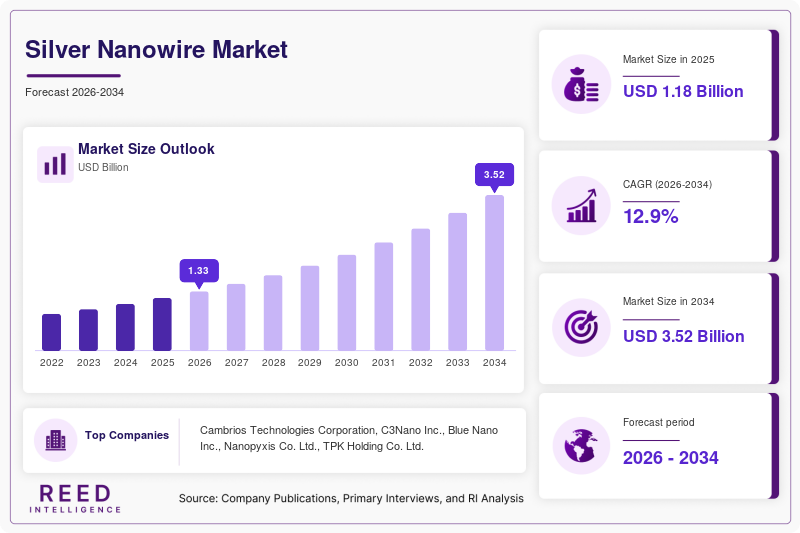
Key Highlights
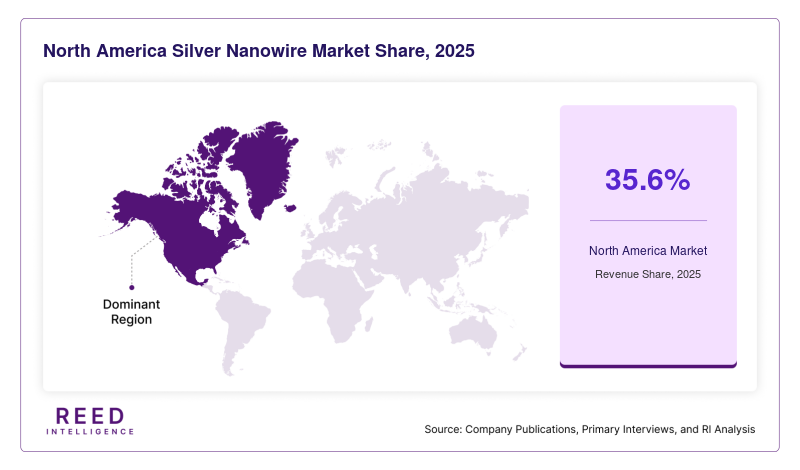
- North America dominated the market with a 35.6% share in 2025.
- Asia Pacific is expected to grow at the fastest CAGR of 13.8% during 2026–2034.
- By type, coated silver nanowires accounted for the largest share of 42.3%, while ultra-thin nanowires are projected to grow at a CAGR of 14.5%.
- By application, transparent electrodes led with a 46.1% share, whereas flexible displays are expected to expand at a CAGR of 15.2%.
- The United States remained the dominant country, with market values of USD 420 million in 2024 and USD 465 million in 2025.
Market Trends
Increasing adoption in flexible and foldable electronics
The growing demand for flexible and foldable electronic devices is shaping the Silver Nanowire Market. Manufacturers are increasingly integrating silver nanowires into touch panels and displays due to their excellent conductivity and mechanical flexibility. Unlike brittle materials such as indium tin oxide, silver nanowires can withstand repeated bending without losing performance. This makes them suitable for foldable smartphones, rollable televisions, and wearable devices. The consumer electronics sector is witnessing a steady shift toward innovative display formats, which is accelerating the adoption of advanced conductive materials. As companies continue to invest in flexible display technologies, the role of silver nanowires is expected to expand significantly across both premium and mid-range product segments.
Rising use in energy-efficient and renewable technologies
Another notable trend is the increasing use of silver nanowires in energy-related applications such as solar cells and smart windows. These nanomaterials enable the development of transparent conductive films that enhance light transmission while maintaining electrical efficiency. This property is particularly valuable in photovoltaic systems and building-integrated energy solutions. Governments and industries are focusing on sustainability and energy efficiency, leading to higher investments in advanced materials. Silver nanowires are gaining traction as a key component in next-generation solar panels, contributing to improved performance and reduced energy losses. This trend is expected to continue as renewable energy adoption grows globally.
Market Drivers
Growth in consumer electronics manufacturing
The rapid expansion of the consumer electronics industry is a major driver of the Silver Nanowire Market. Increasing production of smartphones, tablets, and wearable devices has created strong demand for high-performance conductive materials. Silver nanowires offer advantages such as flexibility, transparency, and improved electrical properties, making them suitable for advanced touchscreens and displays. As manufacturers focus on enhancing product performance and durability, the adoption of nanowire-based technologies is increasing. Emerging markets are also contributing to this growth, with rising disposable incomes and expanding access to electronic devices. This sustained demand is expected to support long-term market expansion.
Advancements in nanotechnology and material science
Technological advancements in nanotechnology are significantly boosting the Silver Nanowire Market. Improved synthesis techniques and scalable production methods are reducing costs and enhancing material quality. These developments are enabling manufacturers to produce uniform and high-purity nanowires, which are essential for consistent performance in applications. Additionally, ongoing research is leading to the development of hybrid materials that combine silver nanowires with other conductive components. These innovations are expanding the range of applications and improving product efficiency. As research and development activities continue to grow, the market is likely to benefit from enhanced product capabilities and broader adoption across industries.
Market Restraint
High production costs and material stability concerns
Despite its growth potential, the Silver Nanowire Market faces challenges related to high production costs and material stability. The synthesis of high-quality silver nanowires requires precise control over chemical processes, which can increase manufacturing expenses. This cost factor limits adoption, particularly in price-sensitive markets and applications where cost efficiency is critical. Additionally, silver nanowires are susceptible to oxidation and environmental degradation, which can affect their long-term performance. These stability concerns create challenges for manufacturers seeking to ensure product reliability, especially in outdoor or high-humidity environments.
The impact of this restraint is evident in industries such as consumer electronics and solar energy, where durability and cost are key considerations. Companies are investing in protective coatings and advanced formulations to address these issues, but such solutions often add to overall production costs. For example, in large-scale solar panel applications, maintaining performance over extended periods is essential, and any degradation in conductive materials can reduce efficiency. As a result, some manufacturers continue to rely on alternative materials despite their limitations. Overcoming these challenges will require further innovation in material engineering and cost optimization strategies.
Market Opportunities
Expansion in automotive electronics and smart vehicles
The increasing integration of advanced electronics in vehicles presents a significant opportunity for the Silver Nanowire Market. Modern vehicles are incorporating features such as touch-enabled dashboards, heads-up displays, and smart windows, all of which require high-performance conductive materials. Silver nanowires offer flexibility and transparency, making them suitable for these applications. The shift toward electric and autonomous vehicles is further driving demand for innovative materials that enhance functionality and efficiency. As automotive manufacturers continue to invest in next-generation technologies, the adoption of silver nanowires is expected to grow steadily.
Emerging applications in healthcare and biomedical devices
Another promising opportunity lies in the healthcare sector, where silver nanowires are being explored for use in wearable medical devices and biosensors. These materials enable the development of flexible and lightweight sensors that can monitor vital signs in real time. Their conductivity and compatibility with flexible substrates make them ideal for applications such as smart bandages and health monitoring systems. The growing focus on personalized healthcare and remote patient monitoring is driving demand for advanced materials. As research progresses, silver nanowires are likely to play a key role in the development of innovative medical technologies.
Segmental Analysis
By Type
Coated silver nanowires dominated the market in 2024, accounting for approximately 42.3% of the total share. These nanowires are widely used due to their enhanced durability and resistance to environmental degradation. The coating helps protect against oxidation, improving long-term performance in various applications. Industries such as consumer electronics and renewable energy prefer coated nanowires for their reliability and efficiency. Additionally, advancements in coating technologies are enabling manufacturers to improve material properties, further strengthening their market position.
Ultra-thin silver nanowires are expected to be the fastest-growing subsegment, with a projected CAGR of 14.5% during the forecast period. These nanowires offer superior transparency and conductivity, making them suitable for high-performance applications such as advanced displays and touchscreens. The increasing demand for lightweight and flexible electronic devices is driving growth in this segment. Continuous innovation in nanotechnology is also contributing to the development of ultra-thin nanowires with improved performance characteristics.
By Application
Transparent electrodes held the largest share of 46.1% in 2024, driven by their extensive use in displays, touch panels, and solar cells. Silver nanowires provide excellent conductivity and optical clarity, making them an ideal choice for these applications. The growing demand for high-quality displays in consumer electronics is supporting the dominance of this segment. Additionally, the shift toward renewable energy is increasing the use of transparent electrodes in photovoltaic systems.
Flexible displays are projected to be the fastest-growing application, with a CAGR of 15.2%. The increasing popularity of foldable and rollable devices is driving demand for flexible display technologies. Silver nanowires enable the development of durable and high-performance displays that can withstand repeated bending. This segment is expected to benefit from ongoing innovation in display technology and increasing consumer interest in advanced electronic devices.
By End-Use Industry
The consumer electronics segment dominated the market in 2024, accounting for 48.7% of the total share. The widespread use of silver nanowires in smartphones, tablets, and wearable devices is driving this dominance. Manufacturers are focusing on improving device performance and durability, leading to increased adoption of advanced materials. The growing demand for innovative electronic products is expected to sustain growth in this segment.
The healthcare segment is anticipated to grow at the fastest CAGR of 13.9% during the forecast period. The increasing use of wearable medical devices and biosensors is driving demand for flexible and conductive materials. Silver nanowires are being explored for various healthcare applications, including real-time health monitoring and smart medical devices. This segment is expected to benefit from advancements in medical technology and increasing focus on personalized healthcare solutions.
Regional Analysis
North America
North America accounted for a significant share of the Silver Nanowire Market, representing 35.6% in 2025, and is expected to grow at a CAGR of 11.8% during the forecast period. The region benefits from strong technological infrastructure and high investment in research and development. The presence of leading electronics manufacturers and advanced material companies supports market growth. Additionally, the demand for flexible electronics and renewable energy solutions is contributing to increased adoption of silver nanowires.
The United States dominates the regional market, driven by continuous innovation in nanotechnology and strong consumer demand for advanced electronic devices. A unique growth factor in this region is the high level of collaboration between academic institutions and industry players, which accelerates the development of new applications and improves commercialization rates.
Europe
Europe held a market share of 24.3% in 2025 and is projected to grow at a CAGR of 11.2% during the forecast period. The region is characterized by a strong focus on sustainability and energy efficiency, which drives the adoption of advanced materials. Government initiatives supporting renewable energy and green technologies are contributing to market growth.
Germany leads the European market, supported by its robust manufacturing sector and emphasis on innovation. A unique growth factor is the region’s stringent environmental regulations, which encourage the adoption of energy-efficient materials such as silver nanowires in various applications, including smart windows and solar panels.
Asia Pacific
Asia Pacific is the fastest-growing region, with a projected CAGR of 13.8% during 2026–2034 and a market share of 28.7% in 2025. The region’s growth is driven by rapid industrialization and the expansion of the consumer electronics sector. Countries such as China, Japan, and South Korea are major contributors to market development.
China dominates the Asia Pacific market due to its large-scale electronics manufacturing industry. A unique growth factor is the region’s cost-effective production capabilities, which enable large-scale manufacturing of silver nanowires and support widespread adoption across multiple industries.
Middle East & Africa
The Middle East & Africa accounted for 6.1% of the market share in 2025 and is expected to grow at a CAGR of 10.5%. The region is gradually adopting advanced technologies, particularly in the energy and construction sectors. Investments in smart infrastructure projects are driving demand for innovative materials.
The United Arab Emirates leads the regional market, with increasing focus on smart city development. A unique growth factor is the region’s investment in renewable energy projects, which is creating demand for advanced conductive materials such as silver nanowires.
Latin America
Latin America held a market share of 5.3% in 2025 and is projected to grow at a CAGR of 10.9%. The region is experiencing steady growth in electronics manufacturing and renewable energy adoption. Government initiatives aimed at technological advancement are supporting market expansion.
Brazil is the dominant country in this region, driven by its growing industrial base. A unique growth factor is the increasing investment in solar energy projects, which is boosting demand for conductive materials used in photovoltaic systems.
Competitive Landscape
The Silver Nanowire Market is moderately competitive, with several key players focusing on innovation and product development. Leading companies are investing in research and development to improve material performance and reduce production costs. Strategic partnerships and collaborations are also common, enabling companies to expand their product portfolios and strengthen their market presence.
One of the leading players in the market is Cambrios Technologies Corporation, known for its advanced silver nanowire solutions used in flexible electronics. The company has recently introduced new formulations that enhance conductivity and durability, addressing key challenges in the market. Other major players are also focusing on expanding their production capacities and entering new markets to gain a competitive edge. Continuous innovation and technological advancements are expected to shape the competitive landscape in the coming years.
Key Players
- Cambrios Technologies Corporation
- C3Nano Inc.
- Blue Nano Inc.
- Nanopyxis Co. Ltd.
- TPK Holding Co. Ltd.
- ACS Material LLC
- Sigma-Aldrich Corporation
- Seashell Technology LLC
- BASF SE
- DuPont de Nemours Inc.
- Heraeus Holding GmbH
- Hitachi Chemical Co. Ltd.
- Johnson Matthey Plc
- LG Chem Ltd.
- Merck KGaA
Recent Developments
- In 2025, Cambrios Technologies Corporation launched an advanced silver nanowire formulation designed for foldable display applications.
- In 2024, C3Nano Inc. expanded its manufacturing facility to increase production capacity and meet growing demand.
- In 2025, BASF SE announced a collaboration with a technology firm to develop hybrid conductive materials combining silver nanowires with other nanostructures.
Silver Nanowire Market Segments
Type
- Coated Silver Nanowires
- Ultra-Thin Silver Nanowires
- Standard Silver Nanowires
Application
- Transparent Electrodes
- Flexible Displays
- Solar Cells
- Sensors
End-Use Industry
- Consumer Electronics
- Automotive
- Healthcare
- Energy
By Region
- North America
- Europe
- APAC
- Middle East and Africa
- LATAM