Silver Powder Flake Market Size, Share & Demand Report By Type (Micro Silver Flakes, Nano Silver Flakes), By Application (Conductive Pastes, Printed Electronics, Coatings, Adhesives), By End-Use Industry (Electronics, Automotive, Energy, Healthcare), By Formulation (Flake-Based, Hybrid Formulations), By Region & Segment Forecasts, 2025–2034
USD 3950
Market Overview
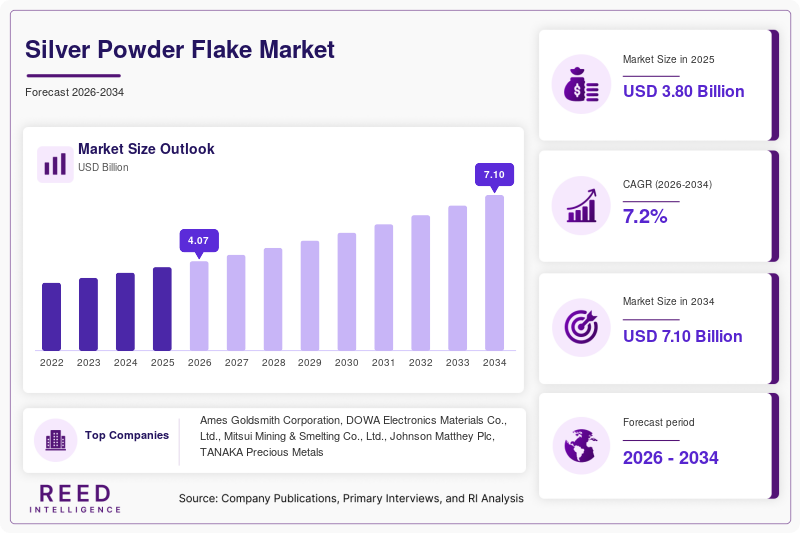
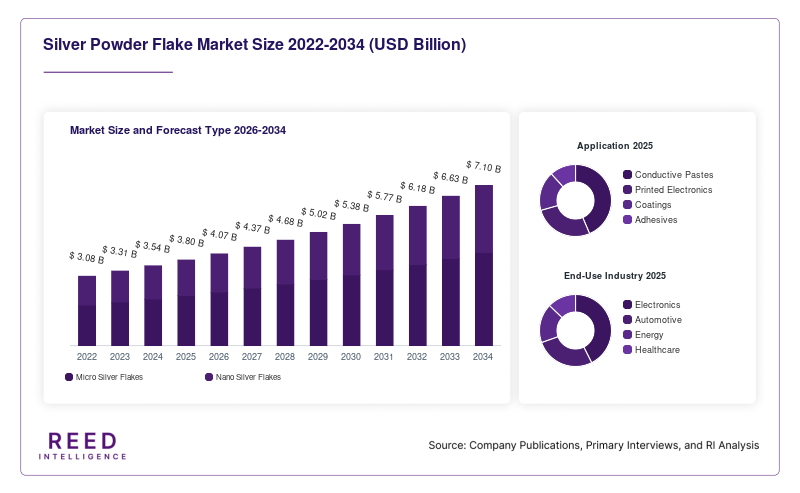
The global Silver Powder Flake Market size was valued at approximately USD 3.8 billion in 2025 and is projected to reach USD 7.1 billion by 2034, expanding at a CAGR of 7.2% during 2025–2034. The market growth is being supported by the increasing demand for high-performance conductive materials across electronics, photovoltaics, and automotive applications. Silver powder flakes, known for their superior electrical conductivity, thermal stability, and corrosion resistance, have become essential in advanced manufacturing processes.
A key global factor supporting the expansion of the Silver Powder Flake Market is the rapid advancement of renewable energy infrastructure, particularly solar photovoltaics. Silver flakes are widely used in conductive pastes for solar cells, where efficiency and reliability are critical. As global investments in clean energy increase, the demand for high-purity silver materials continues to rise.
Key Highlights
- Asia Pacific dominated the market with a 42% share in 2025, while Europe is projected to be the fastest-growing region with a CAGR of 7.8%.
- By type, micro silver flakes accounted for 55% share in 2025, while nano silver flakes are expected to grow at a CAGR of 8.5%.
- By application, conductive pastes led with 48% share, whereas printed electronics are projected to grow at a CAGR of 8.9%.
- China, the dominant country, recorded a market value of USD 1.1 billion in 2025, expected to reach USD 1.2 billion in 2026.
Market Trends
Rising Adoption of Printed Electronics
The Silver Powder Flake Market is witnessing strong momentum due to the growing adoption of printed electronics in flexible devices, wearable technology, and smart packaging. Silver flakes are integral in conductive inks used for printing circuits on flexible substrates. The trend is driven by the need for lightweight, cost-effective, and scalable electronics manufacturing. As industries move toward miniaturization and flexible design, silver flakes are becoming increasingly critical in next-generation electronic components.
Integration in Electric Vehicles (EVs)
The increasing penetration of electric vehicles is shaping the Silver Powder Flake Market trends significantly. Silver flakes are used in EV battery systems, sensors, and power electronics due to their conductivity and reliability. With governments promoting EV adoption and automakers investing in electrification, demand for silver-based conductive materials is expected to rise steadily. This trend is further supported by advancements in battery technology and power management systems, enhancing the role of silver flakes in automotive innovation.
Market Drivers
Growth in Renewable Energy Applications
The expansion of solar power installations is a key driver of the Silver Powder Flake Market. Silver flakes are used in photovoltaic cells to form conductive pathways, improving energy conversion efficiency. As countries increase their renewable energy targets, the demand for high-performance materials continues to rise. This has created a consistent demand stream for silver powder flakes, particularly in regions investing heavily in solar energy infrastructure.
Increasing Demand from Electronics Industry
The rapid growth of the global electronics sector is driving the Silver Powder Flake Market size. Silver flakes are widely used in conductive adhesives, coatings, and inks for electronic devices. With the proliferation of smartphones, IoT devices, and advanced computing systems, manufacturers require materials that offer reliability and high conductivity. This has resulted in increased adoption of silver flakes across various electronic applications, supporting steady market growth.
Market Restraint
Volatility in Silver Prices
One of the major challenges affecting the Silver Powder Flake Market is the fluctuation in raw material prices. Silver, being a precious metal, is subject to price volatility influenced by global economic conditions, supply-demand imbalances, and geopolitical factors. This variability impacts production costs and profit margins for manufacturers.
Additionally, price instability makes long-term procurement planning difficult for end-users, particularly in cost-sensitive industries such as consumer electronics. Manufacturers often face challenges in maintaining competitive pricing while ensuring product quality. This restraint may limit market expansion, especially in developing regions where cost considerations play a crucial role in material selection.
Market Opportunities
Expansion in 5G Infrastructure
The rollout of 5G networks presents a significant opportunity for the Silver Powder Flake Market. Silver flakes are used in high-frequency electronic components and antennas due to their उत्कृष्ट conductivity. As telecom companies expand their infrastructure, the demand for advanced materials is expected to increase. This creates a strong growth avenue for manufacturers specializing in high-purity silver flakes.
Advancements in Nanotechnology
The development of nano-scale silver flakes is opening new possibilities in the Silver Powder Flake Market. Nano silver flakes offer enhanced surface area, improved conductivity, and better dispersion characteristics. These properties make them suitable for emerging applications such as biomedical devices, advanced coatings, and high-performance sensors. As research and development activities increase, the adoption of nano silver flakes is expected to grow, creating new revenue streams for market players.
Segmental Analysis
By Type
Micro silver flakes dominated the Silver Powder Flake Market, accounting for approximately 55% share in 2025. These flakes are widely used due to their cost-effectiveness and suitability for a broad range of applications, including conductive coatings and adhesives. Their balanced performance characteristics make them a preferred choice for industrial applications.
Nano silver flakes are expected to be the fastest-growing subsegment, projected to expand at a CAGR of 8.5%. Their superior conductivity, high surface area, and enhanced dispersion properties make them ideal for advanced applications. Increasing use in high-performance electronics and emerging technologies will drive their growth.
By Application
Conductive pastes held the largest share of the Silver Powder Flake Market, capturing 48% in 2025. These pastes are extensively used in solar cells and electronic components, where efficient conductivity is essential. The widespread use of conductive pastes in photovoltaic systems has contributed significantly to their dominance.
Printed electronics are anticipated to be the fastest-growing application, with a projected CAGR of 8.9%. The rise of flexible electronics, wearable devices, and smart packaging is driving demand for conductive inks made with silver flakes. This trend is expected to accelerate market expansion.
By End-Use Industry
The electronics industry dominated the Silver Powder Flake Market with a 50% share in 2025. Silver flakes are widely used in circuit boards, connectors, and conductive adhesives, making them essential for electronic manufacturing.
The automotive sector is expected to be the fastest-growing end-use segment, with a CAGR of 7.9%. The increasing adoption of electric vehicles and advanced automotive electronics is driving demand for silver-based materials.
By Formulation
Flake-based formulations dominated the market, accounting for 60% share in 2025. These formulations offer excellent conductivity and are widely used in coatings and pastes.
Hybrid formulations combining flakes with nanoparticles are expected to grow at a CAGR of 8.2%. These formulations provide improved performance and versatility, making them suitable for advanced applications.
Regional Analysis
North America
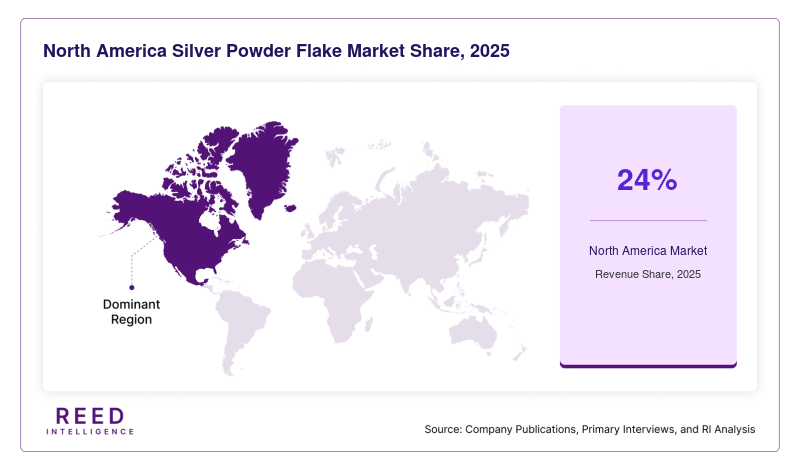
North America accounted for approximately 24% of the Silver Powder Flake Market share in 2025 and is expected to grow at a CAGR of 6.8% during the forecast period. The region’s market growth is supported by strong demand from the electronics and renewable energy sectors.
The United States emerged as the dominant country in North America, driven by its advanced manufacturing ecosystem and strong investments in clean energy technologies. The presence of leading electronics manufacturers and increasing adoption of solar panels have contributed to sustained demand for silver powder flakes.
Europe
Europe held nearly 20% share of the Silver Powder Flake Market in 2025 and is projected to grow at a CAGR of 7.8% through 2034. The region’s growth is supported by stringent environmental regulations and a strong focus on sustainable energy solutions.
Germany dominated the European market due to its robust automotive and industrial sectors. The country’s emphasis on electric mobility and renewable energy adoption has significantly increased the demand for conductive materials such as silver flakes.
Asia Pacific
Asia Pacific dominated the Silver Powder Flake Market with a 42% share in 2025 and is expected to maintain strong growth at a CAGR of 7.5%. The region benefits from large-scale electronics manufacturing and rapid industrialization.
China led the regional market, driven by its extensive electronics production and solar panel manufacturing capabilities. The country’s strong supply chain and government support for renewable energy have played a key role in sustaining high demand for silver flakes.
Middle East & Africa
The Middle East & Africa region accounted for around 7% of the Silver Powder Flake Market share in 2025 and is anticipated to grow at a CAGR of 6.5%. Growth in this region is driven by increasing investments in infrastructure and energy projects.
Saudi Arabia emerged as the dominant country due to its focus on diversifying its economy and investing in renewable energy. The development of solar energy projects has contributed to the demand for silver-based materials.
Latin America
Latin America held approximately 7% share of the Silver Powder Flake Market in 2025 and is projected to grow at a CAGR of 6.9%. The region is experiencing gradual growth due to expanding industrial activities and energy investments.
Brazil dominated the regional market, supported by its growing renewable energy sector and increasing adoption of advanced materials in manufacturing processes. The country’s focus on sustainable development has positively influenced market growth.
Competitive Landscape
The Silver Powder Flake Market is moderately consolidated, with key players focusing on product innovation, capacity expansion, and strategic collaborations. Leading companies are investing in research and development to enhance product quality and meet evolving industry requirements.
A major market leader is Ames Goldsmith Corporation, known for its extensive product portfolio and strong global presence. The company has recently expanded its production capabilities to cater to growing demand from the electronics and renewable energy sectors.
Other prominent players are focusing on developing nano silver flakes and advanced formulations to gain a competitive edge. Strategic partnerships and technological advancements are expected to shape the competitive landscape in the coming years.
Key Players
- Ames Goldsmith Corporation
- DOWA Electronics Materials Co., Ltd.
- Mitsui Mining & Smelting Co., Ltd.
- Johnson Matthey Plc
- TANAKA Precious Metals
- Metalor Technologies SA
- Heraeus Holding GmbH
- Fukuda Metal Foil & Powder Co., Ltd.
- Sumitomo Metal Mining Co., Ltd.
- Shoei Chemical Inc.
- Technic Inc.
- AG PRO Technology Corporation
- NanoTop Corporation
- Cermet Inc.
- Shanghai CNPC Powder Material Co., Ltd.
Recent Developments
- 2024: A leading manufacturer expanded its nano silver flake production facility to meet rising demand from electronics applications.
- 2023: A key player introduced a new hybrid silver flake formulation designed for high-performance conductive inks.
- 2023: Strategic partnerships between material suppliers and solar panel manufacturers increased supply chain efficiency.
- 2022: Investments in research and development led to improved dispersion technologies for silver flakes.
Silver Powder Flake Market Segments
Type
- Micro Silver Flakes
- Nano Silver Flakes
Application
- Conductive Pastes
- Printed Electronics
- Coatings
- Adhesives
End-Use Industry
- Electronics
- Automotive
- Energy
- Healthcare
Formulation
- Flake-Based
- Hybrid Formulations
By Region
- North America
- Europe
- APAC
- Middle East and Africa
- LATAM